Joyoung(002242)

Search documents
九阳股份(002242)季报点评:收入有待改善 盈利水平逐渐恢复
Xin Lang Cai Jing· 2025-10-28 08:33
Core Insights - The company reported a revenue of 5.59 billion yuan for the first three quarters of 2025, a year-on-year decrease of 9.7%, while the net profit attributable to shareholders was 120 million yuan, an increase of 26.0% [1] - The company's non-recurring net profit reached 190 million yuan, reflecting a year-on-year increase of 48.2% [1] - In Q3 2025, the company achieved a revenue of 1.6 billion yuan, down 11.0% year-on-year, but the net profit attributable to shareholders surged to 1 million yuan, a remarkable increase of 101.1% [1] Revenue and Profitability - The core retail categories showed positive growth, with online sales of the Joyoung brand's products such as wall-breaking machines, soybean milk machines, and rice cookers increasing by 4.7%, 26.5%, and 5.0% respectively in the first three quarters of 2025 [1] - The gross profit margin for the first three quarters of 2025 increased by 0.6 percentage points year-on-year to 26.9%, while Q3 gross profit margin rose by 4.4 percentage points to 26.2% [2][3] - The net profit margin for the first three quarters of 2025 improved by 0.7 percentage points to 2.2%, and for Q3, it increased by 4.6 percentage points to 0.1% [4] Expense Ratios - The expense ratios for sales, management, R&D, and finance showed mixed trends, with the sales expense ratio decreasing by 0.8 percentage points to 16.4% for the first three quarters of 2025, while the management expense ratio increased by 0.3 percentage points to 4.3% [3] - In Q3 2025, the sales expense ratio decreased by 0.7 percentage points to 18.5%, while the management expense ratio increased by 0.5 percentage points to 4.9% [3] Profit Forecast - The company has adjusted its profit forecast, expecting net profits attributable to shareholders to be 151 million yuan, 184 million yuan, and 220 million yuan for 2025, 2026, and 2027 respectively, reflecting year-on-year growth of 23.2%, 21.9%, and 19.6% [4]

九阳股份(002242):收入有待改善,盈利水平逐渐恢复
GOLDEN SUN SECURITIES· 2025-10-28 07:06
Investment Rating - The investment rating for the company is "Accumulate" [5] Core Views - The company reported a revenue of 5.59 billion yuan for the first three quarters of 2025, a year-on-year decrease of 9.7%, while the net profit attributable to shareholders was 120 million yuan, an increase of 26.0% year-on-year [1] - The core product categories showed good growth in retail, with online sales of the brand's products such as wall-breaking machines, soybean milk machines, and rice cookers increasing by 4.7%, 26.5%, and 5.0% respectively in the first three quarters of 2025 [1] - The gross profit margin has gradually recovered, with a year-on-year increase of 0.6 percentage points and 4.4 percentage points for the first three quarters and the third quarter of 2025, reaching 26.9% and 26.2% respectively [2] - The company has adjusted its profit forecast, expecting net profits of 151 million, 184 million, and 220 million yuan for 2025, 2026, and 2027, representing year-on-year growth of 23.2%, 21.9%, and 19.6% respectively [2] Financial Summary - For 2025, the company is projected to have a revenue of 8.635 billion yuan, a decrease of 2.4% year-on-year, and a net profit of 151 million yuan, an increase of 23.2% year-on-year [4] - The earnings per share (EPS) for 2025 is estimated to be 0.20 yuan, with a projected price-to-earnings (P/E) ratio of 49.2 [4] - The company’s return on equity (ROE) is expected to improve from 3.5% in 2024 to 4.4% in 2025 [4]
JS环球生活:九阳前三季度归母净利润1.24亿元 同比增加26.03%
Zhi Tong Cai Jing· 2025-10-27 12:42
Core Viewpoint - JS Global Life (01691) reported the performance of its subsidiary Joyoung Co., Ltd. (002242.SZ) for the first three quarters of 2025, indicating a decline in revenue but an increase in net profit [1] Financial Performance - The group achieved an operating revenue of 5.585 billion yuan, representing a year-on-year decrease of 9.66% [1] - The net profit attributable to Joyoung's shareholders was 124 million yuan, showing a year-on-year increase of 26.03% [1] - The basic earnings per share were reported at 0.16 yuan [1]
JS环球生活(01691):九阳(002242.SZ)前三季度归母净利润1.24亿元 同比增加26.03%
智通财经网· 2025-10-27 12:41
Core Viewpoint - JS Global Life (01691) reported the performance of its subsidiary Joyoung Co., Ltd. (002242.SZ) for the first three quarters of 2025, indicating a decline in revenue but an increase in net profit [1] Financial Performance - The group achieved operating revenue of 5.585 billion yuan, representing a year-on-year decrease of 9.66% [1] - The net profit attributable to Joyoung shareholders was 124 million yuan, reflecting a year-on-year increase of 26.03% [1] - The basic earnings per share stood at 0.16 yuan [1]
九阳股份(002242) - 关于公司境外业务运营模式调整暨关联交易的公告
2025-10-27 10:31
证券代码:002242 证券简称:九阳股份 公告编号:2025-042 九阳股份有限公司 关于公司境外业务运营模式调整暨关联交易的公告 本公司及董事会全体成员保证信息披露的内容真实、准确、完整,没有虚假记载、误导 性陈述或重大遗漏。 一、关联交易概述 1、概述 因九阳股份有限公司(以下简称"公司")及下属公司相关业务发展需要,现 拟将境外业务运营模式由自营模式调整为授权经销模式,经销商包括 JS 环球生 活有限公司及其下属公司以及其他符合条件的独立经销商。根据《深圳证券交易 所股票上市规则》的相关规定,JS 环球生活有限公司及其下属公司构成公司的 关联方,本次交易构成关联交易,自董事会审议通过之日起至本年末所涉关联交 易金额预计为 150 万美元(按交易发生时的即期汇率折算人民币预计为 1,077 万元),该额度未超出公司 2025 年度日常关联交易预计上限。公司后续年度亦 将上述关联交易纳入日常关联交易进行管理。 2、审议程序 公司独立董事于 2025 年 10 月 27 日召开第七届董事会独立董事专门会议 2025 年第一次会议,以 3 票同意、0 票反对、0 票弃权的表决结果审议通过《关 于公司境外业务 ...
九阳股份(002242) - 关于调增2025年度日常关联交易预计额度及2026年度日常关联交易预计公告
2025-10-27 10:31
证券代码:002242 证券简称:九阳股份 公告编号:2025-043 九阳股份有限公司 关于调增 2025 年度日常关联交易预计额度及 2026 年度日常关联交易预计公告 本公司及董事会全体成员保证信息披露的内容真实、准确、完整,没有虚假记载、误导 性陈述或重大遗漏。 一、日常关联交易基本情况 (一)本次调增日常关联交易额度及下一年度预计概述 1、概述 因相关业务发展需要,现拟调增九阳股份有限公司(以下简称:九阳股份、 公司)及下属公司与关联人 SharkNinja (Hong Kong) Company Limited(以下 简称:SNHK)的日常关联交易额度,由 77 百万美元调增至 100 百万美元(按 交易发生时的即期汇率折算人民币预计为 7.18 亿元)。 2026 年度,九阳股份及下属公司拟与公司关联人 SNHK 进行销售商品的日 常关联交易,与关联人 JS 环球生活有限公司(以下简称:JS 环球)及其下属公 司进行销售商品和提供服务的日常关联交易。预计 2026 年日常关联交易商品销 售和提供服务总金额不超过 67.41 百万美元(按交易发生时的即期汇率折算预计 不超过人民币 4.84 亿元) ...
九阳股份(002242) - 关于召开2025年第三次临时股东会的通知
2025-10-27 10:31
九阳股份有限公司 关于召开 2025 年第三次临时股东会的通知 本公司及董事会全体成员保证信息披露的内容真实、准确、完整,没有虚假记载、误 导性陈述或重大遗漏。 一、召开会议的基本情况 1、股东会届次:2025 年第三次临时股东会 证券代码:002242 证券简称:九阳股份 公告编号: 2025-044 2、股东会的召集人:董事会。九阳股份有限公司(以下简称"公司"或 "本公司")第七届董事会第二次会议于 2025 年 10 月 27 日召开,审议通过 了《关于召开公司 2025 年第三次临时股东会的议案》。 3、会议召开的合法、合规性:本次会议的召集、召开符合《中华人民共和 国公司法》《深圳证券交易所股票上市规则》《深圳证券交易所上市公司自律 监管指引第 1 号——主板上市公司规范运作》等法律、行政法规、部门规章、 规范性文件及《公司章程》的有关规定。 4、会议时间: (1)现场会议时间:2025 年 11 月 17 日(星期一)15:00 (2)网络投票时间:通过深圳证券交易所系统进行网络投票的具体时间为 2025 年 11 月 17 日 9:15-9:25,9:30-11:30,13:00-15:00; ...
九阳股份(002242) - 2025 Q3 - 季度财报
2025-10-27 10:30
九阳股份有限公司 2025 年第三季度报告 2.公司负责人、主管会计工作负责人及会计机构负责人(会计主管人员)声明:保证季度报告中财务信息的真实、准确、完 整。 3.第三季度财务会计报告是否经过审计 □是 否 1 证券代码:002242 证券简称:九阳股份 公告编号:2025-041 九阳股份有限公司 2025 年第三季度报告 本公司及董事会全体成员保证信息披露的内容真实、准确、完整,没有虚假记载、误导性陈述或重大遗漏。 重要内容提示: 1.董事会及董事、高级管理人员保证季度报告的真实、准确、完整,不存在虚假记载、误导性陈述或重大遗漏,并承担 个别和连带的法律责任。 九阳股份有限公司 2025 年第三季度报告 一、主要财务数据 (一) 主要会计数据和财务指标 公司是否需追溯调整或重述以前年度会计数据 是 □否 追溯调整或重述原因 会计政策变更 | | | | | 本报告 期比上 | | | | 年初至 报告期 | | --- | --- | --- | --- | --- | --- | --- | --- | --- | | | 本报告期 | 上年同期 | | 年同期 | 年初至报告期 末 | 上年同期 | ...
九阳股份(002242) - 第七届董事会第二次会议决议公告
2025-10-27 10:30
证券代码:002242 证券简称:九阳股份 公告编号:2025-040 九阳股份有限公司 第七届董事会第二次会议决议公告 本公司及董事会全体成员保证信息披露的内容真实、准确、完整,没有虚假记载、误导 性陈述或重大遗漏。 一、董事会会议召开情况 九阳股份有限公司(以下简称:公司)于 2025 年 10 月 21 日以书面的方式 发出关于召开公司第七届董事会第二次会议的通知,会议于 2025 年 10 月 27 日 以通讯表决的方式召开。本次会议应参与表决董事 7 名,实际参与表决董事 7 名。会议由董事长杨宁宁女士主持。本次会议的召集、召开与表决程序符合《公 司法》和《公司章程》等的有关规定,合法有效。 董事会就以下议案进行了审议,经书面表决,通过决议如下: 二、董事会会议审议情况 1、 审议通过《公司 2025 年第三季度报告》 表决结果:7 票同意,0 票反对,0 票弃权。 本议案已经董事会审计委员会审议通过。 公司 2025 年第三季度报告详见 2025 年 10 月 28 日《证券时报》《中国证 券报》及巨潮资讯网(http://www.cninfo.com.cn)上公司公告编号为 2025-041 号 ...
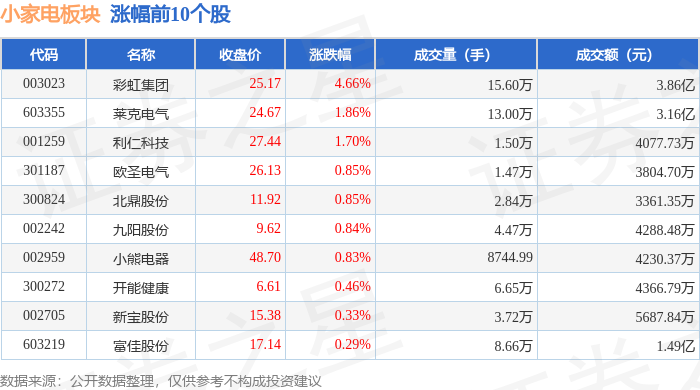
小家电板块10月23日涨0.02%,彩虹集团领涨,主力资金净流出1.01亿元
Zheng Xing Xing Ye Ri Bao· 2025-10-23 08:20
Market Overview - On October 23, the small home appliance sector rose by 0.02% compared to the previous trading day, with Rainbow Group leading the gains [1] - The Shanghai Composite Index closed at 3922.41, up 0.22%, while the Shenzhen Component Index closed at 13025.45, also up 0.22% [1] Stock Performance - Key stocks in the small home appliance sector showed varied performance, with Rainbow Group closing at 25.17, up 4.66%, and Lek Electric at 24.67, up 1.86% [1] - Other notable performers included Liren Technology at 27.44, up 1.70%, and Ousheng Electric at 26.13, up 0.85% [1] Trading Volume and Value - Rainbow Group had a trading volume of 156,000 shares and a transaction value of 386 million yuan [1] - Lek Electric recorded a trading volume of 130,000 shares with a transaction value of 316 million yuan [1] Capital Flow - The small home appliance sector experienced a net outflow of 101 million yuan from institutional investors, while retail investors saw a net inflow of approximately 89.85 million yuan [2] - The capital flow data indicates that retail investors were more active in the market compared to institutional investors [2] Individual Stock Capital Flow - Rainbow Group had a net inflow of 31.61 million yuan from institutional investors, while it faced a net outflow of 2.87 million yuan from retail investors [3] - Lek Electric saw a net inflow of 4.47 million yuan from institutional investors but a significant outflow of 19.97 million yuan from speculative funds [3]