
Hongqi Chain(002697)

Search documents
一般零售板块12月15日涨2.74%,红旗连锁领涨,主力资金净流入9.92亿元
Zheng Xing Xing Ye Ri Bao· 2025-12-15 09:08
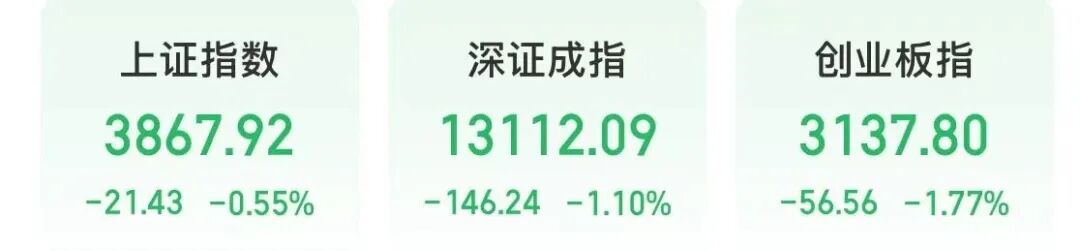
Market Overview - The general retail sector increased by 2.74% on December 15, with Hongqi Chain leading the gains [1] - The Shanghai Composite Index closed at 3867.92, down 0.55%, while the Shenzhen Component Index closed at 13112.09, down 1.1% [1] Top Performers in General Retail Sector - Hongqi Chain (002697) closed at 6.23, up 10.07% with a trading volume of 2.05 million shares and a transaction value of 1.256 billion [1] - Quanxinhao (000007) closed at 11.61, up 10.05% with a trading volume of 345,100 shares and a transaction value of 394 million [1] - Baida Group (600865) closed at 13.07, up 10.02% with a trading volume of 646,300 shares and a transaction value of 817 million [1] - Other notable gainers include Zhejiang Dongri (600113), Dongbai Group (600693), and Agricultural Products (000061) with increases of 10.01%, 10.00%, and 9.97% respectively [1] Market Capital Flow - The general retail sector saw a net inflow of 999.2 million from institutional investors, while retail investors experienced a net outflow of 549 million [2][3] - The top net inflows from institutional investors were seen in Hongqi Chain (2.05 billion), Central Mall (1.20 billion), and Guangbai Co. (1.01 billion) [3] - Retail investors showed significant outflows in stocks like Hongqi Chain, Central Mall, and Guangbai Co., indicating a shift in investor sentiment [3]


今天,A股三大主线逆势走强
Zhong Guo Zheng Quan Bao· 2025-12-15 08:32
Group 1: Market Overview - The cyclical market showed significant activity today, with major consumption sectors like dairy and retail experiencing substantial gains, while financial sectors such as insurance, banking, and securities also performed well [1] - Some cyclical sectors, including pork, steel, and construction materials, saw increases [1] - Technology stocks experienced a pullback, particularly in computing and semiconductor sectors, with the Shanghai Composite Index down 0.55%, Shenzhen Component Index down 1.1%, and ChiNext Index down 1.77% [1] Group 2: Retail and Commercial Aerospace Sectors - Recent trading data indicates that retail and commercial aerospace sectors are attracting active market funds, with retail benefiting from favorable policies and aerospace seeing event-driven catalysts [2] - Specific retail stocks such as Hongqi Chain (002697), Quanxinhao (000007), and Baida Group (600865) reached their daily limit up, with Baida Group achieving three consecutive limit-ups [2][3] Group 3: Consumption and Policy Support - The retail sector index rose by 2.75%, with notable stocks like Hongqi Chain increasing by 10.07% and Baida Group by 10.02% [3] - The Ministry of Commerce and other regulatory bodies announced measures to enhance collaboration between commerce and finance, aiming to boost consumption through 11 specific initiatives [4] - A recent plan from the Ministry of Industry and Information Technology aims to create three trillion-level consumption areas and ten billion-level consumption hotspots by 2027, with a focus on high-quality development by 2030 [5] Group 4: Aerospace Sector Developments - The commercial aerospace sector is currently very popular, with stocks like Aerospace Electronics (600879) and Aerospace Information (600271) experiencing significant gains [5] - A recent successful satellite launch using the Lijian-1 rocket demonstrated the sector's capability to serve international clients, contributing to a positive cycle in the industry [8] Group 5: Steel Sector Performance - The steel sector saw gains today, with stocks like Fushun Special Steel (600399) and Taiyuan Iron & Steel (000825) achieving limit-ups [9] - The Ministry of Commerce and the General Administration of Customs announced export license management for certain steel products starting January 1, 2026, which may positively influence the industry [11] - Analysts suggest that the steel industry is expected to stabilize and improve, with structural investment opportunities available in companies with advanced equipment and strong growth potential [11]


红旗连锁成交额创2025年4月28日以来新高
Zheng Quan Shi Bao Wang· 2025-12-15 07:31
Group 1 - The core point of the article highlights that Hongqi Chain's transaction volume reached 1.011 billion RMB, marking a new high since April 28, 2025 [1] - The latest stock price increased by 9.19%, with a turnover rate of 14.50% [1] - The previous trading day's total transaction volume for the stock was 364 million RMB [1] Group 2 - Chengdu Hongqi Chain Co., Ltd. was established on June 22, 2000, with a registered capital of 1.36 billion RMB [1]
【盘中播报】133只个股突破半年线
Zheng Quan Shi Bao Wang· 2025-12-15 06:28
Market Overview - The Shanghai Composite Index is at 3880.75 points, slightly down by 0.22%, with a total trading volume of 1,456.64 billion yuan [1] - A total of 133 A-shares have surpassed the half-year line, indicating positive market sentiment [1] Stocks with Significant Deviation - Notable stocks with high deviation rates include: - Hongqi Chain (002697) with a deviation rate of 9.35% and a price increase of 10.07% [1] - Aerospace Information (600271) with a deviation rate of 8.95% and a price increase of 10.00% [1] - Great Wall Electric (600192) with a deviation rate of 8.62% and a price increase of 10.02% [1] Stocks with Minor Deviation - Stocks that have just crossed the half-year line with lower deviation rates include: - Huasoft Technology (300980) with a deviation rate of 5.60% and a price increase of 6.71% [1] - Juran Smart Home (002100) with a deviation rate of 5.62% and a price increase of 6.34% [1] - Tianzhun Technology (688003) with a deviation rate of 6.49% and a price increase of 6.89% [1] Additional Stocks with Positive Performance - Other stocks showing positive performance include: - Tiankang Biotechnology (002100) with a price increase of 6.34% [1] - Xinyuan New Materials (300980) with a price increase of 6.71% [1] - Fushun Special Steel (600399) with a price increase of 10.00% [1]

A股零售股拉升,红旗连锁、东百集团、新世界涨停,百大集团、浙江东日、广百股份此前涨停
Ge Long Hui· 2025-12-15 06:01
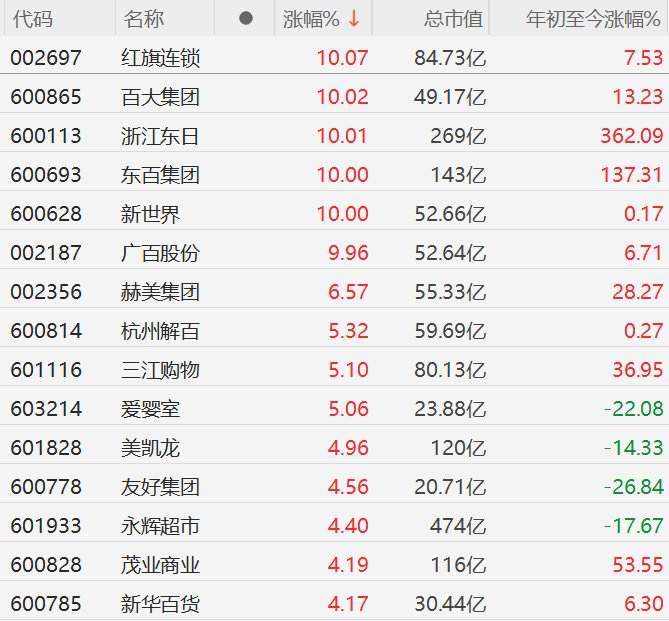
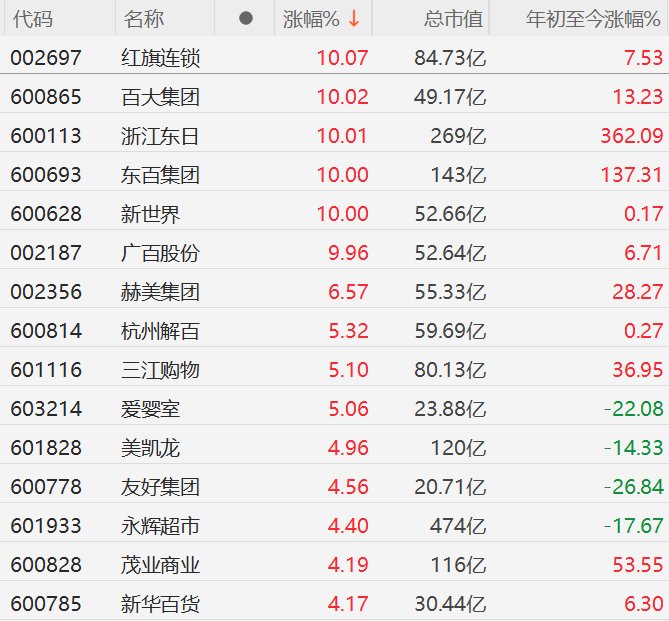
Core Viewpoint - The retail sector in the A-share market has seen a significant rally, with multiple stocks hitting the daily limit up, indicating strong investor interest and potential growth in this sector [1] Group 1: Stock Performance - Hongqi Chain (002697) experienced a rise of 10.07%, with a total market capitalization of 8.473 billion and a year-to-date increase of 7.53% [2] - Baida Group (600865) increased by 10.02%, with a market cap of 4.917 billion and a year-to-date growth of 13.23% [2] - Zhejiang Dongri (600113) saw a 10.01% rise, with a market value of 26.9 billion and an impressive year-to-date increase of 362.09% [2] - Dongbai Group (600693) rose by 10.00%, with a market cap of 14.3 billion and a year-to-date increase of 137.31% [2] - New World (600628) also increased by 10.00%, with a market capitalization of 5.266 billion and a year-to-date growth of 0.17% [2] - Other notable performers include Guangbai Co. (002187) with a 9.96% increase and a market cap of 5.264 billion, and Sanjiang Shopping (601116) with a 5.10% rise and a market cap of 8.013 billion [2]


零售股午后持续走高 新世界、红旗连锁涨停
Zheng Quan Shi Bao· 2025-12-15 05:37
Core Viewpoint - Retail stocks experienced a significant rise in the afternoon, with several companies hitting the daily limit up, indicating strong market interest and potential investment opportunities in the retail sector [1][2]. Group 1: Stock Performance - New World and Hongqi Chain both reached the daily limit up, showcasing robust investor confidence [1][2]. - Prior to this, Baida Group, Dongbai Group, and Guangbai Co. also hit the daily limit up, reflecting a broader positive trend in the retail sector [1][2]. - Other companies such as Guoguang Chain, Dazhongfang, and Maoye Commercial also saw their stock prices increase, indicating a widespread rally in retail stocks [1][2].

零售股拉升,红旗连锁、东百集团、新世界涨停
Ge Long Hui· 2025-12-15 05:34
12月15日,A股市场零售股拉升,其中,红旗连锁、东百集团、新世界涨停,百大集团、浙江东日、广 百股份此前涨停,三江购物、友好集团、中百集团、益民集团等跟涨。 | 代码 | 名称 | 涨幅% ↓ | 总市值 | 年初至今涨幅%。 | | --- | --- | --- | --- | --- | | 002697 | 红旗连锁 | 10.07 | 84.73亿 | 7.53 | | 600865 | 百大集团 | 10.02 | 49.17亿 | 13.23 | | 600113 | 浙江东日 | 10.01 | 269亿 | 362.09 | | 600693 | 东百集团 | 10.00 | 143亿 | 137.31 | | 600628 | 新世界 | 10.00 | 52.66亿 | 0.17 | | 002187 | 广百股份 | 9.96 | 52.64亿 | 6.71 | | 002356 | 赫美集团 | 6.57 | 55.33亿 | 28.27 | | 600814 | 杭州解百 | 5.32 | 59.69亿 | 0.27 | | 601116 | 三江购物 | 5.10 | 80.1 ...
零售股午后再度逆势拉升 新世界直线涨停
Mei Ri Jing Ji Xin Wen· 2025-12-15 05:32
Core Viewpoint - Retail stocks experienced a significant rebound, with several companies reaching their daily limit up, indicating strong market performance in the sector [1] Group 1: Company Performance - New World achieved a straight limit up, reflecting positive investor sentiment [1] - Hongqi Chain also returned to its limit up, showcasing resilience in the retail market [1] - Baida Group, Dongbai Group, and Guangbai Co. all hit their limit up, indicating a broader trend of growth among retail stocks [1] Group 2: Market Trends - The surge in retail stocks was accompanied by follow-up gains from companies such as Guoguang Chain, Dazhongfang, Maoye Commercial, and Youhao Group, suggesting a collective upward movement in the industry [1]
A股零售股拉升,红旗连锁、东百集团、新世界涨停
Ge Long Hui· 2025-12-15 05:30
Core Viewpoint - The A-share market has seen a significant rise in retail stocks, with several companies reaching their daily limit up [1] Group 1: Stock Performance - Hongqi Chain, Dongbai Group, and New World have hit the daily limit up [1] - Baida Group, Zhejiang Dongri, and Guangbai Co. previously reached their daily limit up [1] - Other companies such as Sanjiang Shopping, Youhao Group, Zhongbai Group, and Yimin Group have also experienced gains [1]
零售板块再度走高
Xin Lang Cai Jing· 2025-12-15 04:15
Group 1 - Retail sector experiences a significant rise with multiple companies hitting the daily limit up, including Xinyuanhao (000007), Nongchanpin (000061), Zhejiang Dongri (600113), and Hongqi Lianchuan (002697) [1][2] - Other companies in the retail sector such as Hangzhou Xie Bai (600814), Central Mall (600280), Dazhongfang (600327), Bubugao (002251), and Yonghui Supermarket (601933) also show upward movement [1][2] Group 2 - Related ETFs, specifically the tourism ETF (159766), increased by 0.54% with a trading volume of 101 million yuan, while another tourism ETF (562510) recorded a trading volume of 15.39 million yuan [1][2]

