
Drinda(002865)

Search documents
太空光伏概念大幅高开 明阳智能等多股涨停
Xin Lang Cai Jing· 2026-01-26 01:55
Group 1 - The space photovoltaic concept stocks experienced a significant surge in early trading on January 26, with several companies hitting the daily limit up [1] - Companies such as Mingyang Smart Energy, Tuori New Energy, GCL-Poly Energy, Junda Co., and Shuangliang Eco-Energy all reached the daily limit up [1] - Other companies like Dongfang Risheng, Optec, Aotwei, and Liancheng CNC opened more than 10% higher [1]


A股高开,太空光伏概念股领涨
第一财经· 2026-01-26 01:47
Market Overview - The three major stock indices in A-shares opened higher, with the Shanghai Composite Index up by 0.21%, the Shenzhen Component Index up by 0.37%, and the ChiNext Index up by 0.48% [3][4] - The STAR Market Index saw a slight increase of 0.04% [3][4] Sector Performance - The photovoltaic industry chain showed strong performance, particularly the space photovoltaic concept stocks, which led the gains [3][4] - Notable stocks that hit the daily limit include Mingyang Smart Energy, Tuori New Energy, GCL-Poly Energy, JunDa Co., and Shuangliang Eco-Energy [4] - Other active sectors included gold, lithium mining, humanoid robots, and AI applications, while the commercial aerospace concept stocks experienced a slight pullback [3] Hong Kong Market - The Hang Seng Index opened up by 0.35%, and the Hang Seng Tech Index increased by 0.05% [5][6] - Noteworthy gainers included Pop Mart, which rose over 4%, and Zijin Mining, which increased nearly 3% [5]


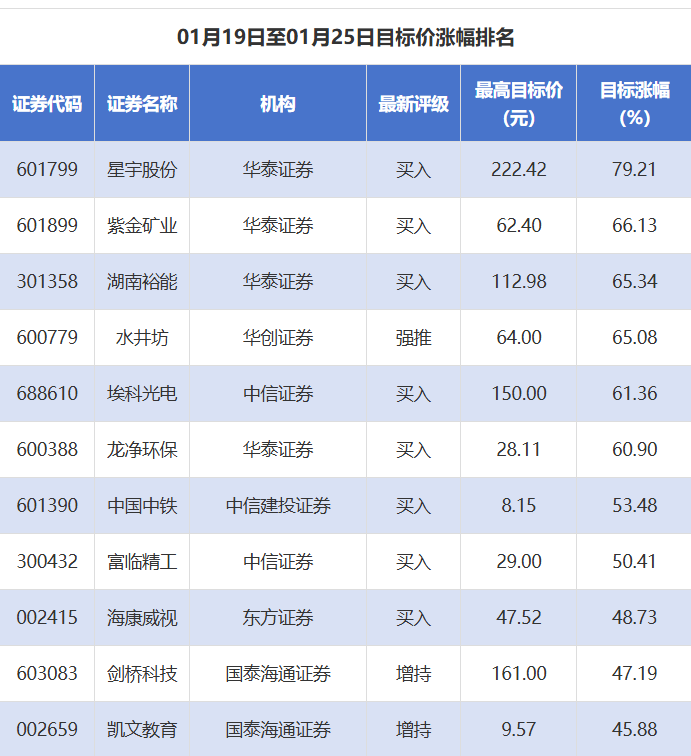
紫金矿业等目标价涨幅超60%;钧达股份评级被调低
2 1 Shi Ji Jing Ji Bao Dao· 2026-01-26 01:43
Group 1 - The core viewpoint of the article highlights the significant target price increases for several companies from January 19 to January 25, with notable mentions including Xingyu Co., Zijin Mining, and Hunan YN, which saw target price increases of 79.21%, 66.13%, and 65.34% respectively [1][2][3] Group 2 - The companies with the highest target price increases are as follows: Xingyu Co. (target price: 222.42 yuan, increase: 79.21%), Zijin Mining (target price: 62.40 yuan, increase: 66.13%), and Hunan YN (target price: 112.98 yuan, increase: 65.34%) [3] - A total of 167 listed companies received broker recommendations during this period, with Ningbo Bank and China Duty Free each receiving 11 recommendations, and Industrial Bank receiving 9 [4][5] - The companies with the most broker recommendations include Ningbo Bank (closing price: 28.98 yuan, recommendations: 11), China Duty Free (closing price: 93.32 yuan, recommendations: 11), and Industrial Bank (closing price: 19.12 yuan, recommendations: 9) [5] - Six companies had their ratings upgraded during this period, including Guowang Co. (from "Hold" to "Buy"), Baiwei Storage (from "Hold" to "Buy"), and Jianghuai Automobile (from "Hold" to "Buy") [6] - One company, Junda Co., had its rating downgraded from "Strong Buy" to "Hold" [7] - A total of 46 first-time coverage ratings were issued, with Kevin Education receiving an "Increase" rating from Guotai Junan Securities, and Longxin General receiving a "Buy" rating from Zhongtai Securities [8]



钧达股份高开,马斯克力挺太空光伏,公司拟入股星翼芯能
Zhi Tong Cai Jing· 2026-01-26 01:41
Group 1 - Tesla CEO Elon Musk supports space-based solar power during a discussion with BlackRock CEO Larry Fink at the World Economic Forum, revealing key production capacity plans [2] - SpaceX and Tesla aim to achieve an annual solar manufacturing capacity of 100GW within the next three years [2] - Junda Co. announced on January 14 that it plans to invest 30 million yuan to acquire a 16.6667% stake in Shanghai Xingyi Chip Energy Technology Co., marking a strategic shift from ground-based to space-based solar power [2] Group 2 - Junda Co. stated on January 23 that the comprehensive cost-effectiveness of perovskite solar technology in extreme space environments still needs verification [2] - No formal business agreements have been signed between Junda Co. and its investee company Xingyi Chip Energy regarding space-based solar power [2]
A股太空光伏概念大幅高开 明阳智能等多股涨停
Ge Long Hui A P P· 2026-01-26 01:33
格隆汇1月26日|早盘太空光伏概念继续大幅高开,明阳智能、拓日新能、协鑫集成、钧达股份、双良 节能封涨停,东方日升、欧普泰、奥特维、连城数控高开超10%。消息面上,1月22日,马斯克在达沃 斯宣称,未来三年建设100GW光伏产能,用于地面数据中心与太空AI卫星供能。 ...
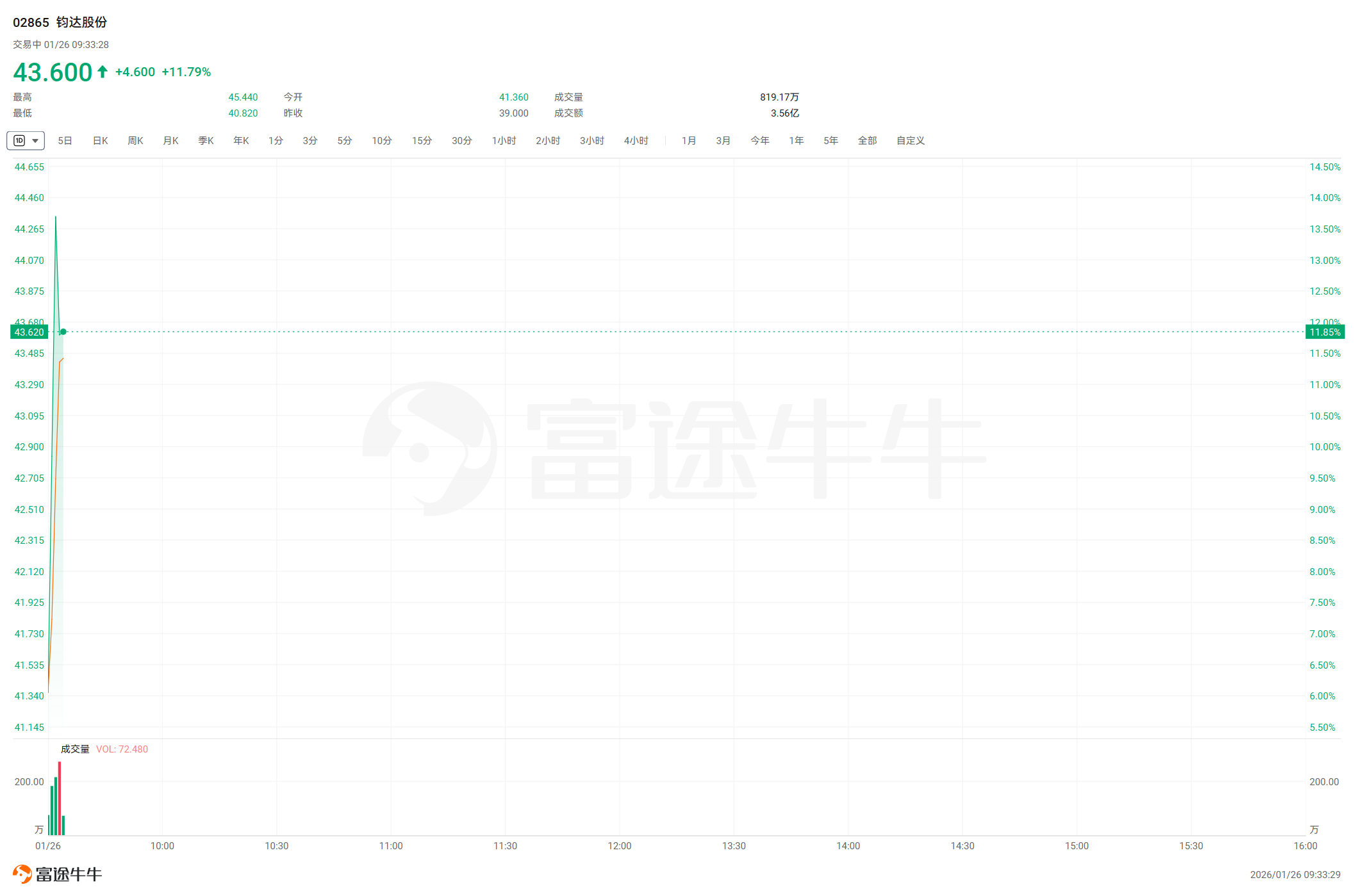
港股异动 | 钧达股份(02865)高开逾6% 马斯克力挺太空光伏 公司拟入股星翼芯能
智通财经网· 2026-01-26 01:31
智通财经APP获悉,钧达股份(02865)上一交易日暴涨51%,今日继续高开逾6%。截至发稿,涨6.05%, 报41.36港元,成交额3108.2万港元。 消息面上,1月22日,特斯拉CEO埃隆·马斯克在瑞士达沃斯世界经济论坛年会期间,在与贝莱德CEO拉 里·芬克的对谈中明确力挺太空光伏,并披露关键产能规划。他表示,SpaceX与特斯拉正同步推进太阳 能产能提升,目标在未来三年内实现每年100GW的太阳能制造能力。 值得注意的是,钧达股份1月14日公告称,拟以现金出资3000万元,参股上海星翼芯能科技有限公司, 认购星翼芯能46.1539万元新增注册资本并获其16.6667%股权,启动从地面光伏向太空光伏的战略延 伸。而公司1月23日再发布公告称,钙钛矿光伏技术在太空极端环境下的综合成本效益仍有待验证,与 参股公司星翼芯能在太空光伏方面未签订正式业务协议。 ...
碳中和领域动态追踪(一百六十九):商业航天赋能,太空光伏开启成长新篇
EBSCN· 2026-01-25 14:08
Investment Rating - The industry is rated as "Buy" with an expectation of leading market benchmark returns by over 15% in the next 6-12 months [6]. Core Insights - The commercial aerospace sector has emerged as one of the strongest market themes recently, with space photovoltaics being a core beneficiary [2]. - Recent catalysts in the commercial aerospace sector include the establishment of the Commercial Space Administration and the issuance of the "Action Plan for Promoting High-Quality and Safe Development of Commercial Aerospace (2025-2027)" [2]. - Elon Musk's announcement at the 2026 Davos World Economic Forum regarding Tesla and SpaceX's plan to build a total of 200GW photovoltaic capacity in the U.S. over the next three years is a key driver for stock price increases in the sector [3]. - The transition from ground-based photovoltaic applications to space photovoltaics represents a significant shift in usage scenarios, driving technological evolution and capacity expansion [4]. Summary by Sections Industry Overview - The commercial aerospace sector is experiencing rapid development due to policy support, increasing demand for low-orbit satellite constellations, and capital market activity [2]. - The demand for space photovoltaics is expected to grow significantly as commercial aerospace scales up [2]. Technological Development - The technology path for space photovoltaics has evolved through several iterations, leading to advancements in gallium arsenide technology and the development of ultra-thin P-type HJT and perovskite tandem technologies [4]. Investment Recommendations - Companies that have strategically positioned themselves in the space photovoltaics sector, such as Junda Co., Dongfang Risheng, JinkoSolar, and Trina Solar, are expected to gain first-mover advantages and valuation premiums [5]. - Continuous growth in demand for new technology production equipment related to space photovoltaics suggests investment opportunities in companies like Maiwei Co., Jiejia Weichuang, Aotwei, and Shuangliang Energy [5].




“太空光伏”引爆涨停潮
第一财经· 2026-01-25 12:07
Core Viewpoint - The photovoltaic (PV) sector in A-shares has seen a significant surge, with multiple stocks experiencing a 20% increase, driven by Elon Musk's endorsement of space photovoltaics at the Davos Forum. However, the industry faces a harsh reality of prolonged losses, overcapacity, and persistent price pressures, with major companies expected to report substantial losses in 2025 [3][4][5]. Group 1: Industry Performance and Financial Outlook - A total of 32 listed PV companies have issued profit warnings, with 23 companies, over 70%, expected to incur losses in 2025 [5]. - Major players like Tongwei Co. are projected to face losses between 9 billion to 10 billion yuan, a significant increase from the previous year's loss of 7.04 billion yuan, marking it as the only company with a projected loss exceeding 10 billion yuan [5][6]. - Trina Solar and JinkoSolar are also expected to report substantial losses, with Trina Solar's losses estimated at 6.5 billion to 7.5 billion yuan, up from 3.44 billion yuan the previous year [5][6]. Group 2: Market Dynamics and Challenges - The PV industry is grappling with a dual weakness in supply and demand, leading to significant price declines across the supply chain, including silicon materials, cells, and modules [8][9]. - The rapid expansion of manufacturing capacity in recent years has coincided with a slowdown in global demand, resulting in severe supply-demand imbalances [9]. - The cost of key raw materials, particularly silver, has surged, further straining the profitability of PV companies. Silver prices have increased by over 118% since October of the previous year, significantly impacting production costs [9][10]. Group 3: Future Industry Prospects - The path to recovery for the PV industry hinges on supply-side reforms, including capacity utilization improvements and the elimination of outdated production capabilities [10]. - The industry must address the current overcapacity and restore a healthy balance between supply and demand to improve product pricing and overall profitability [10].


连年巨亏 光伏业如何逃出“血海”
经济观察报· 2026-01-25 10:54
Core Viewpoint - The photovoltaic industry is undergoing a brutal survival elimination race and a deep restructuring of the industrial pattern, with the next phase expected to be redefined after this intense reshuffle [2][4]. Group 1: Industry Performance and Losses - In 2025, major companies in the photovoltaic sector are expected to report significant losses, with JinkoSolar forecasting a net loss of 5.9 billion to 6.9 billion yuan, Trina Solar predicting a loss of 6.5 billion to 7.5 billion yuan, and Tongwei expecting a loss of 9 billion to 10 billion yuan [2][6]. - The total expected losses from leading companies amount to hundreds of billions, indicating that the photovoltaic industry is still mired in a loss-making situation [2][5]. - The industry has shifted from a phase of rapid expansion to a deep adjustment period, with companies generally operating at a loss to maintain operations, severely squeezing overall profitability [7][12]. Group 2: Causes of the Crisis - The root cause of the current industry crisis is attributed to aggressive expansion in the past, leading to severe structural oversupply and intense price competition [3][6]. - The prices of key materials such as silicon have plummeted from 300,000 yuan per ton in 2022 to around 55,000 yuan per ton, while silver prices have nearly doubled in recent months, further exacerbating the challenges faced by companies [4][10]. Group 3: Strategic Responses and Industry Restructuring - In response to the crisis, leading companies are turning to mergers and acquisitions to strengthen competitiveness or are extending into related fields such as energy storage and hydrogen energy to seek strategic breakthroughs [4][12]. - TCL Zhonghuan announced plans to invest in a new energy technology company to enhance its integrated strategy and expand battery and module production capacity [12]. - The industry is experiencing a "淘汰赛" (elimination race), with smaller companies likely to exit the market or seek mergers as the competitive landscape narrows [13][14]. Group 4: Future Outlook and Recovery Potential - Companies like Tongwei have seen some operational profitability in the latter half of 2025, but overall losses are expected to continue due to declining sales prices and rising raw material costs [9][10]. - The recovery of profitability is contingent on the overall price recovery across the supply chain and the expansion of photovoltaic application scenarios, which could provide significant growth opportunities [9][10]. - The photovoltaic industry is witnessing a recent increase in component prices, with some manufacturers raising prices by 0.04 to 0.15 yuan per watt, indicating a potential shift in market dynamics [18][19].

“太空光伏”引爆涨停潮,概念炒作难掩行业供需双弱
Di Yi Cai Jing· 2026-01-25 09:44
Core Viewpoint - The A-share photovoltaic sector has experienced a significant surge, with multiple stocks hitting a 20% limit-up, driven by Elon Musk's endorsement of space photovoltaics at the Davos Forum. However, the industry faces a harsh reality of prolonged losses, overcapacity, and persistent price pressure, with major companies expected to report substantial losses in 2025 [1][2]. Group 1: Industry Performance - The photovoltaic industry has seen widespread losses, with 23 out of 32 listed companies expected to report losses in 2025, accounting for over 70% of the sample [2]. - Major players like Tongwei Co. anticipate a net loss of 90 to 100 billion yuan in 2025, up from a loss of 70.39 billion yuan the previous year, marking it as the only company with a projected loss exceeding 100 billion yuan [2]. - Trina Solar and JinkoSolar are also expected to report significant losses, with Trina Solar projecting a loss of 65 to 75 billion yuan, and JinkoSolar estimating a loss of 59 to 69 billion yuan [2][3]. Group 2: Market Dynamics - The photovoltaic supply chain is experiencing intensified losses due to weak terminal demand, overcapacity, and stagnant product prices, which are the main contributors to the industry's financial struggles [2][3]. - Despite some companies like Daqo Energy and Longi Green Energy reducing their losses, the overall trend remains negative, with Daqo Energy expecting a loss of 14.18 to 17.18 billion yuan, a reduction of 52.17% to 63.21% year-on-year [3]. - The industry is facing a dual challenge of weak supply and demand, with overcapacity leading to low prices, which is the primary cause of losses [4][5]. Group 3: Cost Pressures - The rapid increase in raw material prices, particularly silver, has significantly impacted production costs, with silver prices rising over 118% since October of the previous year [6][7]. - The cost of silver paste, a critical material in photovoltaic technology, has surged, further straining the profitability of companies in the sector [6][7]. - Companies are exploring cost-reduction strategies, including substituting silver with copper and aluminum, but the impact of these innovations on profitability remains limited [7]. Group 4: Future Outlook - The industry is expected to undergo structural reforms characterized by capacity utilization improvements, elimination of outdated capacity, and potential mergers and acquisitions, which are essential for recovery [7]. - A return to a healthy supply-demand balance and a restoration of product prices to reasonable levels are crucial for the fundamental improvement of companies' profitability [7].