BANK OF QINGDAO(002948)
Search documents
第十次荣获“五星钻石奖”!青岛银行隐藏着什么获奖秘籍?
Jin Rong Shi Bao· 2025-12-17 12:36
Core Viewpoint - Qingdao Bank has been awarded the prestigious "Five Star Diamond Award" for the tenth time, recognizing its exceptional customer service and experience, making it the only company from Shandong Province to receive this honor [1][9]. Group 1: Customer Service Excellence - Qingdao Bank emphasizes its commitment to serving the real economy, integrating national priorities into its operational development, and focusing on quality and efficiency [3]. - The bank has handled over 78,000 consumer complaints and customer assistance requests, using data analysis to improve service quality [4]. - The bank's intelligent service initiatives have achieved significant metrics, including over 1.81 million interactions with text-based robots and a 98.73% accuracy rate in responses [4]. Group 2: Senior Citizen Services - In response to the aging population, Qingdao Bank has updated its elderly service standards, focusing on enhancing the financial experience for senior customers [5]. - The bank has established a three-tier service network in rural areas, with 28 branches to improve accessibility [5]. Group 3: Sustainable Financial Services - Qingdao Bank is committed to supporting the real economy through its "Green Finance" and "Blue Finance" initiatives, aligning with national dual carbon strategies [7]. - The bank launched the first domestic bond index focused on the marine economy, enhancing financing channels for the marine industry [7]. - As of September 2025, the bank's blue loan balance reached 21.34 billion, a 27.17% increase year-on-year, significantly outpacing overall loan growth [7]. Group 4: Green Finance Initiatives - The bank has developed a comprehensive green finance product matrix, including various loan products aimed at supporting low-carbon transitions [8]. - By September 2025, the green loan balance reached 54.83 billion, reflecting a 46.80% increase, demonstrating a strong commitment to sustainable finance [8]. Group 5: Future Directions - Qingdao Bank plans to continue its focus on blue economy cultivation, green transition, and support for small and micro enterprises, contributing to high-quality development [9].
青岛银行台湾路支行将在12月20日起撤并调整
Jin Tou Wang· 2025-12-16 03:35
2025年12月15日,青岛银行(002948)发布公告称,为进一步优化网点布局,提升金融服务水平,经监 管部门批准,青岛银行台湾路支行将撤并调整。自2025年12月20日起,台湾路支行终止对外营业,停止 办理各项金融业务。 网点停业后,承接安排如下: 一、个人客户及相关业务由青岛银行香港花园支行承接。 二、公司客户及相关业务由青岛银行福州路支行承接。 您可前往以上对应网点办理业务,或通过青岛银行网上银行、手机银行自助办理。 衷心感谢您长期以来对青岛银行的信任与支持。青岛银行将竭诚为您提供更加高效、专业的金融服务。 因规划调整给您带来不便,敬请谅解! 如有疑问,请联系对应网点或咨询青岛银行客户服务热线40066-96588。 ...
新华信用会客厅|陶雅楠:以数字金融拓展服务生态 助力城商行高质量发展
Zhong Guo Jin Rong Xin Xi Wang· 2025-12-12 15:31
近日,2025企业家博鳌论坛·品牌信用建设论坛在海南博鳌举办,青岛银行股份有限公司数字金融部总 经理陶雅楠接受了新华信用专访,围绕城商行信用品牌建设、生态化经营与新质生产力发展、社会责任 履行等议题,介绍了青岛银行的实践经验与突出成效。她表示,青岛银行于2025年4月成立数字金融 部,着力构建"线上青银"服务体系,通过拓宽服务的时空维度,提升服务精准性与覆盖面,为高效服务 客户提供支撑。(刘旭阳 丁雅雯) ...
城商行板块12月12日跌0.23%,杭州银行领跌,主力资金净流出908.98万元
Zheng Xing Xing Ye Ri Bao· 2025-12-12 09:12
Core Points - The city commercial bank sector experienced a decline of 0.23% on December 12, with Hangzhou Bank leading the drop [1] - The Shanghai Composite Index closed at 3889.35, up 0.41%, while the Shenzhen Component Index closed at 13258.33, up 0.84% [1] Summary by Category Stock Performance - Hangzhou Bank closed at 15.12, down 0.92% with a trading volume of 543,600 shares and a transaction value of 824 million yuan [2] - Qilu Bank closed at 5.63, down 0.71% with a trading volume of 1,165,000 shares and a transaction value of 657 million yuan [2] - Qingdao Bank closed at 4.58, down 0.65% with a trading volume of 370,100 shares and a transaction value of 169 million yuan [2] - Chongqing Bank closed at 10.84, down 0.64% with a trading volume of 118,200 shares and a transaction value of 129 million yuan [2] - Chengdu Bank closed at 16.35, down 0.49% with a trading volume of 390,900 shares and a transaction value of 642 million yuan [2] - Lanzhou Bank closed at 2.32, down 0.43% with a trading volume of 529,700 shares and a transaction value of 123 million yuan [2] - Xiamen Bank closed at 7.56, down 0.26% with a trading volume of 358,000 shares and a transaction value of 270 million yuan [2] - Ningbo Bank closed at 27.72, down 0.25% with a trading volume of 215,400 shares and a transaction value of 596 million yuan [2] - Changsha Bank closed at 9.48, down 0.21% with a trading volume of 321,800 shares and a transaction value of 306 million yuan [2] - Jiangsu Bank closed at 10.39, down 0.19% with a trading volume of 1,989,400 shares and a transaction value of 2.066 billion yuan [2] Capital Flow - The city commercial bank sector saw a net outflow of 9.0898 million yuan from institutional investors, while retail investors contributed a net inflow of 230 million yuan [4] - Speculative funds experienced a net outflow of 2.21 billion yuan [4]
聚焦发展玉兰债 共促开放新格局
Xin Lang Cai Jing· 2025-12-11 10:17
聚焦发展玉兰债 共促开放新格局 -2025年青岛银行金融研讨会 成功举办- 供稿:青岛银行 上海清算所指出,"玉兰债"业务是上海清算所在人民银行指导下研究推出的基于境内外金融基础设施互联互通、统筹安全与开放的中资离岸债券发行创新 模式,也是重要的跨境金融创新产品。"玉兰债"是中资企业面向国际市场发行的境外债券,以人民币、美元、欧元等多币种计价,依托上海清算所与欧洲 清算银行建立的跨境托管联通机制,为发行人与投资者提供安全、高效的登记结算服务。"玉兰债"自2020年12月推出以来,已成为我国债券市场高水平对 外开放的重要创新载体,不仅拓宽了中资企业境外融资渠道,也为全球投资者配置人民币资产提供了便利,在服务实体经济、推动上海国际金融中心建 设、促进人民币国际化等方面具有积极意义。 中信证券团队则从实操层面分享了"玉兰债承销与发行的实务经验",为与会机构提供了从产品理解到业务落地的全链条知识赋能。 本次研讨会的成功举办,为"玉兰债"等创新产品的推广应用拓宽了路径。搭建了政策解读、市场分析与业务对接的多元平台,既为金融机构把握开放机 遇、防范跨境风险凝聚了共识。会议还围绕宏观市场环境展开了广泛讨论。中信证券专家就国 ...
青岛银行跌1.07% 垫底银行板块
Zhong Guo Jing Ji Wang· 2025-12-11 09:26
(责任编辑:徐自立) 中国经济网北京12月11日讯 青岛银行(002948.SZ)今日收报4.61元,跌幅1.07%。银行板块今日涨 0.09%,青岛银行为银行板块跌幅最大的公司。 ...
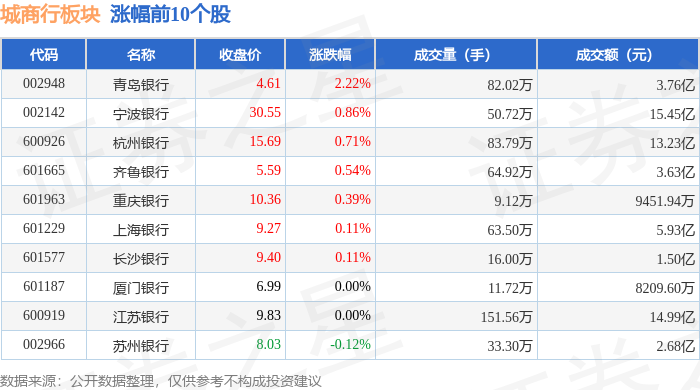
城商行板块12月11日跌0.07%,青岛银行领跌,主力资金净流出7715.14万元
Zheng Xing Xing Ye Ri Bao· 2025-12-11 09:08
证券之星消息,12月11日城商行板块较上一交易日下跌0.07%,青岛银行领跌。当日上证指数报收于 3873.32,下跌0.7%。深证成指报收于13147.39,下跌1.27%。城商行板块个股涨跌见下表: 从资金流向上来看,当日城商行板块主力资金净流出7715.14万元,游资资金净流入6492.73万元,散户 资金净流入1222.41万元。城商行板块个股资金流向见下表: 以上内容为证券之星据公开信息整理,由AI算法生成(网信算备310104345710301240019号),不构成投资建议。 ...
银行净息差专题报告:负债管理能力成为业绩分化的关键
GUOTAI HAITONG SECURITIES· 2025-12-11 08:03
Investment Rating - The report assigns an "Overweight" rating for the banking sector [7]. Core Insights - The report emphasizes the significant improvement in the cost of liabilities for banks in 2025, with a notable decrease of 28 basis points (bp) in the first half of the year, compared to only 4 bp in the same period last year. This improvement is primarily driven by reductions in deposit and interbank liabilities costs, contributing 19 bp and 7 bp respectively [3][11]. - The net interest margin (NIM) is expected to decline by approximately 5 bp in 2026, with the downward pressure on margins continuing to ease marginally, suggesting that some banks may stabilize their NIMs [2][10]. Summary by Sections 1. Liability Cost Improvement in 2025 - The first half of 2025 saw a significant reduction in the cost of interest-bearing liabilities, with the cost rate dropping to 1.70%, a decrease of 28 bp from 2024. This was supported by improvements in both deposit and interbank liability costs [11]. 2. Liability Side: Deposit Maturity and Repricing Benefits 1) **Term Structure**: The proportion of long-term deposits entering the repricing cycle has increased, with the share of deposits with a remaining maturity of 1-5 years declining by 1.5 percentage points (pct) to 22.6% by the end of Q2 2025. Some banks, such as those in Ningbo and Chongqing, experienced declines exceeding 10 pct [4]. 2) **Price Factors**: Regulatory focus on maintaining reasonable NIM levels has increased, with expectations of further interest rate cuts. The maximum reduction for three-year deposits could exceed 100 bp, indicating substantial room for cost improvement [5]. 3. Asset Side: Yield Pressure Expected to be Better than 2025 1) **Loans**: The repricing pressure on loans is expected to ease, with the five-year Loan Prime Rate (LPR) declining by only 10 bp in 2025, significantly less than the 50 bp drop the previous year [6]. 2) **Debt Replacement**: The shift from high-interest to low-interest debt is anticipated to have a limited impact on net interest margins, estimated to drag down margins by about 4 bp [6]. 3) **Bond Maturity**: The widening gap between new bond issuance rates and existing bond yields is expected to exert downward pressure on investment yields, with an estimated drag of 6 bp on margins from the reallocation of bonds maturing within one year [6]. 4. NIM Projections - The report forecasts a 5 bp decline in NIM for 2026, with the downward trend continuing to converge. The asset yield is expected to decrease by 17 bp, while the cost of liabilities is projected to improve by 13 bp, with deposit costs improving by 17 bp [7][10].
探寻利率方向(4):从M2看2026年债市流动性
GF SECURITIES· 2025-12-10 11:48
Investment Rating - The report assigns a "Buy" rating for the banking sector, indicating an expectation that stock prices will outperform the market by more than 10% over the next 12 months [40]. Core Insights - The growth of M2 is primarily driven by government and corporate leverage, with government leverage's contribution increasing from 23.9% in 2015 to 45.5% in 2025, while corporate leverage is expected to contribute 63.6% to M2 growth in 2025 [5][14]. - The report highlights a divergence between the social financing (社融) and M2 growth rates, indicating a liquidity accumulation in the financial system when the demand for financing from the real economy is insufficient, which can lead to a decline in bond yields [5][19]. - The expected social financing-M2 differential for 2026 is projected to be 0.56%, with a quarter-on-quarter increase of 33 basis points [32]. Summary by Sections M2 and Liquidity Analysis - M2 includes cash, personal deposits, corporate deposits, non-bank deposits, and deposits from non-deposit financial institutions. The main contributors to M2 growth are government and corporate leverage [5][13]. - The report discusses the relationship between the social financing-M2 differential and bond market performance, noting a shift in correlation since the second half of 2022 [5][19]. Social Financing Projections - For 2026, the report forecasts a total of 16.3 trillion yuan in new loans under the social financing framework, with a growth rate of 8.11% [32][34]. - The report anticipates that the net issuance of government bonds will reach 14.8 trillion yuan in 2026, with a focus on maintaining a proactive fiscal policy [34]. M2 Growth Forecast - The M2 growth rate for 2026 is projected at 7.55%, influenced by factors such as net fiscal deposits, the strengthening of the equity market, and cross-border capital flows [32][36].
多家银行公告:增资扩股!
Xin Lang Cai Jing· 2025-12-09 09:32
Core Viewpoint - The capital replenishment of small and medium-sized banks is entering a "sprint period" as they increasingly rely on methods such as capital increase and targeted fundraising to address capital adequacy pressures, with a new wave of capital replenishment accelerating [1][4]. Group 1: Recent Developments in Capital Increases - On December 8, Suzhou Bank announced that its major shareholder, Suzhou International Development Group, would increase its holdings by 44.7 million shares, accounting for 1.00% of the total share capital, between July 1, 2025, and December 5, 2025 [1]. - Hunan Bank has completed its capital increase, receiving approval to raise its registered capital by 1 billion RMB, increasing from approximately 7.75 billion RMB to about 8.75 billion RMB, a nearly 13% increase [3][8]. - Hunan Bank issued 1 billion shares to nine specific entities, raising a total of 4.01 billion RMB, with a net amount of 4.009 billion RMB after deducting issuance costs [3][8]. Group 2: Capital Adequacy and Regulatory Context - As of the end of Q3 2025, the capital adequacy ratio for commercial banks (excluding foreign bank branches) was 15.36%, with tier one capital adequacy at 12.36% and core tier one capital adequacy at 10.87% [4][9]. - The capital adequacy ratios for city commercial banks and rural commercial banks were 12.40% and 13.20%, respectively, which are lower than the average levels of 17.99% for large commercial banks and 13.48% for joint-stock commercial banks [4][9]. Group 3: Role of Local State-owned Capital - Local state-owned capital has become a significant force in the current wave of capital increases among small and medium-sized banks, with Hunan Bank's issuance entirely directed to state-owned entities [10][11]. - The involvement of local state-owned capital not only provides immediate financial support but also contributes to long-term capital generation effects, as local governments often promote such investments [5][11].