BANK OF QINGDAO(002948)

Search documents
A股低开高走,三大股指收涨:黄金股再度上涨,两市成交近2.9万亿元
Xin Lang Cai Jing· 2026-01-27 07:32
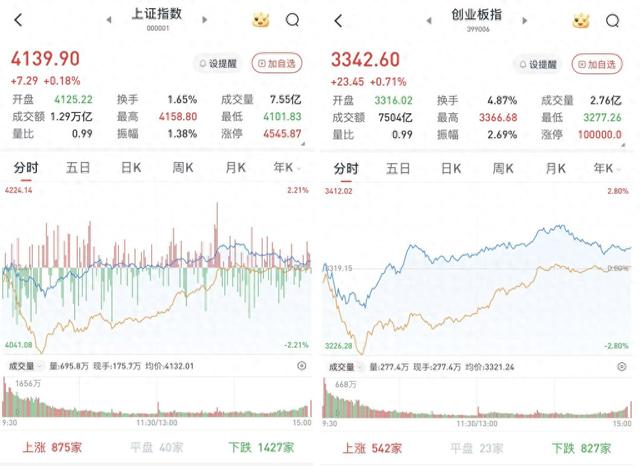
Market Overview - The three major A-share indices opened lower on January 27, with the Shanghai Composite Index closing at 4139.9 points, up 0.18% [2] - The ChiNext Index rose by 0.71% to 3342.6 points, while the Sci-Tech 50 Index increased by 1.51% to 1555.98 points [2] Trading Activity - A total of 1928 stocks rose, while 3450 stocks fell, with 91 stocks remaining flat [3] - The total trading volume was 28.949 billion yuan, a decrease of 3.533 billion yuan from the previous trading day [3] Sector Performance - Semiconductor stocks saw significant gains, with over 20 stocks hitting the daily limit or rising more than 10% [5] - Gold stocks also performed well, with several stocks reaching the daily limit or increasing by over 10% [5] - Coal and basic metal sectors experienced notable declines, with major coal stocks dropping over 4% [6] Market Sentiment and Predictions - Financial analysts suggest that the A-share market may continue to experience fluctuations in the short term due to increased overseas uncertainties and pressure at previous high levels [7] - The current market is viewed as a short-term adjustment risk, with expectations for continued upward movement in the medium term [7] - Long-term perspectives indicate that the current market trend is still in its mid-stage, with potential for a "slow bull" market to continue [8][9] Investment Recommendations - Analysts recommend focusing on sectors such as technology, particularly AI and robotics, as well as industries benefiting from price increases like chemicals and non-ferrous metals [8][9] - Short-term investment opportunities are suggested in power equipment and photovoltaic sectors, which are supported by market demand and policies [10]





青岛银行济南分行被罚 涉承兑汇票保证金管理不尽职等
Zhong Guo Jing Ji Wang· 2026-01-27 06:40
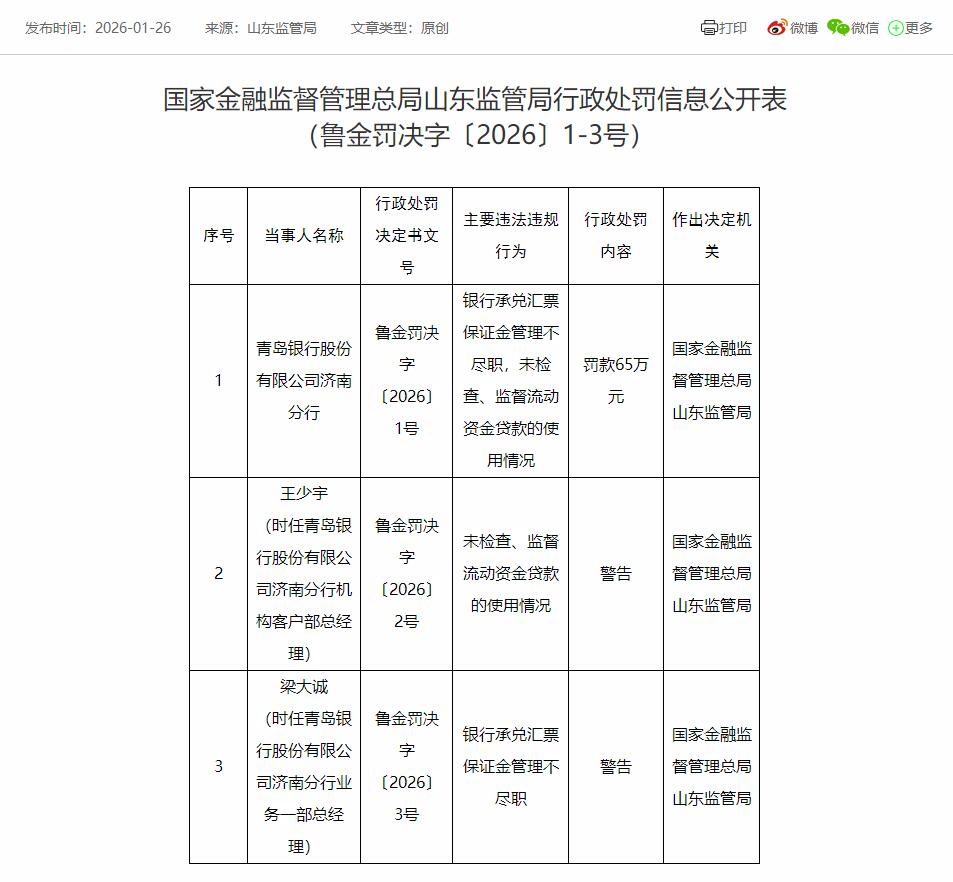
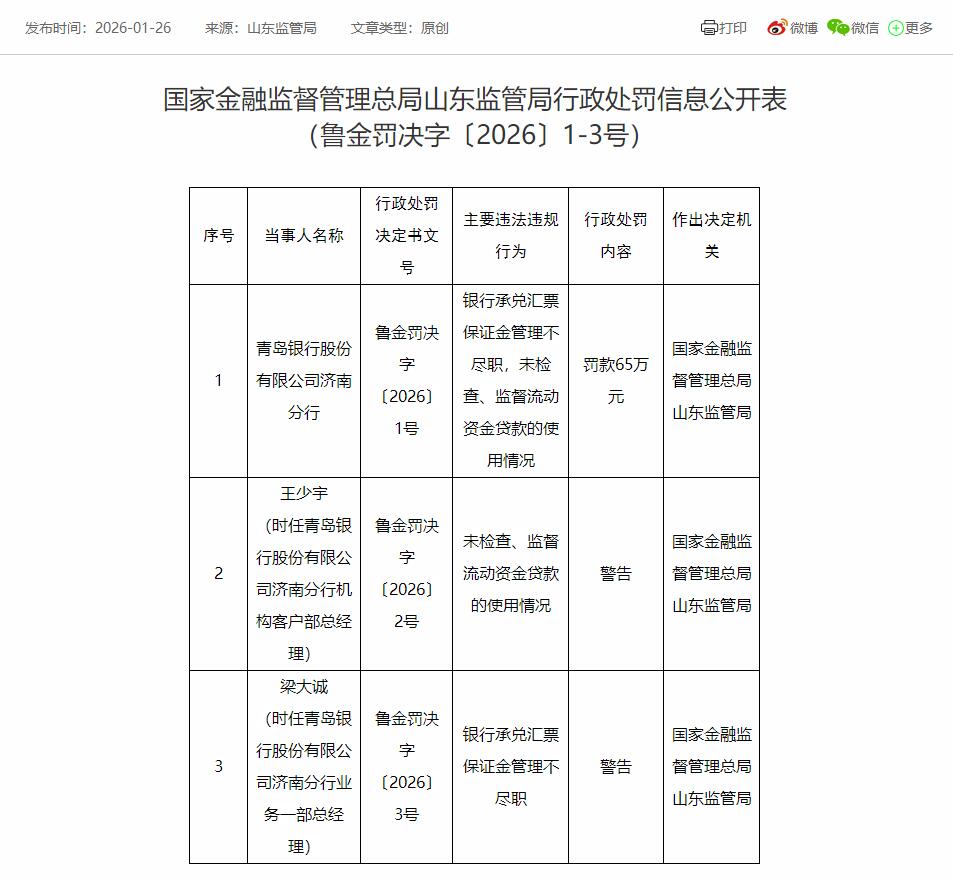
中国经济网北京1月27日讯 国家金融监督管理总局网站昨日发布的山东监管局行政处罚信息公开表(鲁金罚决字〔2026〕1号)显示, 青岛银行(002948)股份有限公司济南分行存在以下主要违法违规行为:银行承兑汇票保证金管理不尽职,未检查、监督流动资金贷款 的使用情况。国家金融监督管理总局山东监管局对青岛银行股份有限公司济南分行罚款65万元。 鲁金罚决字〔2026〕2号显示,王少宇(时任青岛银行股份有限公司济南分行机构客户部总经理)未检查、监督流动资金贷款的使用情 况,被警告。 梁大诚(时任青岛银行股份有限公司济南分行业务一部总经理)银行承兑汇票保证金管理不尽职,被警告。 | 序号 | 当事人名称 | 行政处罚 决定书文 | 主要违法违规 | 行政处罚 | 作出决定机 | | --- | --- | --- | --- | --- | --- | | | | | 行为 | 内容 | 米 | | | | 름 | | | | | 1 | 青岛银行股份 | 鲁金罚决 字 [2026] | 银行承兑汇票 保证金管理不 尽职,未检 查、监督流动 | 罚款65万 元 | 国家金融监 | | | 有限公司济南 | | | | ...
青岛银行济南分行被罚 涉承兑汇票保证金管理不尽职等
Zhong Guo Jing Ji Wang· 2026-01-27 06:40
中国经济网北京1月27日讯 国家金融监督管理总局网站昨日发布的山东监管局行政处罚信息公开表(鲁金罚决字〔2026〕1号)显 示,青岛银行股份有限公司济南分行存在以下主要违法违规行为:银行承兑汇票保证金管理不尽职,未检查、监督流动资金贷款的使用 情况。国家金融监督管理总局山东监管局对青岛银行股份有限公司济南分行罚款65万元。 鲁金罚决字〔2026〕2号显示,王少宇(时任青岛银行股份有限公司济南分行机构客户部总经理)未检查、监督流动资金贷款的使 用情况,被警告。 梁大诚(时任青岛银行股份有限公司济南分行业务一部总经理)银行承兑汇票保证金管理不尽职,被警告。 以下为原文: | 序号 | 当事人名称 | 行政处罚 决定书文 | 主要违法违规 | 行政处罚 | 作出决定机 | | --- | --- | --- | --- | --- | --- | | | | | 行为 | 内容 | 米 | | | | 름 | | | | | 1 | 青岛银行股份 | 鲁金罚决 字 (2026) | 银行承兑汇票 保证金管理不 尽职,未检 查、监督流动 | 罚款65万 元 | 国家金融监 | | | 有限公司济南 | | | | 督 ...
银行板块获政策加持,或筑底反弹
Mei Ri Jing Ji Xin Wen· 2026-01-27 05:43
数据显示,银行ETF华夏是跟踪中证银行指数综合费率最低的ETF,联接基金A类、联接基金C类、联接 基金D类。 近期,财政金融协同政策加码落地,对银行板块形成结构性支撑。1月20日国新办联合财政部等部门宣 布一揽子政策:中小企业贷款贴息1.5个百分点、设备更新贷款贴息范围扩大、消费与经营贷贴息延长 至2026年底、设立5000亿元民间投资专项担保计划、完善民企债券风险分担机制等。上述举措在降低社 会融资成本的同时,引导信贷资源向中小微、科创及扩内需领域倾斜,既优化银行资产结构,又通过风 险分担机制缓释不良压力,为息差企稳和资产质量改善提供中长期支撑。 截至2026年1月27日13:29,中证银行指数上涨0.93%,成分股农业银行上涨2.34%,青岛银行上涨 2.22%,建设银行上涨1.73%,中国银行上涨1.69%,杭州银行上涨1.6%。 ...

银行业周度追踪2026年第3周:再议指数基金波动对银行股的影响-20260126
Changjiang Securities· 2026-01-26 13:44
Investment Rating - The investment rating for the banking sector is "Positive" and maintained [12] Core Insights - The banking sector continues to adjust, underperforming compared to the CSI 300 and ChiNext indices, primarily due to significant net outflows from broad-based ETF index funds [2][6] - Despite the short-term pressures, the fundamental outlook for quality bank stocks is stable, and their valuations are considered oversold, indicating a potential buying opportunity [6][20] - Recommended banks include quality city commercial banks in Zhejiang, Jiangsu, and Shandong regions, such as Hangzhou Bank, Ningbo Bank, Jiangsu Bank, Nanjing Bank, Qilu Bank, and Qingdao Bank [2][6] Summary by Sections Market Performance - The banking index fell by 2.7%, with excess returns of -2.0% and -2.3% compared to the CSI 300 and ChiNext indices respectively [6][20] - Significant net outflows from the CSI 300 and SSE 50 ETFs amounted to 238 billion and 36.1 billion respectively, indicating a worsening trend in fund outflows [6][20] Individual Bank Performance - Some smaller banks, like Qingdao Bank, showed positive performance due to favorable fundamental expectations, while larger state-owned banks lagged [2][6] - Eight banks reported Q4 earnings, with most showing revenue growth exceeding expectations, driven by stabilized net interest margins and increased interest income [8] Market Trends - There is a growing interest in the recovery potential of oversold bank stocks, as evidenced by a slight net inflow into bank-related index funds after a period of outflows [26] - The average turnover rate for bank stocks has increased, but the transaction volume share for various bank types, excluding joint-stock banks, has decreased [45][49] Convertible Bonds - The space for strong redemption of convertible bonds in the banking sector has expanded, with current stock prices approaching redemption thresholds [43] - Notable banks for potential convertible bond trading opportunities include Changshu Bank, Shanghai Bank, and Chongqing Bank, which have stable performance expectations [43]



金融行业周报(2026、01、25):业绩比较基准新规正式落地,坚定保险中长期向好逻辑-20260125
Western Securities· 2026-01-25 10:30
Investment Rating - The report maintains a positive long-term outlook for the insurance sector, indicating a strong continuity in market performance despite recent fluctuations [2][12][16]. Core Insights - The financial sector experienced a mixed performance this week, with the non-bank financial index down by 1.45%, underperforming the CSI 300 index by 0.83 percentage points. The insurance sector saw a decline of 4.02%, while the brokerage sector decreased by 0.61% [1][10]. - The insurance sector's performance is driven by two main factors: policy support leading to economic recovery and liquidity easing combined with a strong stock market. The report suggests a shift from liquidity-driven growth to a focus on macro policy support and economic recovery expectations [2][13][16]. - The brokerage sector is expected to benefit from new regulations that enhance investment management quality, with a recommendation to focus on larger, undervalued firms and those involved in mergers and acquisitions [3][18]. - The banking sector is facing a slight decline, but there are signs of recovery in profitability for leading banks, with recommendations to focus on banks with high dividend yields and those expected to benefit from market conditions [19][21]. Summary by Sections Insurance Sector - The insurance sector's recent decline is attributed to short-term market sentiment and liquidity changes, but the long-term outlook remains positive due to strong support from both the liability and asset sides [2][12][16]. - Key recommendations include focusing on companies like China Pacific Insurance, China Ping An, China Life (H), and China Taiping, with a specific recommendation for New China Life [4][16]. Brokerage Sector - The brokerage sector's performance is slightly better than the overall market, with a focus on the new guidelines from the regulatory body that aim to improve fund management quality [3][17]. - Recommended firms include Guotai Junan, Huatai Securities, and others, particularly those with strong merger and acquisition prospects [4][18]. Banking Sector - The banking sector has shown a decline but is expected to stabilize, with recommendations to focus on banks with high earnings elasticity and strong dividend yields [19][21]. - Specific banks to watch include Hangzhou Bank, Ningbo Bank, and others, with a focus on those that have previously been undervalued [4][21].




25Q4基金对银行持仓点评:主动基金环比持平,被动基金增持
GUOTAI HAITONG SECURITIES· 2026-01-23 11:10
股票研究 /[Table_Date] 2026.01.23 票 研 究 主动基金环比持平,被动基金增持 [Table_Industry] 商业银行 | [姓名table_Authors] | 电话 | 邮箱 | 登记编号 | | --- | --- | --- | --- | | 马婷婷(分析师) | 021-23185608 | matingting@gtht.com | S0880525100001 | | 陈惠琴(分析师) | 021-38676666 | chenhuiqin@gtht.com | S0880525100003 | 本报告导读: 25Q4 主动基金对银行持仓比例环比持平于 1.9%,被动基金持仓比例环比+1.6pct 至 7.0%,其中宁波银行、兴业银行、中国银行、建设银行等获主动基金增配。 25Q4 基金对银行持仓点评 投资要点: [Table_Summary] 2025 年四季度基金重仓持股情况披露(主动基金包括普通股票型、 偏股混合型、灵活配置型,被动基金包括被动指数型、指数增强型): [Table_Report] 相关报告 商业银行《国有大行投放力度较大,不良压力或 企稳》20 ...



丈量地方性银行(1):江苏127家区域性银行全梳理-20260123
GF SECURITIES· 2026-01-23 11:08
Investment Rating - The industry investment rating is "Buy" [2] Core Insights - The report provides a comprehensive analysis of 127 regional banks in Jiangsu Province, highlighting their asset and liability structures, profitability, and asset quality [6][18] - Jiangsu's regional banks have shown a significant increase in asset growth, with major city commercial banks growing at 19.4%, surpassing the growth of listed city commercial banks at 14.2% [24][26] - The report indicates that the loan-to-asset ratio for city commercial banks is projected to reach 48.4% in 2024, reflecting a gradual increase in lending activities [30] - Jiangsu's regional banks exhibit better return on assets (ROA) compared to listed banks, with city commercial banks outperforming by 16 basis points and rural commercial banks by 9 basis points [6][42] - The asset quality of Jiangsu's regional banks is superior to that of listed banks, with lower non-performing loan ratios and higher provision coverage ratios [6][42] Summary by Sections 1. Economic Structure of Jiangsu Province - Jiangsu Province is focusing on new industrialization and strategic emerging industries, with significant contributions from cities like Nanjing and Suzhou [13][14] 2. Overview of 127 Regional Banks in Jiangsu - The report categorizes the banks into city commercial banks, rural commercial banks, and others, with a total of 127 banks established between 2006 and 2015 [18][20] 3. Asset/Liability Structure - The asset growth of major city commercial banks is accelerating, while rural commercial banks are experiencing a decline in growth rates [24][26] - The loan-to-asset ratio for city commercial banks is expected to increase to 48.4% by 2024, indicating a shift towards more lending [30] 4. Profitability - Jiangsu's regional banks have a higher ROA compared to listed banks, with city commercial banks showing a 16 basis point advantage [6][42] 5. Asset Quality/Capital Levels - Jiangsu's regional banks maintain a lower non-performing loan ratio compared to listed banks, with city commercial banks having a 30 basis point lower ratio [6][42]


城商行板块1月23日跌1.01%,上海银行领跌,主力资金净流入1.48亿元
Zheng Xing Xing Ye Ri Bao· 2026-01-23 09:04
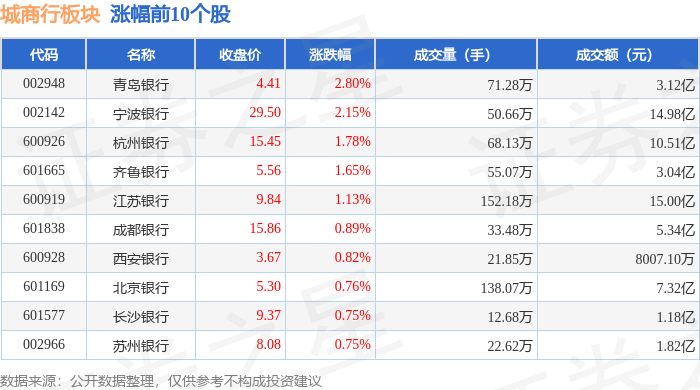
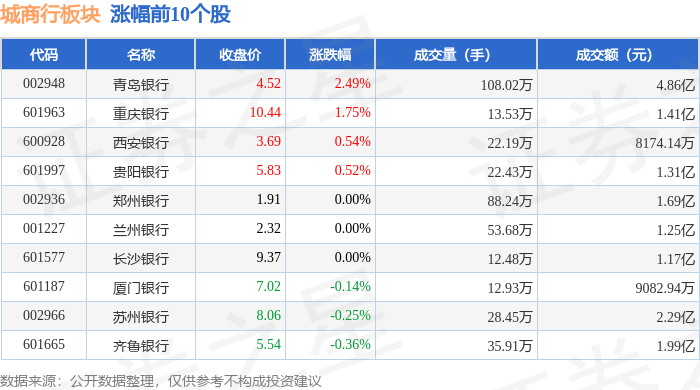
证券之星消息,1月23日城商行板块较上一交易日下跌1.01%,上海银行领跌。当日上证指数报收于 4136.16,上涨0.33%。深证成指报收于14439.66,上涨0.79%。城商行板块个股涨跌见下表: | 代码 | 名称 | 收盘价 | 涨跌幅 | 成交量(手) | 成交额(元) | | --- | --- | --- | --- | --- | --- | | 002948 | 青岛银行 | 4.52 | 2.49% | 108.02万 | 4.86亿 | | 601963 | 重庆银行 | 10.44 | 1.75% | 13.53万 | 1.41亿 | | 600928 | 西安银行 | 3.69 | 0.54% | 22.19万 | 8174.14万 | | 601997 | 豊阳银行 | 5.83 | 0.52% | 22.43万 | 1.31亿 | | 002936 | 郑州银行 | 1.91 | 0.00% | 88.24万 | 1.69亿 | | 001227 | 兰州银行 | 2.32 | 0.00% | 53.68万 | 1.25亿 | | 601577 | 长沙银行 | 9.37 | ...

城商行板块1月22日涨0.8%,青岛银行领涨,主力资金净流入3.96亿元
Zheng Xing Xing Ye Ri Bao· 2026-01-22 09:01
证券之星消息,1月22日城商行板块较上一交易日上涨0.8%,青岛银行领涨。当日上证指数报收于 4122.58,上涨0.14%。深证成指报收于14327.05,上涨0.5%。城商行板块个股涨跌见下表: | 代码 | 名称 | 主力净流入(元) | 主力净占比 游资净流入(元) | | 游资净占比 散户净流入(元) | | 散户净占比 | | --- | --- | --- | --- | --- | --- | --- | --- | | 600919 江苏银行 | | 2.02亿 | 13.49% | -1.14 Z | -7.60% | -8827.44万 | -5.89% | | 600926 杭州银行 | | 7317.50万 | 6.96% | -6483.11万 | -6.17% | -834.39万 | -0.79% | | 601169 | 北京银行 | 5714.07万 | 7.81% | -159.29万 | -0.22% | -5554.78万 | -7.59% | | 6000000 | 南京银行 | 3295.77万 | 4.44% | 2708.43万 | 3.65% | -6004 ...