BANK OF SUZHOU(002966)

Search documents
上市银行2025年三季报综述:盈利温和修复,利息与中收共振回暖
Ping An Securities· 2025-11-05 10:38
Investment Rating - The report maintains a "stronger than the market" rating for the banking sector [1][4]. Core Views - As of the end of October, 42 listed banks reported a 1.5% year-on-year increase in net profit for the first three quarters of 2025, an improvement of 0.7 percentage points compared to the first half of 2025 [4][9]. - The report highlights a continued recovery in profitability, driven by a rebound in interest income and non-interest income [4][10]. - The report anticipates that the positive signals from interest margin and non-interest income will persist into the fourth quarter of 2025, with a focus on the impact of policies aimed at reducing competition and the quality of retail assets [15][4]. Summary by Sections Profitability Analysis - The net interest income for the first three quarters of 2025 decreased by 0.6% year-on-year, while non-interest income from fees and commissions grew by 4.6% [10][6]. - The report notes that the profitability of individual banks varies, with some banks like Shanghai Pudong Development Bank and Agricultural Bank of China showing significant growth rates of 10.2% and 3.0% respectively [4][9]. Operational Breakdown - Total asset growth for the 42 listed banks was 9.3% year-on-year, with loan growth at 7.7% and deposit growth at 7.9% [22][4]. - The annualized net interest margin for the third quarter was stable at 1.36%, with a decrease in the cost of interest-bearing liabilities [4][6]. Investment Recommendations - The report suggests a shift towards reallocation rather than trading, emphasizing the importance of structural changes in funding flows that support valuation recovery in the banking sector [6][4]. - Specific banks such as Chengdu Bank, Jiangsu Bank, and Suzhou Bank are highlighted for their regional advantages and potential for continued profit growth [6][4].






城商行板块11月5日涨0.12%,宁波银行领涨,主力资金净流入5236.36万元
Zheng Xing Xing Ye Ri Bao· 2025-11-05 08:55
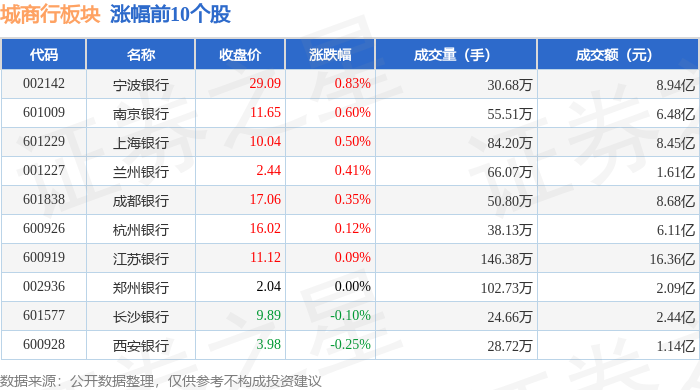
Market Performance - The city commercial bank sector increased by 0.12% on November 5, with Ningbo Bank leading the gains [1] - The Shanghai Composite Index closed at 3969.25, up 0.23%, while the Shenzhen Component Index closed at 13223.56, up 0.37% [1] Individual Stock Performance - Ningbo Bank (002142) closed at 29.09, up 0.83% with a trading volume of 306,800 shares and a transaction value of 894 million [1] - Nanjing Bank (6000000) closed at 11.65, up 0.60%, with a trading volume of 555,100 shares and a transaction value of 648 million [1] - Shanghai Bank (601229) closed at 10.04, up 0.50%, with a trading volume of 842,000 shares [1] - Other notable performances include Chengdu Bank (601838) at 17.06, up 0.35%, and Hangzhou Bank (600926) at 16.02, up 0.12% [1] Capital Flow Analysis - The city commercial bank sector saw a net inflow of 52.36 million from institutional investors, while retail investors contributed a net inflow of 89.18 million [2] - The sector experienced a net outflow of 142 million from speculative funds [2] Detailed Capital Flow for Selected Banks - Jiangsu Bank (600919) had a net inflow of 63.74 million from institutional investors, while it faced a net outflow of 46.26 million from speculative funds [3] - Chengdu Bank (601838) reported a net inflow of 63.42 million from institutional investors, with a net outflow of 57.05 million from speculative funds [3] - Ningbo Bank (002142) had a net inflow of 5.72 million from institutional investors but a significant net outflow of 43.57 million from retail investors [3]





银行业2025年三季报综述:业绩稳健性凸显,引领银行价值回归
Shenwan Hongyuan Securities· 2025-11-04 14:41
Investment Rating - The report maintains a positive outlook on the banking sector, indicating a potential return to a valuation of 1 times net asset value [4][7]. Core Insights - The banking sector has demonstrated steady performance, with a year-to-date revenue growth of 0.8% and a net profit growth of 1.5% for the first nine months of 2025, reflecting a stable regulatory environment supporting bank profitability [10][14]. - The report highlights a shift in focus from scale to balance in credit growth, with banks increasingly pursuing a "quantity-price balance" strategy [4][7]. - The cost of liabilities has improved more significantly than the decline in asset pricing, leading to a stabilization of net interest margins, which is expected to continue into the next year [4][7]. - Asset quality remains stable but shows signs of divergence, particularly with rising risks in small and micro businesses [4][7]. - The report suggests that the current dividend yield of the banking sector has returned to an attractive range, indicating a significant disconnect between stable earnings and stock holdings, which could lead to a value recovery [4][7]. Summary by Sections Performance Overview - The banking sector's performance has been characterized by a steady increase in revenue and profit, with state-owned banks showing better-than-expected stability and regional banks leading in performance [11][12][15]. - The report notes that the revenue growth of state-owned banks has turned positive, with non-interest income contributing significantly to this growth [12][15]. Credit Growth and Strategy - The report indicates a gradual abandonment of scale-driven growth, with banks focusing on achieving a balance between volume and pricing in their lending practices [4][7]. - The credit growth rate for listed banks decreased by 0.3 percentage points to 7.7% in Q3 2025, with state-owned banks maintaining a growth rate of approximately 8.5% [4][7]. Profitability and Asset Quality - The net interest margin for listed banks remained stable at 1.5%, with a slight quarter-on-quarter increase of 3 basis points in Q3 2025 [4][7]. - The overall non-performing loan ratio remained stable at 1.22%, indicating manageable risk levels across the sector [4][7]. Investment Recommendations - The report recommends focusing on leading banks and undervalued regional banks as key investment opportunities, suggesting that the recovery in valuations is supported by stable earnings and attractive dividend yields [4][7].

长三角城商行扩表进行时:对公信贷狂飙,财富业务回暖
2 1 Shi Ji Jing Ji Bao Dao· 2025-11-04 11:57
Core Insights - The banking sector in the Yangtze River Delta is experiencing a different trend compared to the overall slowdown in loan growth, with several city commercial banks showing double-digit asset growth [1][3] Group 1: Loan Growth - As of the end of Q3, several city commercial banks in the Yangtze River Delta reported significant asset growth: Jiangsu Bank at 4.93 trillion yuan (up 24.68%), Ningbo Bank at 3.58 trillion yuan (up 14.50%), and Nanjing Bank at 2.96 trillion yuan (up 14.31%) [1] - The overall loan growth for all A-share listed banks was 7.70% year-on-year, with city commercial banks leading at 12.86% [1][2] - Specific banks like Jiangsu Bank and Ningbo Bank reported loan growth rates exceeding 17% in Q3, driven primarily by corporate loans [3][5] Group 2: Corporate Loans - Corporate loans have significantly increased, with Ningbo Bank's corporate loan growth reaching 32.10% in Q3, the highest among peers [5] - The proportion of corporate loans in total loans has risen for many banks, with Jiangsu Bank's corporate loans making up 67.38% and Nanjing Bank's at 76.03% [4][5] - The focus on corporate loans, particularly in technology sectors, has been emphasized by several banks, with notable increases in technology-related loan disbursements [6][8] Group 3: Revenue and Profitability - The total revenue for six city commercial banks in the Yangtze River Delta reached 243.6 billion yuan in Q3, a year-on-year increase of 6.41%, while net profit grew by 8.36% to 111.2 billion yuan [7] - Jiangsu Bank reported a revenue of 67.18 billion yuan and a net profit of 30.58 billion yuan, both showing positive growth [7] - Wealth management and retail banking segments are showing signs of recovery, contributing to the overall revenue growth [8] Group 4: Investment Income - Investment income has been under pressure due to rising interest rates and market volatility, with the fair value changes of financial assets showing negative results [9][10] - Shanghai Bank reported the highest investment income at 16.77 billion yuan, but also faced significant losses in fair value changes [11]


苏州银行:董事、行长庄颖杰因工作变动离任
Xin Lang Cai Jing· 2025-11-04 11:23
Core Viewpoint - Suzhou Bank's president, Zhuang Yingjie, has submitted a resignation letter due to job changes, effective October 31, 2025, which will not affect the normal operations of the board or management [1] Group 1 - Zhuang Yingjie has applied to resign from his positions as director and president of the bank, with his term originally set to end on December 27, 2026 [1] - The resignation will take effect upon delivery to the board and will not impact the board's normal operations or management [1] - As of the announcement date, Zhuang Yingjie has fulfilled all public commitments and has completed the necessary handover work [1]
城商行板块11月4日涨1.62%,厦门银行领涨,主力资金净流入2.8亿元
Zheng Xing Xing Ye Ri Bao· 2025-11-04 08:48
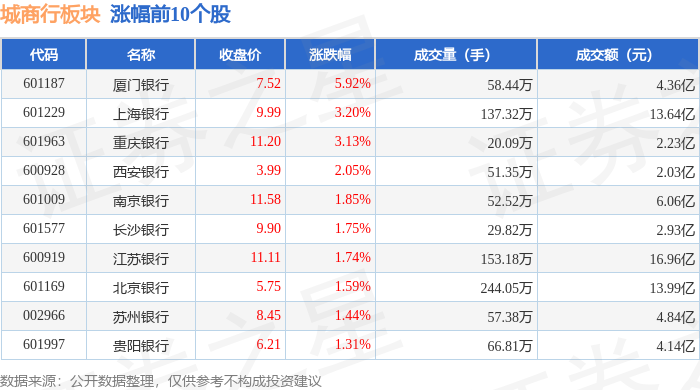
Market Performance - The city commercial bank sector increased by 1.62% on November 4, with Xiamen Bank leading the gains [1] - The Shanghai Composite Index closed at 3960.19, down 0.41%, while the Shenzhen Component Index closed at 13175.22, down 1.71% [1] Individual Bank Performance - Xiamen Bank's closing price was 7.52, up 5.92% with a trading volume of 584,400 shares and a transaction value of 4.36 billion [1] - Shanghai Bank closed at 66.6, up 3.20%, with a trading volume of 1,373,200 shares and a transaction value of 1.364 billion [1] - Chongqing Bank closed at 11.20, up 3.13%, with a trading volume of 200,900 shares and a transaction value of 223 million [1] - Other notable banks include Xi'an Bank, Nanjing Bank, and Changsha Bank, with respective increases of 2.05%, 1.85%, and 1.75% [1] Fund Flow Analysis - The city commercial bank sector saw a net inflow of 280 million from main funds, while retail funds experienced a net outflow of 89.43 million [1] - Beijing Bank had a main fund net inflow of 1.47 billion, but retail funds saw a net outflow of 55.81 million [2] - Xiamen Bank recorded a main fund net inflow of 49.44 million, with retail funds experiencing a net outflow of 54.06 million [2]
苏州银行:关于董事任职资格获核准的公告
Zheng Quan Ri Bao Zhi Sheng· 2025-11-03 12:16
Core Points - Suzhou Bank announced the approval of Chen Wenying's qualification as a director by the Jiangsu Financial Regulatory Bureau [1] Group 1 - Suzhou Bank received the approval document numbered Su Jin Fu [2025] 384 from the Jiangsu Financial Regulatory Bureau [1]
一体化领航,双引擎驱动,苏州银行的差异化发展道路
Nan Fang Du Shi Bao· 2025-11-03 10:28
Core Insights - Suzhou Bank reported a strong performance in Q3 2025, showcasing a "steady progress with dual improvements in quality and efficiency" through an integrated strategy that combines "technology innovation + cross-border" and "livelihood + wealth" as dual engines for growth [2][11] Integrated Strategy - The bank has adopted an "integrated operation" strategy to build a collaborative development system, effectively responding to market challenges while deepening its local market presence in Suzhou [2][3] - By combining specialized development with financial initiatives, the bank aims to achieve reasonable quantitative growth and effective qualitative improvement, establishing itself as a leading city commercial bank [2][3] Financial Performance - As of September 2025, the bank's total assets reached 776.04 billion, an increase of 11.87% from the beginning of the year; total loans were 368.55 billion, up 10.56%; and total deposits were 471.52 billion, rising by 13.08% [3] - The non-performing loan ratio stood at 0.83%, with a provision coverage ratio of 420.59%, indicating stable asset quality [3] - The bank's operating income for the first three quarters was 9.477 billion, a year-on-year increase of 1.88%, while net profit attributable to shareholders reached 4.477 billion, up 7.12% [3] Dual Engine Growth - The "dual engine" system, comprising "technology innovation + cross-border" and "livelihood + wealth," serves as the driving force behind the bank's growth [6][7][8] - In technology finance, the bank has established a comprehensive support framework for innovation-driven enterprises, with total credit for technology enterprises exceeding 130 billion and over 13,500 cooperative clients [7] - In cross-border finance, the bank has developed a digital system to enhance international trade services, achieving an international settlement volume of over 17.5 billion [7] Livelihood and Wealth Management - The bank has strengthened its collaboration with government entities to enhance its pension finance services, issuing over 4.8 million social security cards and 360,000 senior citizen cards [8] - Wealth management services have been improved, with personal financial assets nearing 400 billion, reflecting a growth rate of over 10% [8] Risk Management and Innovation - Suzhou Bank employs a comprehensive risk management system to balance risk and innovation, maintaining a non-performing loan ratio of 0.83% and a provision coverage ratio of 420.59% [9][10] - The bank has also focused on green finance, with green loan balances exceeding 55 billion, marking a growth of over 30% [10]

苏州银行(002966) - 关于董事任职资格获核准的公告
2025-11-03 09:15
证券代码:002966 证券简称:苏州银行 公告编号:2025-087 苏州银行股份有限公司 关于董事任职资格获核准的公告 陈文颖女士的简历详见本行于 2025 年 3 月 13 日登载于巨潮资讯网 (www.cninfo.com.cn)的《苏州银行股份有限公司第五届董事会第二十三次会议 决议公告》(公告编号:2025-039)。 特此公告。 苏州银行股份有限公司董事会 2025 年 11 月 3 日 本行及董事会全体成员保证信息披露内容的真实、准确和完整,没有虚假 记载、误导性陈述或重大遗漏。 苏州银行股份有限公司(以下简称"本行")近日收到《江苏金融监管局关 于陈文颖苏州银行董事任职资格的批复》(苏金复〔2025〕384 号),核准陈文颖 女士本行董事任职资格。 ...
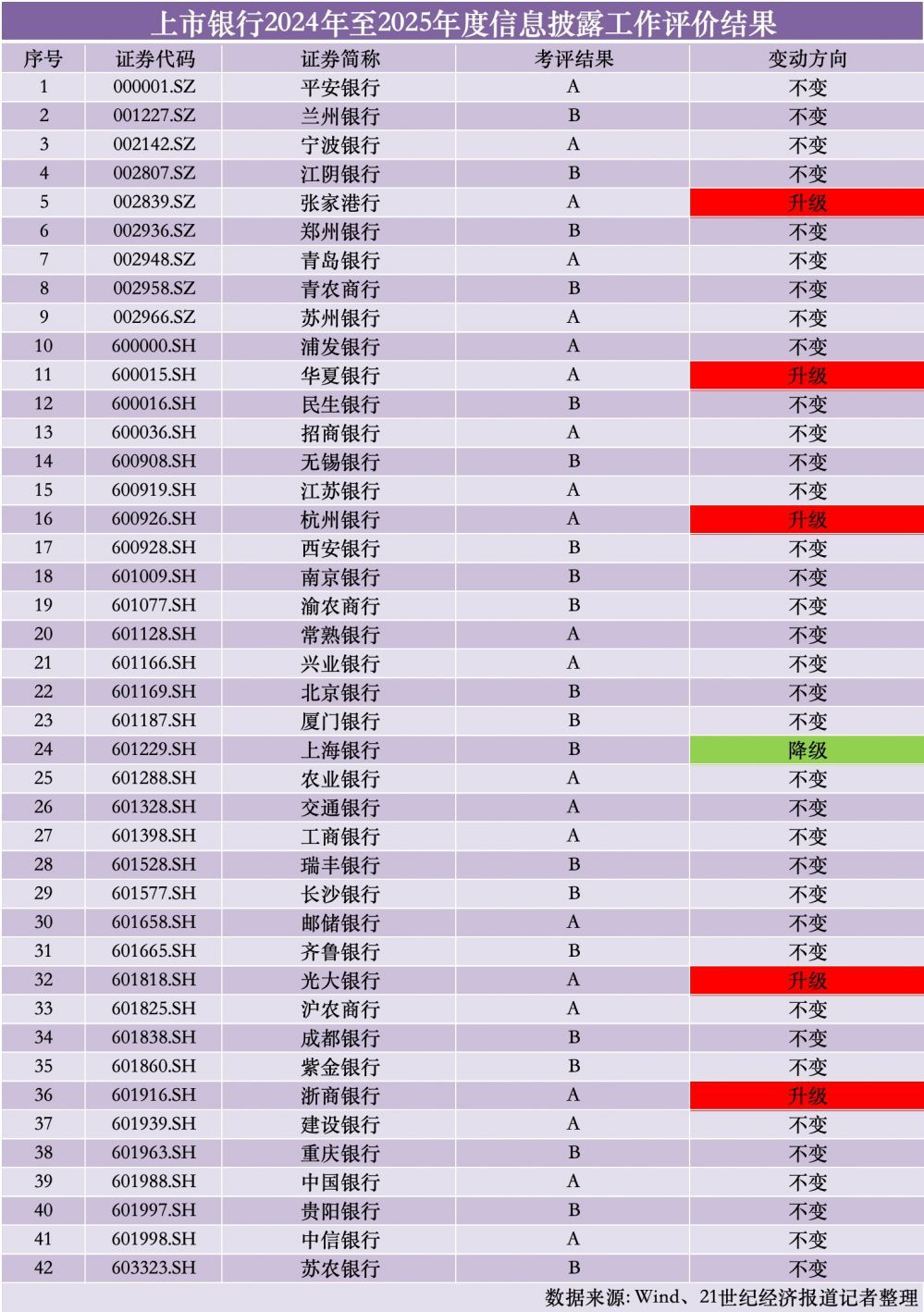
42家上市银行信披考评出炉:22家获A,光大、华夏和浙商银行提级
2 1 Shi Ji Jing Ji Bao Dao· 2025-11-03 08:21
Core Insights - The recent disclosure evaluation results for listed banks in China for the 2024-2025 period show that all listed banks received ratings of B or above, with 22 banks rated A, indicating a strong performance in information disclosure [1] Summary by Category Overall Ratings - All listed banks achieved a rating of B or higher, with 22 banks rated A, reflecting consistent performance compared to the previous year [1] - Only six banks experienced rating changes, with five banks improving their ratings and one bank, Shanghai Bank, experiencing a downgrade [1] Banks with Rating Changes - The following banks improved their ratings: - Zhangjiagang Bank - Hangzhou Bank - Huaxia Bank - Everbright Bank - Zhejiang Commercial Bank [1] - Shanghai Bank was the only bank to see a downgrade in its rating [1] Detailed Ratings - A selection of banks and their ratings includes: - Ping An Bank: A - Ningbo Bank: A - Agricultural Bank of China: A - Industrial and Commercial Bank of China: A - Shanghai Bank: B (downgraded) [2]