
BANK OF SUZHOU(002966)

Search documents
银行业十五五展望系列专题(上篇):回眸十四五,监管引导和主动求变下的银行经营理念重构
Shenwan Hongyuan Securities· 2025-12-31 14:14
Investment Rating - The report indicates a positive outlook for the banking industry, suggesting a return to a price-to-book (PB) ratio of 1x during the "15th Five-Year Plan" period, focusing on stable profitability and high-quality development [3][4]. Core Insights - The banking sector is transitioning from a focus on scale to quality, with an emphasis on risk management and structural optimization. The "15th Five-Year Plan" includes the goal of building a strong financial nation, highlighting the importance of high-quality development [3][16]. - The report identifies key changes in the banking industry during the "14th Five-Year Plan," including a shift in credit structure, a focus on profitability, and the need for banks to balance risk and efficiency [2][4]. - Regulatory support is expected to stabilize net interest margins, which have reached record lows, with a projected recovery in the coming years [5][19]. Summary by Sections 1. From Quantity to Quality - The banking industry has evolved through three five-year plans, with a shift from rapid expansion to a focus on quality and risk management. The current phase emphasizes high-quality development and financial support for key sectors [2][10]. 2. Developments During the "14th Five-Year Plan" 2.1 ROE: Resilience of State-Owned Banks and Advantages of City Commercial Banks - The return on equity (ROE) for listed banks has remained around 10%, with city commercial banks showing a slight advantage due to higher leverage and better provisioning [19][20]. 2.2 Credit: Moving Away from Scale to Balance Capital and Efficiency - Banks are prioritizing structural transformation over sheer volume, focusing on supporting key sectors and optimizing credit distribution [4][12]. 2.3 Interest Margin: Recovery from Continuous Decline - The report anticipates a stabilization of net interest margins, which have been under pressure, with regulatory measures aimed at supporting banks [5][19]. 2.4 Risk: Provisioning to Support Stability - The banking sector is expected to manage risks more effectively, with a focus on maintaining adequate provisions to support profitability during challenging economic conditions [4][19]. 2.5 Financial Markets: An Alternative Revenue Stream - The report highlights the increasing importance of financial market activities as a means to smooth revenue amid declining interest income, with banks diversifying their investment strategies [4][19]. 3. Investment Analysis Opinion - The report suggests a dual strategy of focusing on leading banks and undervalued city commercial banks, anticipating a recovery in valuations for state-owned banks that have been lagging [3][4].


银行业“十五五”展望系列专题(上篇):回眸“十四五”,监管引导和主动求变下的银行经营理念重构
Shenwan Hongyuan Securities· 2025-12-31 11:51
Investment Rating - The report maintains a positive outlook on the banking industry, indicating a "buy" rating for the sector during the "15th Five-Year Plan" period [1]. Core Insights - The banking sector is transitioning from a focus on quantity to quality, emphasizing risk management and efficiency in capital utilization. This shift is driven by the need to support the real economy while managing risks effectively [2][3]. - The report highlights that the return on equity (ROE) for listed banks has remained resilient, averaging around 10%, with city commercial banks leading at 11%-12% ROE, while state-owned banks maintain about 10% [2][3]. - Key changes observed during the "14th Five-Year Plan" include a shift away from scale-driven growth towards a balanced approach between capital and efficiency, a stabilization of net interest margins, and an increased focus on capital markets as a revenue source [2][3]. Summary by Sections 1. From Quantity to Quality - The banking industry has evolved through three five-year plans, with a core transformation focusing on risk and efficiency rather than mere volume [2][3]. 2. High-Quality Development During the "14th Five-Year Plan" 2.1 ROE: Resilience of State-Owned and City Commercial Banks - Listed banks' ROE has slightly declined but remains around 10%, reflecting operational pressures while showcasing resilience [23]. 2.2 Credit: Balancing Capital and Efficiency - The focus has shifted from merely increasing credit volume to optimizing the structure of credit distribution, with significant changes in loan allocation towards technology and green sectors [16][19]. 2.3 Net Interest Margin: Stabilization Efforts - Regulatory support is expected to stabilize net interest margins, which have reached record lows, with proactive measures to prevent further declines [2][3]. 2.4 Risk Management: Provisioning for Stability - The banking sector has moved past peak risk levels, with provisions supporting ROE stability, while new economic challenges require ongoing risk management [2][3]. 2.5 Capital Markets: A New Revenue Stream - Capital market activities have become increasingly important, with banks leveraging these for revenue amidst pressure on interest income [2][3]. 3. Investment Analysis Opinion - The report suggests a focus on stable, high-quality development, with an expectation for bank valuations to return to 1x price-to-book (PB) ratios. It emphasizes a dual strategy of investing in leading banks and quality city commercial banks [3][4].




城商行板块12月31日跌0.33%,厦门银行领跌,主力资金净流入2.01亿元
Zheng Xing Xing Ye Ri Bao· 2025-12-31 09:07
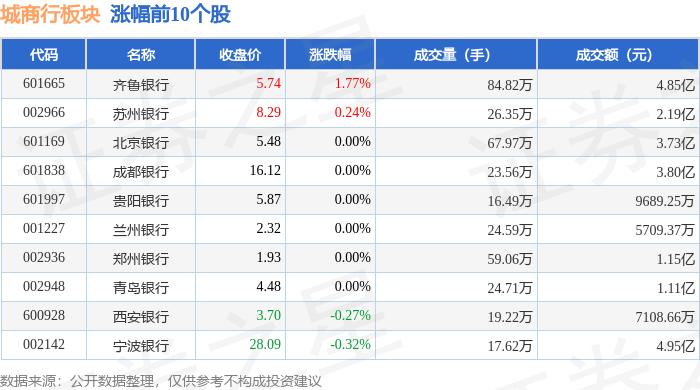
Market Overview - The city commercial bank sector experienced a decline of 0.33% on December 31, with Xiamen Bank leading the drop [1] - The Shanghai Composite Index closed at 3968.84, up 0.09%, while the Shenzhen Component Index closed at 13525.02, down 0.58% [1] Individual Bank Performance - Qilu Bank closed at 5.74, up 1.77% with a trading volume of 848,200 shares and a transaction value of 485 million [1] - Suzhou Bank closed at 8.29, up 0.24% with a trading volume of 263,500 shares and a transaction value of 219 million [1] - Xiamen Bank closed at 7.34, down 1.08% with a trading volume of 133,200 shares and a transaction value of 97.8 million [2] - Nanjing Bank closed at 11.43, down 0.78% with a trading volume of 235,600 shares and a transaction value of 270 million [2] Capital Flow Analysis - The city commercial bank sector saw a net inflow of 201 million from institutional investors, while retail investors experienced a net outflow of 9.56 million [2] - The capital flow for individual banks shows that Shanghai Bank had a net inflow of 48.9 million from institutional investors, while Hangzhou Bank had a net outflow of 50.55 million [3] - Suzhou Bank recorded a net inflow of 30.66 million from institutional investors, while retail investors had a net outflow of 27.1 million [3]


智引新程 价值共生 金融业绘写高质量发展新蓝图
Cai Jing Wang· 2025-12-31 06:59
Group 1: Financial Industry Development - The Chinese financial industry is focusing on five key areas: technology finance, green finance, inclusive finance, pension finance, and digital finance, aiming for high-quality development and openness by 2025 [1] - Financial institutions are expected to direct funds towards key sectors encouraged by the state, such as technology and green initiatives, transitioning from quantity to quality in financial services [1] Group 2: Insurance Product Innovation - AIA Life is optimizing its medical insurance product system by launching the "Smart Choice Medical Insurance," which allows customers to customize their medical coverage through a modular product approach [2] - Fude Life Insurance is enhancing its product offerings in health insurance, annuities, and floating income products to meet diverse customer needs, focusing on health and quality of life [2] Group 3: Aging Population and Pension Finance - The financial industry is innovating products and models to build a multi-tiered pension security system in response to the aging population [3] - Dehua Angu Life has developed a comprehensive insurance product system for the elderly, achieving over 90% market share in disability insurance products [3] Group 4: Digital Transformation in Banking - Ningbo Bank is implementing a systematic, digital, and intelligent approach to enhance service efficiency and risk management through digital banking models [6] - Suzhou Bank has achieved an asset custody scale of 281.32 billion yuan by focusing on process optimization and technology empowerment [6] Group 5: Digital Claims and Service Efficiency - China Life is building a comprehensive digital claims service system, with over 160 million registered users on its insurance app, enhancing service accessibility [7] - Taikang Online has achieved a 99% automation rate in underwriting and a 97% automation rate in claims processing, showcasing significant advancements in digital transformation [8] Group 6: Green Finance Initiatives - Jiangxi Bank is pioneering green finance by offering "Green Transition Loans" to support traditional industries in their low-carbon transformation [9] - Xinhua Insurance has invested over 31.6 billion yuan in green projects, serving over 6,000 green enterprises to enhance their sustainable development capabilities [11] Group 7: Social Responsibility and Inclusive Finance - Xinhua Insurance has developed over 50 affordable insurance products targeting vulnerable groups, enhancing public satisfaction and access to insurance [12] - Sunshine Property Insurance has integrated consumer rights protection into its core strategy, focusing on transparency and proactive risk reduction [14] Group 8: Public Awareness and Education - Dehua Angu Life has actively participated in public insurance awareness campaigns, reaching over 1.02 million viewers in 2025 [15] - Financial institutions are increasingly focusing on consumer rights protection as a core value, enhancing trust and long-term relationships with clients [14]




银行金融投资如何摆布记账?
GF SECURITIES· 2025-12-30 05:34
Investment Rating - The report provides a "Buy" rating for all listed banks analyzed, indicating a positive outlook for their stock performance [6]. Core Insights - The report focuses on the classification of financial investments, the current allocation of listed banks, and how related revenues are accounted for under new accounting standards [5]. - As of Q3 2025, the financial investments of 42 listed banks total approximately 101.5 trillion CNY, with 87% allocated to the configuration portfolio and 13% to the trading portfolio [5][23]. - The bond market is the primary investment direction for listed banks, accounting for 87.6% of their financial investments, with government bonds making up 59.5% of this total [5]. Summary by Sections 1. Classification of Financial Investments - Financial assets are classified into three categories under the new accounting standards: FVTPL (fair value through profit or loss), AC (amortized cost), and FVOCI (fair value through other comprehensive income) [12][13]. - The classification is based on the business model for managing financial assets and the cash flow characteristics of the financial assets [14]. 2. Accounting for Market Revenues - FVTPL assets reflect market fluctuations through "fair value changes" in profit or loss, while AC assets do not reflect fair value changes and primarily generate income from interest [5]. - FVOCI assets account for market fluctuations in other comprehensive income, with interest income recognized in profit or loss [5]. 3. Financial Investment Structure - The configuration portfolio is dominant, with state-owned banks showing the highest allocation to AC, while joint-stock banks and city commercial banks have a higher proportion of trading assets [23][24][25]. - The report notes a structural shift where FVOCI is becoming the main growth area, as banks seek flexibility in their investment strategies [5][23].




鹏安基金管理有限公司鹏安安泰利率债债券型证券投资基金基金份额发售公告
Shang Hai Zheng Quan Bao· 2025-12-29 18:32
Fund Overview - The fund is named "Peng'an Antai Interest Rate Bond Securities Investment Fund" and is categorized as a bond-type securities investment fund [15][16] - The fund will be managed by Peng'an Fund Management Co., Ltd. and the custodian will be Suzhou Bank Co., Ltd. [2][3] Fundraising Details - The fundraising period is set from January 5, 2026, to February 6, 2026, with a maximum fundraising scale of 6 billion RMB [4][18] - The fund will accept subscriptions from individual investors, institutional investors, qualified foreign investors, and other investors permitted by laws and regulations [6][18] Subscription Process - Investors must fully pay the subscription amount as per the sales institution's regulations, and multiple subscriptions are allowed during the fundraising period [8][20] - The minimum initial subscription amount for other sales institutions is 0.01 RMB, while for direct sales institutions, it is 10 RMB [9][27] Confirmation and Allocation - If the total subscription amount exceeds 6 billion RMB, a proportionate confirmation method will be used to control the scale [4][5] - The calculation method for the proportionate confirmation is provided, ensuring that the final confirmation results are based on the registration institution's calculations [5][21] Fund Management and Operation - The fund operates as a contractual open-end fund, and the fund shares will be issued at a par value of 1.00 RMB [16][17] - The fund's contract will become effective once the fundraising conditions are met, including a minimum of 200 investors and a total fundraising amount of at least 200 million RMB [40] Investor Rights and Responsibilities - Investors are responsible for ensuring that the funds used for subscription are legally sourced and free from any legal or contractual restrictions [10][12] - Investors must read the fund contract and prospectus carefully to understand the fund's risk-return characteristics [10][12]
苏州银行:大股东国发集团及其一致行动人增持本行股份约4905.95万股,增持计划实施完毕
Mei Ri Jing Ji Xin Wen· 2025-12-29 10:42
每经AI快讯,苏州银行(SZ 002966,收盘价:8.27元)12月29日晚间发布公告称,2025年7月1日至 2025年12月26日,大股东国发集团及其一致行动人东吴证券股份有限公司以自有资金通过深圳证券交易 所交易系统以集中竞价交易的方式累计增持本行股份约4905.95万股,占本行总股本的1.0974%,增持资 金合计约4.03亿元,相关增持计划实施完毕。 每经头条(nbdtoutiao)——绕开光刻机"卡脖子",中国新型芯片问世!专访北大孙仲:支撑AI训练和 具身智能,可在28纳米及以上成熟工艺量产 (记者 曾健辉) 截至发稿,苏州银行市值为370亿元。 2025年1至6月份,苏州银行的营业收入构成为:利息收入占比82.01%,非利息收入占比6.1%。 ...
苏州银行:国发集团及东吴证券增持4905.9456万股股份
Bei Jing Shang Bao· 2025-12-29 10:40
北京商报讯(记者 宋亦桐)12月29日,苏州银行发布公告称,2025年7月1日至2025年12月26日,该行 大股东苏州国际发展集团有限公司(简称"国发集团")及其一致行动人东吴证券股份有限公司以自有资 金通过深圳证券交易所交易系统以集中竞价交易的方式累计增持该行股份4905.9456万股,占该行总股 本的1.0974%,增持资金合计40295.9623万元,本次增持计划实施完毕。 ...

苏州银行(002966.SZ):国发集团及其一致行动人东吴证券累计增持1.0974%股份
Ge Long Hui A P P· 2025-12-29 10:17
格隆汇12月29日丨苏州银行(002966.SZ)公布,2025年7月1日至2025年12月26日,国发集团及其一致行 动人东吴证券股份有限公司(简称"东吴证券")以自有资金通过深圳证券交易所交易系统以集中竞价交 易的方式累计增持本行股份4,905.9456万股,占本行总股本的1.0974%,增持资金合计40,295.9623万 元,本次增持计划实施完毕。 ...
苏州银行:国发集团及其一致行动人东吴证券累计增持1.0974%股份
Ge Long Hui· 2025-12-29 10:12
格隆汇12月29日丨苏州银行(002966.SZ)公布,2025年7月1日至2025年12月26日,国发集团及其一致行 动人东吴证券股份有限公司(简称"东吴证券")以自有资金通过深圳证券交易所交易系统以集中竞价交 易的方式累计增持本行股份4,905.9456万股,占本行总股本的1.0974%,增持资金合计40,295.9623万 元,本次增持计划实施完毕。 ...