
BANK OF SUZHOU(002966)

Search documents
城商行板块1月8日跌0.89%,重庆银行领跌,主力资金净流入673.97万元
Zheng Xing Xing Ye Ri Bao· 2026-01-08 08:56
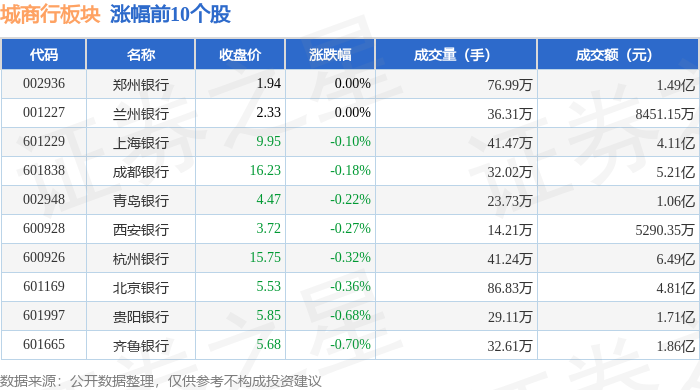
Market Overview - The city commercial bank sector experienced a decline of 0.89% on January 8, with Chongqing Bank leading the drop [1] - The Shanghai Composite Index closed at 4082.98, down 0.07%, while the Shenzhen Component Index closed at 13959.48, down 0.51% [1] Individual Stock Performance - Zhengzhou Bank closed at 1.94 with no change, while Lanzhou Bank also remained unchanged at 2.33 [1] - Shanghai Bank closed at 9.95, down 0.10%, and Chengdu Bank closed at 16.23, down 0.18% [1] - Chongqing Bank saw a significant decline of 2.70%, closing at 10.45, with a trading volume of 99,000 shares [2] Trading Volume and Turnover - The trading volume for Zhengzhou Bank was 769,900 shares with a turnover of 149 million yuan, while Lanzhou Bank had a trading volume of 363,100 shares and a turnover of 84.51 million yuan [1] - The highest turnover was recorded for Nanjing Bank at 1.342 billion yuan with a trading volume of 1,217,000 shares [2] Capital Flow Analysis - The city commercial bank sector saw a net inflow of 6.7397 million yuan from institutional investors, while retail investors experienced a net outflow of 70.5351 million yuan [2] - Chengdu Bank had a net inflow of 87.0825 million yuan from institutional investors, but a net outflow of 46.0321 million yuan from retail investors [3] Summary of Capital Flows - Institutional investors showed a positive net flow for several banks, including Hangzhou Bank with 77.8301 million yuan and Qingdao Bank with 8.4480 million yuan [3] - Conversely, Chongqing Bank had a negative net flow of 535,600 yuan from institutional investors, indicating a lack of confidence [3]

城商行板块1月7日涨0%,杭州银行领涨,主力资金净流出1.7亿元
Zheng Xing Xing Ye Ri Bao· 2026-01-07 08:58
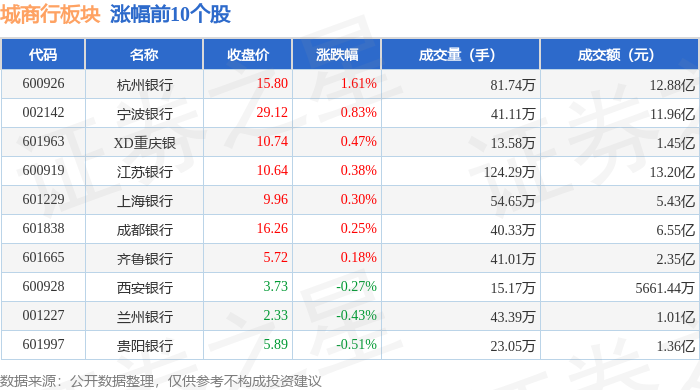
Market Performance - The city commercial bank sector experienced a slight increase of 0.0% on January 7, with Hangzhou Bank leading the gains [1] - The Shanghai Composite Index closed at 4085.77, up 0.05%, while the Shenzhen Component Index closed at 14030.56, up 0.06% [1] Individual Stock Performance - Hangzhou Bank (600926) closed at 15.80, with a rise of 1.61% and a trading volume of 817,400 shares [1] - Ningbo Bank (002142) closed at 29.12, up 0.83%, with a trading volume of 411,100 shares [1] - Other notable performances include Jiangsu Bank (601963) at 10.64 (+0.38%) and Shanghai Bank (601229) at 9.96 (+0.30%) [1] Capital Flow Analysis - The city commercial bank sector saw a net outflow of 170 million yuan from institutional investors, while retail investors contributed a net inflow of 188 million yuan [2] - The overall capital flow indicates a mixed sentiment, with institutional investors withdrawing funds while retail investors increased their positions [2] Detailed Capital Flow by Bank - Jiangsu Bank had a net inflow of 123 million yuan from institutional investors, while retail investors saw a net outflow of 27 million yuan [3] - Hangzhou Bank experienced a net inflow of 84 million yuan from institutional investors, but retail investors had a significant outflow of 132 million yuan [3] - Chengdu Bank recorded a net inflow of 55 million yuan from institutional investors, with retail investors also experiencing a net outflow [3]




苏州银行:本行已于2025年10月下旬召开2026年旺季工作动员会
Zheng Quan Ri Bao Wang· 2026-01-06 12:13
Core Viewpoint - Suzhou Bank has announced plans to hold a mobilization meeting for the peak season in late October 2025, introducing incentive schemes to accelerate project reserves and ensure efficient approval processes for the peak season [1] Group 1: Company Initiatives - The bank is implementing an incentive plan related to the "opening red" strategy to encourage faster project reserve work [1] - The current credit issuance for the peak season is progressing in an orderly manner, aiming to support stable growth in annual credit scale [1] Group 2: Industry Context - The initiatives are part of a broader strategy to ensure effective support for credit growth during the peak season [1]
苏州银行:截至2025年9月末,集团核心一级资本充足率9.79%
Zheng Quan Ri Bao Wang· 2026-01-06 12:13
Core Viewpoint - Suzhou Bank's capital adequacy ratios are in compliance with regulatory requirements and the group's capital planning management goals, indicating a strong financial position and proactive management strategy [1] Group 1: Capital Adequacy Ratios - As of September 2025, the group's core tier 1 capital adequacy ratio is projected to be 9.79% [1] - The tier 1 capital adequacy ratio is expected to reach 11.55% [1] - The overall capital adequacy ratio is anticipated to be 13.57% [1] Group 2: Strategic Focus - The bank is focused on future planning by closely monitoring refinancing policy requirements [1] - There is an ongoing effort to optimize the business structure to enhance capital utilization efficiency [1] - These strategies aim to effectively support sustainable high-quality business development [1]
苏州银行:本行积极把握市场动态,持续优化负债结构
Zheng Quan Ri Bao Wang· 2026-01-06 12:10
证券日报网1月6日讯,苏州银行(002966)在接受调研者提问时表示,本行积极把握市场动态,持续优 化负债结构,通过灵活调整存款定价策略以适应利率市场变化。在存款重定价过程中,本行始终坚持以 客户需求为导向,深化存款产品创新,强化财富业务布局,在保持合理付息成本的同时不断提升客户服 务质效,争取保持存款规模的较好增长。 ...
苏州银行:截至2025年12月31日股东户数为59065户
Zheng Quan Ri Bao· 2026-01-06 11:45
Group 1 - The core point of the article is that Suzhou Bank has disclosed its shareholder count, which is projected to reach 59,065 by December 31, 2025 [2]
苏州银行:持续优化存款重定价策略以应对利率变化
2 1 Shi Ji Jing Ji Bao Dao· 2026-01-06 10:38
南财智讯1月6日电,苏州银行在投资者关系活动中表示,本行积极把握市场动态,持续优化负债结构, 通过灵活调整存款定价策略以适应利率市场变化。在存款重定价过程中,坚持以客户需求为导向,深化 存款产品创新,强化财富业务布局,在保持合理付息成本的同时不断提升客户服务质量,争取保持存款 规模的较好增长。 ...
苏州银行(002966) - 2026年1月6日投资者关系活动记录表
2026-01-06 09:00
Group 1: Credit and Deposit Strategies - The bank has implemented incentive plans to accelerate project preparation for the "opening red" credit reserve, aiming for steady growth in annual credit scale [1] - The bank actively optimizes its liability structure and adjusts deposit pricing strategies to adapt to market interest rate changes, focusing on customer needs and enhancing service quality [1] Group 2: Capital Adequacy and Refinancing Plans - As of September 2025, the bank's core Tier 1 capital adequacy ratio is 9.79%, Tier 1 capital adequacy ratio is 11.55%, and total capital adequacy ratio is 13.57%, all meeting regulatory requirements [2] - The bank plans to closely monitor refinancing policies and continuously optimize its business structure to enhance capital efficiency for sustainable high-quality development [2] Group 3: Investor Communication - During the investor relations activity, the bank's representatives engaged in thorough communication with investors, ensuring compliance with disclosure regulations and preventing the leakage of undisclosed significant information [2]
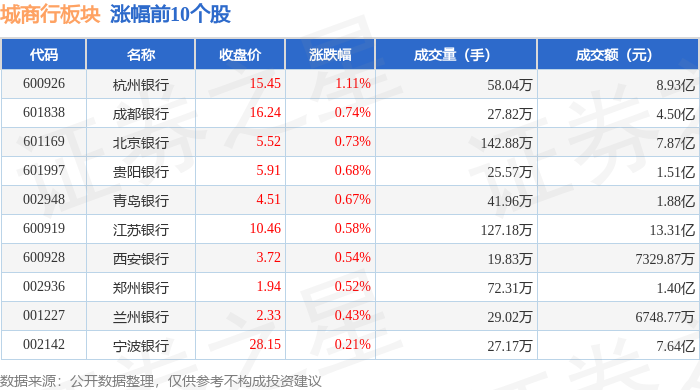
城商行板块1月5日涨0.26%,杭州银行领涨,主力资金净流入3.8亿元
Zheng Xing Xing Ye Ri Bao· 2026-01-05 09:09
Market Overview - The city commercial bank sector increased by 0.26% on January 5, with Hangzhou Bank leading the gains [1] - The Shanghai Composite Index closed at 4023.42, up by 1.38%, while the Shenzhen Component Index closed at 13828.63, up by 2.24% [1] Individual Bank Performance - Hangzhou Bank (600926) closed at 15.45, with a rise of 1.11% and a trading volume of 580,400 shares, amounting to a transaction value of 893 million yuan [1] - Chengdu Bank (601838) closed at 16.24, up by 0.74%, with a trading volume of 278,200 shares and a transaction value of 450 million yuan [1] - Beijing Bank (601169) closed at 5.52, increasing by 0.73%, with a trading volume of 1,428,800 shares and a transaction value of 787 million yuan [1] - Guizhou Bank (601997) closed at 5.91, up by 0.68%, with a trading volume of 255,700 shares and a transaction value of 151 million yuan [1] - Qindao Bank (002948) closed at 4.51, increasing by 0.67%, with a trading volume of 419,600 shares and a transaction value of 188 million yuan [1] - Jiangsu Bank (616009) closed at 10.46, up by 0.58%, with a trading volume of 1,271,800 shares and a transaction value of 1.331 billion yuan [1] - Xian Bank (600928) closed at 3.72, increasing by 0.54%, with a trading volume of 198,300 shares and a transaction value of 73.3 million yuan [1] - Zhengzhou Bank (002936) closed at 1.94, up by 0.52%, with a trading volume of 723,100 shares and a transaction value of 140 million yuan [1] - Lanzhou Bank (001227) closed at 2.33, increasing by 0.43%, with a trading volume of 290,200 shares and a transaction value of 67.5 million yuan [1] - Ningbo Bank (002142) closed at 28.15, up by 0.21%, with a trading volume of 271,700 shares and a transaction value of 764 million yuan [1] Capital Flow Analysis - The city commercial bank sector saw a net inflow of 380 million yuan from main funds, while retail funds experienced a net outflow of 134 million yuan [2] - The main funds' net inflow and outflow for individual banks include: - Jiangsu Bank (600919) had a net inflow of 10.4 million yuan, with a 7.78% share of main funds [3] - Shanghai Bank (601229) had a net inflow of 87.04 million yuan, with a 13.64% share of main funds [3] - Hangzhou Bank (600926) had a net inflow of 79.04 million yuan, with an 8.86% share of main funds [3] - Nanjing Bank (600000) had a net inflow of 67.86 million yuan, with a 9.68% share of main funds [3] - Ningbo Bank (002142) had a net inflow of 58.14 million yuan, with a 7.61% share of main funds [3] - Qilu Bank (601665) had a net inflow of 57.72 million yuan, with a 14.60% share of main funds [3] - Qingdao Bank (002948) had a net inflow of 22.18 million yuan, with an 11.82% share of main funds [3] - Suzhou Bank (002966) had a net inflow of 6.29 million yuan, with a 2.71% share of main funds [3] - Xiamen Bank (601187) had a net inflow of 520,450 yuan, with a 5.25% share of main funds [3] - Xian Bank (600928) had a net inflow of 287,550 yuan, with a 3.92% share of main funds [3]

科技赋能,规模领先 苏州银行获评年度典范托管银行
Cai Jing Wang· 2025-12-31 14:41
Core Viewpoint - Suzhou Bank has been recognized as the "Annual Model Custodian Bank" in the 2025 Financial Industry Annual Awards for its outstanding performance in the custody business and continuous innovation in the financial sector [1] Group 1: Custody Business Performance - Since obtaining the asset custody license in 2022, Suzhou Bank has implemented an integrated operational approach, enhancing its custody business as a platform for resource integration [1] - As of September 2025, Suzhou Bank's asset custody scale reached 281.32 billion yuan [1] - The bank has developed a diversified custody service system with over 1,000 custody products, including securities investment funds, bank wealth management products, trust plans, and asset management products [1] - In the public fund custody sector, Suzhou Bank has custody of 17 public funds with a scale of nearly 30 billion yuan, maintaining the largest custody scale among its peers [1] Group 2: Institutional Framework and Compliance - Suzhou Bank has established a comprehensive institutional framework for its custody business, with 26 regulations covering the legal responsibilities of fund custodians, ensuring compliance and operational integrity [1] Group 3: Digital Transformation and Technological Innovation - In the context of the digital economy, Suzhou Bank is enhancing its system capabilities while steadily developing its business, focusing on process optimization and technological empowerment [2] - The bank is advancing its operational capabilities from "standardization" to "intelligentization" through digital transformation across all areas, including product design, operational services, management, and market expansion [2] - By applying cutting-edge technologies such as OCR and NLP, Suzhou Bank has centralized custody operations and reduced manual intervention, thereby strengthening risk control in its custody business [2] Group 4: Future Outlook - Suzhou Bank aims to continuously enhance its custody service expertise, fulfill custodian responsibilities to higher standards, and contribute to the healthy development of the asset management industry [2] - The bank is committed to creating greater value for clients and supporting the high-quality development of the real economy, with a goal of becoming a leading custodian bank in China [2]