
Beijing Beimo High-tech Frictional Material (002985)

Search documents
北摩高科:关于5%以上股东的减持计划时间届满的公告
Zheng Quan Ri Bao· 2026-01-26 13:42
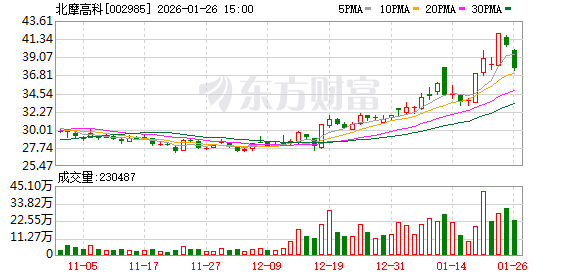
(文章来源:证券日报) 证券日报网讯 1月26日,北摩高科发布公告称,公司5%以上股东陈剑锋减持计划时间届满,期间未减 持,仍持股33066586股,占总股本9.96%。 ...

北摩高科(002985) - 关于5%以上股东的减持计划时间届满的公告
2026-01-26 10:31
证券代码:002985 证券简称:北摩高科 公告编号:2026-001 北京北摩高科摩擦材料股份有限公司 关于 5%以上股东的减持计划时间届满的公告 近日,公司收到 5%以上股东陈剑锋先生出具的《关于股份减持计划时间届 满的告知函》,截至本公告披露之日,陈剑锋先生减持计划的时间已届满。根据 《证券法》、《深圳证券交易所上市公司自律监管指引第 18 号——股东及董事、 高级管理人员减持股份》、《深圳证券交易所股票上市规则》、《上市公司自律监管 指引第 1 号——主板上市公司规范运作》等有关法律法规,现将相关情况公告如 下: 2、股东本次减持前后持股情况 一、股东减持情况 1、股东减持股份情况 截至本公告披露之日,5%以上股东陈剑锋先生在本次减持计划期间未减持公 司股份。 | 股东 | | 本次减持前持有股份 | | 本次减持后持有股份 | | | --- | --- | --- | --- | --- | --- | | 名称 | 股份性质 | 股数 | 占总股本 | 股数 | 占总股本 | | | | (股) | 比例(%) | (股) | 比例(%) | | | 合计持有股 份 其中: | 33,066,5 ...
北摩高科:股东陈剑锋未减持公司股份,减持计划时间已届满
Mei Ri Jing Ji Xin Wen· 2026-01-26 10:29
每经头条(nbdtoutiao)——国际金价冲破5000美元!7年涨了280%,什么时候才见顶?专家:关键还 看美元,重点关注国际货币体系、降息和科技革命 每经AI快讯,北摩高科1月26日晚间发布公告称,北京北摩高科摩擦材料股份有限公司于2025年9月25 日披露了《关于5%以上股东、高级管理人员减持股份预披露公告》,对公司5%以上股东陈剑锋先生、 高级管理人员杨昌坤先生的股份减持计划进行了预披露。 公司于2025年11月19日披露了《关于高级管理人员减持计划实施完成的公告》(公告编号:2025- 039),公司高级管理人员杨昌坤先生减持计划已实施完成。 近日,公司收到5%以上股东陈剑锋先生出具的《关于股份减持计划时间届满的告知函》,截至本公告 披露之日,陈剑锋先生减持计划的时间已届满,在本次减持计划期间未减持公司股份。 (记者 王晓波) ...
通用航空板块领跌,下跌1.07%




Di Yi Cai Jing· 2026-01-23 13:00
Group 1 - The general aviation sector experienced a decline of 1.07% [1] - Among the companies, Hangya Technology saw a drop of 5.25% [1] - Beimo High-tech decreased by 3.12% [1] - Hangfa Control fell by 2.7% [1] - Other companies such as Boyun New Materials, China Eastern Airlines, and Hongdu Aviation also experienced declines of over 2% [1]
SpaceX上市,有新消息!航空航天ETF天弘(159241)标的指数昨日大涨3.6%,机构:今年航空航天行业将迎来供需拐点
2 1 Shi Ji Jing Ji Bao Dao· 2026-01-23 01:23
消息面上,据证券时报,马斯克据悉希望在7月前让SpaceX上市。当地时间1月21日,据媒体报道,马 斯克正积极推进麾下太空探索技术公司SpaceX的首次公开募股(IPO)计划,其目标是在今年7月之前 完成IPO。报道称,知情人士称,马斯克一心想着让SpaceX成为首家在太空建数据中心的公司。如果没 有IPO一次性带来的数十亿美元资金,就很难尝试这样的壮举。马斯克还认为,SpaceX IPO将有助于他 的AI公司xAI追赶上竞争对手。 国金证券认为,2026年航空航天行业将迎来供需拐点。供给端受飞机制造商产能制约显著。需求端则持 续增长,中国民航客运量预计同比增速4.7%-5.5%,供需缺口或达1.4%,推动客座率超2019年水平。 (文章来源:21世纪经济报道) 相关ETF方面,航空航天ETF天弘(159241)昨日成交额为1.59亿元,溢价率为0.14%。资金流向方面,该 ETF1月19日至21日三日累计获资金净流入额超4000万元。截至1月21日收盘,该ETF最新流通份额为 5.44亿份,最新流通规模为8.12亿元。 航空航天ETF天弘(159241)紧密跟踪国证航天航空行业指数,该指数覆盖航空装备、航天 ...



成飞概念涨3.44% 主力资金净流入这些股
Zheng Quan Shi Bao Wang· 2026-01-22 09:29
Core Viewpoint - The Chengfei concept stock has shown a significant increase of 3.44%, ranking third in the concept sector, with notable performances from several stocks within the sector [1]. Group 1: Stock Performance - The Chengfei concept stock increased by 3.44%, with 39 stocks in the sector rising, including Qiaoyuan Co., which hit a 20% limit up [1]. - Other notable gainers include Aileda (up 13.58%), Beimo High-Tech (up 10.01%), and Boyun New Materials (up 9.97%) [2][3]. - The stocks with the largest declines include Chuanhuan Technology (down 1.67%), United Precision (down 0.82%), and *ST Xinyan (down 0.61%) [1]. Group 2: Capital Flow - The Chengfei concept sector saw a net inflow of 1 billion yuan, with 28 stocks receiving net inflows, and 7 stocks attracting over 50 million yuan each [2]. - Boyun New Materials led the net inflow with 223 million yuan, followed by Beimo High-Tech (169 million yuan) and Huali Chuangtong (85 million yuan) [2][3]. - The net inflow ratios for leading stocks include Boyun New Materials at 27.36%, Beimo High-Tech at 15.21%, and Guangyun Da at 11.74% [3].

航空装备板块1月22日涨3.83%,三角防务领涨,主力资金净流入29.63亿元
Zheng Xing Xing Ye Ri Bao· 2026-01-22 09:01
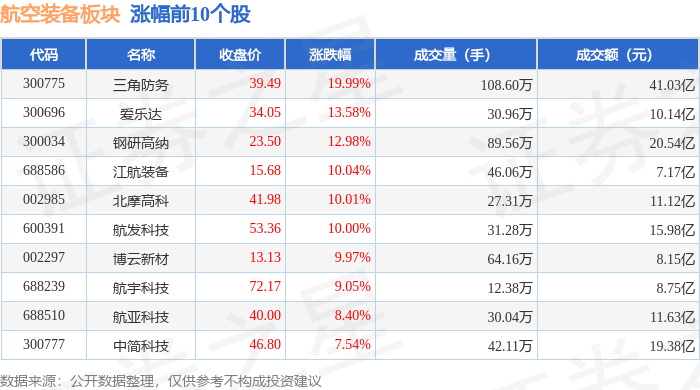
Core Viewpoint - The aviation equipment sector experienced a significant increase of 3.83% on January 22, with Triangular Defense leading the gains [1] Group 1: Market Performance - The Shanghai Composite Index closed at 4122.58, up 0.14%, while the Shenzhen Component Index closed at 14327.05, up 0.5% [1] - The aviation equipment sector saw a net inflow of 2.963 billion yuan from main funds, while retail investors experienced a net outflow of 2.038 billion yuan [1] Group 2: Individual Stock Performance - Triangular Defense (300775) closed at 39.49, with a remarkable increase of 19.99% and a trading volume of 1.086 million shares, amounting to 4.103 billion yuan [1] - Other notable performers included: - Aileda (300696) with a closing price of 34.05, up 13.58% [1] - Steel Research Tube (300034) at 23.50, up 12.98% [1] - Jianghang Equipment (688586) at 15.68, up 10.04% [1] - Beimo High-tech (002985) at 41.98, up 10.01% [1] - Aviation Power Technology (600391) at 53.36, up 10.00% [1] Group 3: Fund Flow Analysis - The main funds showed a net inflow for Triangular Defense of 550 million yuan, while retail funds had a net outflow of 220 million yuan [2] - Other stocks with significant fund flows included: - Aviation Control (000738) with a net inflow of 189 million yuan from main funds [2] - North Mo High-tech (002985) with a net inflow of 168 million yuan from main funds [2]


刚刚,集体拉升!突传重磅消息!
天天基金网· 2026-01-22 08:25
Core Viewpoint - The commercial aerospace sector is experiencing a significant rally, with many related stocks seeing substantial gains due to various positive developments in the industry [2][3]. Group 1: Stock Performance - Commercial aerospace stocks have surged, with over 20 related stocks hitting the daily limit or rising more than 10% [2][3]. - The overall increase in the commercial aerospace sector exceeded 2% after a period of decline [3]. Group 2: Industry Developments - Reports indicate that Elon Musk is actively advancing SpaceX's IPO plans, aiming for completion by July [6][7]. - The third Beijing Commercial Aerospace Industry High-Quality Development Promotion Conference is scheduled for January 23-24, focusing on technological advancements and industry growth [4][5]. - A new offshore liquid rocket launch recovery test platform is under construction, with a mainstream commercial liquid rocket set for launch and recovery tests soon [3][5]. Group 3: Future Projections - By 2025, the commercial aerospace sector is expected to maintain rapid growth, with 50 launches planned, accounting for 54% of China's total space launches [5]. - The successful first flight of the reusable Zhuque-3 rocket marks a significant technological breakthrough in the sector [5]. Group 4: Market Insights - The commercial aerospace industry is entering a golden era driven by both demand and supply-side dynamics, with a focus on satellite launches and manufacturing [5]. - Analysts suggest that the rapid development of private rocket companies indicates a shift from national to commercial aerospace [5].



刚刚,集体拉升!商业航天,突传重磅消息
券商中国· 2026-01-22 06:21
Core Viewpoint - The commercial aerospace concept stocks have experienced a significant surge, driven by multiple positive news events, including SpaceX's potential IPO and advancements in domestic aerospace capabilities [1][3][4]. Group 1: Market Performance - Commercial aerospace stocks saw a collective increase, with over 20 related stocks hitting the daily limit or rising more than 10% [1][3]. - The overall increase in the commercial aerospace sector exceeded 2% [3]. Group 2: Key Developments - Reports indicate that Elon Musk is actively pushing for SpaceX's IPO, aiming for completion before July [7][8]. - The third Beijing Commercial Aerospace Industry High-Quality Development Promotion Conference is scheduled for January 23-24, focusing on technological advancements and industry growth [4]. - A new offshore liquid rocket launch recovery test platform is under construction, with a mainstream commercial liquid rocket set for launch and recovery tests around the Chinese New Year [3][4]. Group 3: Industry Outlook - The "14th Five-Year Plan" emphasizes accelerating the construction of a strong aerospace nation, marking a pivotal year for the commercial aerospace industry [3][4]. - In 2025, commercial aerospace is projected to maintain rapid growth, with 50 launches expected, accounting for 54% of China's total space launches [4]. - The focus on reusable liquid rocket technology is expected to significantly reduce satellite networking costs, positioning it as the primary direction for domestic commercial aerospace launches [3][4]. Group 4: Investment Insights - The commercial aerospace industry is entering a golden era driven by both demand and supply-side dynamics, with a recommendation to focus on structural component suppliers and satellite manufacturing [5].

商业航天板块强势回归,航空航天ETF(159227)涨幅3.83%,规模稳居同类第一
Mei Ri Jing Ji Xin Wen· 2026-01-22 06:11
Group 1 - The A-share market saw a positive performance in the afternoon, with the aerospace sector showing strong gains, particularly the Aerospace ETF (159227), which rose by 3.83% and achieved a trading volume of 5.33 billion yuan, making it the largest in its category [1] - Key stocks in the aerospace sector, such as Triangle Defense, Beimo High-Tech, and Aero Engine Corporation, reached their daily limit, while Steel Research High-Tech increased by over 12% [1] - The Aerospace ETF has reached a total scale of 29.75 billion yuan, making it the largest in its category [1] Group 2 - Recent updates from three commercial aerospace companies, including Xinghe Power, Xingji Glory, and Tianbing Technology, regarding their listing guidance, along with the acceptance of Blue Arrow Aerospace's IPO application and the completion of guidance filing by China Aerospace, indicate that five core enterprises focused on launch vehicles are preparing to compete for the title of "first commercial aerospace stock" [1] - According to Ping An Securities, the aerospace sector is recognized as an important new productive force in the country, benefiting from government support, technological advancements, and supply chain development, leading to an acceleration in space launch tasks [1] - The continuous decrease in rocket launch costs and the maturation of recovery technologies are expected to further expedite the rocket launch process [1] Group 3 - The Aerospace ETF (159227) closely tracks the National Aerospace Index, covering leading companies across the entire industry chain, including fighter jets, aircraft engines, rockets, missiles, satellites, and radars, aligning perfectly with the strategic direction of "integrated air and space" [2] - The ETF includes emerging fields such as large aircraft, commercial aerospace, and low-altitude economy, with a high commercial aerospace content of 70.19% [2]
