
Enlight Media(300251)

Search documents
国产电影海外票房破10亿元 “中国故事”走向全球
Zheng Quan Shi Bao· 2025-10-30 22:09
Core Insights - The trend of Chinese films being released overseas is becoming a new norm in the industry, with 9 out of the top 10 domestic films this year having international screenings, and 15 out of the top 20 films also achieving overseas releases [1] - The overseas box office for Chinese films has significantly increased, surpassing 1 billion yuan (approximately 140 million USD) this year, indicating a shift from optional to essential for the domestic film industry [3][8] Group 1: Overseas Expansion - The film "Fengshen Part II: War of West Qi" is being released simultaneously in over 20 countries during the 2025 Spring Festival, showcasing the growing international reach of Chinese cinema [2] - Beijing Culture, the main producer of "Fengshen Part II," has been proactive in exploring overseas markets, having previously released "Fengshen Part I" in multiple countries and engaging with audiences directly [2][6] - The overseas box office for "Fengshen Part II" has exceeded 8 million USD, with significant contributions from markets like Malaysia [3] Group 2: Technological and Narrative Advancements - The success of films like "Nezha 2" is attributed to advancements in storytelling and production technology, making them more relatable to international audiences [4][5] - Innovations such as the "dynamic ink wash rendering engine" in "Nezha 2" enhance the visual appeal and competitiveness of Chinese animated films [5] - The industrialization of Chinese animation has improved production quality and scale, allowing for high-quality outputs that can compete globally [5] Group 3: Marketing and Distribution Strategies - Effective marketing strategies, including localized promotion and partnerships with international distribution companies, have been crucial for reaching global audiences [6][8] - "Fengshen Part II" has been translated into over 15 languages to enhance understanding and viewing experience for international audiences [6] - The use of local distribution teams has allowed for tailored strategies that resonate with specific audience demographics in various countries [6] Group 4: Future Opportunities - The increasing success of Chinese films overseas presents new market opportunities, especially as domestic growth slows [8] - The diversification of genres in films being released internationally, from mythology to science fiction, reflects a broader appeal and potential for growth in overseas markets [8] - The "Go Global" strategy aligns with national goals to enhance the international influence of Chinese cinema, as outlined in the "14th Five-Year Plan" for film development [9]


10月份电影票房达25.74亿元 影视上市公司积极寻求第二增长曲线
Zheng Quan Ri Bao Wang· 2025-10-30 12:52
Core Insights - The film market in October 2023 generated a total box office of 2.574 billion yuan, reflecting a month-on-month decline of 3% and a year-on-year decline of 29% [1] - The performance during the "Double Festival" period (National Day and Mid-Autumn Festival) was disappointing, with box office earnings of 1.835 billion yuan, significantly lower than the expected 2.105 billion yuan for 2024 [1] Group 1: Company Performance - Beijing Enlight Media reported record-high revenue and net profit for the first three quarters of 2023, with revenue reaching 3.616 billion yuan, a year-on-year increase of 150.81%, and net profit of 2.336 billion yuan, up 406.78% [2] - Hengdian Film's revenue for the same period was 1.895 billion yuan, a year-on-year growth of 17.28%, with net profit soaring to 206 million yuan, marking an increase of 1084.80% [2] Group 2: Business Strategy - Companies are increasingly focusing on enhancing IP derivative income as a strategy to mitigate market risks, with many executives emphasizing the importance of IP development [3][4] - Disney's financial report indicated a decline in traditional entertainment profits, yet overall revenue grew by 2.1% due to gains in other business segments, highlighting the potential of diversified revenue streams [3] Group 3: IP Derivative Potential - The potential for IP derivatives is significant, with Enlight Media's "Nezha" series generating over 10 billion yuan in derivative income, and projections suggesting total sales could exceed 100 billion yuan [4] - The commercial value of the animated film "Wang Wang Mountain Little Monster" is estimated to exceed 1 billion yuan, with over 400 licensed derivative products launched simultaneously [4] Group 4: Industry Trends - Companies like Wanda Film are exploring integration with ACG (Animation, Comics, Games) to enhance derivative income, showcasing various IP resources at industry events [5] - The concept of "super entertainment space" proposed by Wanda Film aims to cultivate super IPs and brands, indicating a shift towards creating a new industry ecosystem [5] Group 5: Challenges and Opportunities - The success of IP integration relies on achieving a unified core narrative across different media, rather than mere licensing, to fully unlock the potential of cross-media collaborations [6]


AI+系列报告十:从Sora看AI视频的昨天、今天和明天
CMS· 2025-10-30 06:01
Investment Rating - The report maintains a recommendation for the industry [3] Core Insights - The release of Sora2 by OpenAI marks a second revolution in the AI video industry, showcasing significant technological breakthroughs and the integration of social interaction features [2][18] - The report highlights the rapid growth of "AI comic dramas" and other innovative content forms, which are expected to capture a larger share of internet usage among younger demographics [2][16] - The report identifies three key trends for the future of AI video applications: deep integration with social interactions, evolution towards an ecosystem represented by ChatGPT, and the combination with AI agents for comprehensive video creation solutions [7][17] Industry Overview - The industry consists of 160 listed companies with a total market capitalization of 1,947 billion and a circulating market value of 1,783.1 billion [3] - The absolute performance of the industry over 1 month, 6 months, and 12 months is -5.4%, 20.3%, and 27.7% respectively, while the relative performance is -8.5%, -3.8%, and 9.3% [5] Technological Breakthroughs - Sora2 has achieved three major technological advancements: realistic simulation of the physical world, multi-modal integration for simultaneous audio generation, and initial capabilities for narrative logic and editing akin to a director [18][51] - The report emphasizes the shift from professional tools to consumer-level applications, with AI video tools becoming more accessible and integrated into social platforms [43][44] Market Opportunities - Investment opportunities are identified in various sectors: - Film industry: AI video tools are revolutionizing traditional content production, creating new dynamics [7][8] - Gaming: AI video technology is enhancing game development and gameplay innovation, increasing commercial potential [7][8] - Intellectual Property (IP): AI video is accelerating the visualization of IP, reshaping industry value [7][8] Related Companies - Key companies mentioned include Tencent Holdings, Kuaishou, Bilibili, Meitu, Kunlun Wanwei, and Mango TV, among others, which are leveraging AI technologies to enhance their core business operations [8]




影视院线板块10月29日跌0.07%,幸福蓝海领跌,主力资金净流出1.49亿元
Zheng Xing Xing Ye Ri Bao· 2025-10-29 08:41
Core Viewpoint - The film and cinema sector experienced a slight decline of 0.07% on October 29, with "Happiness Blue Sea" leading the drop, while the overall market indices showed positive movements with the Shanghai Composite Index rising by 0.7% and the Shenzhen Component Index increasing by 1.95% [1][2]. Group 1: Market Performance - The film and cinema sector's decline was primarily driven by "Happiness Blue Sea," which fell by 8.62% to a closing price of 22.15 [2]. - Other notable performers included "China Film" with a 1.90% increase, closing at 14.51, and "Jiecheng Co." which rose by 1.61% to 6.33 [1][2]. - The total trading volume for the sector was significant, with "Happiness Blue Sea" alone accounting for a transaction amount of 1 billion yuan [2]. Group 2: Capital Flow - The sector saw a net outflow of 149 million yuan from institutional investors, while retail investors contributed a net inflow of 206 million yuan [2][3]. - "Wanda Film" experienced a significant net outflow of 43.51 million yuan from institutional investors, indicating a lack of confidence among larger investors [3]. - In contrast, "Jiecheng Co." had a net inflow of 29.82 million yuan from institutional investors, suggesting a positive sentiment towards this stock [3].


10月29日早间重要公告一览
Xi Niu Cai Jing· 2025-10-29 04:05
Group 1 - Chuanfa Longmang's wholly-owned subsidiary plans to invest 660 million yuan to establish a joint venture for a 175,000 tons/year high-pressure lithium iron phosphate project in Sichuan Mianzhu, with a total investment of 1.961 billion yuan [1] - The joint venture will be co-owned by Jiangxi Shenghua New Materials (51%) and Deyang Chuanfa Longmang (49%) [1] - Chuanfa Longmang specializes in the production and sales of various phosphate products, including lithium iron phosphate [1] Group 2 - Sino Medical's COMETIU self-expanding intracranial drug-coated stent system registration application was not approved by the National Medical Products Administration [2] - Sino Medical focuses on the research, development, production, and sales of high-end interventional medical devices [3] Group 3 - Jincheng Pharmaceutical's subsidiaries have been selected for the 11th batch of national drug centralized procurement [3] - Jincheng Pharmaceutical is engaged in the research, development, production, and sales of pharmaceutical intermediates and formulations [3] Group 4 - Zhongke Lanyun reported a 4.29% increase in revenue to 1.302 billion yuan and a 2.17% increase in net profit to 211 million yuan for the first three quarters [4] - The company specializes in wireless audio SoC chip research, design, and sales [5] Group 5 - Dabo Medical achieved a 22.69% increase in revenue to 1.876 billion yuan and a 77.03% increase in net profit to 425 million yuan for the first three quarters [6] - Dabo Medical focuses on the production, research, and sales of high-value medical consumables [7] Group 6 - Dayang Electric reported a 3.81% increase in revenue to 9.180 billion yuan and a 25.95% increase in net profit to 845 million yuan for the first three quarters [8][9] - The company operates in the electric motor sector, focusing on building and home appliance motors and automotive components [9] Group 7 - Fudan Microelectronics reported a 12.70% increase in revenue to 3.024 billion yuan but a 22.69% decrease in net profit to 330 million yuan for the first three quarters [10][11] - The company specializes in the design, development, and testing of large-scale integrated circuits [11] Group 8 - Shaanxi Energy reported a 2.83% decrease in revenue to 16.359 billion yuan and a 3.23% decrease in net profit to 2.417 billion yuan for the first three quarters [12][13] - The company is involved in thermal power generation and coal production and sales [13] Group 9 - Runhe Software reported a 12.86% increase in revenue to 2.719 billion yuan but a 29.01% decrease in net profit to 78.57 million yuan for the first three quarters [14][15] - The company focuses on financial technology, smart IoT, and smart energy [15] Group 10 - Shenzhen Gas reported an 8.63% increase in revenue to 22.528 billion yuan but a 13.08% decrease in net profit to 918 million yuan for the first three quarters [16][17] - The company specializes in urban gas supply and comprehensive energy services [17] Group 11 - Light Media reported a 150.81% increase in revenue to 3.616 billion yuan and a 406.78% increase in net profit to 2.336 billion yuan for the first three quarters [18][19] - The company is engaged in the investment, production, and distribution of film projects [19] Group 12 - Dazhong Mining's subsidiary obtained a mining license for the Hunan Jijiao Mountain lithium mine, with a resource amount of 490 million tons, equivalent to approximately 3.2443 million tons of lithium carbonate [19] - The company specializes in iron ore mining and production [19] Group 13 - Yirui Technology reported a 14.22% increase in revenue to 1.549 billion yuan and a 20.61% increase in net profit to 471 million yuan for the first three quarters [20] - The company focuses on the research, production, and sales of digital X-ray detectors and related solutions [20] Group 14 - TCL Zhonghuan reported a 4.48% decrease in revenue to 121.572 billion yuan and a net loss of 5.777 billion yuan for the first three quarters [21][22] - The company specializes in the research, production, and sales of photovoltaic silicon wafers, cells, and modules [22] Group 15 - Huangshan Tourism reported an 8.75% increase in revenue to 1.535 billion yuan but an 11.02% decrease in net profit to 253 million yuan for the first three quarters [23][24] - The company provides tourism and leisure services [24] Group 16 - Mountain Outside Mountain reported a 39.79% increase in revenue to 584 million yuan and a 68.68% increase in net profit to 105 million yuan for the first three quarters [25][26] - The company specializes in the research, production, and sales of blood purification equipment and services [26] Group 17 - Huajin Capital reported a 16.36% increase in revenue to 349 million yuan and a 185.62% increase in net profit to 104 million yuan for the first three quarters [27] - The company focuses on investment management and electronic device manufacturing [27] Group 18 - Datang Power reported a 1.82% decrease in revenue to 89.345 billion yuan but a 51.48% increase in net profit to 6.712 billion yuan for the first three quarters [28][29] - The company primarily engages in thermal power generation [29] Group 19 - Datang Power announced the acquisition of a 50% stake in Anhui Electric Power for 1 yuan, which will result in full ownership of Anhui Electric Power [30] - The company focuses on thermal power generation [30] Group 20 - Kairun Co. reported a 22.94% increase in revenue to 3.719 billion yuan but a 13.38% decrease in net profit to 278 million yuan for the first three quarters [31] - The company specializes in the research, design, production, and sales of leisure bags and related products [31] Group 21 - Dafu Technology reported a 1.95% increase in revenue to 1.764 billion yuan but a net loss of 170 million yuan for the first three quarters [32] - The company focuses on the research, production, and sales of RF products and automotive components [32] Group 22 - Dafu Technology plans to publicly transfer 49% of its stake in Dasheng Graphite [34] - The company specializes in the research, production, and sales of RF products and automotive components [34]


机构风向标 | 光线传媒(300251)2025年三季度已披露前十大机构累计持仓占比49.07%
Xin Lang Cai Jing· 2025-10-29 02:28
Group 1 - The core viewpoint of the articles highlights the significant institutional investment in Light Media, with 27 institutional investors holding a total of 1.445 billion shares, representing 49.27% of the total share capital [1] - The top ten institutional investors collectively hold 49.07% of the shares, with a slight increase of 0.09 percentage points compared to the previous quarter [1] - In the public fund sector, nine funds increased their holdings, while nine funds decreased their holdings, indicating a mixed sentiment among public investors [2] Group 2 - The newly disclosed public funds total six, reflecting ongoing interest in Light Media from various investment vehicles [2] - Foreign investment sentiment shows a slight increase, with one foreign fund, Hong Kong Central Clearing Limited, raising its holdings by 0.44% [2]
光线传媒(300251.SZ)发布前三季度业绩,归母净利润23.36亿元,增长406.78%
智通财经网· 2025-10-28 17:47
Core Viewpoint - The company reported significant growth in both revenue and net profit for the first three quarters of 2025, indicating strong operational performance and financial health [1] Financial Performance - The company's operating revenue for the first three quarters reached 3.616 billion yuan, representing a year-on-year increase of 150.81% [1] - The net profit attributable to shareholders was 2.336 billion yuan, showing a remarkable year-on-year growth of 406.78% [1] - The net profit attributable to shareholders after deducting non-recurring gains and losses was 2.289 billion yuan, with a year-on-year increase of 428.21% [1] - The basic earnings per share stood at 0.8 yuan [1]
光线传媒(300251.SZ):第三季度净利润1.06亿元 同比增加993.71%
Ge Long Hui A P P· 2025-10-28 15:12
Core Viewpoint - Light Media (300251.SZ) reported significant growth in revenue and net profit for the first three quarters of 2025, indicating strong operational performance and market position [1] Financial Performance - For the first three quarters of 2025, the company achieved revenue of 3.616 billion yuan, a year-on-year increase of 150.81% [1] - The net profit attributable to shareholders reached 2.336 billion yuan, reflecting a year-on-year increase of 406.78% [1] - The net profit excluding non-recurring gains and losses was 2.289 billion yuan, up 428.21% year-on-year [1] - Basic earnings per share stood at 0.80 yuan [1] Quarterly Results - In the third quarter of 2025, the company reported revenue of 374 million yuan, a year-on-year increase of 247.54% [1] - The net profit attributable to shareholders for the third quarter was 106 million yuan, showing a remarkable year-on-year increase of 993.71% [1] - The net profit excluding non-recurring gains and losses for the third quarter was 90.634 million yuan, up 425.87% year-on-year [1] - Basic earnings per share for the third quarter were 0.036 yuan [1]
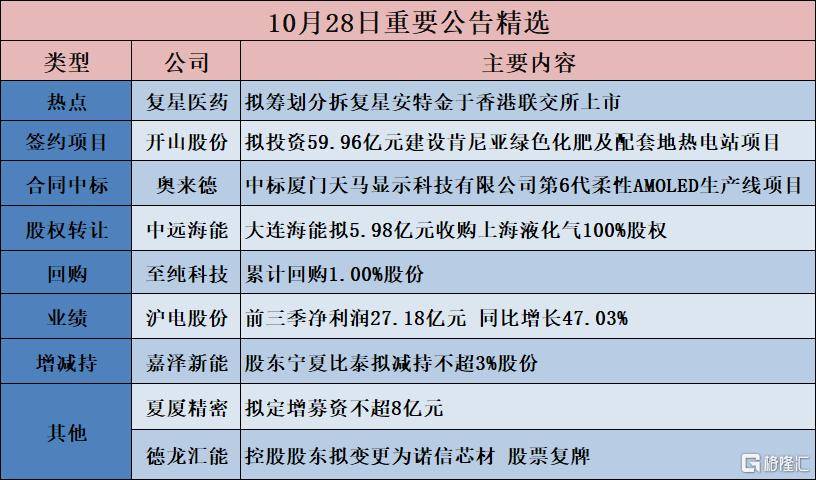
公告精选︱开山股份:拟投资59.96亿元建设肯尼亚绿色化肥及配套地热电站项目;光线传媒:第三季度净利润1.06亿元 同比增加993.71%
Sou Hu Cai Jing· 2025-10-28 15:03
Key Highlights - Fosun Pharma plans to spin off Fosun Antigen for listing on the Hong Kong Stock Exchange [1] - Kaishan Holdings intends to invest CNY 59.96 billion in a green fertilizer and geothermal power station project in Kenya [1] - Aolai De has won a contract for the 6th generation flexible AMOLED production line project from Xiamen Tianma Display Technology [2] - COSCO Shipping Energy is set to acquire 100% equity of Shanghai Liquefied Gas for CNY 5.98 billion [2] - Zhichun Technology has repurchased 1.00% of its shares [1][2] - Huadian Power's net profit for the first three quarters reached CNY 2.718 billion, a year-on-year increase of 47.03% [1][2] - Jiaze New Energy's shareholder Ningxia Bitai plans to reduce its stake by no more than 3% [1][2] - Xiashan Precision plans to raise no more than CNY 800 million through a private placement [1]
光线传媒:关于第一期员工持股计划存续期展期的公告
Zheng Quan Ri Bao Zhi Sheng· 2025-10-28 14:28
Core Viewpoint - The company announced an extension of the first employee stock ownership plan until October 28, 2026, during the sixth board meeting on October 28, 2025 [1] Summary by Categories Company Announcement - The company will hold its sixth board meeting on October 28, 2025, to review and approve the extension of the first employee stock ownership plan [1] Employee Stock Ownership Plan - The duration of the first employee stock ownership plan has been extended to October 28, 2026 [1]