Zhejiang Jingsheng Mechanical & Electrical (300316)

Search documents
晶盛机电股价受传闻驱动冲高后回调
Jing Ji Guan Cha Wang· 2026-02-12 04:34
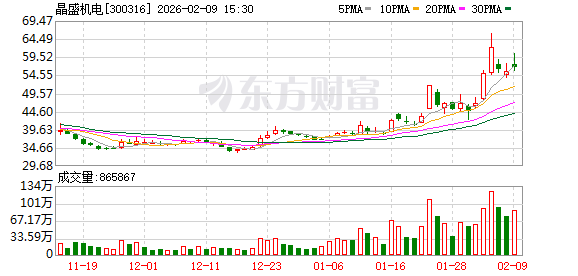
以上内容基于公开资料整理,不构成投资建议。 股价在传闻刺激下快速冲高后回调。根据内部数据库,晶盛机电股价在2026年2月4日达到65.90元的近 期高点,但近7天(2月5日至12日)区间涨跌幅为12.25%,振幅达50.87%。2月10日主力资金净流出3.22亿 元,2月12日最新股价报52.67元,单日下跌1.39%,资金面显示短期获利了结压力。 经济观察网近7天,晶盛机电(300316)股价主要受市场传闻驱动。2026年2月初,特斯拉首席执行官马 斯克团队来华考察光伏企业的消息引发关注,据新浪财经2月10日报道,传闻涉及晶盛机电,虽未获公 司证实,但被市场解读为潜在合作信号,推动股价在2月初一度暴涨近40%。36氪同日报道指出,此传 闻与马斯克在达沃斯论坛宣布的太空光伏计划相关,加剧了市场预期。 股票近期走势 ...

晶盛机电跌2.08%,成交额7.13亿元,主力资金净流出9508.88万元
Xin Lang Zheng Quan· 2026-02-12 02:20
资金流向方面,主力资金净流出9508.88万元,特大单买入6329.93万元,占比8.88%,卖出9233.56万 元,占比12.95%;大单买入1.39亿元,占比19.49%,卖出2.05亿元,占比28.75%。 晶盛机电今年以来股价涨42.31%,近5个交易日跌6.74%,近20日涨35.56%,近60日涨42.00%。 今年以来晶盛机电已经1次登上龙虎榜,最近一次登上龙虎榜为2月4日。 2月12日,晶盛机电盘中下跌2.08%,截至10:14,报52.30元/股,成交7.13亿元,换手率1.10%,总市值 684.89亿元。 截至9月30日,晶盛机电股东户数8.68万,较上期增加25.88%;人均流通股14189股,较上期减少 20.56%。2025年1月-9月,晶盛机电实现营业收入82.73亿元,同比减少42.86%;归母净利润9.01亿元, 同比减少69.56%。 分红方面,晶盛机电A股上市后累计派现32.41亿元。近三年,累计派现20.27亿元。 机构持仓方面,截止2025年9月30日,晶盛机电十大流通股东中,香港中央结算有限公司位居第二大流 通股东,持股4248.66万股,相比上期减少53.84万 ...
晶盛机电:公司业务主要覆盖光伏装备、核心耗材及智能工厂解决方案
Zheng Quan Ri Bao· 2026-02-09 13:37
(文章来源:证券日报) 证券日报网讯 2月9日,晶盛机电在互动平台回答投资者提问时表示,在光伏板块,公司业务主要覆盖 光伏装备、核心耗材及智能工厂解决方案,不涉及光伏电池片材料的生产,因此没有白银储备计划。 ...

晶盛机电:公司12英寸减压外延设备广泛适用于逻辑芯片、存储芯片、硅光芯片、功率器件中的各项制程
Zheng Quan Ri Bao Zhi Sheng· 2026-02-09 13:12
(编辑 丛可心) 证券日报网讯 2月9日,晶盛机电在互动平台回答投资者提问时表示,在芯片制造端,公司12英寸减压 外延设备广泛适用于逻辑芯片、存储芯片、硅光芯片、功率器件中的各项制程。具体业绩信息请关注公 司披露的定期报告。 ...
晶盛机电(300316.SZ):不涉及光伏电池片材料的生产,没有白银储备计划
Ge Long Hui· 2026-02-09 12:47
格隆汇2月9日丨晶盛机电(300316.SZ)在互动平台表示,在光伏板块,公司业务主要覆盖光伏装备、核 心耗材及智能工厂解决方案,不涉及光伏电池片材料的生产,因此没有白银储备计划。 ...
未知机构:国海机械张钰莹Again继续持续再次Call太空光伏设备0208-20260209
未知机构· 2026-02-09 02:45
Summary of Conference Call on Space Photovoltaic Equipment Industry Overview - The conference call focuses on the space photovoltaic industry, particularly in the context of China's satellite deployment plans and the evolution of satellite technology, including the Starlink project [1][2]. Key Points and Arguments 1. **China's Satellite Deployment Plans**: - By the end of 2025, China plans to submit approximately 203,000 satellites to the ITU, covering 14 satellite constellations. This includes 96,714 satellites for each of the CTC-1 and CTC-2 constellations, totaling nearly 193,000 satellites [1]. - Operators and commercial satellite companies are advancing medium-scale constellations, with China Mobile applying for 2,520 satellites, Yuanxin Satellite for 1,296, and Guodian Gaoke for 1,132 [1]. - As of December 2025, the overall launch completion rate for major domestic constellations remains low, indicating a "low launch rate and early networking stage" [1]. 2. **Starlink Project Development**: - As of January 25, 2026, Starlink has cumulatively launched approximately 11,034 satellites and applied for about 41,943 [2]. - The annual launch volume has increased from "hundreds" in 2018-2019 to an expected peak of around 3,200 satellites in 2025 [2]. 3. **Cost and Efficiency Dynamics**: - Gallium arsenide (GaAs) remains the mainstream technology for space photovoltaic applications, but it is no longer the only viable option due to high costs. The industry is exploring lower-cost alternatives such as silicon-based and perovskite solar cells [2]. - Starlink's V1-V3 satellites utilize crystalline silicon technology to achieve supply chain scalability and system-level cost reductions, sacrificing some unit efficiency for significant cost advantages [2]. 4. **Future Directions for Starlink**: - Starlink V4 may adopt P-type silicon HJT or P-type silicon HJT-perovskite tandem structures, which are expected to offer better reliability in space environments [3]. 5. **Domestic Space Photovoltaic Developments**: - The core technology remains multi-junction GaAs, but several companies are reporting progress in testing perovskite systems in orbit. For instance, Jiangyin Jinghao has completed over three months of stable operation for perovskite components in orbit as of May 6, 2025 [4]. - The industry outlook is positive, with an upgrade in the rating for the space photovoltaic sector to "recommended" due to accelerated satellite launches and ongoing validation of new photovoltaic technologies [4]. Additional Important Content - **Related Companies**: The call mentions several companies involved in the space photovoltaic sector, including Maiwei Co., Aotewi, High Measurement Co., Jing Sheng Machinery, Jiejia Weichuang, and Shanghai Port [5]. - **Risk Factors**: The report highlights several risks, including uncertainties in technology maturity and reliability, challenges in industrialization and commercialization, early investment and project execution risks, market space and competitive landscape uncertainties, and potential changes in policy and regulatory environments [7].





晶盛机电股价涨5.37%,广发基金旗下1只基金重仓,持有47.77万股浮盈赚取142.83万元
Xin Lang Cai Jing· 2026-02-09 02:05
2月9日,晶盛机电涨5.37%,截至发稿,报58.69元/股,成交13.03亿元,换手率1.84%,总市值768.57亿 元。 资料显示,浙江晶盛机电股份有限公司位于浙江省杭州市临平区顺达路500号,成立日期2006年12月14 日,上市日期2012年5月11日,公司主营业务涉及晶体生长设备及其控制系统的研发、制造和销售。主 营业务收入构成为:设备及其服务70.48%,材料21.18%,其他8.34%。 从基金十大重仓股角度 数据显示,广发基金旗下1只基金重仓晶盛机电。广发中证光伏龙头30ETF(560980)四季度增持18.51 万股,持有股数47.77万股,占基金净值比例为3.65%,位居第八大重仓股。根据测算,今日浮盈赚取约 142.83万元。 广发中证光伏龙头30ETF(560980)成立日期2022年11月16日,最新规模4.81亿。今年以来收益 14.42%,同类排名109/5579;近一年收益70.17%,同类排名203/4289;成立以来亏损18.49%。 广发中证光伏龙头30ETF(560980)基金经理为夏浩洋。 截至发稿,夏浩洋累计任职时间4年267天,现任基金资产总规模199.9亿元, ...
培育钻石板块盘初上扬,四方达涨近9%
Mei Ri Jing Ji Xin Wen· 2026-02-09 01:58
Group 1 - The cultivated diamond sector experienced an initial rise on February 9, with significant gains in several companies [1] - Sifangda saw an increase of nearly 9%, while Huanghe Xuanfeng and Power Diamond both rose over 5% [1] - Jing Sheng Mechanical and Chao Hong Ji also showed positive movement, with increases exceeding 4% [1]


商业航天深度:太空光伏的技术底层逻辑(附29页PPT)
材料汇· 2026-02-08 15:24
Core Viewpoint - The article discusses the emergence of a new era in satellite technology, emphasizing the urgent need for efficient power supply systems for satellites as China prepares to launch a significant number of satellites by the end of 2025 [6][9]. Group 1: Satellite Launch and Development - By the end of 2025, China plans to submit approximately 203,000 satellites to the ITU, covering 14 satellite constellations, with the Radio Innovation Institute applying for two constellations, each with 96,714 satellites, totaling nearly 193,000 satellites [7][8]. - Major operators and commercial satellite companies are also advancing medium-scale constellations, with China Mobile applying for 2,520 satellites, Yuxin Satellite for 1,296, and Guodian Gaoke for 1,132 [8][10]. - As of December 2025, the overall launch completion rate for major domestic constellations remains low, indicating they are in the early stages of network formation [13]. Group 2: Starlink Program and Launch Trends - The Starlink program exhibits a clear generational rhythm, with cumulative launches reaching approximately 11,034 satellites and applications totaling about 41,943 as of January 2026 [2][16]. - The annual launch volume has increased significantly, with projections for 2025 reaching around 3,200 satellites, reflecting a trend of accelerating deployment [15][20]. - Starlink's V1 to V3 satellites utilize crystalline silicon technology to prioritize supply chain scalability and system-level cost reduction, while V4 may adopt P-type silicon HJT or P-type silicon HJT-perovskite tandem structures [3][4]. Group 3: Photovoltaic Technology in Space - The current mainstream technology for space photovoltaic applications in China is multi-junction gallium arsenide (GaAs), although there is ongoing testing and validation of perovskite systems by various companies [4][26]. - The high unit price of GaAs photovoltaic cells is becoming a significant factor limiting system economics, prompting the industry to explore lower-cost alternatives such as silicon-based and perovskite technologies [21][34]. - The article highlights the unique requirements for photovoltaic cells in space, including radiation resistance, thermal stability, and long-term reliability under extreme conditions [22][25]. Group 4: Industry Outlook and Recommendations - The acceleration of satellite launches and the continuous validation of new photovoltaic technologies indicate a rising industry outlook and long-term growth potential for the space photovoltaic sector [5][6]. - The article recommends a "buy" rating for the space photovoltaic industry, citing key companies such as Maiwei Co., Aotewi, and others as relevant investment targets [5][6].


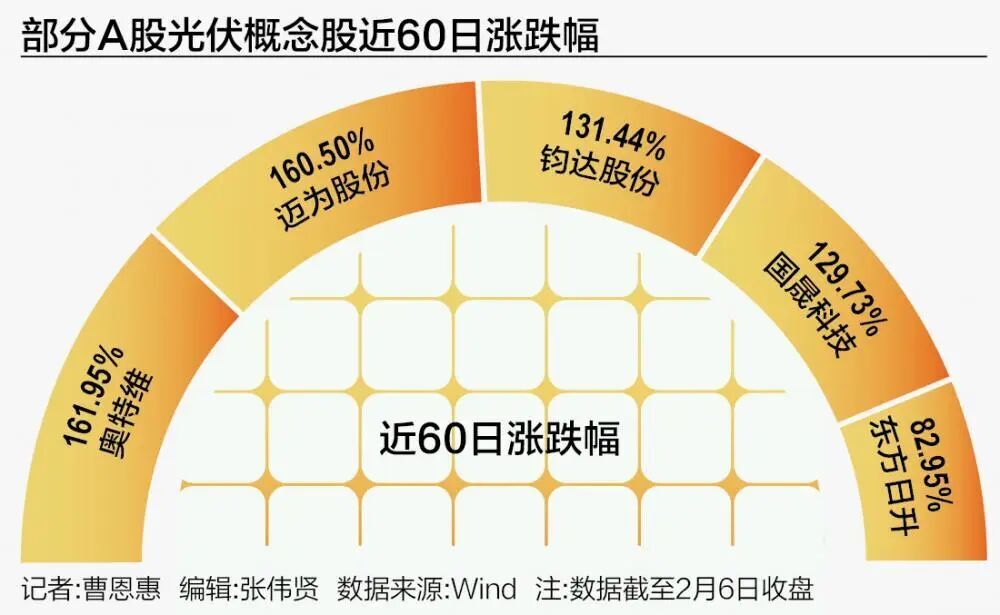
马斯克点火A股光伏,奥特维等股价翻倍
2 1 Shi Ji Jing Ji Bao Dao· 2026-02-07 01:48
Core Viewpoint - Elon Musk is significantly influencing the Chinese A-share photovoltaic sector, with his comments on solar energy and its potential to provide substantial power, which has led to a surge in stock prices within the sector [2][3][4]. Group 1: Market Reaction - On January 23, 2026, following Musk's remarks at the World Economic Forum, 24 photovoltaic stocks in China hit their daily limit up, with the photovoltaic index rising by 7.46% [2]. - Two weeks later, Musk's interest in Chinese photovoltaic companies, including JinkoSolar and TCL Zhonghuan, further ignited stock price increases, with many stocks reaching their daily limit up again [3]. - The excitement surrounding Musk's "space photovoltaic" vision has injected new vitality into the previously stagnant A-share photovoltaic market [3][4]. Group 2: Industry Context - The photovoltaic industry is currently facing challenges, with nearly 70% of A-share photovoltaic companies reporting losses due to low prices in the supply chain [8]. - Despite some companies showing signs of recovery, the overall market sentiment remained negative, as indicated by a 4.10% decline in the Wind photovoltaic index during a week of earnings announcements [8]. - Musk's "space photovoltaic" concept has shifted the focus of the industry from terrestrial applications to potential space-based solutions, which could represent a new growth avenue for the sector [12]. Group 3: Future Prospects - Analysts predict that the "space photovoltaic" market could become a significant growth area, with estimates suggesting a market size of approximately 295 billion RMB by 2030, which is ten times the current scale [15]. - Musk's plans for deploying 100GW of solar power in space could potentially open up vast opportunities for new technologies and applications in the photovoltaic sector [15]. - However, the current competitive landscape and the need for immediate solutions to existing challenges in the industry remain pressing concerns [16].