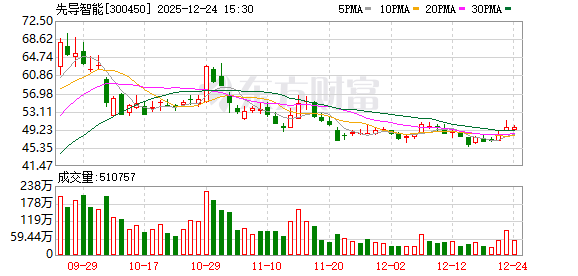
LEAD INTELLIGENT(300450)

Search documents
21专访|先导智能王燕清:我们不是在追赶,而是定义下一代技术
2 1 Shi Ji Jing Ji Bao Dao· 2025-12-24 11:28
Core Insights - The lithium battery industry is entering the "TWh era," with global demand for power batteries expected to exceed 1300 GWh by 2025, alongside explosive growth in the energy storage market [1] - The competition in the "TWh era" is not just about individual companies but the resilience of the entire industry chain [1] Group 1: Industry Dynamics - The shift to the "TWh era" signifies a reconstruction of competitive logic, moving beyond mere capacity growth to a focus on efficiency and quality [5] - In the past decade, lithium battery companies competed primarily on scale, with rapid factory construction and production line deployment being key to gaining market share [6] - The new challenges in the "TWh era" require manufacturers to achieve capacity increases within limited space and labor constraints, necessitating a departure from traditional production line replication [8] Group 2: Company Strategy - The company has established a "full value chain" capability for "turnkey delivery," creating a competitive moat [7] - The company emphasizes "extreme manufacturing" to address the challenges of scale, efficiency, and quality, relying on data-driven decision-making, AI empowerment, and flexible automation [8] - The use of digital twin technology allows for significant efficiency improvements, with equipment delivery efficiency potentially increasing by 50% and overall equipment effectiveness (OEE) improving by 35% [8] Group 3: Collaborative Innovation - The company has formed joint R&D mechanisms with top global battery enterprises, allowing for collaborative innovation from the initial design phase [9] - This deep collaboration ensures that the company's products are precisely aligned with market demands [9] Group 4: Competitive Barriers - The company leverages its large delivery scale to gain advantages in supply chain negotiations and cost control [10] - The core competitive strengths are summarized as platform reuse capabilities, a robust R&D innovation system, and localized global service capabilities [10] Group 5: Technological Leadership - The company aims to define next-generation technologies rather than merely catch up, with early investments in solid-state battery equipment and other advanced technologies [11] - Key factors for the industrialization of solid-state batteries include manufacturing processes, equipment efficiency, and cost control [11] Group 6: Market Positioning - The company advocates for a shift from price competition to a "value war," focusing on total cost of ownership (TCO) rather than just equipment purchase prices [12] - By targeting high-tech, high-barrier markets such as solid-state batteries, the company avoids low-end capacity competition and positions itself for future market leadership [12] - The company is expanding its global presence to tap into higher-quality orders, moving away from domestic price wars [12] Group 7: Financial Performance - The company's overseas business generated revenue of 1.154 billion yuan in the first half of 2025, with a gross margin of 40.27%, surpassing the overall business margin [13] - The company is actively involved in setting national and international industry standards to promote the development of standardized and modular manufacturing [13]


先导智能王燕清:我们不是在追赶,而是定义下一代技术
2 1 Shi Ji Jing Ji Bao Dao· 2025-12-24 11:17
Core Viewpoint - The lithium battery industry is entering the "TWh era," with global demand for power batteries expected to exceed 1300 GWh by 2025, alongside explosive growth in the energy storage market [2] Group 1: Industry Dynamics - The competition in the "TWh era" is not just about individual companies but the resilience of the entire industry chain [3] - The biggest change in the lithium battery "TWh era" is the restructuring of competitive logic, moving beyond mere capacity growth [4] - Over the past decade, lithium battery companies have focused on scale competition, with rapid factory construction and production line deployment being key to gaining an advantage [5] Group 2: Company Strategy - The company has established a first barrier with its "full value chain delivery" capability, enhancing customer loyalty through "turnkey" solutions in non-standard automation [6] - The company is addressing the "impossible triangle" of scale, efficiency, and quality through "extreme manufacturing," emphasizing data-driven decision-making, AI empowerment, and flexible automation [7] - The company collaborates with top global battery enterprises from the initial design phase to ensure its products meet market demands [8] Group 3: Competitive Advantages - The company leverages its large delivery scale for supply chain negotiation, core component self-research, and cost control, allowing it to respond effectively to market competition [9] - The core competitive advantages are summarized as the reuse capability of the "platform strategy," a robust R&D innovation system, and localized global service capabilities [10] Group 4: Market Positioning - The company advocates for a shift from price competition to "value warfare," focusing on total cost of ownership (TCO) rather than just equipment purchase prices [11] - The company aims to avoid low-end capacity competition by targeting high-tech orders in advanced fields like solid-state batteries and large-capacity energy storage [12] - The company is expanding its global presence, with overseas business revenue reaching 1.154 billion yuan in the first half of 2025, reflecting a continuous increase and a gross margin of 40.27% [12] Group 5: Industry Standards and Innovation - The company is actively participating in the formulation of national and international industry standards, promoting the standardization and modularization of equipment manufacturing [12] - The company emphasizes the importance of protecting intellectual property to encourage a shift from price competition to technology-driven competition [13]
锂电材料涨价落地节奏加速,新能车ETF(515700)冲击4连涨
Sou Hu Cai Jing· 2025-12-24 02:57
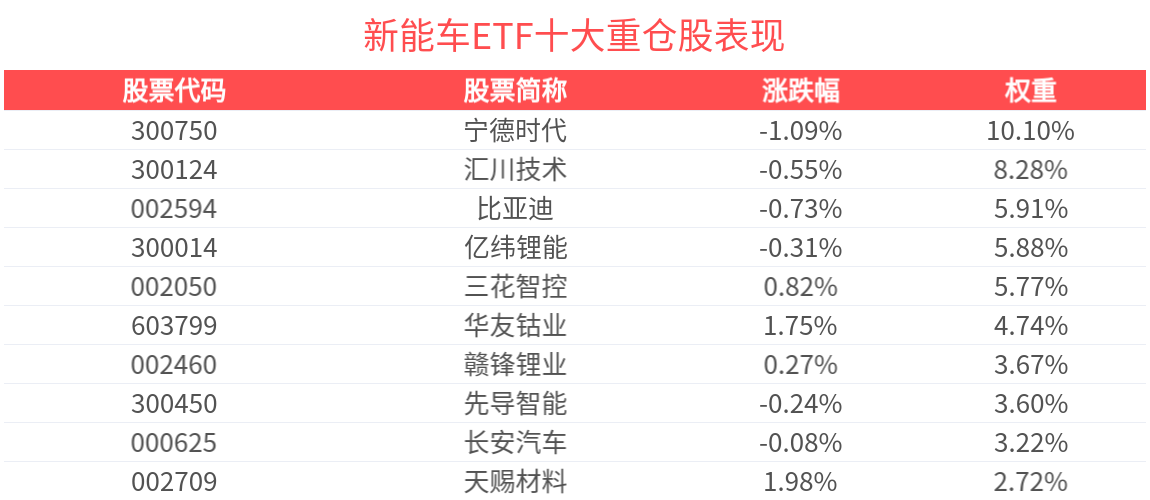
Group 1 - The core material for electrolytes, lithium hexafluorophosphate, has seen a price increase that exceeds market expectations, reaching an average price of 177,250 yuan per ton, which is over a 200% increase since early November [1] - The demand from energy storage and new energy vehicles has triggered a boom in the lithium battery industry chain, marking a turning point in industry prosperity since December 2025, with price increases expected to continue until the second quarter of 2026 due to supply-demand mismatches [1] - As of December 24, 2025, the CSI New Energy Vehicle Industry Index (930997) rose by 0.36%, with notable increases in component stocks such as Weichai Power (8.32%) and Zhongmin Resources (4.77%) [1] Group 2 - The CSI New Energy Vehicle Industry Index closely tracks the performance of 50 listed companies involved in the new energy vehicle sector, including manufacturers of electric vehicles, electric motors, battery equipment, and materials [2] - As of November 28, 2025, the top ten weighted stocks in the CSI New Energy Vehicle Industry Index accounted for 51.96% of the index, with leading companies including CATL, BYD, and Ganfeng Lithium [2]




东方证券:储能需求支持下游扩产 行业新订单有望继续落地
Zhi Tong Cai Jing· 2025-12-24 02:01
Core Viewpoint - The lithium battery equipment industry is experiencing a significant increase in demand driven by the growth in energy storage, leading to a positive outlook for the sector in 2026 [2][4]. Industry Summary - The demand for energy storage is rapidly increasing, with new bidding scales for domestic energy storage exceeding 400 GWh from January to November 2025, representing a 75% year-on-year growth [2]. - The Chinese government has announced plans for large-scale energy storage construction, aiming for an installed capacity of over 180 million kilowatts by 2027, which is expected to drive direct project investments of approximately 250 billion yuan [2]. - Internationally, energy storage demand is also rising, with LG Energy's plan to increase its storage battery production capacity from an initial target of 30 GWh to 50 GWh by 2026, a 60% increase [2]. Company Summary - The lithium battery equipment industry saw a rapid recovery in orders in 2025, with leading companies like Xian Dao Intelligent, Hai Mu Xing, and Li Yuan Heng reporting new and existing orders exceeding 30 billion yuan, a year-on-year increase of 70%-80% [3]. - The recent signing of large contracts by lithium battery equipment manufacturers reflects the expansion trend driven by new energy storage demands [4]. - The profitability of lithium battery equipment has improved this year, and the continued landing of future orders is expected to enhance the growth certainty of the sector [4].


上游碳酸锂涨价延续至下游,产业进展频频,锂电产业链景气度持续攀升!电池ETF(159755)、储能电池ETF广发(159305)冲击3连涨!
Xin Lang Cai Jing· 2025-12-23 05:27
Group 1 - The lithium battery industry chain has seen a continuous increase in demand since December, driven by the energy storage sector, leading to price hikes across multiple segments [1] - Prices for lithium hexafluorophosphate, VC additive (ethylene carbonate), and FEC (fluoroethylene carbonate) are on the rise due to an expanding supply-demand gap [1] - Several lithium iron phosphate companies have announced price increases, with Suzhou Dejia Energy Technology Co., Ltd. planning a 15% price hike for its battery products starting December 16 [1] Group 2 - EVE Energy is planning to build a nearly 30GWh cylindrical battery factory near BMW's plant in Hungary, expected to be operational by 2026 [2] - The new generation BMW iX3, equipped with EVE Energy's cylindrical battery, achieved a real-world range of 1007.7 km, surpassing the official WLTP range of 805 km [2] - The lithium iron phosphate market is projected to see significant demand growth, with production expected to rise from 3.9 million tons in 2025 to 5.8 million tons by 2026 [2] Group 3 - As of December 22, 2025, the battery ETF has seen a significant growth of 1.05 billion yuan in scale over the past week [3] - The battery ETF has also experienced a substantial increase in shares, with a growth of 19.46 billion shares over the past three months [3] - The storage battery ETF has surged over 2%, with constituent stocks like Tongfei Co. and Penghui Energy showing notable gains [3] Group 4 - The battery ETF (159755) closely tracks the National Index for New Energy Vehicle Batteries, focusing on the electric vehicle battery industry chain [4] - The storage battery ETF (Guangfa, 159305) tracks the National Index for New Energy Batteries, emphasizing the storage battery sector and selecting 50 stocks with high market capitalization and liquidity [4]


新型工业化板块领涨,上涨2.2%




Di Yi Cai Jing· 2025-12-23 05:20
Group 1 - The new industrialization sector leads the market with a rise of 2.2% [1] - Wavelength Optoelectronics increased by 4.87% [1] - Industrial Fulian rose by 4.39% [1] - Keri Technology saw an increase of 3.64% [1] - Jiechuan Intelligent and Xiandai Intelligent both rose over 2% [1]
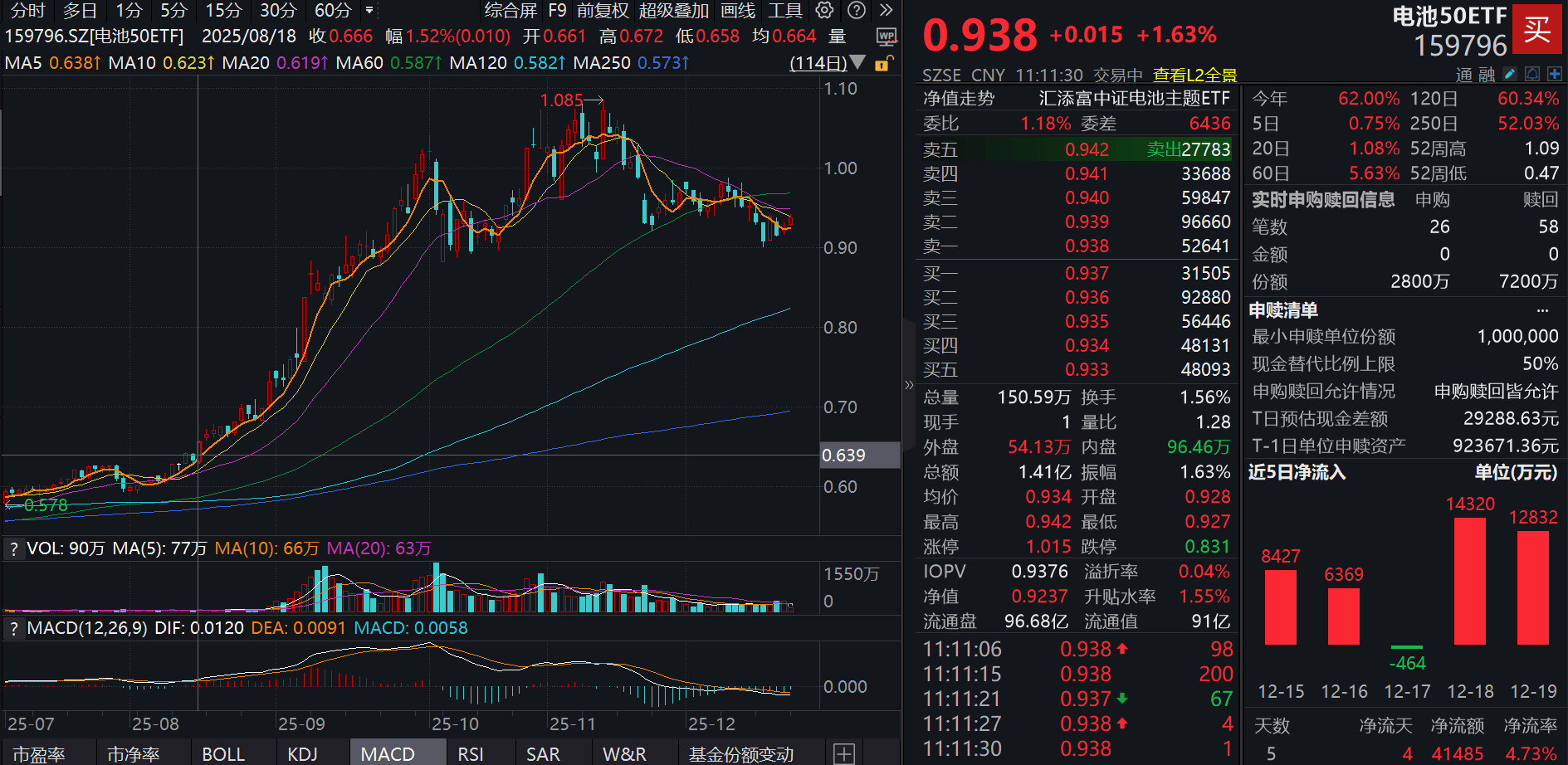
碳酸锂期货暴涨超4%,广期所调整交易限额!恩捷股份劲升超9%,并购重组进行中!电池50ETF(159796)一度涨近2%,储能出海大爆发!
Sou Hu Cai Jing· 2025-12-22 03:44
Core Viewpoint - The battery sector is experiencing significant growth driven by surging demand for energy storage solutions, with the Battery 50 ETF showing strong performance and capital inflow [1][3][21]. Group 1: Market Performance - As of December 22, the Battery 50 ETF (159796) rose by 1.63%, with a trading volume exceeding 1.4 billion yuan, indicating strong market interest [1]. - The ETF has seen a net inflow of 1.28 billion yuan on the latest trading day, with a total of 4.15 billion yuan in net inflows over the past five trading days [1]. Group 2: Stock Performance - Key stocks within the Battery 50 ETF saw significant gains, with Enjie Technology rising over 9% and multiple other stocks like Molybdenum and Xiwangda increasing by over 2% [3]. - The top ten constituent stocks of the ETF include major players like Ningde Times and Sunshine Power, with varying performance metrics [3]. Group 3: Lithium Price Trends - Lithium carbonate futures surged over 4%, with recent adjustments to trading limits on lithium contracts by the Guangxi Futures Exchange [3]. - Morgan Stanley has raised the target price for lithium carbonate to $18,000 per ton for Q4 2026, significantly above the current spot price of approximately $13,500 per ton [5]. Group 4: Demand Drivers - The growth in lithium demand is primarily driven by energy storage systems (ESS) and electric commercial vehicles (CV), with demand growth exceeding market expectations [5]. - The domestic energy storage market is experiencing a substantial increase in project bidding, with a year-on-year growth of 118% in capacity [10]. Group 5: Industry Outlook - The battery industry is expected to see a significant increase in demand, with projections indicating a global lithium battery demand of 2,721 GWh by 2026, reflecting a 30% year-on-year growth [15]. - The supply-demand balance is expected to improve, particularly in the electrolyte and separator segments, as industry capacity utilization rates exceed 75% [19][20]. Group 6: Investment Strategy - The Battery 50 ETF is highlighted as a strategic investment vehicle, with a high concentration in energy storage and solid-state battery technologies, making it well-positioned to benefit from market trends [21][23]. - The ETF's management fee is notably low at 0.15% per year, enhancing its attractiveness for investors [26].





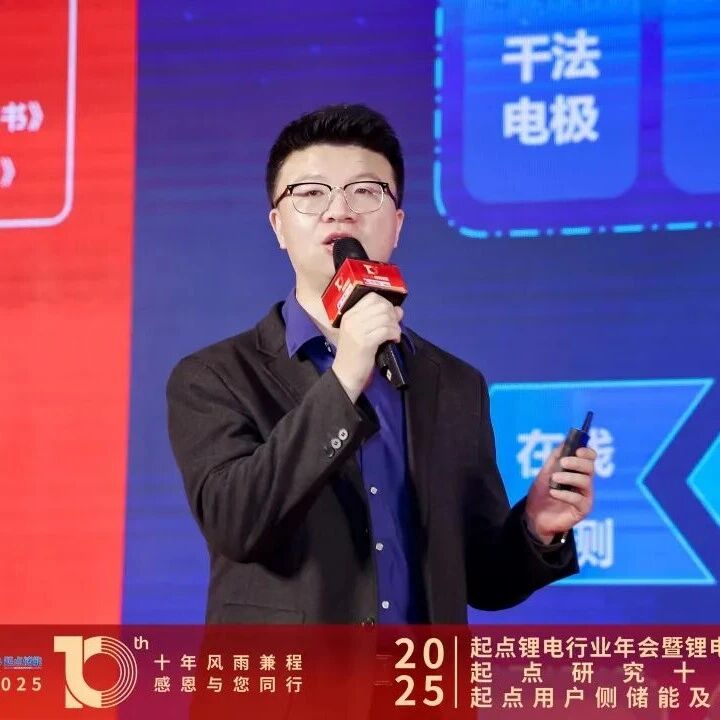
先导智能 营销总经理 叶正平:破界·精工 定义全固态电池量产新标准
起点锂电· 2025-12-20 07:04
Core Viewpoint - The article discusses the advancements in solid-state battery technology, emphasizing its importance in the energy storage sector and the need for efficient mass production standards [5][10]. Group 1: Event Overview - The 2025 User-Side Energy Storage and Battery Technology Forum was held on December 19, focusing on commercial, portable, and residential energy storage solutions, as well as AIDC storage batteries [2]. - The event featured over 800 attendees and aimed to analyze technological breakthroughs, safety challenges, and value chain restructuring in the energy storage industry [2]. Group 2: Solid-State Battery Insights - Solid-state batteries are highlighted as a crucial direction for future energy storage, offering significant improvements in safety and energy density compared to traditional batteries [5][6]. - The manufacturing process for solid-state batteries differs greatly from traditional liquid or semi-solid batteries, requiring an estimated 80% to 90% update in production lines [7]. Group 3: Production Challenges and Innovations - The presentation outlined the challenges in solid-state battery production, including issues with electrode alignment and material fragility, which can lead to low yield rates [8]. - A new stacking solution was introduced, achieving a production efficiency of 0.35 seconds per piece, which is an 85-fold improvement over competitors [9][10]. - The company aims to address the "impossible triangle" of precision, yield, and efficiency in solid-state battery production through innovative techniques [10]. Group 4: Company Profile - The company has been a leader in the new energy equipment sector for 26 years, holding the largest market share globally and serving over 25 countries [12].
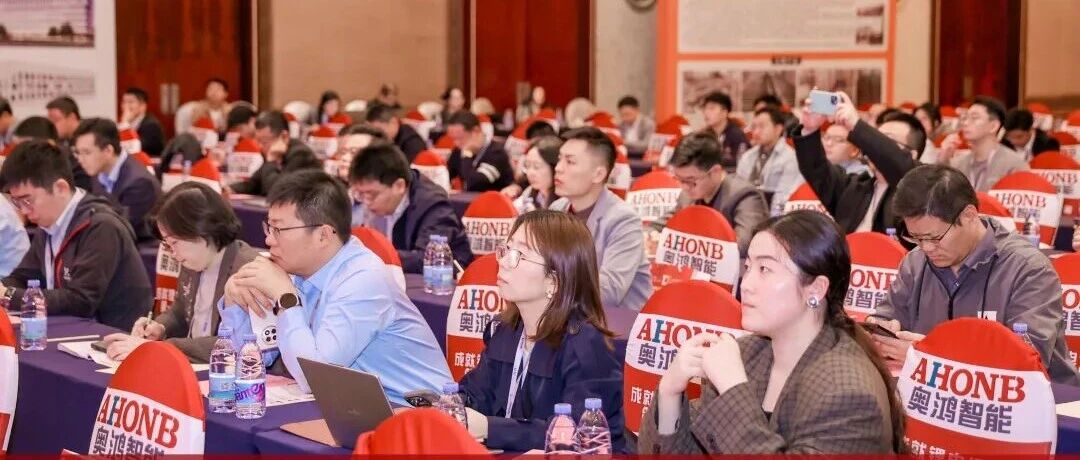
新周期 新技术 新生态——2025起点锂电年会暨用户侧储能论坛圆满举办!
起点锂电· 2025-12-19 12:17
Core Viewpoint - The lithium battery industry is entering a new cycle characterized by both opportunities and challenges, with significant growth potential in the energy storage market and increasing penetration of electric vehicles, while facing challenges such as rising raw material prices and supply chain management [3]. Group 1: Industry Overview - The scale of China's lithium battery industry has grown from less than 100 billion to over 1 trillion in value over the past decade, with the number of related listed companies increasing from dozens to hundreds [3]. - The domestic penetration rate of new energy passenger vehicles has exceeded 50%, with substantial growth potential in commercial vehicles and overseas markets [3]. - The energy storage market is expected to grow at a rate of 70%-80% this year, with continuous expansion across multiple scenarios [3]. Group 2: Technological Innovations - The cylindrical battery market is experiencing a shift towards small power and small storage applications, particularly in emerging markets such as low-altitude economies and intelligent robotics [7]. - The introduction of new standards is expected to create opportunities for responsible companies in the industry, particularly in the context of safety challenges [7]. - The development of all-tab cylindrical batteries is projected to see a shipment volume of 100 GWh globally by 2025, with a significant annual growth rate exceeding 400% for lithium iron phosphate cylindrical batteries [11]. Group 3: Market Trends - The market for small power batteries is vast, with the demand for electric two-wheelers in China reaching approximately 260 GWh annually [16]. - The industry is witnessing a trend towards larger capacity cells, with specifications evolving from early small capacities to larger ones like 314Ah and 587Ah [59][62]. - The introduction of mandatory national standards for energy storage lithium batteries is set to enhance safety regulations and market entry requirements [63][64]. Group 4: Company Strategies - Companies are focusing on technological innovation and differentiation to navigate the competitive landscape, with an emphasis on sustainable development and global expansion [28][29]. - The integration of AI in Battery Management Systems (BMS) is being prioritized to enhance safety and efficiency across the supply chain [39][40]. - Firms are exploring new materials and processes to improve battery safety and performance, with a focus on solid-state and high-voltage systems [48][50].
锂电池产业链双周报(2025、12、05-2025、12、18):11月电池销量同比高增-20251219
Dongguan Securities· 2025-12-19 09:09
Investment Rating - The report maintains an "Overweight" rating for the lithium battery industry, indicating an expectation that the industry index will outperform the market index by more than 10% over the next six months [47]. Core Insights - The lithium battery market is experiencing high demand due to the year-end surge in sales and favorable tax policies, with November sales reaching new highs. The overall demand for lithium batteries remains strong, supported by robust energy storage needs. The industry is expected to see a slight increase in production in December, maintaining a positive outlook for the sector [42][40]. - The report highlights the ongoing development of solid-state batteries, which is anticipated to drive demand for materials and equipment upgrades within the industry. Key areas of focus include advancements in solid-state electrolytes and new materials for anode and cathode components [43][42]. Summary by Sections Market Review - As of December 18, 2025, the lithium battery index has decreased by 2.86% over the past two weeks, underperforming the CSI 300 index by 3.00 percentage points. Year-to-date, the lithium battery index has increased by 46.16%, outperforming the CSI 300 index by 30.46 percentage points [12][4]. Price Changes in the Lithium Battery Supply Chain - As of December 18, 2025, the average price of battery-grade lithium carbonate is 98,800 CNY/ton, reflecting a 4.99% increase over the past two weeks. The price of lithium hydroxide remains stable at 72,200 CNY/ton. Other materials such as lithium iron phosphate and various NCM materials have also seen price increases ranging from 0.60% to 1.37% [25][28][23]. Industry News - The report notes that the domestic electric vehicle market is entering a phase of high sales but low growth, with expectations for 2026 to see a slight increase in new car sales. The demand for new energy vehicles is projected to continue growing rapidly, with sales potentially reaching 20 million units [40]. - In November, the domestic power battery installation volume reached 93.5 GWh, marking a 39.2% year-on-year increase. The report emphasizes the strong performance of lithium iron phosphate batteries, which accounted for 80.5% of total installations [40]. Company Announcements - The report includes several significant company announcements, such as the acquisition plans by Enjie Co. and Rongbai Technology, which aim to enhance their production capabilities in the lithium battery supply chain [41]. Recommendations - The report suggests focusing on companies that are likely to benefit from the ongoing improvements in the supply-demand dynamics of the lithium battery industry, particularly those involved in solid-state battery technology and innovative material development [44].