
S.C(300724)

Search documents
光伏设备板块1月30日跌2.59%,赛伍技术领跌,主力资金净流出39.46亿元
Zheng Xing Xing Ye Ri Bao· 2026-01-30 09:00
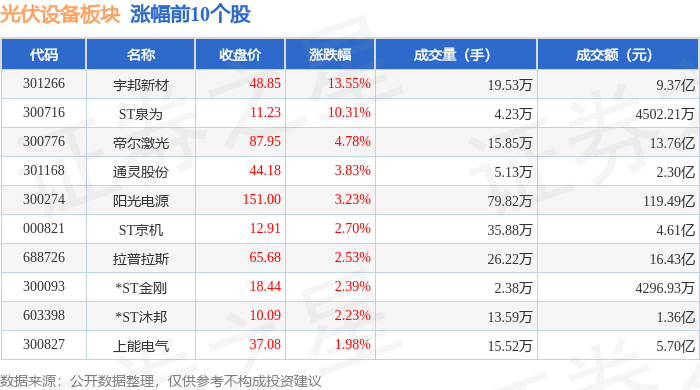
证券之星消息,1月30日光伏设备板块较上一交易日下跌2.59%,赛伍技术领跌。当日上证指数报收于 4117.95,下跌0.96%。深证成指报收于14205.89,下跌0.66%。光伏设备板块个股涨跌见下表: 从资金流向上来看,当日光伏设备板块主力资金净流出39.46亿元,游资资金净流出4.62亿元,散户资金 净流入44.08亿元。光伏设备板块个股资金流向见下表: | 代码 | 名称 | 主力净流入(元) | | 主力净占比 游资净流入 (元) | | 游资净占比 散户净流入(元) | | 散户净占比 | | --- | --- | --- | --- | --- | --- | --- | --- | --- | | 300274 阳光电源 | | | 8.14亿 | 6.81% | -5.98 Z | -5.00% | -2.16 Z | -1.80% | | 300724 捷佳伟创 | | | 3.18 Z | 6.17% | -7034.50万 | -1.37% | -2.47 Z | -4.81% | | 300776 帝尔激光 | | | 5644.10万 | 4.10% | -1229.08万 | ...




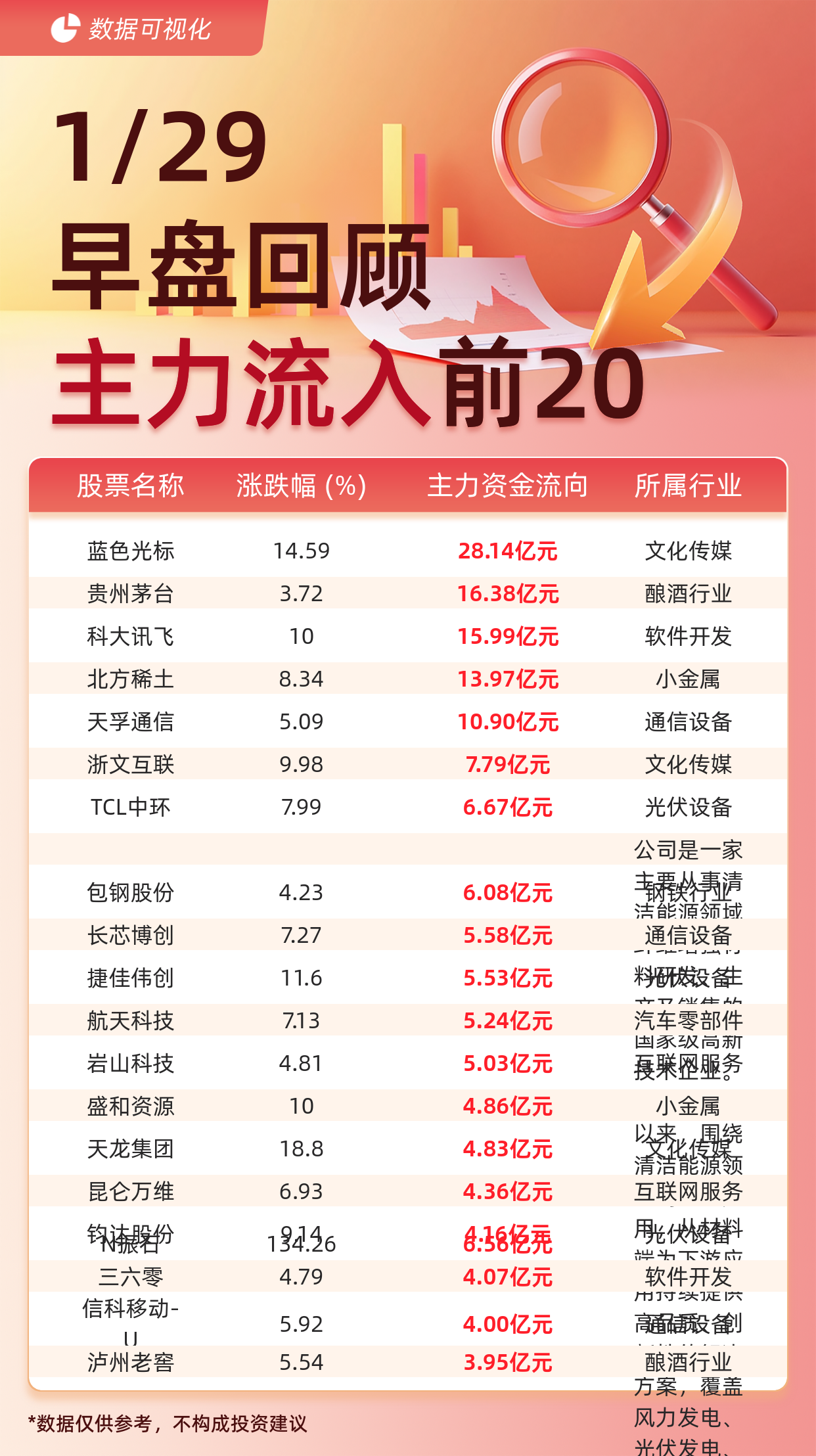
主力资金流入前20:蓝色光标流入28.14亿元、贵州茅台流入16.38亿元
Jin Rong Jie· 2026-01-29 04:10
Core Viewpoint - The data indicates significant capital inflows into various stocks, highlighting investor interest in specific sectors and companies, with notable amounts flowing into BlueFocus and Kweichow Moutai among others [1][2][3] Group 1: Stock Performance and Capital Inflows - BlueFocus saw a capital inflow of 2.814 billion, with a price increase of 14.59% [2] - Kweichow Moutai experienced a capital inflow of 1.638 billion, with a price increase of 3.72% [2] - iFlytek had a capital inflow of 1.599 billion, with a price increase of 10% [2] - Northern Rare Earth attracted 1.397 billion in capital inflow, with a price increase of 8.34% [2] - Tianfu Communication received 1.090 billion, with a price increase of 5.09% [2] - Zhejiang Wenhu Interconnect had a capital inflow of 0.779 billion, with a price increase of 9.98% [2] - TCL Zhonghuan saw a capital inflow of 0.667 billion, with a price increase of 7.99% [2] - Baosteel received 0.608 billion, with a price increase of 4.23% [3] - Changxin Bochuang attracted 0.558 billion, with a price increase of 7.27% [3] - Jiejia Weichuang had a capital inflow of 0.553 billion, with a price increase of 11.6% [3] - Aerospace Science and Technology received 0.524 billion, with a price increase of 7.13% [3] - Yanshan Technology attracted 0.503 billion, with a price increase of 4.81% [3] - Shenghe Resources had a capital inflow of 0.486 billion, with a price increase of 10% [3] - Tianlong Group saw a capital inflow of 0.483 billion, with a price increase of 18.8% [3] - Kunlun Wanwei received 0.436 billion, with a price increase of 6.93% [3] - Junhai received 0.416 billion, with a price increase of 34.46% [3] - 360 had a capital inflow of 0.407 billion, with a price increase of 4.79% [3] - Xinke Mobile U attracted 0.400 billion, with a price increase of 5.92% [3] - Luzhou Laojiao received 0.395 billion, with a price increase of 5.54% [3]





商业航天为何会成为2026年的主线?
Soochow Securities· 2026-01-29 00:20
Investment Rating - The report maintains an "Overweight" rating for the commercial aerospace industry, indicating a positive outlook for the sector in the coming months [1]. Core Insights - The commercial aerospace industry is expected to undergo a significant transformation by 2026, driven by advancements in launch capabilities and the successful deployment of domestic rockets, which will remove previous constraints on industry growth [8][9]. - The competition in commercial aerospace is fundamentally a "land grab" for space sovereignty and resource allocation, emphasizing the need for increased launch frequency to secure China's position in low Earth orbit [10]. - The report highlights the strategic importance of commercial aerospace in national defense and resource acquisition, particularly in the context of lunar resources like Helium-3, which could reshape global energy dynamics [12]. - Key catalysts for the industry include domestic policy support and capital market developments, with significant IPOs expected from leading aerospace companies in 2026 [13][15]. Summary by Sections 1. Why has the domestic commercial aerospace industry reached a qualitative change? - The industry has transitioned from a limited payload capacity to a robust launch capability, marked by the successful launch of the Zhuque-3 rocket, which signifies a shift from speculative themes to a narrative driven by operational capacity [8]. 2. How to understand the importance of commercial aerospace? - The scarcity of low Earth orbit resources has made the commercial aerospace race a critical national strategy, with the need to enhance launch frequency to secure space assets and maintain competitive advantages [10][11]. 3. What subsequent catalysts are worth paying attention to in commercial aerospace? 3.1. Domestic: Accelerated release of policy and capital dividends - The report anticipates significant policy support and capital market activity, with major aerospace companies expected to enter the IPO market in 2026, reflecting the strategic importance of the sector [13]. 3.2. International: Clear policy framework and tight planning timeline - The U.S. has shifted from a public to a private ownership model for space resources, establishing a legal framework that encourages commercial investment in space resource development [15][16]. 4. Investment Recommendations 4.1. SpaceX Concept - Companies that could potentially enter the SpaceX supply chain are highlighted, indicating a strong future in commercial aerospace [17]. 4.2. Rocket Sector: "Many Stars, Few Rockets" Expected to Breakthrough - The report suggests that advancements in large-capacity reusable rocket technology will lead to significant changes and valuation adjustments in the sector [19]. 4.3. Satellite Sector: Certainty in Implementation - The urgency to secure low Earth orbit resources is driving domestic satellite constellations from planning to large-scale deployment [20]. 4.4. Space Computing and Space Photovoltaics: Next-Generation Core Tracks - The report identifies space computing and space photovoltaics as critical future sectors, emphasizing their role in supporting lunar economies and global intelligence ecosystems [22].



新能源概念股走低,创业板新能源相关ETF跌超2%
Sou Hu Cai Jing· 2026-01-28 02:41
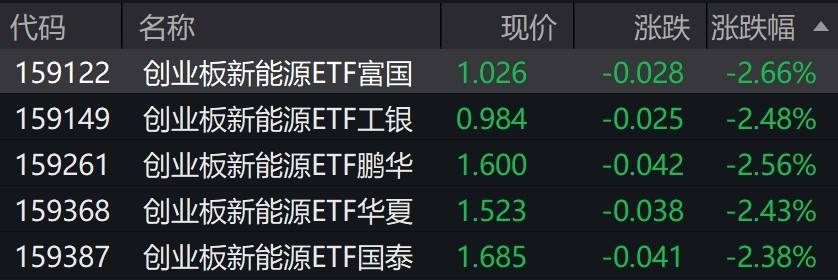
Core Viewpoint - The new energy concept stocks have declined, with significant drops in companies such as Sungrow Power Supply, Maiwei Co., Tianhua New Energy, and Jiejia Weichuang, all falling over 4% [1]. Group 1: Market Performance - The ChiNext new energy-related ETFs have also seen a decline, with an average drop exceeding 2% [1]. - Specific ETF performance includes: - ETF 富国: Current price 1.026, down 0.028 (-2.66%) [2] - ETF 工银: Current price 0.984, down 0.025 (-2.48%) [2] - ETF 鹏华: Current price 1.600, down 0.042 (-2.56%) [2] - ETF 华夏: Current price 1.523, down 0.038 (-2.43%) [2] - ETF 国泰: Current price 1.685, down 0.041 (-2.38%) [2] Group 2: Market Outlook - Analysts indicate that the market is currently in a critical phase of policy transition. The new energy vehicle market is gradually shifting towards a new stage that relies on product strength and normalized consumption patterns [1]. - Two key areas are highlighted for potential growth: 1. High-end manufacturers with differentiated products are expected to be less affected by changes in subsidy rules and reduced vehicle purchase taxes, benefiting from the high-end market trend and upward price movement of domestic brands [1]. 2. Domestic car companies expanding into overseas markets may achieve performance recovery through high growth and high margins in international sales [1].


光伏概念股走弱,相关ETF跌超2%
Sou Hu Cai Jing· 2026-01-28 02:41
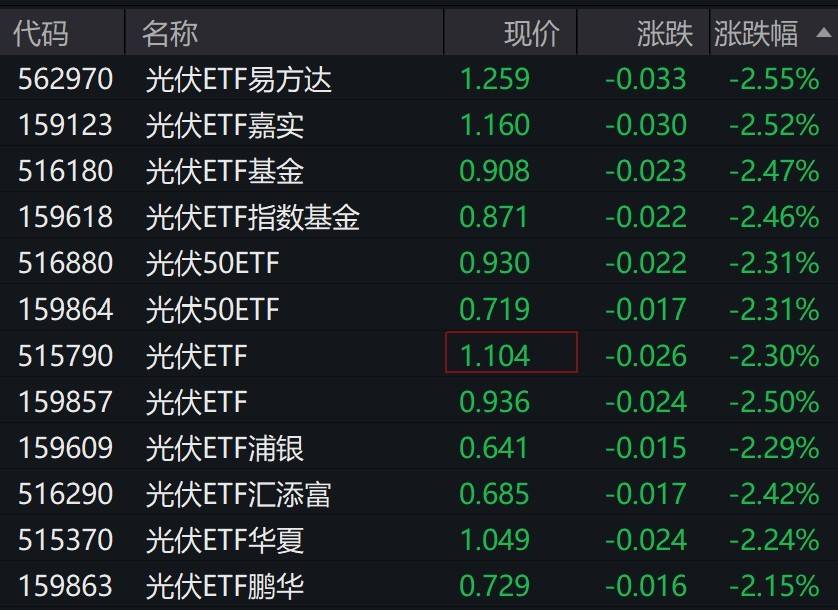
Group 1 - The photovoltaic concept stocks have weakened, with Maiwei Co., Ltd. dropping over 6%, Jiejia Weichuang falling over 5%, and both Sunshine Power and Deye Co., Ltd. declining over 4% [1] - Affected by the market, photovoltaic-related ETFs have decreased by over 2% [1] Group 2 - Various photovoltaic ETFs are showing declines, with the E Fund Photovoltaic ETF at 1.259, down 2.55%, and the Jiashi Photovoltaic ETF at 1.160, down 2.52% [2] - A brokerage firm indicates that China has submitted applications for over 200,000 satellite constellations, marking a new phase of large-scale deployment in commercial space, which will directly drive long-term demand for space photovoltaics [2] Group 3 - The current valuation of the photovoltaic industry remains at a historically low level [3] - Future policies regarding product sales price measures to combat internal competition, mergers and acquisitions among companies, increased industry entry barriers, and improved product quality standards are expected to be implemented [3] - The competitive landscape and industrial chain ecology of the photovoltaic industry are likely to optimize, presenting opportunities for valuation recovery [3]

太空光伏火了!马斯克联手贝莱德冲刺100GW,低轨卫星+AI算力刚需爆发!
Xin Lang Cai Jing· 2026-01-26 11:09
Group 1: Industry Overview - The space photovoltaic industry is experiencing significant growth driven by the demand for gallium arsenide batteries and other advanced solar technologies, particularly in high-altitude satellites and deep space exploration [1][2][3] - Musk's 100GW solar power capacity plan is expected to boost the demand for space photovoltaic products, benefiting various companies in the supply chain [1][2][3] Group 2: Key Companies and Their Developments - Qianzhao Optoelectronics (300102) is a leading player in gallium arsenide space batteries with over 60% market share in China, achieving a production efficiency of 35% and an experimental efficiency exceeding 42% [1][12] - Dongfang Risen (300118) has successfully delivered small batches of HJT batteries to SpaceX, with its ultra-thin P-type HJT battery meeting the lightweight requirements for satellites [1][13] - Junda Co., Ltd. (002865) is a global leader in TOPCon batteries, with laboratory conversion efficiency surpassing 33.53%, and is rumored to be a potential supplier for SpaceX's perovskite batteries [1][14] - Yunnan Zhiyuan (002428) is a core supplier of germanium wafers for gallium arsenide space batteries, benefiting from the increasing demand for germanium substrates [1][15] - Sanan Optoelectronics (600703) holds the largest gallium arsenide production capacity globally and is expected to see significant revenue growth from its space photovoltaic applications [1][16] - Maiwei Co., Ltd. (300751) is a leading supplier of HJT production equipment and is well-positioned to benefit from the surge in demand for space photovoltaic manufacturing equipment [1][17] - Saiwu Technology (603212) specializes in photovoltaic packaging materials and is developing radiation-resistant encapsulation films for space applications [1][18][19] - China Satellite (600118) is a key player in satellite platform manufacturing and is expected to benefit from the growth in space photovoltaic systems [1][20] - Aerospace Electronics (600879) provides power systems and communication equipment for satellites, with increasing demand expected due to the growth in space photovoltaic applications [1][21] - Tuojin New Energy (002218) focuses on flexible photovoltaic components suitable for space applications, with expected growth in orders as the market expands [1][22] - Trina Solar (688599) covers multiple technology routes and is positioned to benefit from the expansion of space photovoltaic systems [1][23] - Shanghai Portwan (605598) supplies flexible solar wings and is accelerating the commercialization of perovskite batteries through in-orbit testing services [1][24] - Ruihua Tai (688323) is a leader in CPI film materials, essential for flexible space photovoltaic components, and is expected to see increased demand [1][25] - Jiejia Weichuang (300724) is a leading manufacturer of photovoltaic battery production equipment, poised to benefit from the demand surge in space photovoltaic manufacturing [1][26] - Lens Technology (300433) supplies protective covers for satellite batteries, with expected growth in orders due to the increasing demand for space photovoltaic applications [1][27]





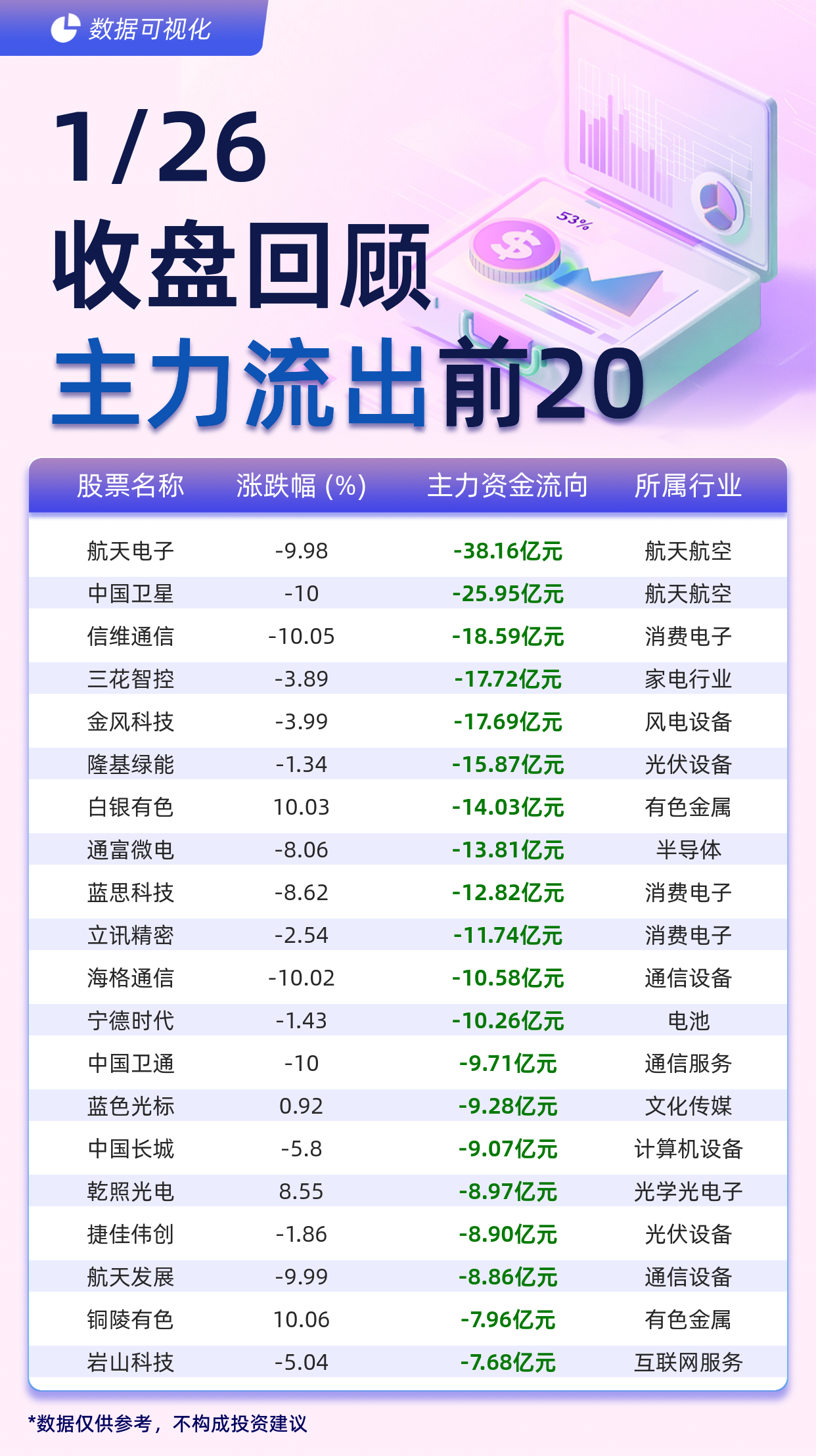
主力个股资金流出前20:航天电子流出38.16亿元、中国卫星流出25.95亿元
Jin Rong Jie· 2026-01-26 07:37
Core Viewpoint - The data indicates significant outflows of main funds from various stocks, particularly in the aerospace and consumer electronics sectors, reflecting a bearish sentiment among investors. Group 1: Stock Performance and Fund Flow - Aerospace stocks, such as Aerospace Electronics and China Satellite, experienced the largest fund outflows, with -38.16 billion and -25.95 billion respectively, and declines of -9.98% and -10% in their stock prices [1][2] - Other notable stocks with significant outflows include Xinwei Communication (-18.59 billion, -10.05%), Sanhua Intelligent Control (-17.72 billion, -3.89%), and Goldwind Technology (-17.69 billion, -3.99%) [1][2] - The outflow from Longi Green Energy was -15.87 billion with a stock price decrease of -1.34%, indicating a relatively smaller decline compared to others in the same sector [1][2] Group 2: Sector Analysis - The consumer electronics sector saw major outflows, particularly from companies like Xinwei Communication and Lens Technology, with outflows of -18.59 billion and -12.82 billion respectively [1][2] - The wind power equipment sector, represented by Goldwind Technology, also faced significant outflows, reflecting potential challenges in the renewable energy market [1][2] - The communication equipment sector, including companies like Haige Communication and China Satellite, showed substantial fund outflows, indicating investor caution in this area [1][3]






光伏设备行业深度报告:太空光伏深度报告:光伏向空,志在星海
KAIYUAN SECURITIES· 2026-01-26 05:43
Investment Rating - The investment rating for the photovoltaic equipment industry is optimistic (maintained) [1] Core Insights - The photovoltaic sector is entering a silicon era in space applications, driven by the need for cost reduction and efficiency improvement in photovoltaic technology [5][18] - Photovoltaic systems are the most reliable and sustainable power source for spacecraft, providing stable energy supply without the need for fuel resupply [18] - The transition to silicon-based photovoltaic technology in space is being accelerated by the high costs and limitations of III-V multi-junction solar cells, which are currently the most efficient but expensive [64][67] Summary by Sections 1. From Parallel to Convergence: Space Enters the Silicon Era - Photovoltaics are the most important energy supply for spacecraft, providing stable energy without atmospheric interference [18] - Cost reduction and efficiency improvement are the main drivers for the evolution of photovoltaic technology [19] - P-type HJT (Heterojunction Technology) cells show significant advantages in space applications due to their superior radiation resistance [6][69] - Silicon-perovskite tandem cells are expected to become the ultimate solution, breaking the efficiency-cost-radiation resistance triangle [6][68] 2. The Space Race Begins: Photovoltaics Open New Blue Oceans - Low Earth orbit communication satellites are driving the demand for large-scale satellite deployment [7] - The space computing market is expected to release significant potential, with a focus on reliable power supply rather than cost competition [7] 3. Pre-Volume Layout: Equipment Manufacturers Seize Opportunities - Key equipment manufacturers benefiting from the space photovoltaic technology include Maiwei, Jiejia Weichuang, Laplace, and others [8] 4. Competition Among Giants: Leading Manufacturers Tap into Blue Oceans - Major battery manufacturers deeply involved in space photovoltaic technology include Dongfang Risheng, Junda, Trina Solar, and JinkoSolar [8]


商业航天行业:太空光伏,逐日天穹,叩问千亿星辰市场
2026-01-26 02:49
Summary of the Conference Call on the Space Photovoltaics Industry Industry Overview - **Industry Focus**: Space Photovoltaics - **Key Players**: SpaceX, Amazon, Chinese satellite companies - **Market Potential**: Estimated to reach a trillion-dollar market Core Insights and Arguments 1. **Cost Reduction through Reusable Technology**: The advent of reusable rocket technology has significantly lowered launch costs, creating a golden opportunity for space photovoltaics. The successful exploration of reusable rockets by companies like SpaceX has led to a rapid decrease in launch costs, making commercial space activities more frequent [5][23][24] 2. **US-China Competition in Commercial Space**: The competition between the US and China in commercial space is accelerating, particularly in low Earth orbit (LEO) communications satellites, which is expected to drive demand for solar wings. The US currently leads in LEO satellite deployment, with China planning to submit applications for 203,000 satellites to the International Telecommunication Union (ITU) by December 2025, aiming to secure valuable orbital resources [5][44][46] 3. **AI and Space Computing**: The concept of deploying AI data centers in space is gaining traction among tech giants. Space-based computing, or "computing in space," is seen as a solution to energy and space limitations. The cost of deploying a 40MW AI data center in space is estimated at $8.2 million, significantly lower than ground deployment costs [5][52][53] 4. **Technological Developments in Photovoltaics**: - **Gallium Arsenide (GaAs)** is currently the mainstream choice for space photovoltaics due to its excellent performance, though it is costly and has material sourcing limitations. - **Heterojunction (HJT)** technology is expected to be a significant choice for large-scale industrialization due to its efficiency and simpler manufacturing process. - **Perovskite technology** shows promise but lacks sufficient empirical data for large-scale application in the short term [5][64] 5. **Investment Recommendations**: The space photovoltaics sector is entering an active exploration phase, with equipment manufacturers poised to benefit. Key companies to watch include: - **HJT/Perovskite Equipment Suppliers**: Maiwei Co., Aotwei, and Jiejia Weichuang - **Comprehensive Photovoltaic Companies**: Jing Sheng Mechanical and Gao Ce Co. [5][5] Additional Important Content 1. **Risks**: Potential risks include slower-than-expected development of the commercial space industry, uncertainties in the technological pathways for space photovoltaics, and lower-than-expected investment and application demand for space computing [5][5] 2. **Market Dynamics**: The global satellite launch frequency has increased significantly since 2020, with projections indicating around 4,000 launches annually by 2025, marking a growth rate exceeding 50% [5][38] 3. **Future Projections**: The estimated demand for space photovoltaics from existing satellite plans could reach nearly 10GW in the near term, with significant growth expected as more satellites are deployed [5][46][62] 4. **Cost Comparisons**: The Levelized Cost of Energy (LCOE) for space photovoltaics is projected to decrease significantly due to reduced launch costs and advancements in technology, potentially reaching $0.04/kWh by 2050 [5][33][34] 5. **Global Competition**: The competition for orbital resources is intensifying, with the US and China leading the charge in satellite deployments, highlighting the strategic importance of space resources [5][42][43] This summary encapsulates the key points discussed in the conference call regarding the space photovoltaics industry, emphasizing the technological advancements, market dynamics, and investment opportunities within this rapidly evolving sector.


碳中和领域动态追踪(一百六十九):商业航天赋能,太空光伏开启成长新篇
EBSCN· 2026-01-25 14:08
Investment Rating - The industry is rated as "Buy" with an expectation of leading market benchmark returns by over 15% in the next 6-12 months [6]. Core Insights - The commercial aerospace sector has emerged as one of the strongest market themes recently, with space photovoltaics being a core beneficiary [2]. - Recent catalysts in the commercial aerospace sector include the establishment of the Commercial Space Administration and the issuance of the "Action Plan for Promoting High-Quality and Safe Development of Commercial Aerospace (2025-2027)" [2]. - Elon Musk's announcement at the 2026 Davos World Economic Forum regarding Tesla and SpaceX's plan to build a total of 200GW photovoltaic capacity in the U.S. over the next three years is a key driver for stock price increases in the sector [3]. - The transition from ground-based photovoltaic applications to space photovoltaics represents a significant shift in usage scenarios, driving technological evolution and capacity expansion [4]. Summary by Sections Industry Overview - The commercial aerospace sector is experiencing rapid development due to policy support, increasing demand for low-orbit satellite constellations, and capital market activity [2]. - The demand for space photovoltaics is expected to grow significantly as commercial aerospace scales up [2]. Technological Development - The technology path for space photovoltaics has evolved through several iterations, leading to advancements in gallium arsenide technology and the development of ultra-thin P-type HJT and perovskite tandem technologies [4]. Investment Recommendations - Companies that have strategically positioned themselves in the space photovoltaics sector, such as Junda Co., Dongfang Risheng, JinkoSolar, and Trina Solar, are expected to gain first-mover advantages and valuation premiums [5]. - Continuous growth in demand for new technology production equipment related to space photovoltaics suggests investment opportunities in companies like Maiwei Co., Jiejia Weichuang, Aotwei, and Shuangliang Energy [5].
