
S.C(300724)

Search documents
AH股震荡走高,光伏爆发掀起涨停潮,贵金属再度大涨,阿里巴巴涨超3%,金属期货全线拉升
Hua Er Jie Jian Wen· 2026-01-23 02:37
Group 1: Market Overview - International gold and silver prices reached new highs, with gold approaching $5000 and silver surpassing $99, leading to significant gains in precious metal stocks in A-shares and Hong Kong stocks [1][10] - A-shares experienced a collective rise on January 23, with major indices showing positive movements, particularly in the photovoltaic and precious metals sectors [1] - The Hang Seng Index rose by 0.66%, while the Hang Seng Technology Index increased by 0.46% [2][3] Group 2: Precious Metals Sector - The precious metals sector saw substantial gains, with platinum rising over 9% and silver increasing by 8% in domestic commodity futures [4][19] - Specific stocks such as Hunan Silver and Sichuan Gold experienced significant price increases, contributing to the overall strength of the precious metals sector [1][10] - Silver-related stocks, including Baiyin Youse and Zhongjin Gold, achieved multiple consecutive trading limits, indicating strong market interest [10][16] Group 3: Photovoltaic Sector - The photovoltaic sector surged, driven by news of SpaceX's plans for solar energy initiatives and China's submission of a large satellite constellation application [6][13] - Stocks in the photovoltaic industry, such as Maiwei and Jiejia Weichuang, saw substantial price increases, with some reaching their daily limit [11][12] - The market is optimistic about the future of space-based solar energy, with expectations of technological advancements in photovoltaic materials [13]





耀看光伏第13期:太空光伏:万亿蓝海市场,产业趋势明确
Changjiang Securities· 2026-01-23 02:33
Investment Rating - The report maintains a "Positive" investment rating for the space photovoltaic industry [3]. Core Insights - The space photovoltaic market is projected to reach a trillion-dollar scale, driven by the increasing demand from low Earth orbit (LEO) satellites and advancements in photovoltaic technology [8][41]. - The report highlights the transition from traditional gallium arsenide (GaAs) solar cells to silicon and perovskite technologies, indicating a shift towards cost-effective solutions in space applications [55][64]. Summary by Sections 1. Growth Drivers - The demand for space photovoltaics is significantly driven by communication and computing satellites, with LEO satellites becoming the mainstream development direction due to their lower costs and shorter development cycles [12]. - The Starlink project is expected to generate substantial revenue, with predictions of over 9 million customers by 2025, covering more than 155 countries [17]. 2. Technology Trends - GaAs multi-junction solar cells are currently the mainstream technology for space applications, achieving efficiencies over 30% [45]. - The report anticipates that silicon will become the next-generation technology, while perovskite is expected to emerge as the ultimate solution due to its high power-to-weight ratio and lower production costs [64]. 3. Material Innovations - The satellite power system consists of three main components: power generation units (solar wings), energy storage units (lithium-ion batteries), and control units [71]. - Flexible solar wings are gaining traction, with advancements in materials leading to the development of ultra-thin glass (UTG) and polyimide (PI) films for better performance in harsh space environments [81][84]. 4. Market Potential - The report estimates that the market space for low Earth orbit satellite photovoltaic systems could reach 275 billion yuan, while the market for space computing could exceed 1 trillion yuan by 2030 [41]. - The anticipated peak in satellite launches from 2030 to 2035 is expected to further drive the demand for space photovoltaics, with projections indicating over 18,000 satellites launched annually [23]. 5. Competitive Landscape - The report outlines the competitive landscape, highlighting key players in the space photovoltaic sector and their respective advancements in technology and materials [88].



光伏产业链延续强势,迈为股份等多只个股涨停
Mei Ri Jing Ji Xin Wen· 2026-01-23 02:25
Group 1 - The photovoltaic industry chain continues to show strong performance, with Maiwei Co., Ltd. (300751) hitting a 20% limit up [1] - JunDa Co., Ltd. (002865), Aisxu Co., Ltd. (600732), and Foster (603806) also reached a 10% limit up [1] - Jiejia Weichuang (300724) increased by over 17%, while Jingsheng Mechanical and Electrical (300316) rose by over 13% [1]


光伏ETF基金(516180)涨超5.1%,太空光伏全线爆发
Xin Lang Cai Jing· 2026-01-23 02:22
Core Viewpoint - The photovoltaic industry is experiencing significant growth, driven by innovations and a shift from price competition to innovation-driven competition, alongside emerging opportunities in space photovoltaic technology [1] Group 1: Market Performance - As of January 23, 2026, the China Securities Photovoltaic Industry Index (931151) surged by 5.09%, with key stocks such as Laplace rising by 20.01%, Maiwei Co. by 20.00%, and Dongfang Risen by 20.00 [1] - The Photovoltaic ETF Fund (516180) increased by 5.16%, with the latest price reported at 0.92 yuan [1] Group 2: Industry Developments - The State Administration for Market Regulation held a press conference on January 21, 2025, addressing the need to transition the photovoltaic industry from "price competition" to "innovation-driven" competition [1] - The low Earth orbit satellite market is expected to create nearly 10GW of demand for space photovoltaics, as indicated by Guangfa Securities [1] - Elon Musk's Twitter mentioned plans to deploy 100GW of AI computing satellites annually, with a white paper suggesting that space-based AI data centers could reduce total costs by 95% compared to ground-based solutions [1] Group 3: Index Composition - The China Securities Photovoltaic Industry Index comprises up to 50 representative listed companies involved in the photovoltaic industry chain, with the top ten weighted stocks accounting for 55.11% of the index [2]

HIT电池板块领涨,上涨2.92%
Mei Ri Jing Ji Xin Wen· 2026-01-23 01:57
(文章来源:每日经济新闻) 每经AI快讯,HIT电池板块领涨,上涨2.92%。其中,迈为股份上涨12.1%,明阳智能上涨10.01%,双良 节能上涨9.94%,东方日升、捷佳伟创、琏升科技涨超4%。 ...


中国工业 - 2026 年展望:复苏持续-China Industrials-2026 Outlook – Recovery Continues
2026-01-22 02:44
Summary of China Industrials 2026 Outlook Industry Overview - **Industry**: China Industrials - **Core Themes**: AI technology diffusion, industrial upgrades, and globalization are central to the industrial sector's recovery in 2026. The government is focused on enhancing productivity through equipment upgrades, particularly in high-end equipment [1][4]. Key Insights - **Industrial Cycle**: The industrial cycle is characterized by strong global demand for capital goods, driven by AI technology applications and supply chain security concerns. China's trend of localizing high-end equipment remains strong, with specific sectors like data centers, electronics, and robotics expected to show growth, while processing markets may experience muted demand [3][10]. - **AI Applications**: 2026 is anticipated to mark the beginning of significant capital expenditure on physical AI, which will benefit automation and robotics companies. The government is supporting this through initiatives aimed at increasing the deployment of AI-powered robotics [4][11][12]. - **Localization and Supply Chain**: The localization rates for automation and industrial robots are projected to rise, with expectations of reaching 60-70% by 2030. This trend is expected to benefit companies involved in automation and precision components [21][22][23]. Market Dynamics - **Overseas Expansion**: Equipment exports from China have grown significantly, outpacing overall export growth. Companies are motivated to expand into international markets to capture larger total addressable markets (TAM) and improve margins [24][25]. - **Margin Expansion**: The overall net margin for China's industrials is expected to increase from approximately 13.0% in 2025 to around 14.6% in 2027, driven by overseas growth and advancements in AI technology [26][27]. Stock Recommendations - **Preferred Stocks**: The report highlights several stocks that are expected to benefit from cyclical strength and structural tailwinds, including: - **Geekplus (2590.HK)**: OW - **Sany Heavy (600031.SS)**: OW - **Leaderdrive (688017.SS)**: OW - **Han's Laser (002008.SZ)**: OW - **Inovance (300124.SZ)**: OW - **Hengli (601100.SS)**: OW - **Wuxi Lead (300450.SZ)**: OW - **Envicool (002837.SZ)**: OW - **Underweight Stocks**: Stocks such as **CSCEC (601668.SS)**, **CRRC-H (1766.HK)**, and **Maxwell (300751.SZ)** are rated as underweight due to various market challenges [5][8][46]. Additional Considerations - **Geopolitical Factors**: The geopolitical landscape is influencing supply chain security, which is a critical factor for capital goods demand globally [3]. - **Investment in AI**: The anticipated investment in AI infrastructure is expected to redefine smart manufacturing and create new opportunities within the industrial sector [10][11]. - **Sector Performance**: The report indicates that most industrial stocks are trading at or above their historical five-year average P/E ratios, reflecting a positive outlook for continuous upgrades and AI-related demand [26][38]. This comprehensive analysis provides insights into the expected recovery and growth opportunities within the China Industrials sector for 2026, highlighting key themes, market dynamics, and stock recommendations.



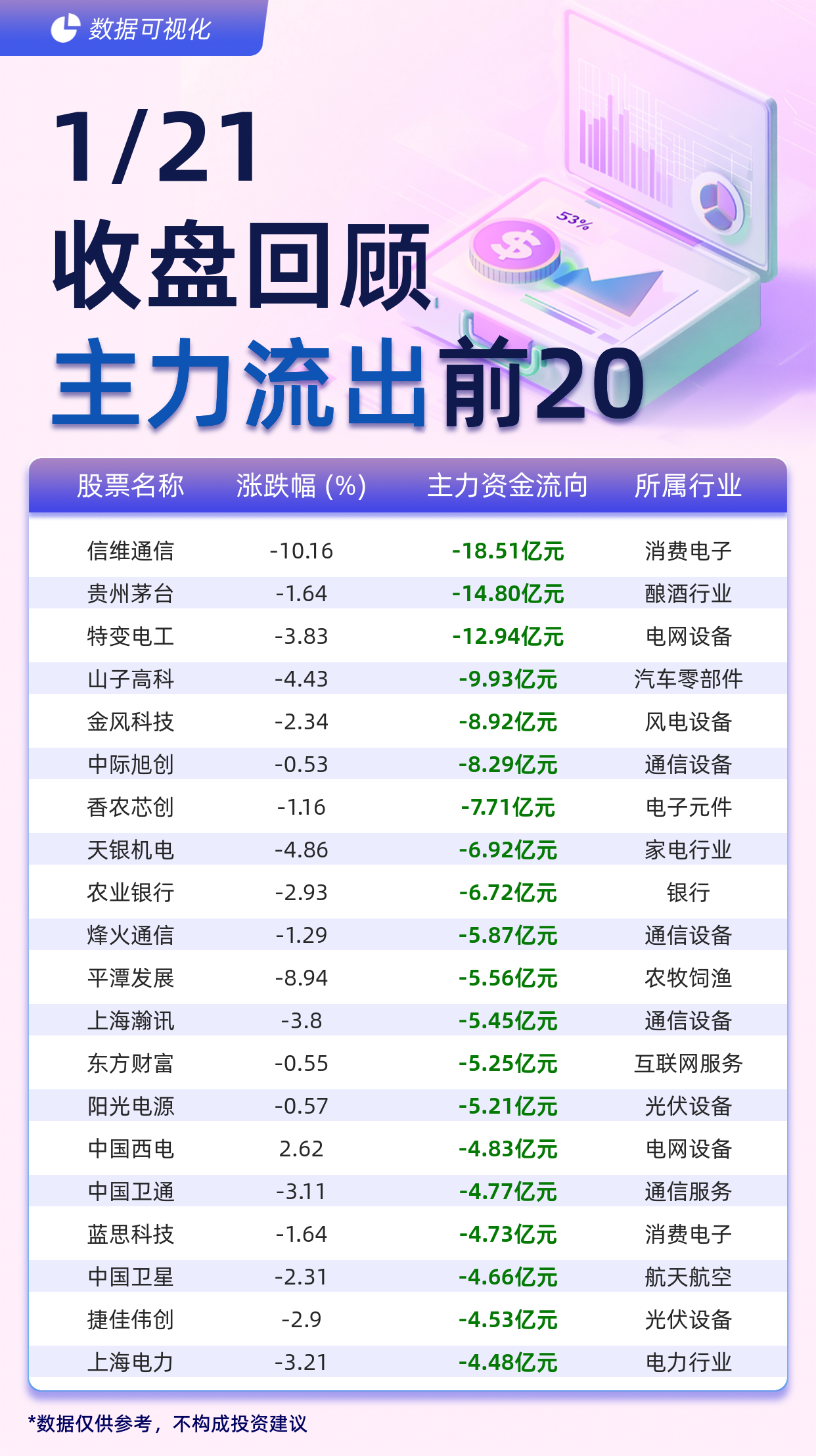
主力个股资金流出前20:信维通信流出18.51亿元、贵州茅台流出14.80亿元
Jin Rong Jie· 2026-01-21 07:11
Core Viewpoint - The data indicates significant outflows of main funds from various stocks, with notable amounts withdrawn from companies across different sectors, suggesting a potential shift in investor sentiment and market dynamics [1][2][3] Group 1: Stock Performance and Fund Outflows - The top stock with the largest fund outflow is XW Communication, with a withdrawal of 1.851 billion yuan and a decline of 10.16% in its stock price [2] - Guizhou Moutai follows with a fund outflow of 1.480 billion yuan and a decrease of 1.64% [2] - TBEA Co., Ltd. experienced a fund outflow of 1.294 billion yuan and a drop of 3.83% [2] - Other notable companies with significant outflows include: - Sanzi Gaoke: -0.993 billion yuan, -4.43% [2] - Goldwind Technology: -0.892 billion yuan, -2.34% [2] - Zhongji Xuchuang: -0.829 billion yuan, -0.53% [2] Group 2: Sector Analysis - The consumer electronics sector is represented by XW Communication and Lens Technology, both experiencing substantial fund outflows [2][3] - The beverage industry, highlighted by Guizhou Moutai, shows a minor decline in stock price despite significant fund outflow [2] - The power equipment sector, including TBEA Co., Ltd. and China Western Power, reflects mixed performance with varying fund outflows [2][3] - The telecommunications sector, represented by companies like Zhongji Xuchuang and Fenghuo Communication, also shows notable fund withdrawals [2][3]






商业航天行业系列五:太空光伏:逐日天穹,叩问千亿星辰市场
GF SECURITIES· 2026-01-21 06:27
Investment Rating - The industry investment rating is "Buy" [2] Core Insights - The report highlights that the development of reusable rocket technology has significantly reduced launch costs, creating a golden opportunity for space photovoltaics [5] - The competition in commercial space between China and the US is accelerating, with low Earth orbit (LEO) communication satellites driving short-term demand for solar wings [5] - AI giants are increasingly recognizing the potential of deploying computing power in space, which is expected to benefit space photovoltaics [5] - The report emphasizes the importance of gallium arsenide as the current mainstream technology for space photovoltaics, while also highlighting the potential of silicon-based batteries and perovskite technology in the long term [5] - Investment recommendations include focusing on HJT/perovskite equipment suppliers and companies covering various segments of the photovoltaic supply chain [5] Summary by Sections 1. Space Photovoltaics: The Main Energy Source in Space - Space photovoltaics convert solar energy into electrical energy in space environments, which are harsher than ground conditions [12][13] - Solar panels are the core component of spacecraft power systems, essential for converting solar energy into the electricity needed for satellite operations [12][13] 2. Downstream Scenarios: Commercial Space Boom Leading to a Trillion-Dollar Market - The report notes a significant increase in global satellite launches since 2020, with a projected 4000 launches by 2025, driven by reduced costs from reusable rockets [38] - The US currently dominates the satellite market, with 11,688 satellites in orbit, while China and Russia lag behind [38] - The competition for orbital resources is intensifying, with both the US and China making substantial satellite deployment plans [44][45] 3. Technology Pathways: Gallium Arsenide as the Current Mainstream, with Potential for Silicon-Based Batteries and Perovskite Breakthroughs - Gallium arsenide solar cells are currently the most efficient option for space applications, with over 30% efficiency [65] - The report discusses the evolution of solar cell technologies, including silicon and multi-junction cells, and the potential for future advancements in perovskite technology [65] 4. Investment Recommendations: Focus on HJT/Perovskite Core Equipment Suppliers - Companies such as Maiwei, Aotwei, and Jiejia Weichuang are highlighted as key players in the HJT/perovskite equipment supply chain [5] - The report suggests monitoring companies that cover the entire photovoltaic supply chain, including polysilicon, batteries, and modules [5]




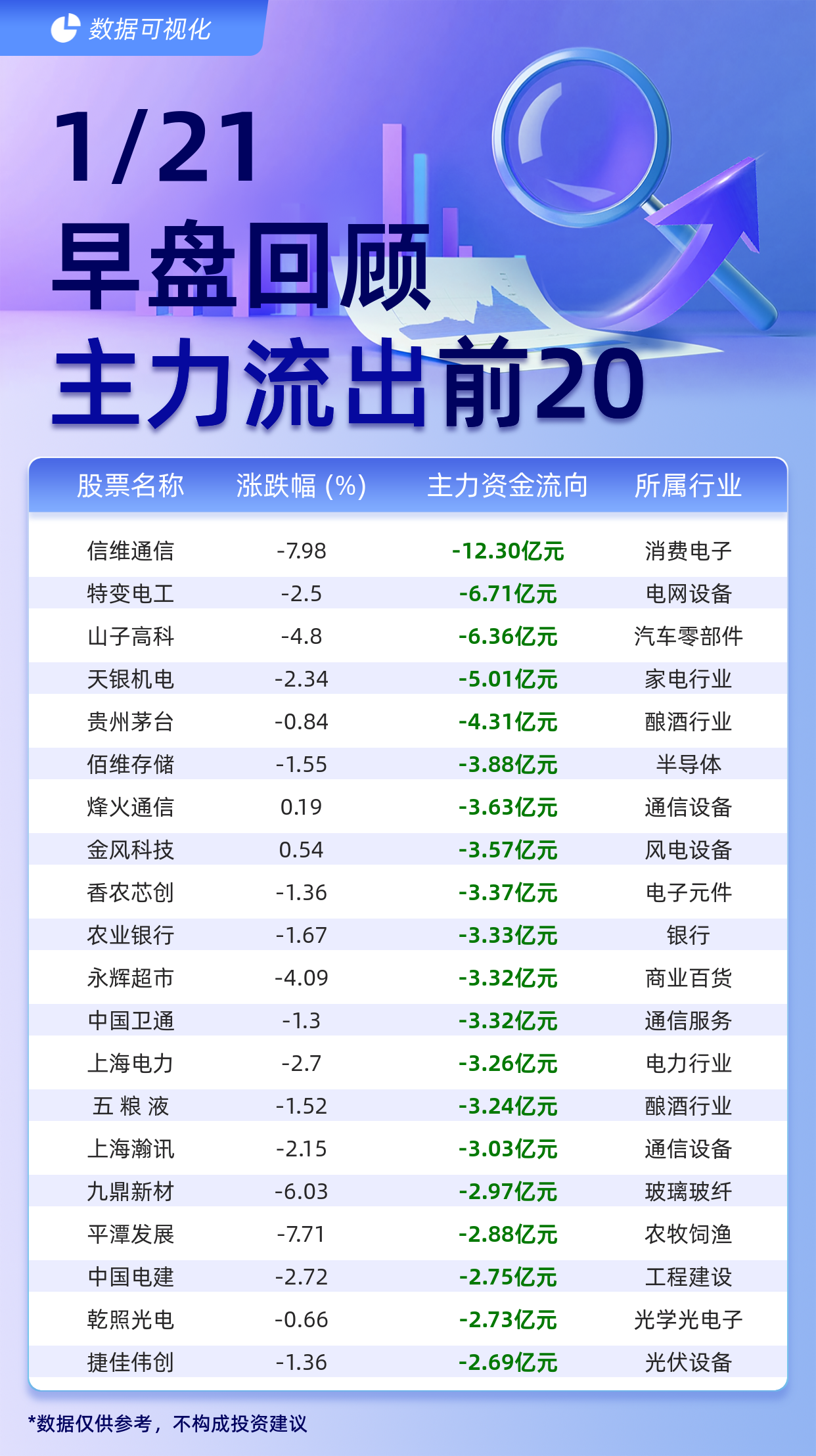
主力个股资金流出前20:信维通信流出12.30亿元、特变电工流出6.71亿元
Jin Rong Jie· 2026-01-21 04:04
Core Viewpoint - The data indicates significant outflows of capital from various stocks, with notable declines in share prices across multiple sectors, suggesting a bearish sentiment in the market. Group 1: Major Stocks with Capital Outflows - Xinyi Communication experienced a capital outflow of 1.23 billion, with a price drop of 7.98% [1][2] - Tebian Electric witnessed a capital outflow of 671 million, with a price decline of 2.5% [1][2] - Shanzi Gaoke had a capital outflow of 636 million, with a decrease of 4.8% [1][2] - Tianyin Electromechanical saw an outflow of 501 million, with a drop of 2.34% [1][2] - Kweichow Moutai experienced a capital outflow of 431 million, with a decline of 0.84% [1][2] Group 2: Additional Stocks with Notable Outflows - Baiwei Storage had a capital outflow of 388 million, with a price drop of 1.55% [1][2] - Fenghuo Communication saw an outflow of 363 million, with a slight increase of 0.19% [1][2] - Goldwind Technology experienced a capital outflow of 357 million, with a price increase of 0.54% [1][2] - Shannon Chip Creation had an outflow of 337 million, with a decline of 1.36% [1][2] - Agricultural Bank saw a capital outflow of 333 million, with a drop of 1.67% [1][2] Group 3: Further Stocks with Capital Outflows - China Satellite Communications experienced a capital outflow of 332 million, with a decline of 1.3% [3] - Shanghai Electric saw an outflow of 326 million, with a price drop of 2.7% [3] - Wuliangye experienced a capital outflow of 324 million, with a decline of 1.52% [3] - Shanghai Hanxun had an outflow of 303 million, with a drop of 2.15% [3] - Jiuding New Materials saw a capital outflow of 297 million, with a significant decline of 6.03% [3]


捷佳伟创跌2.00%,成交额7.16亿元,主力资金净流出1.02亿元
Xin Lang Zheng Quan· 2026-01-21 02:08
Core Viewpoint - The stock price of Jiejia Weichuang has experienced fluctuations, with a recent decline despite a year-to-date increase, indicating potential volatility in the market [1][2]. Group 1: Stock Performance - As of January 21, Jiejia Weichuang's stock price decreased by 2.00% to 108.25 CNY per share, with a trading volume of 716 million CNY and a turnover rate of 2.27%, resulting in a total market capitalization of 37.703 billion CNY [1]. - Year-to-date, the stock has risen by 13.23%, but it has dropped by 6.06% over the last five trading days, while showing a 23.50% increase over the past 20 days and a 14.74% increase over the last 60 days [2]. Group 2: Company Overview - Jiejia Weichuang, established on June 18, 2007, and listed on August 10, 2018, is located in Shenzhen, Guangdong Province, specializing in the research, production, and sales of crystalline silicon solar cell equipment [2]. - The company's revenue composition includes 83.34% from process equipment, 12.05% from automation supporting equipment, and 4.62% from components [2]. - The company operates within the power equipment sector, specifically in photovoltaic equipment and processing [2]. Group 3: Financial Performance - For the period from January to September 2025, Jiejia Weichuang reported a revenue of 13.106 billion CNY, reflecting a year-on-year growth of 6.17%, and a net profit attributable to shareholders of 2.688 billion CNY, which is a 32.90% increase year-on-year [2]. - The company has distributed a total of 1.143 billion CNY in dividends since its A-share listing, with 903 million CNY distributed over the past three years [3]. Group 4: Shareholder Information - As of September 30, 2025, the number of shareholders for Jiejia Weichuang was 77,200, a decrease of 4.62% from the previous period, with an average of 3,725 circulating shares per shareholder, an increase of 4.85% [2]. - Among the top ten circulating shareholders, Hong Kong Central Clearing Limited holds 8.3907 million shares, a decrease of 3,934 shares from the previous period, while the Southern CSI 500 ETF is a new entrant with 4.2388 million shares [3].