S.C(300724)

Search documents
太空光伏板块,午后走强
第一财经· 2026-02-04 05:21
编辑 | 钉钉 | 名称 | 现价 | 涨跌幅 - | | --- | --- | --- | | 晶科能源 | 8.40 | 20.00% | | 中来股份 | 10.32 | 20.00% | | 拓日新能 | 7.04 | 10.00% | | 天合光能 | 22.04 | 8.68% | | 金晶科技 | 6.81 | 6.41% | | ST京机 | 14.95 | 4.99% | | 捷佳伟创 | 148.47 | 4.04% | 消息面上,据多家媒体报道,近期马斯克旗下的SPACE X团队和Tesla团队"摸底"中国光伏企业,其中TESLA团队目前仅是验 厂阶段,到访多家产业链企业;SPACE X团队主要到访光伏设备厂,并与国内某头部异质结设备厂有订单合作,但基于商业保 密要求等因素,未作公开。 2月4日午后,太空光伏板块走强,晶科能源、中来股份20%涨停,拓日新能涨停,天合光能涨超8%,乾照光电涨近4%,通 威股份涨超3%。 ...






捷佳伟创股价涨5.05%,易方达基金旗下1只基金位居十大流通股东,持有559.9万股浮盈赚取4036.9万元
Xin Lang Cai Jing· 2026-02-04 05:20
2月4日,捷佳伟创涨5.05%,截至发稿,报149.92元/股,成交57.91亿元,换手率13.78%,总市值522.16 亿元。 资料显示,深圳市捷佳伟创新能源装备股份有限公司位于广东省深圳市坪山区龙田街道竹坑社区金牛东 路62号一层至六层,成立日期2007年6月18日,上市日期2018年8月10日,公司主营业务涉及晶体硅太阳 能电池设备研发、生产和销售。主营业务收入构成为:工艺设备83.34%,自动化配套设备12.05%,配 件4.62%。 从捷佳伟创十大流通股东角度 数据显示,易方达基金旗下1只基金位居捷佳伟创十大流通股东。易方达创业板ETF(159915)三季度 减持93.53万股,持有股数559.9万股,占流通股的比例为1.95%。根据测算,今日浮盈赚取约4036.9万 元。 易方达创业板ETF(159915)成立日期2011年9月20日,最新规模1004.46亿。今年以来收益3.9%,同类 排名2773/5562;近一年收益63.55%,同类排名585/4285;成立以来收益279.62%。 责任编辑:小浪快报 刘树荣累计任职时间8年204天,现任基金资产总规模1276.84亿元,任职期间最佳基金 ...

航天+AI跨界整合引爆赛道,SpaceX合并xAI打开太空光伏增量,中国企业凭硬核实力扩份额,出海提速筑牢2026增长根基
Xin Lang Cai Jing· 2026-02-03 12:52
Group 1 - Company Sunlight Power (300274) is a leading domestic enterprise in photovoltaic inverters, covering the entire industry chain including energy storage systems and photovoltaic power station development [1][43] - The company has strong technical capabilities in power electronics and system integration, with products suitable for various applications including residential, commercial, and large-scale ground power stations [1][43] - In the space photovoltaic and computing power sector, Sunlight Power's technology can be adapted for space applications, providing stable power support for space computing centers [1][43][44] Group 2 - Longi Green Energy (601012) is a leading domestic photovoltaic company focusing on the research and production of monocrystalline silicon rods and wafers, with a complete vertical integration in the industry chain [2][45] - The company excels in new generation high-efficiency battery technologies such as N-type TOPCon and HJT, with significant cost control and technical advantages [2][45] - Longi's ultra-thin silicon wafer technology meets the stringent requirements for space photovoltaic components, enabling reduced weight and improved energy efficiency for space computing centers [2][45] Group 3 - Tongwei Co., Ltd. (600438) is a dual leader in photovoltaic silicon materials and battery production, with a strong focus on high-purity crystalline silicon and photovoltaic battery manufacturing [3][46] - The company has a high market share in high-purity silicon production and is well-positioned to meet the rigorous standards required for space photovoltaic components [3][46] - Tongwei's efficient battery technology can enhance power generation in space photovoltaic applications, positioning the company as a key supplier in the space photovoltaic supply chain [3][46] Group 4 - Deye Technology (605117) is a quality enterprise with core businesses in dehumidification equipment and photovoltaic energy storage systems, excelling in household and commercial energy storage solutions [4][43] - The company's energy storage technology is crucial for providing stable energy supply in space photovoltaic applications, addressing intermittent power generation issues [4][43][44] - Deye's experience in developing equipment for extreme environments positions it well to adapt products for space applications [4][43] Group 5 - Jingcheng Machinery (300316) is a leading domestic enterprise in photovoltaic crystal growth equipment, focusing on high-end equipment for photovoltaic manufacturing [5][6] - The company's technology supports the production of high-purity silicon crystals and ultra-thin silicon wafers, essential for space photovoltaic components [5][6] - As the space photovoltaic industry matures, Jingcheng is expected to provide core manufacturing equipment for the space photovoltaic supply chain [5][6] Group 6 - Maiwei Co., Ltd. (300751) is a leading enterprise in photovoltaic battery equipment, specializing in HJT and perovskite tandem battery technologies [7][41] - The company's equipment is crucial for the mass production of high-efficiency batteries that meet the stringent requirements of space photovoltaic applications [7][41] - Maiwei's technology can support the development of space-specific battery manufacturing equipment, enhancing energy system efficiency for space computing centers [7][41] Group 7 - Foster (603806) is a global leader in photovoltaic packaging materials, focusing on EVA and POE films, with a strong market presence [8][43] - The company's packaging materials are essential for ensuring the durability and performance of photovoltaic components in extreme space environments [8][43] - Foster aims to develop specialized packaging materials for space applications, enhancing the reliability of space photovoltaic systems [8][43] Group 8 - JinkoSolar (002459) is a global leader in photovoltaic modules, with a comprehensive business model covering silicon wafers, battery cells, and modules [10][43] - The company has a strong technical foundation and global production capabilities, allowing it to meet diverse application needs [10][43] - JinkoSolar's module manufacturing technology is well-suited for space applications, with the potential to become a core supplier for space photovoltaic systems [10][43] Group 9 - TCL Zhonghuan (002129) is a core enterprise in the silicon wafer sector, focusing on monocrystalline silicon materials and semiconductor materials [12][43] - The company's high-purity silicon technology is critical for space photovoltaic components, meeting the stringent requirements for purity and performance [12][43] - TCL Zhonghuan is positioned to develop space-specific silicon products, enhancing its role in the space photovoltaic supply chain [12][43] Group 10 - Aerospace Electromechanical (600151) is a leading enterprise in the integration of aerospace and photovoltaic technologies, covering the entire industry chain from component manufacturing to power station operation [19][43] - The company's aerospace power technology can be directly applied to space photovoltaic systems, providing essential energy management solutions [19][43] - With its experience in satellite systems, Aerospace Electromechanical is well-positioned to participate in the development of space computing centers [19][43]





太空光伏掀涨停潮!一图看懂相关概念
天天基金网· 2026-02-03 08:42
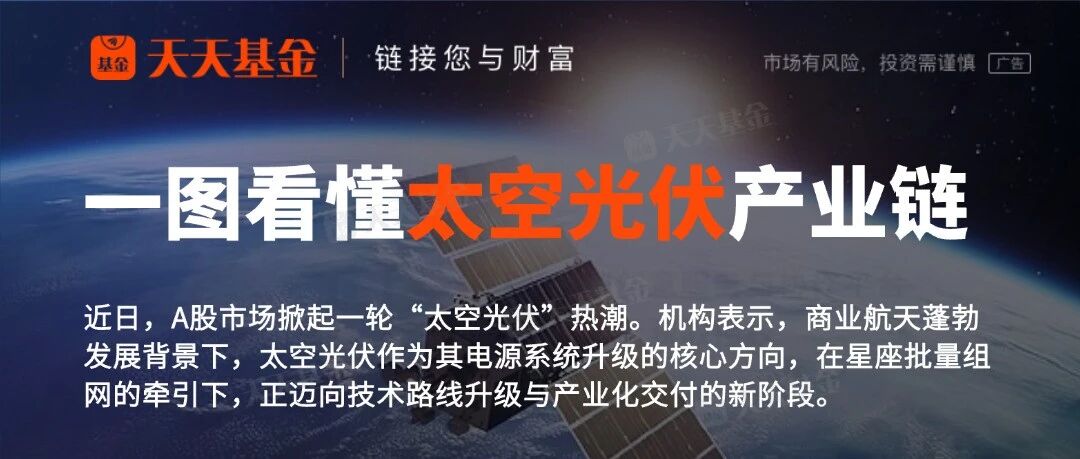
Core Viewpoint - The article highlights the emerging trend of "space photovoltaics" in the A-share market, driven by the rapid development of commercial aerospace and the need for upgraded power systems in satellite constellations [1]. Industry Chain - The space photovoltaic industry chain includes various components such as photovoltaic auxiliary materials, photovoltaic cells, and photovoltaic equipment, with key players like Double Good Energy, Junda Co., and Trina Solar [3]. Institutional Interpretation - As China's low-orbit satellite constellations enter a phase of intensive deployment, the industry is expected to undergo significant transformation, with a focus on manufacturing and technological advancements [4][11]. Market Potential - Space photovoltaics are projected to achieve commercialization within the next 10 to 15 years, with the Chinese low-orbit satellite photovoltaic market expected to exceed $3 billion by 2030. If the deployment reaches 100GW for space data centers, the global market could reach between $500 billion to $1 trillion [5][12]. Technological Advantages - Space photovoltaics can generate power continuously, unaffected by day-night cycles or weather changes, achieving 7-10 times the annual generation hours and energy density compared to ground-based photovoltaics [10]. Recent Developments - The recent acquisition of xAI by SpaceX aims to create a vertically integrated innovation engine, which is expected to enhance SpaceX's space computing capabilities, directly benefiting the space photovoltaic industry [9].





捷佳伟创2月2日获融资买入5.69亿元,融资余额28.51亿元
Xin Lang Cai Jing· 2026-02-03 01:33
2月2日,捷佳伟创跌3.66%,成交额43.99亿元。两融数据显示,当日捷佳伟创获融资买入额5.69亿元, 融资偿还4.69亿元,融资净买入1.00亿元。截至2月2日,捷佳伟创融资融券余额合计28.77亿元。 融资方面,捷佳伟创当日融资买入5.69亿元。当前融资余额28.51亿元,占流通市值的6.17%,融资余额 超过近一年90%分位水平,处于高位。 融券方面,捷佳伟创2月2日融券偿还3200.00股,融券卖出4.80万股,按当日收盘价计算,卖出金额 636.77万元;融券余量19.56万股,融券余额2594.83万元,超过近一年90%分位水平,处于高位。 资料显示,深圳市捷佳伟创新能源装备股份有限公司位于广东省深圳市坪山区龙田街道竹坑社区金牛东 路62号一层至六层,成立日期2007年6月18日,上市日期2018年8月10日,公司主营业务涉及晶体硅太阳 能电池设备研发、生产和销售。主营业务收入构成为:工艺设备83.34%,自动化配套设备12.05%,配 件4.62%。 截至1月20日,捷佳伟创股东户数7.63万,较上期减少1.24%;人均流通股3772股,较上期增加1.26%。 2025年1月-9月,捷佳伟创 ...
"太空光伏"概念走热,部分企业触发交易异常,业内: 目前仍处于0到1阶段
Di Yi Cai Jing· 2026-02-02 07:45
Core Viewpoint - The "space photovoltaic" concept has become a major focus in the secondary market, significantly influenced by Tesla CEO Elon Musk's endorsements, with the relevant index rising 19.83% in the past month, outperforming the CSI 300 index's 1.18% increase [1] Group 1: Market Performance - The space photovoltaic concept index has seen a substantial increase, with notable stocks such as JunDa Co., Ltd. rising by 84.62%, Mingyang Smart Energy increasing by 60.22%, and Jiejia Weichuang up by 44.04% over the past 20 days [1] - Several photovoltaic companies have experienced significant stock price surges, triggering trading anomalies, with stocks like Dongfang Risen and Laplace exceeding a cumulative price deviation of 30% over multiple trading days [3] Group 2: Technology and Feasibility - Space photovoltaic energy involves utilizing solar photovoltaic technology in outer space to generate and supply energy, with the potential for direct power transmission to Earth or powering satellites and space stations [3] - The feasibility of space photovoltaic technology is supported by the abundant sunlight in space and the ability to deploy photovoltaic components on satellites, with near-Earth orbit satellites experiencing over 60% sunlight exposure [3] - Despite the market enthusiasm, the industry faces significant uncertainties regarding the maturity and long-term reliability of the technology, as well as the economic viability required for large-scale commercialization [4][5] Group 3: Industry Insights - Industry insiders indicate that the application scenarios for space photovoltaic technology are still in the exploratory phase, with many companies in the secondary market not yet supplying products to commercial space satellite companies [4] - Analysts emphasize that space photovoltaic technology is currently in the early stages, requiring validation of technical routes and economic benefits for large-scale commercial applications [5] - The current cost of space photovoltaic energy is estimated to be around $2-3 per kilowatt-hour, significantly higher than ground photovoltaic costs of $0.03-0.05 per kilowatt-hour, highlighting the economic challenges ahead [6] Group 4: Future Outlook - Companies like Trina Solar and HaiMuxing express optimism about the future of space photovoltaic technology, with ongoing collaborations with leading aerospace institutions to accumulate practical experience [6] - The commercial viability of space photovoltaic technology is projected to gradually materialize over the next 10 to 15 years, driven by decreasing launch costs and breakthroughs in battery technology [7]



光伏ETF基金(516180)涨超1.8%,两部门推动建立可靠容量补偿机制
Xin Lang Cai Jing· 2026-02-02 02:26
Group 1 - The core viewpoint of the news highlights the strong performance of the photovoltaic industry, with the China Securities Photovoltaic Industry Index rising by 1.84% and key stocks like Dongfang Risheng and Nanjing Energy showing significant gains [1] - The National Development and Reform Commission and the National Energy Administration have issued a notice to improve the capacity pricing mechanism on the generation side, emphasizing the need for a reliable capacity compensation mechanism to ensure stable power supply during peak demand [1] - The reliable capacity compensation mechanism will be based on fixed costs that cannot be recovered in the energy and ancillary services markets, taking into account power supply-demand relationships and user affordability [1] Group 2 - Zhongyin Securities identifies "anti-involution" and "space photovoltaic" as the two main investment themes for 2026, with Elon Musk indicating the potential to establish a 100GW photovoltaic full industry chain, which is expected to enhance the demand for photovoltaic equipment [2] - The China Securities Photovoltaic Industry Index includes up to 50 representative listed companies involved in the photovoltaic industry chain, with the top ten weighted stocks accounting for 53.49% of the index [2] - The photovoltaic ETF fund closely tracks the China Securities Photovoltaic Industry Index, with various related index funds available for investors [2]



“太空光伏”概念走热,业内:目前仍处于0到1阶段
Di Yi Cai Jing Zi Xun· 2026-01-30 13:27
Core Insights - The "space photovoltaic" concept has gained significant attention in the secondary market, largely influenced by Tesla CEO Elon Musk's endorsements [2] - The Wind Space Photovoltaic Index has risen by 19.83% over the past month, outperforming the Shanghai and Shenzhen 300 Index, which increased by 1.18% [2] - Several photovoltaic companies have experienced substantial stock price increases, with JunDa Co., Ltd. rising by 84.62% and Mingyang Smart Energy increasing by 60.22% in the last 20 days [2] Market Performance - The stock prices of companies like Dongfang Risen and Laplace have shown abnormal fluctuations, with price deviations exceeding 30% over consecutive trading days [3] - The space photovoltaic sector is characterized by its potential to harness solar energy in outer space, providing power to satellites and space stations [3] Industry Challenges - Despite the market enthusiasm, the commercialization of space photovoltaics faces significant uncertainties related to technology maturity and economic viability [4] - Industry insiders indicate that the application scenarios for space photovoltaics are still in the exploratory phase, with many companies not yet supplying products to commercial satellite firms [4] Technological Considerations - Current leading materials for space photovoltaics include gallium arsenide, which is costly at approximately 1000 RMB per watt, and perovskite, which faces stability issues in extreme space conditions [5] - The cost of electricity generated from space photovoltaics is estimated to be 2-3 USD per kilowatt-hour, significantly higher than the ground-based photovoltaic cost of 0.03-0.05 USD per kilowatt-hour [5] Future Outlook - Several A-share listed companies express optimism about the future of space photovoltaics, with potential market size reaching trillions as technology advances [5] - Companies like Trina Solar and HaiMuxing are actively collaborating with leading aerospace institutions to develop practical applications for space solar energy [5] - The commercialization of space photovoltaics is projected to gradually occur over the next 10 to 15 years as launch costs decrease and battery technologies improve [6]

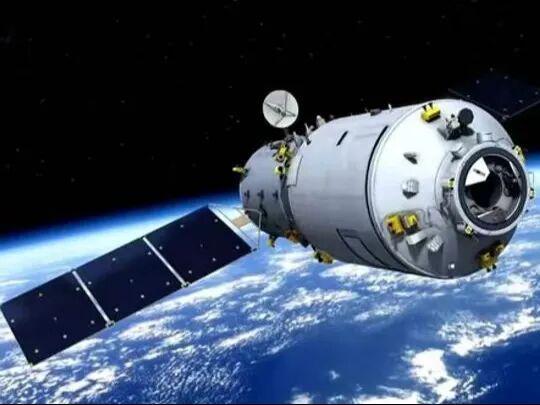
“太空光伏”概念走热 部分企业触发交易异常 业内:目前仍处于0到1阶段
Di Yi Cai Jing· 2026-01-30 12:05
Core Viewpoint - The "space photovoltaic" concept has become a major focus in the secondary market, significantly influenced by Tesla CEO Elon Musk's endorsements, with the relevant index rising 19.83% in the past month, outperforming the CSI 300 index by 18.65% [1] Market Performance - The space photovoltaic concept index has shown strong performance, with notable stock increases: JunDa Co., Ltd. up 84.62%, Mingyang Smart Energy up 60.22%, Jiejia Weichuang up 44.04%, Dier Laser up 41.54%, and Tuori New Energy up 35.94% over the past 20 days [1] - Several photovoltaic companies have experienced significant stock price surges, triggering trading anomalies, such as Dongfang Risheng and Laplace, both exceeding a cumulative price deviation of 30% within a short period [2] Industry Insights - Space photovoltaic energy refers to utilizing solar photovoltaic technology in outer space to generate and supply energy, with the potential to transmit power wirelessly to Earth or supply satellites and space stations [2] - The rationale for space photovoltaics includes abundant sunlight in space and the feasibility of deploying photovoltaic components on satellites, with near-Earth satellites experiencing over 60% sunlight exposure [2] Challenges in Industrialization - Despite the rising stock prices, the industry faces significant uncertainties regarding the industrialization of space photovoltaics, including technological maturity and economic viability for large-scale commercialization [3] - Current applications of space photovoltaics are still exploratory, with many companies in the secondary market not yet supplying products to commercial space satellite companies [3] - Analysts indicate that space photovoltaics are in the early stages of development, requiring validation of technology and economic benefits for large-scale applications [3] Technological Considerations - Gallium arsenide is the mainstream material for space photovoltaics, but its high cost (approximately 1000 RMB per watt) poses challenges for large-scale deployment [4] - Perovskite technology shows promise but has stability concerns in extreme space conditions, necessitating further validation [4] - Multiple technological routes are being explored, with a focus on solving power and cost issues as critical for the commercialization of space energy solutions [4] Cost Analysis - Current estimates suggest that the cost of electricity from space photovoltaics is around $2-3 per kilowatt-hour, compared to $0.03-0.05 per kilowatt-hour for ground-based photovoltaics, indicating a potential cost disparity of up to 100 times [5] - Companies like Trina Solar and HaiMuxing express optimism about the future of space photovoltaics, citing collaborations with leading aerospace institutions and advancements in reusable rocket technology [5] Commercialization Timeline - Predictions indicate that space photovoltaics may gradually commercialize over the next 10 to 15 years, contingent on decreasing launch costs and breakthroughs in battery technology [6]
“太空光伏”概念走热,部分企业触发交易异常,业内:目前仍处于0到1阶段
Di Yi Cai Jing Zi Xun· 2026-01-30 11:37
Core Viewpoint - The "space photovoltaic" concept has gained significant attention in the secondary market, largely influenced by Tesla CEO Elon Musk's endorsements, with the relevant index rising 19.83% in the past month, outperforming the CSI 300 index by 18.65% [1] Market Performance - The space photovoltaic concept index has seen a notable increase, with specific stocks like JunDa Co., Ltd. rising by 84.62%, Mingyang Smart Energy by 60.22%, and Jiejia Weichuang by 44.04% over the past 20 days [1] - Several photovoltaic companies have experienced stock price surges, triggering trading anomalies, such as Dongfang Risheng and Laplace, which saw price deviations exceeding 30% [3] Technology and Feasibility - Space photovoltaic energy involves utilizing solar photovoltaic technology in outer space to generate and supply energy, with the potential for direct power transmission to Earth [3] - The advantages of space photovoltaic systems include abundant sunlight and reduced atmospheric interference, making them a viable option for satellite power supply [3] Industry Challenges - Despite the market enthusiasm, the space photovoltaic industry faces significant uncertainties regarding technological maturity, long-term reliability, and economic viability for large-scale commercialization [4][5] - Current applications are still in the exploratory phase, with many companies not yet supplying products to commercial space satellite firms [5] Technological Development - Various technological routes are being explored, with gallium arsenide being the mainstream material, but its high cost poses challenges for large-scale deployment [5][6] - The cost of space photovoltaic energy is currently estimated at $2-3 per kilowatt-hour, significantly higher than ground-based photovoltaic costs of $0.03-0.05 per kilowatt-hour, indicating a need for cost reduction and efficiency improvements [6] Future Outlook - Companies like Trina Solar and HaiMuxing express optimism about the future of space photovoltaic technology, citing collaborations with leading aerospace institutions and advancements in reusable rocket technology [6][7] - The commercial viability of space photovoltaic systems is projected to develop over the next 10 to 15 years, contingent on decreasing launch costs and breakthroughs in battery technology [7]