S.C(300724)

Search documents
电力设备与新能源行业周观察:太空光伏开辟增量空间,看好产业链发展机遇
HUAXI Securities· 2026-01-25 12:58
Investment Rating - Industry Rating: Recommended [5] Core Insights - The humanoid robot industry is accelerating towards mass production, driven by cost reduction demands and domestic suppliers' advantages in key components like precision transmission parts and electronic skin [15][16] - The sodium battery released by CATL showcases cost and performance advantages, with significant price increases in lithium carbonate impacting lithium battery costs, while sodium batteries are expected to achieve scale applications [19][20] - Domestic energy storage installations are experiencing substantial growth, with a diverse revenue structure and economic viability, benefiting leading companies in system integration and inverters [23] - The photovoltaic industry is poised for growth due to dual applications in ground and space, with HJT technology becoming a key direction for overseas expansion, enhancing global market potential [26][31] - China's wind power equipment exports are surging, with significant opportunities for leading companies in both domestic and overseas markets, supported by technological parity and cost advantages [27][40] - The electric equipment sector is entering a super boom cycle, driven by overseas demand and advancements in AI and smart grid technologies, with companies that possess strong channel resources and technical capabilities expected to benefit [42][43] Summary by Sections Humanoid Robots - The humanoid robot industry is seeing rapid industrialization, with major tech companies entering the market and expected mass production of Tesla's Optimus robot by the end of next year [15][16] - Key components suppliers in the T-chain are likely to benefit from the anticipated production ramp-up [16][17] Electric Vehicles - CATL's sodium battery demonstrates significant advantages in cost and performance, with the price of lithium carbonate impacting battery costs, while sodium batteries are expected to see widespread adoption [19][20] Renewable Energy - Domestic energy storage installations are on a growth trajectory, with leading companies in system integration and inverters set to benefit from the expanding market [23] - The photovoltaic sector is expected to grow due to advancements in HJT technology and increased global demand for solar installations [26][31] Wind Power - China's wind power equipment exports are increasing, with leading companies poised to capitalize on both domestic and international opportunities [27][40] Electric Equipment & AIDC - The electric equipment sector is entering a favorable cycle, with companies that have strong technical capabilities and market presence expected to benefit from increased overseas demand [42][43]




太空光伏为产业链带来新机遇,宁德时代推出天行II方案
GOLDEN SUN SECURITIES· 2026-01-25 08:33
Investment Rating - The report maintains an "Overweight" rating for the power equipment sector [6] Core Insights - The report highlights new opportunities in the photovoltaic industry driven by space solar power initiatives and rising prices of battery components [1][17] - It emphasizes the importance of supply-side reforms and technological advancements in creating long-term growth opportunities within the industry [1][19] - The report identifies key companies to watch in various segments, including supply chain price increases, new technology growth, and perovskite solar cell developments [1][19][21] Summary by Sections Photovoltaics - The price of multi-crystalline silicon n-type raw materials remains stable, with an average transaction price of 59,200 RMB per ton [17] - N-type battery cell prices have increased to 0.42 RMB per watt, with a price range of 0.40-0.43 RMB per watt [17] - The report notes that rising silver prices have led to increased component costs, with distributed component prices now ranging from 0.70 to 0.80 RMB per watt [17] - SpaceX and Tesla plan to achieve a combined solar manufacturing capacity of 200GW annually in the U.S. within three years, with 40GW dedicated to space solar power [1][18] - Key companies to focus on include Tongwei Co., GCL-Poly, LONGi Green Energy, JA Solar, and Trina Solar for supply-side reform opportunities [1][19] Wind Power & Grid - The Netherlands will launch a 1GW offshore wind project tender in September 2026, with a subsidy budget of approximately 32.45 billion RMB [19][20] - Turkey plans to initiate its first offshore wind tender by the end of 2026, aiming for 5GW of installed capacity by 2035 [19][20] - Southern Power Grid has set a fixed asset investment of 180 billion RMB for 2026, focusing on new power system construction and strategic emerging industries [20] - Companies to watch include Goldwind, Yunda, Mingyang Smart Energy, and Sany Heavy Energy in the wind turbine sector [20] Hydrogen Energy - A ceremony for the operation of 300 hydrogen fuel heavy trucks was recently held, showcasing advancements in hydrogen energy technology [3][21] - The trucks are equipped with a 130kW fuel cell system and can achieve a range of over 600 kilometers [3][21] - Key companies in this sector include Shuangliang Energy, Huadian Heavy Industry, and Shenghui Technology [3][21] Energy Storage - The report forecasts that new energy storage installations in China will reach 58.6GW/175.3GWh in 2025, a year-on-year increase of 38%/60% [4][22] - The average bid price for 2-hour energy storage systems is projected to be 0.55 RMB/Wh in 2025, down 16.9% from 2024 [4][22] - Companies to focus on include Sungrow Power, Canadian Solar, and Kehua Data for large-scale energy storage opportunities [4][22] New Energy Vehicles - CATL launched the "Tianxing II" series solutions for light commercial vehicles, including the industry's first intelligent battery management application [5][27] - The solutions cater to various scenarios, including high-frequency urban distribution and extreme temperature conditions [5][27] - Key companies in the battery sector include CATL, Penghui Energy, and Guoxuan High-Tech [5][29]




光伏设备行业点评报告:马斯克规划100GW光伏产能,设备商有望充分受益于海外地面+太空光伏双重机遇
Soochow Securities· 2026-01-24 23:42
Investment Rating - The report maintains an "Overweight" rating for the photovoltaic equipment industry [1] Core Insights - Elon Musk announced plans for 100GW photovoltaic capacity for both terrestrial and space applications, expected to be completed by the end of 2028 [4] - The global satellite launch numbers are expected to grow exponentially, with silicon-based HJT being the optimal solution for space photovoltaics due to its lightweight, cost-effectiveness, and material availability [4] - The demand for terrestrial photovoltaic markets is also strong, with the U.S. market projected to have a compound annual growth rate exceeding 20% from 2024 to 2029, and an installation capacity expected to exceed 60GW in 2025 [4] - Chinese photovoltaic equipment holds a dominant position globally, with over 80% market share in silicon materials, wafers, cells, and modules by 2024 [4] - Key recommended companies include leading HJT equipment manufacturer "Maiwei," low-oxygen monocrystalline furnace leader "Jingsheng," and global market leader in string welding machines "Aotewei" [4] Summary by Sections Industry Trends - The report highlights the significant growth in satellite launches and the corresponding demand for space photovoltaics, indicating a shift towards silicon-based HJT technology as a preferred solution [4] - The U.S. photovoltaic market is experiencing robust growth, with expectations for substantial increases in installation capacity [4] Company Recommendations - The report recommends focusing on leading companies in the HJT equipment sector, including "Maiwei," "Jingsheng," "Aotewei," and suggests monitoring "Jiejia Weichuang" for integrated equipment solutions [4]


A股延续上攻势头航天相关题材表现火热
Shang Hai Zheng Quan Bao· 2026-01-23 18:12
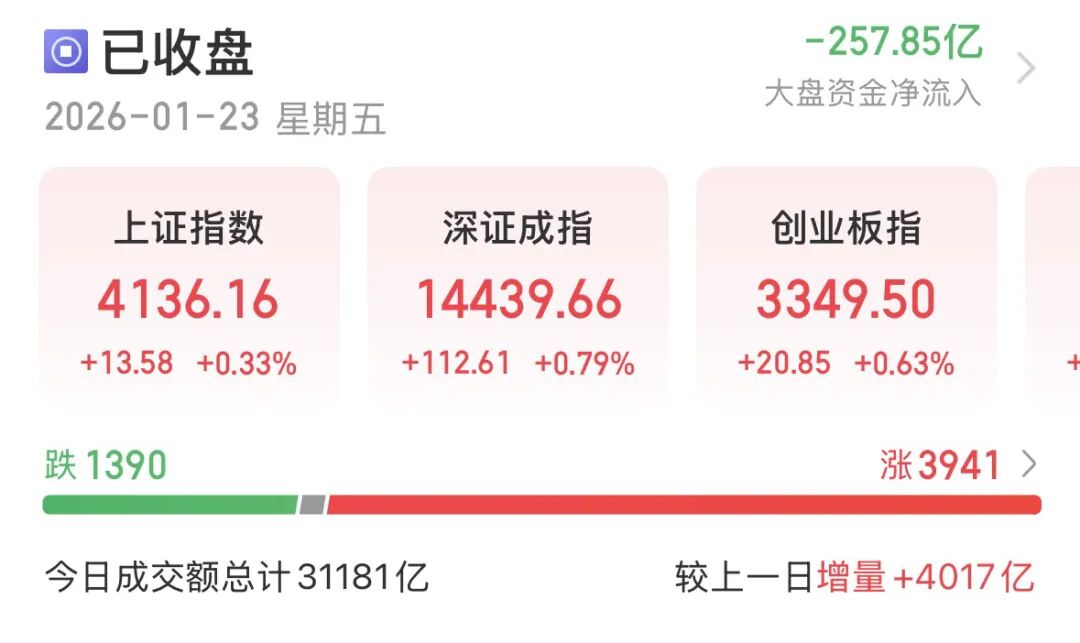
Market Overview - The A-share market continued its upward trend, with significant gains in sectors such as non-ferrous metals and renewable energy, leading to all four major indices closing in the green [2] - The Shanghai Composite Index closed at 4136.16 points, up 0.33%, while the Shenzhen Component Index rose by 0.79% to 14439.66 points [2] - The total trading volume in the Shanghai and Shenzhen markets reached 30.853 trillion yuan, an increase of over 390 billion yuan compared to the previous day [2] Space Industry Developments - The commercial aerospace sector saw a surge in interest, particularly in space photovoltaic technology, which became a focal point for active capital [2][3] - Blue Arrow Aerospace's IPO process on the Sci-Tech Innovation Board is progressing rapidly, with its application status changing to "under inquiry" as of January 22 [3] - SpaceX announced plans to launch its second-generation Starlink system by 2027, while Blue Origin is set to deploy a satellite communication network consisting of 5408 satellites by the fourth quarter of 2027 [3] Photovoltaic Sector Performance - The photovoltaic equipment index rose by 8.69%, with 64 stocks in the sector, of which only two declined, and several stocks, including Maiwei Co. and Jiejia Weichuang, hitting the 20% limit up [4] - Longi Green Energy, a leading company in the photovoltaic sector, also recorded a limit-up performance [4] - Space photovoltaic energy utilizes solar technology in outer space environments, providing a stable and lightweight energy solution compared to traditional fossil fuels and nuclear energy [4] Technological Advancements - SpaceX has confirmed the use of P-type HJT battery technology for large-scale production of space solar cells, which is seen as a short-term optimal alternative due to its cost-effectiveness and material flexibility [5] - The demand for GW-level space photovoltaic solutions is expected to grow significantly, with the existing arsenide gallium batteries unable to meet deployment needs [5] Investment Outlook - Market sentiment is optimistic, with institutions suggesting a focus on company performance as the annual earnings forecast period approaches [5] - The strategy team at CITIC Securities indicates that the market is in an upward trend, with active capital likely to seek thematic investment opportunities, particularly in commercial aerospace [5] - Investors are advised to concentrate on high-growth sectors, such as semiconductor equipment driven by storage expansion [5]




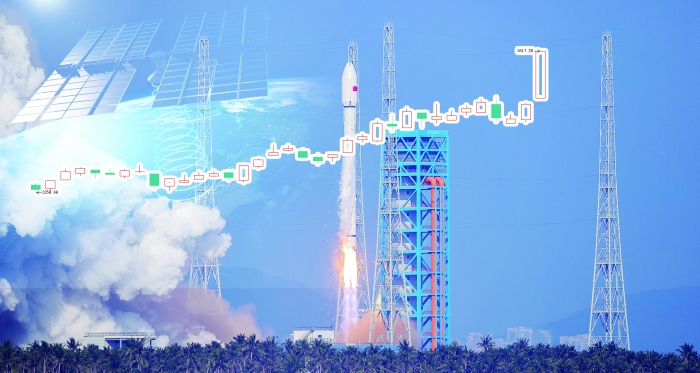
电源设备、商业航天大涨!下周A股怎么走?
Guo Ji Jin Rong Bao· 2026-01-23 16:19
Core Viewpoint - The market shows signs of recovery with a significant increase in trading volume and a majority of stocks rising, indicating a shift in investor sentiment towards riskier assets and sectors with high growth potential [1][4][14]. Market Performance - On January 23, the market's trading volume exceeded 3.12 trillion yuan, with nearly 4,000 stocks closing higher, reflecting a strong market sentiment [1][4][14]. - Major indices experienced moderate gains, with the North Stock 50 index surging nearly 4%, while the Shanghai Composite Index rose by 0.33% [1][4][14]. Sector Performance - Leading sectors included aerospace, marketing services, and power equipment, while consumer sectors remained weak [1][4][7]. - The power equipment sector saw a notable increase, with 28 stocks hitting the daily limit up, indicating strong investor interest [6][10]. - The non-consumer sectors, particularly those related to economic recovery and technology, are attracting more capital, while traditional sectors like banking and consumer goods are underperforming [13][18]. Investment Strategy - Investors are advised to focus on sectors with strong fundamentals and growth potential, such as power equipment, non-ferrous metals, and defense industries, while avoiding high-valuation stocks that have recently surged [3][17][18]. - New investors should adopt a cautious approach, emphasizing gradual accumulation of stocks with solid earnings prospects and reasonable valuations [3][17][18].


硅能源概念涨4.85%,主力资金净流入40股
Zheng Quan Shi Bao Wang· 2026-01-23 10:24
Group 1 - The silicon energy concept index rose by 4.85%, ranking 7th among concept sectors, with 56 stocks increasing in value, including Liancheng CNC at 30% limit up, and others like Dongfang Risheng and Jiejia Weichuang at 20% limit up [1] - Notable gainers in the silicon energy sector included Jingao Technology, Hongyuan Green Energy, and Daqo New Energy, which rose by 8.86%, 8.67%, and 8.19% respectively [1] - The sector saw significant inflows, with a net capital inflow of 2.837 billion yuan, led by Longi Green Energy with a net inflow of 2.762 billion yuan [2] Group 2 - The top stocks by net capital inflow included Dongfang Risheng, Daozhi Technology, and YF Electronics, with net inflows of 681.73 million yuan, 477.63 million yuan, and 428.89 million yuan respectively [2] - The highest net inflow ratios were observed in Shuangliang Energy, Tuori New Energy, and YF Electronics, with ratios of 63.66%, 58.40%, and 40.80% respectively [3] - The trading volume and turnover rates for leading stocks in the silicon energy sector were significant, with Longi Green Energy showing a turnover rate of 6.58% and a trading volume of 276.22 million yuan [4]


HJT电池概念上涨7.30%,19股主力资金净流入超亿元
Zheng Quan Shi Bao Wang· 2026-01-23 09:29
Core Viewpoint - The HJT battery concept has seen a significant increase in stock prices, with a rise of 7.30%, ranking fourth among concept sectors, indicating strong market interest and investment potential in this area [1]. Group 1: Market Performance - As of January 23, the HJT battery concept increased by 7.30%, with 58 stocks rising, including notable gains such as 30% for Liancheng CNC and 20% for Maiwei Co., Dongfang Risheng, and Jiejia Weichuang [1]. - The HJT battery sector attracted a net inflow of 7.766 billion yuan, with 41 stocks receiving net inflows, and 19 stocks exceeding 1 billion yuan in net inflow [2]. - Leading the net inflow was Longi Green Energy, with a net inflow of 2.762 billion yuan, followed by Xian Dao Intelligent, Dongfang Risheng, and Xiexin Integration [2]. Group 2: Stock Performance - Top performers in the HJT battery concept included Longi Green Energy with a 10.01% increase, Xian Dao Intelligent at 10.02%, and Dongfang Risheng at 20.00% [3]. - The highest net inflow ratios were observed in Tuo Ri Xin Neng (58.40%), Xiexin Integration (55.80%), and Saiwu Technology (45.63%) [3]. - Stocks such as Maiwei Co. and Jiejia Weichuang also showed significant gains of 20.00% [4]. Group 3: Declining Stocks - The stocks with the largest declines included Fulei Ant (down 2.08%), Yingli Co. (down 1.51%), and Weiten Electric (down 1.01%) [6].
光伏设备板块1月23日涨9.05%,连城数控领涨,主力资金净流入89.98亿元
Zheng Xing Xing Ye Ri Bao· 2026-01-23 09:12
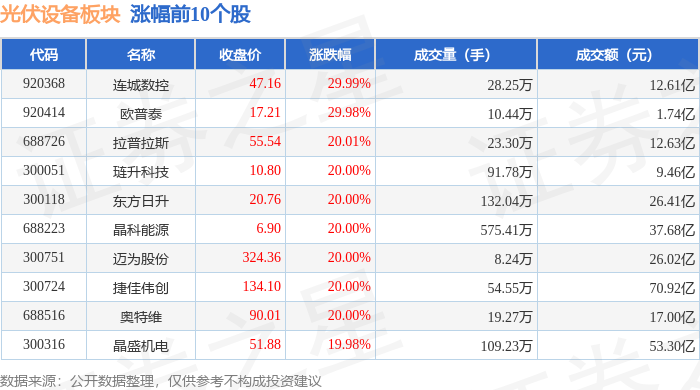
Core Viewpoint - The photovoltaic equipment sector experienced a significant increase of 9.05% on January 23, with Liancheng CNC leading the gains. The Shanghai Composite Index closed at 4136.16, up 0.33%, while the Shenzhen Component Index closed at 14439.66, up 0.79% [1]. Group 1: Stock Performance - Liancheng CNC (code: 920368) closed at 47.16, with a remarkable increase of 29.99% and a trading volume of 282,500 shares, resulting in a transaction value of 1.261 billion yuan [1]. - Oputai (code: 920414) also saw a significant rise of 29.98%, closing at 17.21 with a trading volume of 104,400 shares and a transaction value of 174 million yuan [1]. - Other notable performers included Laplace (code: 688726) with a 20.01% increase, closing at 55.54, and a transaction value of 1.263 billion yuan [1]. Group 2: Capital Flow - The photovoltaic equipment sector saw a net inflow of 8.998 billion yuan from main funds, while retail funds experienced a net outflow of 3.626 billion yuan [2]. - The main funds showed a significant presence in stocks like Longi Green Energy (601012), which had a net inflow of 2.692 billion yuan, accounting for 28.66% of the total [3]. - In contrast, retail investors showed a net outflow from several stocks, including TCL Zhonghuan (002129) and Aiko Solar (600732), indicating a shift in investor sentiment [3].


龙虎榜丨捷佳伟创20%涨停,深股通净买入4.15亿元,量化打板净买入2.1亿元
Ge Long Hui A P P· 2026-01-23 09:08
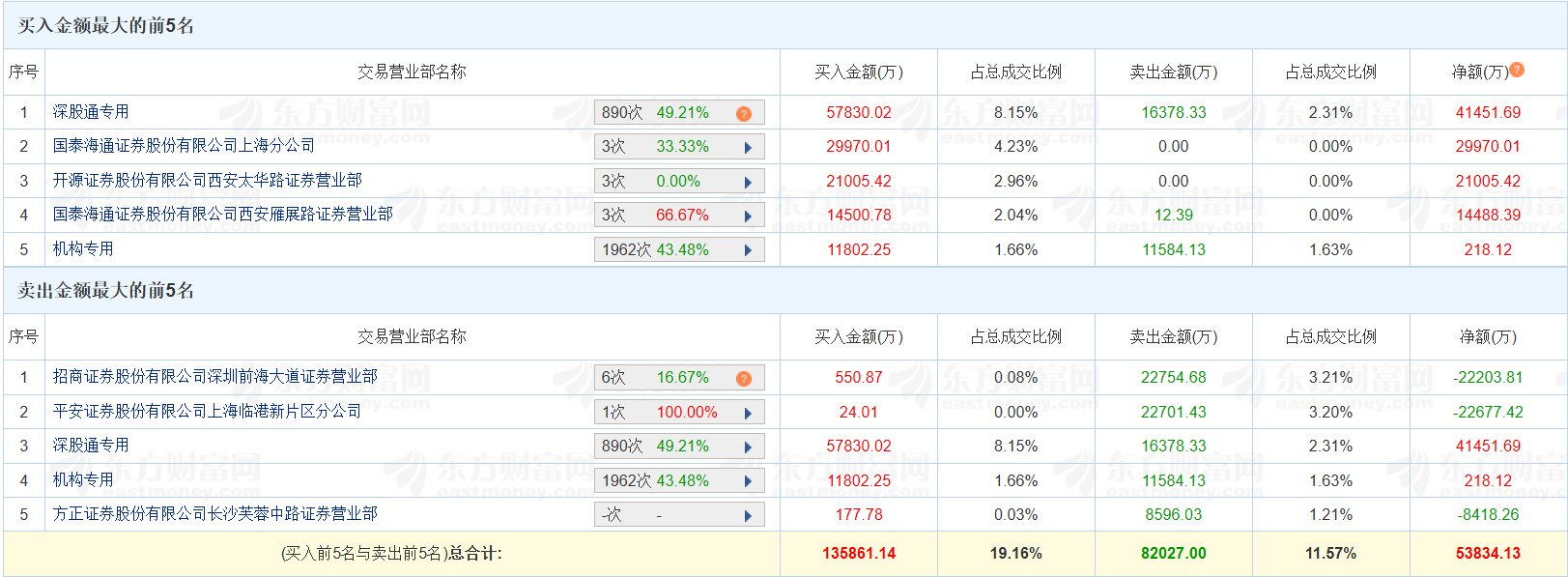
捷佳伟创(300724.SZ)今日20%涨停,换手率18.96%,成交额70.92亿元。龙虎榜数据显示,深股通买入5.78亿元,卖出1.64亿元,净买入4.15亿元;游资"量化 打板"位列买三席位,净买入2.1亿元。上榜席位全天买入13.59亿元,卖出8.2亿元,合计净买入5.38亿元。(格隆汇) | 买入金额最大的前5名 | | | | | | | | | --- | --- | --- | --- | --- | --- | --- | --- | | 序号 | | 交易营业部名称 | | | | 买入金额(万) | 占总成交比例 | | 1 深股通专用 | | | 890次 49.21% | | 2 | 57830.02 | 8.15% | | 2 | 国泰海通证券股份有限公司上海分公司 | | 3次 | 33.33% | | 29970.01 | 4.23% | | 3 | 开源证券股份有限公司西安太华路证券营业部 | | 3次 0.00% | | | 21005.42 | 2.96% | | 4 | 国泰海通证券股份有限公司西安雁展路证券营业部 | | 3次 | 66.67% | | 14500.7 ...
大爆发!601012,午后涨停
证券时报· 2026-01-23 08:50
Core Viewpoint - The photovoltaic industry chain stocks have collectively surged, leading to a wave of stock price limits being hit, driven by the space photovoltaic concept and strong performance in related sectors [1][4]. Photovoltaic Industry - The space photovoltaic concept has catalyzed a significant rise in the entire photovoltaic industry chain, with multiple stocks hitting their daily price limits. Notable performers include Liancheng CNC and Optech, both reaching a 30% increase, while companies like Maiwei and Jiejia Weichuang saw a 20% rise [4]. - The market saw a strong performance from various photovoltaic stocks, with over ten stocks achieving a 20% increase, and others like Longi Green Energy and Junda shares also showing significant gains [4]. Market Performance - On January 23, the A-share market indices rose across the board, with the North Securities 50 Index increasing by nearly 4%. The total market turnover exceeded 3 trillion yuan, with over 3,900 stocks gaining, and more than 120 stocks hitting their daily limits [2]. - The A-share market's strong performance was complemented by a notable increase in the non-ferrous metals sector, with cobalt, nickel, and gold stocks performing particularly well [2][8]. Precious Metals - International gold prices surged, with spot gold breaking through $4,950 per ounce, marking a historical high. The COMEX gold futures also saw significant gains, reaching up to $4,970 per ounce [10]. - The continuous rise in gold prices over the past three years has been attributed to various factors, including geopolitical tensions and concerns over the U.S. dollar's credibility, with expectations of further increases in gold prices [10]. Retail Pharmacy Sector - The retail pharmacy sector experienced a collective rise, with stocks like Yifeng Pharmacy hitting their daily limit, and others like Dazhenglin and Renmintongtai also showing strong performance [12]. - Recent policies from the Ministry of Commerce and other departments aim to promote high-quality development in the pharmaceutical retail industry, encouraging mergers and optimizing the business environment for pharmacies [14].