
S.C(300724)

Search documents
商业航天深度报告:太空光伏大有可为,卫星太阳翼市场持续扩容
ZHONGTAI SECURITIES· 2026-01-21 00:25
Investment Rating - The report does not explicitly state an investment rating for the industry. Core Insights - The demand for satellite internet networking is urgent, and space computing opens new growth opportunities. The construction of satellite internet networks is driven by strong demand due to the advantages of wide coverage, strong disaster resistance, and rapid deployment. The International Telecommunication Union (ITU) has established principles for satellite frequency and orbit usage, leading to a competitive race for low Earth orbit resources. The construction and launch of satellite constellations in China are accelerating, with a significant gap compared to the US [4][16]. - Space computing is leading to increased demand for satellites. The traditional model of "ground computing" is evolving to "space computing," with satellites equipped with AI chips and edge computing modules to process data in orbit, significantly reducing transmission delays and processing times. Major companies are investing in space computing infrastructure, which is expected to drive the demand for satellites [17][19]. - Solar wings are the only efficient and long-term energy supply solution for near-Earth commercial space. Solar wings account for approximately 12%-24% of the satellite's value, and their area is continuously increasing, which enhances the overall power supply capacity of satellites. The transition from rigid to flexible solar wings is a key trend, with different technological routes being adopted in China and the US [4][28][38]. Summary by Sections Satellite Internet Networking - The urgent need for satellite internet networking is driven by the rapid release of rigid application demands in communication, navigation, and remote sensing. The construction of satellite internet networks is becoming increasingly critical due to limited low Earth orbit resources and the competitive landscape [11][16]. - The ITU's "first come, first served" principle has intensified the competition for satellite orbital resources, with China lagging in the completion rate of its satellite constellations compared to the US [16][18]. Space Computing - Space computing is transforming satellite demand by embedding AI capabilities into satellite systems, allowing for in-orbit data processing and reducing the need for ground-based data transmission. This shift is expected to significantly enhance the capabilities and applications of satellites [19][22]. Solar Wings - Solar wings are essential for providing continuous power to satellites, with their value accounting for a significant portion of the satellite's overall worth. The area of solar wings is increasing, which is expected to enhance the power supply capabilities of satellites [28][30]. - The transition from rigid to flexible solar wings allows for greater power generation efficiency and is particularly suited for high-power and multi-satellite launch scenarios. The flexible solar wings can achieve a higher power-to-weight ratio and better space utilization [38][45]. Technology Routes - There are notable differences in the solar wing battery technology routes between China and the US. The US primarily uses silicon solar cells due to their lower costs and established supply chains, while China is exploring gallium arsenide cells for their higher power-to-weight ratios and efficiency [51][62]. - Gallium arsenide cells are being actively explored for cost reduction, and perovskite cells are emerging as a potential next-generation solution for solar wings due to their low cost and high efficiency [65][69].


广发证券:太空算力远期市场空间广阔 太阳翼或为最优通胀环节
智通财经网· 2026-01-20 08:43
Group 1 - The core viewpoint is that the industry has a vast long-term market space due to the active layout of space computing by China and the US, combined with the cost and performance advantages of space computing itself [3][4] - Space computing is transitioning from a "ground-based calculation" model to a "space-based calculation" model, allowing for direct data processing in space [1][3] Group 2 - Space computing has operational cost advantages, with a significant focus on marginal energy costs, which are the core factor in overall operational expenses [2] - For example, a single space-based 40MW computing cluster can operate for 10 years at a total cost of $8.2 million, saving approximately $159 million compared to traditional computing clusters, with over $130 million saved in marginal energy costs [2] Group 3 - The demand for solar wings is expected to increase due to the expansion of power and area requirements driven by space computing, leading to the adoption of flexible technology routes [4] - Flexible solar wings can achieve a weight reduction of 20%-40%, a storage volume reduction of over 60%, and improved performance, making them a key component in the power system [4] Group 4 - Investment recommendations include focusing on companies related to space photovoltaics, such as: - Maiwei Co., Ltd. (300751.SZ), which is expected to become a core equipment supplier for space computing photovoltaic segments [5] - Gaomei Co., Ltd. (688556.SH), which aligns with the cost reduction route for space photovoltaics [5] - Jiejia Weichuang (300724.SZ), which is positioned to benefit from the expansion of flexible solar wings in the space computing sector [5]



捷佳伟创股价跌5.26%,永赢基金旗下1只基金重仓,持有5800股浮亏损失3.6万元
Xin Lang Cai Jing· 2026-01-20 05:31
Group 1 - The core point of the news is that Jiejia Weichuang's stock price dropped by 5.26% to 111.56 CNY per share, with a trading volume of 2.525 billion CNY and a turnover rate of 7.56%, resulting in a total market capitalization of 38.855 billion CNY [1] - Jiejia Weichuang, established on June 18, 2007, and listed on August 10, 2018, specializes in the research, production, and sales of crystalline silicon solar cell equipment, with its main business revenue composition being 83.34% from process equipment, 12.05% from automation supporting equipment, and 4.62% from components [1] Group 2 - From the perspective of major fund holdings, Yongying Fund has one fund heavily invested in Jiejia Weichuang, specifically the Yongying Guozheng Free Cash Flow ETF Link A (025168), which held 5,800 shares, accounting for 0.06% of the fund's net value, ranking as the ninth largest holding [2] - The Yongying Guozheng Free Cash Flow ETF Link A (025168) was established on September 16, 2025, with a latest scale of 444 million CNY, and has achieved a year-to-date return of 4.2%, ranking 3315 out of 5542 in its category, with a cumulative return of 10.5% since inception [2]
捷佳伟创:公司在钙钛矿设备领域紧跟技术发展和客户需求,不断创新持续突破
Zheng Quan Ri Bao Wang· 2026-01-19 13:43
Core Viewpoint - The company, Jiejia Weichuang, is actively expanding its capabilities in the perovskite battery sector, leveraging its technological advancements and material advantages to explore new application areas [1] Group 1: Company Developments - The company has been closely following technological developments and customer demands in the perovskite equipment field, continuously innovating and making breakthroughs [1] - Since entering the perovskite sector, the company has participated in tenders for perovskite projects from various leading and startup companies in the new energy sector, successfully delivering complete perovskite battery production line equipment and multiple key process equipment [1] - The company plans to continue investing in research and development as well as market expansion in the perovskite field [1]
光伏设备行业点评:商业航天星辰大海,太空光伏设备迎增长机遇
Shenwan Hongyuan Securities· 2026-01-19 13:42
Investment Rating - The report rates the commercial aerospace and photovoltaic equipment industry as "Overweight" [4]. Core Insights - The commercial aerospace sector is entering a new phase characterized by large-scale deployment and capability upgrades, leading to increased demand for space photovoltaic systems. The application for over 200,000 satellites in China marks a transition from "thousands" to "tens of thousands" and even "millions" of satellites, indicating a super cycle in satellite manufacturing and launching over the next decade, which will drive long-term, large-scale demand for satellite energy systems, specifically space photovoltaics [4]. - The extreme conditions in space (high radiation, large temperature differences, vacuum) necessitate stringent requirements, leading to continuous iterations in space photovoltaic technology. The current mature solution is gallium arsenide (GaAs) multi-junction cells, which have high conversion efficiency (generally exceeding 30%) and good radiation resistance, but are extremely expensive and have limited production capacity. The short to medium-term scalable path is the HJT (Heterojunction) battery, which is more cost-effective for mass production despite lower absolute efficiency and radiation resistance compared to GaAs. Long-term potential directions include perovskite and tandem batteries, which have high theoretical efficiency limits and lightweight properties, but face challenges in long-term stability [4]. - Key equipment suppliers to focus on include Maiwei Co., Ltd. (HJT production line equipment), High Measurement Co., Ltd. (integrated slicing and processing services), Aotwei (module string welding equipment), and others. Battery module manufacturers include Yunda Co., Ltd. (collaborating on perovskite technology applications) and Trina Solar [4]. Summary by Sections Industry Overview - The commercial aerospace market in China is expected to expand significantly due to the submission of over 200,000 satellite constellation applications, which will stimulate demand across multiple segments including satellite manufacturing and rocket launching [2]. Technology Development - The report highlights the transition from traditional satellite power supply units to essential energy infrastructure for future space economies, driven by advancements in space computing and AI data centers powered by space photovoltaics [4]. Key Companies and Valuations - The report provides a valuation table for key companies in the industry, including Maiwei Co., Ltd. with a market cap of 66.5 billion and projected net profits for 2026 of 970 million, and others like Aotwei and High Measurement with varying financial forecasts [5].


捷佳伟创:公司子公司创微微电子主要业务为半导体清洗设备的研发、生产、销售和服务
Zheng Quan Ri Bao· 2026-01-19 13:12
Group 1 - The core viewpoint of the article is that Jiejia Weichuang's subsidiary, Chuangwei Microelectronics, is actively engaged in the research, production, sales, and service of semiconductor cleaning equipment and has been consistently receiving bulk orders [2] Group 2 - The company has confirmed its ongoing success in securing substantial orders for its semiconductor cleaning equipment [2]

钧达股份3000万元投资抢滩太空光伏! 特变电工涨超7%,光伏龙头ETF(516290)爆量涨超1%冲击四连阳!2026年最强电新主线确定了?
Xin Lang Cai Jing· 2026-01-19 03:01
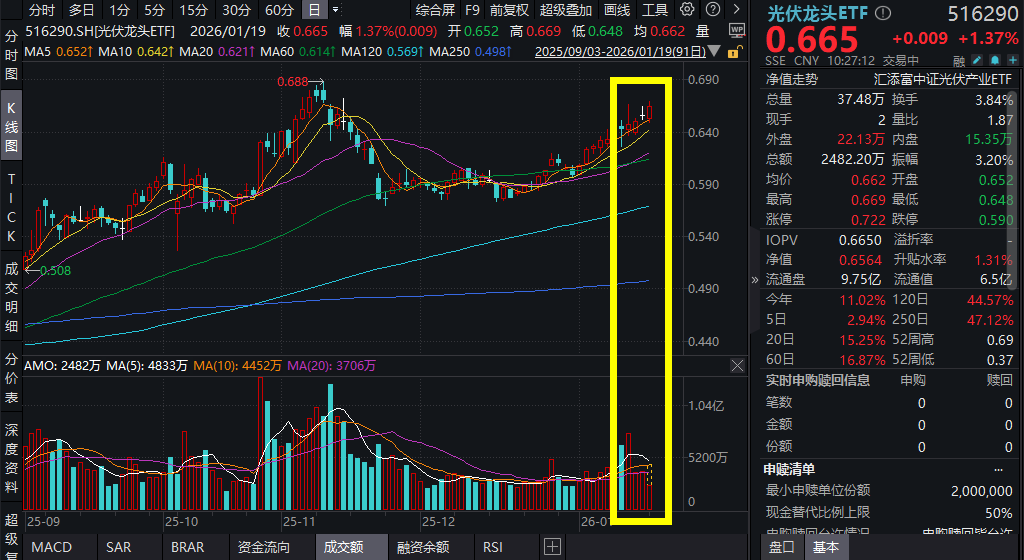
Core Viewpoint - The A-share market experienced fluctuations with the photovoltaic leader ETF (516290) seeing a significant increase of 1.37%, with a trading volume exceeding 30 million yuan, marking a four-day consecutive rise in daily performance [1]. Group 1: Market Performance - The photovoltaic leader ETF (516290) showed mixed performance among its constituent stocks, with TBEA rising over 7%, Maiwei Co. and Chint Electric increasing over 5%, while Longi Green Energy and Jiejia Weichuang experienced pullbacks [3]. - The top ten constituent stocks of the photovoltaic leader ETF include TBEA, which rose by 7.07%, and TCL Technology, which increased by 2.90%, while Longi Green Energy fell by 2.24% [4]. Group 2: Industry Developments - Junda Co. announced a 30 million yuan investment in Shanghai Xingyi Chip Energy Technology Co., aiming to leverage opportunities in the low-orbit satellite networking and space computing industry, enhancing capabilities in photovoltaic industrialization and perovskite technology [5]. - Space photovoltaic energy is highlighted as a strategic solution for commercial space and high-end applications, with the potential to supply energy to satellites and space stations, marking a pivotal moment for the industry [5]. Group 3: Future Outlook - Huaxi Securities emphasizes that photovoltaic technology is the only viable energy solution in space, with advantages over traditional fossil fuels and nuclear energy, making it suitable for extreme environments [5]. - According to CITIC Securities, the space photovoltaic market is expected to reach a trillion yuan scale, with satellite launches projected to increase from 5,000 to 50,000 between 2025 and 2040, driving demand for photovoltaic batteries from 0.024 GW to 1.8 GW [5]. - Guojin Securities expresses strong confidence in "space photovoltaic" becoming a dominant theme in the energy sector through 2026, driven by surging demand and the urgency for resource competition [6].




国家电网“十五五”投资4万亿元,固态电池近期催化密集落地



GOLDEN SUN SECURITIES· 2026-01-18 06:32
Investment Rating - The report indicates a positive outlook for the power equipment industry, particularly in the renewable energy sector, with significant investments and technological advancements expected to drive growth [1][2][4]. Core Insights - The report highlights that the State Grid's investment during the "14th Five-Year Plan" period is projected to reach 4 trillion yuan, marking a 40% increase compared to the previous plan [2]. - The report emphasizes the stability in polysilicon prices and the continuous rise in battery component prices, with N-type battery prices increasing to 0.40 yuan per watt [15][16]. - The report identifies three key areas of focus: supply-side reform leading to price increases in the industry chain, long-term growth opportunities from new technologies, and industrialization opportunities from perovskite GW-level layouts [16]. Summary by Sections 1. New Energy Generation 1.1 Photovoltaics - Polysilicon prices remain stable, while battery component prices are on the rise, with N-type battery prices reaching an average of 0.40 yuan per watt [15]. - The report notes that leading component companies are responding to industry self-discipline by raising component prices, with distributed sales prices reaching 0.72 yuan per watt [15][16]. - Key companies to watch include Tongwei Co., GCL-Poly, LONGi Green Energy, JA Solar, and Trina Solar [16]. 1.2 Wind Power & Grid - The UK AR7 offshore wind auction results exceeded expectations, with a total scale of approximately 8.4GW, validating the upward trend in European offshore wind [17]. - The State Grid's investment is expected to enhance transmission capacity significantly, addressing bottlenecks in renewable energy delivery [18]. - Companies to focus on include Goldwind, Yunda Wind Power, Mingyang Smart Energy, and Sany Heavy Energy [18]. 1.3 Hydrogen & Energy Storage - By 2025, the production and sales of fuel cell vehicles in China are projected to reach 7,797 units, reflecting a 44% year-on-year increase [20]. - The report anticipates that new energy storage installations will reach 58.6GW/175.3GWh by 2025, with significant growth expected in the energy storage sector [21]. - Key players in the hydrogen sector include Shuangliang Energy, Huadian Heavy Industries, and Shenghui Technology [20]. 2. New Energy Vehicles - Solid-state batteries are gaining traction, with several automakers making progress towards mass production by 2026 [29]. - Companies such as BYD, Changan Automobile, and Chery are expected to achieve significant milestones in solid-state battery technology [29]. - The report suggests monitoring companies like Xiamen Tungsten, Hailiang Co., and Nanjing Advanced Lithium Battery [29]. 3. Industry Trends - The report notes a 0.4% increase in the new energy equipment sector from January 12 to January 16, 2026, with a cumulative increase of 5.3% since the beginning of the year [12]. - The photovoltaic equipment sector saw a 3.52% increase, while the wind power equipment sector experienced a decline of 1.28% during the same period [13].
光伏出口退税新政出台!光伏ETF华夏(515370)回调1.83%,钧达股份涨超8%
Mei Ri Jing Ji Xin Wen· 2026-01-13 06:04
Core Viewpoint - The recent announcement by China's Ministry of Finance and State Taxation Administration regarding the adjustment of export tax rebate policies for photovoltaic products is expected to impact the industry significantly, particularly in the battery sector, leading to short-term export surges and long-term structural changes in the market [1]. Group 1: Policy Changes - The export VAT rebate rate for battery products will be reduced from 9% to 6% starting April 1, 2026, and will be completely eliminated from January 1, 2027 [1]. - This policy change is anticipated to create a rush in battery exports in 2026, intensifying supply-demand tensions in lithium mining and lithium hexafluorophosphate sectors [1]. Group 2: Market Impact - The adjustment is expected to lead to the elimination of outdated domestic production capacities in the long run, optimizing the battery industry landscape [1]. - Companies with overseas production capabilities are likely to benefit from these changes, as the market dynamics shift [1]. Group 3: ETF Performance - The Huaxia Photovoltaic ETF (515370) experienced a decline of 1.83%, while its constituent stocks, such as Junda Co., saw gains exceeding 8% [1]. - The ETF tracks the CSI Photovoltaic Industry Index, which includes a comprehensive range of companies across the photovoltaic supply chain, reflecting an 83.64% photovoltaic content, ranking first in the market [1].


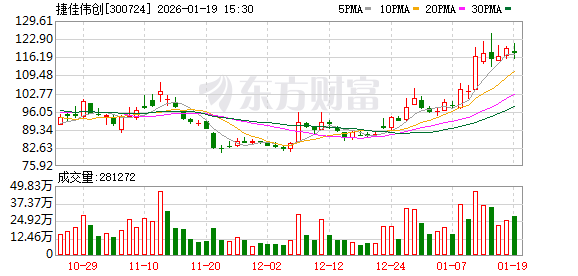
捷佳伟创跌2.02%,成交额9.44亿元,主力资金净流出2673.61万元
Xin Lang Cai Jing· 2026-01-13 03:32
Core Viewpoint - The stock price of Jiejia Weichuang has shown significant growth this year, with a year-to-date increase of 19.45% and notable gains over various trading periods, indicating strong market interest and performance in the photovoltaic equipment sector [2]. Group 1: Stock Performance - As of January 13, Jiejia Weichuang's stock price decreased by 2.02%, trading at 114.19 yuan per share, with a total market capitalization of 39.77 billion yuan [1]. - The company has experienced a stock price increase of 19.45% year-to-date, with a 14.97% rise over the last five trading days, 25.35% over the last 20 days, and 26.18% over the last 60 days [2]. Group 2: Financial Performance - For the period from January to September 2025, Jiejia Weichuang reported a revenue of 13.106 billion yuan, reflecting a year-on-year growth of 6.17%, and a net profit attributable to shareholders of 2.688 billion yuan, which is a 32.90% increase year-on-year [2]. - The company has distributed a total of 1.143 billion yuan in dividends since its A-share listing, with 903 million yuan distributed over the past three years [3]. Group 3: Shareholder Information - As of September 30, 2025, the number of shareholders for Jiejia Weichuang was 81,000, a slight increase of 0.25% from the previous period, with an average of 3,553 circulating shares per shareholder, down by 0.25% [2]. - Among the top ten circulating shareholders, Hong Kong Central Clearing Limited holds 8.3907 million shares, a decrease of 3,934 shares from the previous period, while the Southern CSI 500 ETF is a new entrant with 4.2388 million shares [3].