
SYG(300740)

Search documents
水羊股份(300740):加大投放聚焦长期增长 双11延续亮眼表现
Xin Lang Cai Jing· 2025-11-28 00:32
Group 1 - The core viewpoint indicates that both Yifidan and PA are expected to maintain double-digit growth during the Double Eleven shopping festival, driven by increased marketing efforts and strong product performance [1] - Yifidan's Q3 2025 revenue is projected at 3.409 billion with a year-on-year growth of 11.96%, while net profit attributable to shareholders is expected to reach 136 million, reflecting a significant increase of 44.01% [1] - PA's Q3 2025 revenue is anticipated to be 909 million, showing a year-on-year growth of 20.92%, with a turnaround in net profit attributable to shareholders, indicating a recovery from previous losses [1] Group 2 - The investment suggestion emphasizes that the company is focusing on long-term growth through increased resource allocation, particularly in marketing and research and development [2] - The marketing strategy is centered on enhancing brand strength through content marketing on platforms like Xiaohongshu, while also solidifying foundational R&D capabilities to support overall brand development [2] - Looking ahead, the company expects improvements in the high-end brand matrix and profitability as marketing efforts begin to yield results, alongside structural optimization in agency business [2]
化妆品板块11月27日涨1.6%,科思股份领涨,主力资金净流出2533.51万元
Zheng Xing Xing Ye Ri Bao· 2025-11-27 09:13
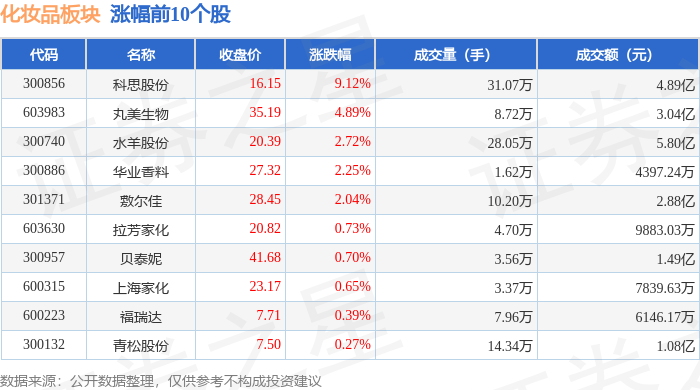
Core Viewpoint - The cosmetics sector experienced a 1.6% increase on November 27, with Keshare leading the gains, while the overall market showed mixed results with the Shanghai Composite Index rising by 0.29% and the Shenzhen Component Index declining by 0.25% [1] Group 1: Market Performance - The Shanghai Composite Index closed at 3875.26, up 0.29% [1] - The Shenzhen Component Index closed at 12875.19, down 0.25% [1] - The cosmetics sector's individual stock performance is detailed in a table, highlighting significant gainers such as Keshare with a 9.12% increase [1] Group 2: Individual Stock Performance - Keshare (300856) closed at 16.15 with a 9.12% increase and a trading volume of 310,700 shares, amounting to a transaction value of 489 million yuan [1] - Marubi Biological (603983) closed at 35.19, up 4.89%, with a trading volume of 87,200 shares and a transaction value of 304 million yuan [1] - Other notable performers include Water Sheep (300740) with a 2.72% increase and a transaction value of 580 million yuan [1] Group 3: Capital Flow Analysis - The cosmetics sector saw a net outflow of 25.34 million yuan from institutional investors and 82.57 million yuan from retail investors, while individual investors contributed a net inflow of 108 million yuan [2] - A detailed table shows the capital flow for individual stocks, indicating that LaFang (603630) had a net inflow of 5.96 million yuan from institutional investors [3] - Other stocks like Shanghai Jahwa (600315) and Huaye Fragrance (300886) also experienced varying degrees of net inflow and outflow from different investor categories [3]



化妆品板块11月26日跌1.1%,科思股份领跌,主力资金净流入795.52万元
Zheng Xing Xing Ye Ri Bao· 2025-11-26 09:12
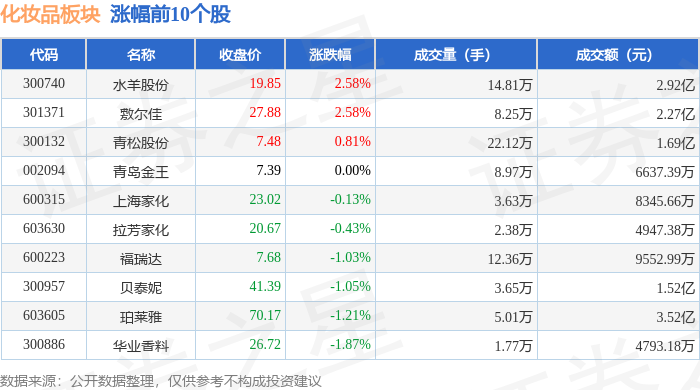
Market Overview - The cosmetics sector experienced a decline of 1.1% on November 26, with Kesheng Co. leading the drop [1] - The Shanghai Composite Index closed at 3864.18, down 0.15%, while the Shenzhen Component Index closed at 12907.83, up 1.02% [1] Individual Stock Performance - Notable gainers included: - Shuiyang Co. (300740) with a closing price of 19.85, up 2.58% [1] - Fulejia (301371) also rose by 2.58% to 27.88 [1] - Major decliners included: - Kesheng Co. (300856) fell by 4.88% to 14.80 [2] - Marubi Bio (603983) decreased by 2.95% to 33.55 [2] - Jiahen Home (300955) dropped by 2.85% to 37.84 [2] Trading Volume and Capital Flow - The cosmetics sector saw a net inflow of 7.95 million yuan from institutional investors, while retail investors contributed a net inflow of 7.35 million yuan [2] - However, there was a net outflow of 15.30 million yuan from speculative funds [2] Detailed Capital Flow Analysis - Key stocks with significant capital flow: - Jiahen Home (300955) had a net inflow of 18.65 million yuan from institutional investors, but a net outflow of 19.54 million yuan from retail investors [3] - Fulejia (301371) saw a net inflow of 12.12 million yuan from speculative funds, despite a net outflow from retail investors [3] - Other stocks like Qingdao King (002094) and Shanghai Jahwa (600315) also experienced mixed capital flows, indicating varied investor sentiment [3]


水羊股份涨2.09%,成交额1.74亿元,主力资金净流出34.60万元
Xin Lang Zheng Quan· 2025-11-25 06:03
Core Viewpoint - Water Goat Co., Ltd. has shown a significant increase in stock price this year, but recent trading indicates a decline in the short term, raising questions about future performance and investor sentiment [1][2]. Financial Performance - For the period from January to September 2025, Water Goat achieved a revenue of 3.409 billion yuan, representing a year-on-year growth of 11.96%. The net profit attributable to shareholders was 136 million yuan, reflecting a substantial increase of 44.01% compared to the previous year [2]. - The company has distributed a total of 142 million yuan in dividends since its A-share listing, with 77.8142 million yuan distributed over the past three years [3]. Stock Market Activity - As of November 25, Water Goat's stock price rose by 2.09% to 19.50 yuan per share, with a trading volume of 174 million yuan and a turnover rate of 2.50%, resulting in a total market capitalization of 7.605 billion yuan [1]. - The stock has increased by 47.50% year-to-date, but has seen a decline of 9.89% over the last five trading days, 11.84% over the last 20 days, and 9.60% over the last 60 days [1]. Shareholder Structure - As of November 10, the number of shareholders for Water Goat increased to 30,000, a rise of 10.64%. The average number of circulating shares per shareholder decreased by 9.61% to 11,966 shares [2]. - Notable changes in institutional holdings include Hong Kong Central Clearing Limited becoming the sixth largest shareholder with 8.1833 million shares, an increase of 5.6594 million shares from the previous period. New shareholders include Huaxia Domestic Demand Driven Mixed A and Caitong Asset Management [3]. Business Overview - Water Goat Co., Ltd. is based in Changsha, Hunan Province, and was established on November 1, 2012. It was listed on February 8, 2018. The company's main business involves the research, production, and sales of cosmetics, with the primary revenue sources being lotions and creams (81.84%), masks (17.32%), and other products (0.84%) [1][2].
烟火智造 潮涌星城 | 水羊股份:以研发双驱解锁 “长沙造美妆” 新高度
Chang Sha Wan Bao· 2025-11-20 09:47
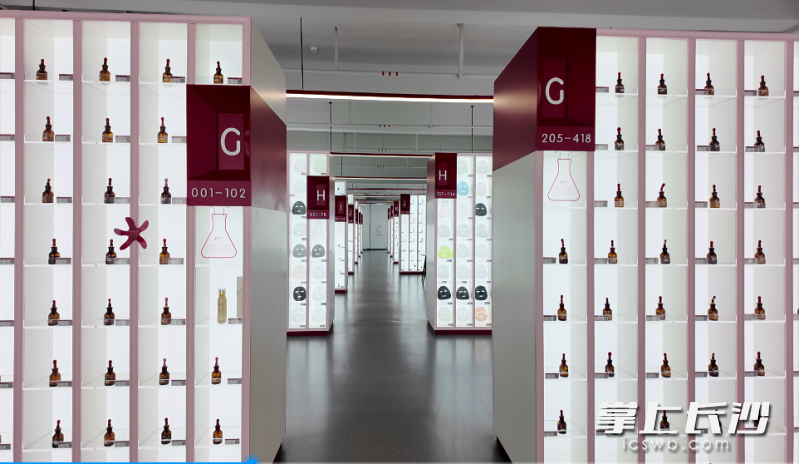
Core Insights - Water Sheep Group Co., Ltd. (水羊股份) is a local beauty manufacturing company in Changsha that focuses on research and development to enhance its global market presence [1][3] - The company has invested over 1 billion yuan in R&D, establishing a 12-story research building and creating an integrated and open collaborative R&D platform [3][4] R&D and Production Capabilities - Water Sheep has developed over 8,000 proprietary formula samples, showcasing its strength in R&D and providing diverse beauty product options [4] - The company has participated in the formulation of 29 national and industry standards, holds over 400 patents, and has developed more than 4,000 quality management processes [4][6] - The production process is highly automated, allowing for simultaneous production of various products, which enhances efficiency by over 30% compared to industry averages [6] Future Plans - Water Sheep aims to invest an additional 1 billion yuan over the next decade to expand its global product development and support Changsha in becoming a global R&D center for the cosmetics industry [6]
化妆品板块11月20日跌2.85%,芭薇股份领跌,主力资金净流出3.77亿元
Zheng Xing Xing Ye Ri Bao· 2025-11-20 09:16
Market Overview - The cosmetics sector experienced a decline of 2.85% on November 20, with Bavi Co. leading the drop [1] - The Shanghai Composite Index closed at 3931.05, down 0.4%, while the Shenzhen Component Index closed at 12980.82, down 0.76% [1] Individual Stock Performance - Jiahen Home Cosmetics (300955) closed at 38.29, up 1.48% with a trading volume of 27,300 shares and a turnover of 103 million yuan [1] - Bavi Co. (920123) saw a significant drop of 9.28%, closing at 17.89 with a trading volume of 88,500 shares and a turnover of 163 million yuan [2] - Qingdao Kingway (002094) closed at 7.69, down 2.16%, with a trading volume of 214,700 shares and a turnover of 166 million yuan [1][2] Capital Flow Analysis - The cosmetics sector experienced a net outflow of 377 million yuan from institutional investors, while retail investors saw a net inflow of 323 million yuan [2] - The main capital inflow and outflow for various stocks indicate a mixed sentiment, with some stocks like Jiahen Home Cosmetics seeing a net inflow of 9.93 million yuan from institutional investors [3] Notable Stock Movements - Fuleida (600223) had a net outflow of 25.36 million yuan from institutional investors, but a net inflow of 9.99 million yuan from retail investors [3] - Kesheng Co. (300856) experienced a net outflow of 29.14 million yuan from institutional investors, while retail investors contributed a net inflow of 12.29 million yuan [3]


美容护理行业资金流出榜:爱美客、水羊股份等净流出资金居前
Zheng Quan Shi Bao Wang· 2025-11-20 09:01
Market Overview - The Shanghai Composite Index fell by 0.40% on November 20, with 7 industries experiencing gains, led by construction materials and comprehensive sectors, which rose by 1.40% and 0.87% respectively [1] - The beauty and personal care industry had the largest decline, dropping by 2.39%, followed by the coal industry with a decrease of 2.10% [1] Capital Flow Analysis - The net outflow of capital from the two markets reached 47.655 billion yuan, with only 4 industries seeing net inflows [1] - The banking sector led the net inflow with 2.188 billion yuan and a daily increase of 0.86%, followed by the telecommunications sector with a net inflow of 1.000 billion yuan and a rise of 0.51% [1] Beauty and Personal Care Industry - The beauty and personal care industry saw a net outflow of 507 million yuan, with 29 stocks in the sector; only 2 stocks increased while 26 stocks declined [2] - The top net inflow stock in this sector was Jiaheng Jiahua, with an inflow of 7.3004 million yuan, followed by Yiyi Co., which had an inflow of 3.7708 million yuan [2] - Six stocks in the beauty and personal care sector experienced net outflows exceeding 30 million yuan, with the largest outflows from Aimeike (67.368 million yuan), Shuiyang Co. (60.040 million yuan), and Qingsong Co. (44.6899 million yuan) [2][3] Individual Stock Performance - Aimeike had a decline of 3.00% with a net outflow of 67.368 million yuan [2] - Shuiyang Co. dropped by 8.32% with a net outflow of 60.0396 million yuan [2] - Qingsong Co. fell by 3.78% with a net outflow of 44.6899 million yuan [2]
美容护理观察系列1:双11稳态与新变并存
Orient Securities· 2025-11-20 04:15
Investment Rating - The industry investment rating is "Positive (Maintain)" [6] Core Insights - The beauty and personal care sector is transitioning from "single functional consumption" to "composite efficacy + emotional consumption," indicating enhanced consumer resilience [4] - The beauty industry is no longer reliant on a single traffic window, with narratives around channel efficiency strengthening [4] - Leading brands exhibit stronger resilience, with a positive outlook on companies with robust brand assets that can capitalize on channel and product cycles [4] Summary by Sections Industry Overview - The Double 11 shopping festival saw a total e-commerce sales of 16,950 billion yuan, reflecting a year-on-year growth of 14.2% [8] - Beauty and personal care sales reached 991 billion yuan, growing by 11.65% [8] - Instant retail sales surged to 670 billion yuan, marking a remarkable growth of 138.4% [8] Market Dynamics - Tmall leads in high-end beauty sales, while Douyin is becoming a significant platform for domestic brands [8] - The top five beauty brands on Tmall include Proya, Estée Lauder, Lancôme, L'Oréal, and SkinCeuticals, with Proya maintaining the top position for three consecutive years [8] - Douyin's beauty sales rankings show Han Shu at the top, followed by Proya and L'Oréal [8] Company Performance - Leading brands like Up Beauty, Ruo Yu Chen, and Mao Ge Ping have shown impressive performance during the Double 11 event [8] - Up Beauty's sales increased by 145% year-on-year, with significant growth on both Tmall and Douyin [8] - Ruo Yu Chen's sales saw a staggering 35-fold increase year-on-year, with Douyin sales growing by over 100% [8]


化妆品板块11月19日涨1.72%,科思股份领涨,主力资金净流入2.01亿元
Zheng Xing Xing Ye Ri Bao· 2025-11-19 08:58
Market Overview - The cosmetics sector increased by 1.72% on November 19, with Keshare leading the gains [1] - The Shanghai Composite Index closed at 3946.74, up 0.18%, while the Shenzhen Component Index closed at 13080.09, unchanged [1] Key Performers - Keshare (300856) closed at 15.29, up 7.98% with a trading volume of 315,500 shares and a turnover of 475 million yuan [1] - Bavi (920123) closed at 19.72, up 4.89% with a trading volume of 118,600 shares and a turnover of 229 million yuan [1] - Lafang (603630) closed at 24.60, up 4.15% with a trading volume of 145,700 shares and a turnover of 353 million yuan [1] - Other notable performers include Shuiyang (300740) and Tian Cai Ya (603605), with increases of 3.28% and 2.55% respectively [1] Fund Flow Analysis - The cosmetics sector saw a net inflow of 201 million yuan from institutional investors, while retail investors experienced a net outflow of 252 million yuan [2] - Keshare had a net inflow of 63.71 million yuan from institutional investors, while retail investors had a net outflow of 47.79 million yuan [3] - Other companies like Shuiyang and Furuida also experienced significant net inflows from institutional investors, indicating strong interest in the sector [3]

水羊股份股价涨5.08%,兴业基金旗下1只基金重仓,持有77.32万股浮盈赚取85.05万元
Xin Lang Cai Jing· 2025-11-19 06:03
Group 1 - The core viewpoint of the news is that Shuiyang Group Co., Ltd. has seen a significant increase in its stock price, rising by 5.08% to 22.74 CNY per share, with a trading volume of 671 million CNY and a turnover rate of 8.39%, resulting in a total market capitalization of 8.869 billion CNY [1] - Shuiyang Group, established on November 1, 2012, and listed on February 8, 2018, is primarily engaged in the research, production, and sales of cosmetics [1] - The main revenue composition of Shuiyang Group includes 81.84% from lotions and creams, 17.32% from masks, and 0.84% from other supplementary products [1] Group 2 - From the perspective of fund holdings, a fund under Industrial Bank has heavily invested in Shuiyang Group, with the "Industrial Consumption Selected Mixed A" fund holding 773,200 shares, accounting for 4.8% of the fund's net value, making it the ninth largest holding [2] - The "Industrial Consumption Selected Mixed A" fund was established on December 16, 2020, with a current scale of 207 million CNY, and has achieved a year-to-date return of 0.99%, ranking 7811 out of 8138 in its category [2] - The fund manager, Jiang Lisi, has been in charge for 4 years and 340 days, with the fund's total asset size at 369 million CNY, and the best and worst returns during her tenure being -1.92% and -25.64%, respectively [2]