
AMD(AMD)

Search documents
人工智能月度跟踪:CES2026AI前沿信息汇总-20260109
Shanghai Aijian Securities· 2026-01-09 11:04
Investment Rating - The report rates the electronic industry as "Outperform the Market" [1] Core Insights - The CES 2026 showcased significant advancements in AI computing platforms, with NVIDIA announcing the Vera Rubin AI supercomputer platform, which is set to enter mass production in 2026. This platform includes six new chips designed for high-performance AI tasks [2][5][20] - NVIDIA's Vera Rubin platform aims to reduce the cost of inference per token by 90% and decrease the number of GPUs required for training mixture of experts (MoE) models by 75% [14][20] - AMD introduced the Helios AI rack platform, featuring a 2nm EPYC Venice Zen6 CPU and Instinct MI455X GPU, promising 2.9 Exaflops of AI computing power [21][24] - Intel launched its Core Ultra Series 3 Processors, marking its first AI personal computer platform based on 18A process technology, with significant performance improvements over previous generations [27][31] Summary by Sections NVIDIA Vera Rubin Platform - The Vera Rubin platform includes Vera CPU and Rubin GPU, designed for high efficiency in AI tasks, with the CPU featuring 88 cores and 176 threads, and a memory bandwidth of 1.2TB/s [16][19] - The Rubin GPU boasts 50 petaflops of NVFP4 computing power and a memory bandwidth of 22TB/s, significantly enhancing performance compared to previous models [19][24] AMD Helios Platform - The Helios platform integrates a 2nm EPYC Venice Zen6 CPU and four MI455X GPUs, achieving a performance increase of 10 times over its predecessor [21][24] - The platform is designed with full liquid cooling and can support extensive AI workloads with a total of 4600 CPU cores and 18000 GPU cores in a complete rack configuration [21][24] Intel Core Ultra Series - Intel's new processors include high-end graphics capabilities and are designed for AI applications, with flagship models featuring 16-core CPUs and 50 TOPS NPU computing power [27][31] - The processors are set to be available for pre-sale starting January 6, 2026, with a global launch on January 27, 2026 [31]


Advanced Micro Devices, Inc. (AMD) Presents at CES 2026 Prepared Remarks Transcript
Seeking Alpha· 2026-01-09 06:44
Core Theme - The central theme of the event is the rapid advancement of AI technology, with a strong emphasis on the notion that the best is yet to come in AI innovation [3] Company and Industry Insights - The event marks the opening of CES 2026, highlighting the significance of the technology showcase and the presence of industry leaders [2] - The CEO expresses excitement about the latest technological advancements and the opportunity to connect with industry partners and experts [2] - The focus on AI indicates a broader industry trend towards integrating artificial intelligence into various sectors, suggesting a transformative impact on modern computing [3]


芯片巨头CES竞逐“千倍算力”,AI竞赛走向系统级对决
Jin Rong Jie· 2026-01-09 06:34
Group 1: Nvidia's Rubin Platform - Nvidia's new AI supercomputing platform, Rubin, has entered full production, featuring the Rubin GPU with a performance increase of 5 times over the previous Blackwell platform [1][2] - The Rubin platform integrates six new chips, achieving a 3.5 times increase in training performance and a 2.8 times increase in HBM4 memory bandwidth, while reducing the cost of generating tokens to about one-tenth of the previous generation [2] Group 2: AMD's Performance Enhancements - AMD announced the MI455X AI chip, which offers a 10 times performance improvement over the MI355X, and set an ambitious goal of achieving a 1000 times increase in AI performance over the next four years [3] - The MI455X chip is based on 2/3nm process technology and features 320 billion transistors, with the flagship model equipped with 432GB of HBM4 memory [3] Group 3: Memory Technology Breakthroughs - SK Hynix showcased its next-generation HBM4 product, featuring 16 layers and 48GB capacity, aimed at training models at the GPT-5 level [3] - HBM4 is crucial for AI chip manufacturers, with Nvidia's Rubin GPU architecture utilizing a Vera CPU and two Rubin 85 HBM4 GPUs, each with eight HBM4 interfaces [3] Group 4: Intel's Process Return and PC Market Competition - Intel launched the Panther Lake third-generation Core Ultra processor, its first consumer-grade product using 18A process technology, achieving a 60% improvement in multi-threaded performance compared to the previous generation [4] - The first consumer laptops featuring the third-generation Core Ultra processors will begin pre-sales on January 6, 2026, with global availability starting January 27, 2026 [4] Group 5: System Integration as a New Battlefield - The AI competition has evolved from a focus on chip performance to a comprehensive system efficiency competition, encompassing storage, interconnect, cooling, and software [5] - AMD's Helios platform features a liquid-cooled, modular design with AI computing power reaching 2.9 Exaflops and equipped with 31TB of HBM4 memory [5][6] - Nvidia also demonstrated its system-level capabilities with the Alpamayo open inference model series for autonomous vehicle development, highlighting the shift towards system integration as a core competitive factor in AI infrastructure [6]
史上最大规模Tech World,联想开启“混合式AI新纪元”
Tai Mei Ti A P P· 2026-01-09 06:16
Core Insights - Lenovo hosted the largest Tech World event at CES 2026, emphasizing the importance of hybrid AI in personal and enterprise applications [2] - The company aims to enhance AI capabilities through strategic partnerships with NVIDIA and AMD, focusing on AI infrastructure and deployment efficiency [3][5] - Lenovo's hybrid AI strategy integrates personal and enterprise AI, with the launch of Lenovo Qira, a personal super-intelligent agent, and Lenovo Lexiang, an enterprise super-intelligent agent [15][18] Group 1: Event Highlights - Lenovo rented the Sphere venue in Las Vegas, accommodating 15,000 attendees for Tech World, featuring discussions on AI with industry leaders [2] - CEO Yang Yuanqing highlighted that hybrid AI will enhance human capabilities and transform enterprises into self-learning entities [2] Group 2: Strategic Partnerships - Lenovo and NVIDIA announced the "Lenovo AI Cloud Super Factory" to reduce AI deployment time and scale up to 100,000 GPUs [5] - The collaboration aims to eliminate uncertainties in AI deployment, making it more predictable and manageable [5] - Lenovo will also be among the first to adopt AMD's Helios AI architecture for enterprise applications [5] Group 3: Product Innovations - Lenovo introduced the Aura Edition AI PC in collaboration with Intel, featuring the latest Core Ultra 300 processors [8] - The new AI PCs will include Smart Modes for automatic system optimization and Smart Share for enhanced sharing capabilities [9] - Lenovo's AI-driven products, including the ThinkPad Rollable XD and AI Glasses, showcase innovative designs and functionalities for various user scenarios [10][11] Group 4: AI Ecosystem Development - Lenovo's hybrid AI strategy includes the integration of personal and enterprise AI needs, with a focus on intelligent model orchestration and multi-agent collaboration [15][16] - The Lenovo Qira personal super-intelligent agent will operate seamlessly across devices, enhancing user experience [16] - Lenovo Lexiang serves as a unified interface for customer interactions, improving operational efficiency across various business functions [18] Group 5: Upcoming Opportunities - Lenovo's AI initiatives will be tested during the 2026 FIFA World Cup, where the company will apply its AI technologies to enhance the event experience [20] - The World Cup, expected to attract over 6 billion viewers, will serve as a platform to showcase Lenovo's AI capabilities in a high-stakes environment [20]



CES 2026:英特尔Panther Lake芯片瞄准掌上游戏,称AMD芯片“老旧”
Huan Qiu Wang· 2026-01-09 06:02
Core Insights - Intel showcased the Panther Lake chip at CES, targeting the handheld gaming device market and positioning itself against AMD's products, which it referred to as "old chips" [1][4] - Panther Lake is the first system-on-chip built on the advanced 18A process, featuring significant improvements in energy efficiency and performance per watt, with over a 15% increase compared to the previous generation [1] - The chip integrates the new Darkmont efficiency cores and utilizes RibbonFET transistors and PowerVia back power delivery technology, aligning with the power and performance needs of handheld devices [1] - The integrated Arc graphics performance, combined with XeSS 3 technology, is expected to enhance frame rates for handheld gaming significantly [1] Company Strategy - Intel's executive Nisha Nilarayouman emphasized that Panther Lake is specifically designed for the handheld market, indicating a strategic focus on this segment [4] - Despite AMD's current dominance in the handheld device market with its Z series chips, Intel is confident in its ability to compete through new product lines or customized optimized versions [4]
3 No-Brainer Next-Gen Technology Stocks to Buy Right Now
The Motley Fool· 2026-01-09 00:47
Core Insights - The article emphasizes the importance of identifying upcoming changes in technology rather than focusing solely on past performance [1][2] Group 1: Navitas Semiconductor - Navitas Semiconductor is positioned as a competitor in the semiconductor industry, focusing on power-efficient circuitry for various applications, including consumer electronics and electric vehicles [4][5] - The company utilizes advancements in silicon carbide and gallium nitride, which can improve power efficiency by 20% and 50% respectively compared to traditional alternatives [6] - The global market for semiconductor materials is projected to grow at an annualized rate of 25% through 2032, which could lead Navitas to profitability in the long term [9] Group 2: Nokia - Nokia has shifted its focus from mobile phones to networking and connectivity equipment, which remains its primary profit center [10] - A recent partnership with Nvidia aims to develop AI-integrated 6G wireless connectivity solutions, which could enhance mobile radio communications networks [11][12] - The collaboration is expected to benefit AI applications that rely on mobile networks, indicating a significant potential for growth in this sector [13] Group 3: Advanced Micro Devices (AMD) - AMD is the second-largest CPU manufacturer and is experiencing growth, particularly in its data center revenue, which increased by 22% year-over-year [15][17] - The company’s new Ryzen Embedded P100 processor is 35% faster than its predecessors, capable of handling 50 trillion operations per second, appealing to industries focused on AI [17] - Analysts maintain a strong buy consensus for AMD, with a price target of $287.27, indicating a potential upside of over 30% from its current price [20]

Why is AMD stock plunging sharply on Thursday?
Invezz· 2026-01-08 18:26
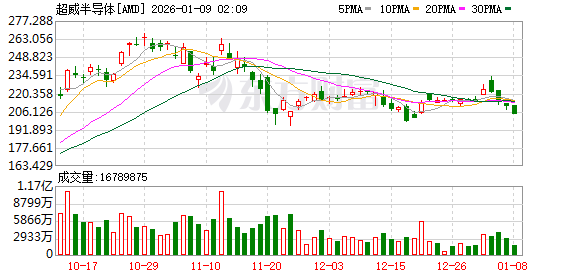
Core Viewpoint - Advanced Micro Devices (AMD) experienced a nearly 3% decline in stock price, dropping to $204.53, as investors shifted away from the semiconductor company following its CES product showcase [1] Company Summary - AMD's stock price fell by approximately 3% to $204.53 on Thursday [1] - The decline in stock price indicates a rotation of investor interest away from AMD after its recent product showcase at CES [1] Industry Summary - The semiconductor industry is experiencing fluctuations in investor sentiment, as evidenced by AMD's stock performance post-CES [1]
苏黄之争!AI芯片迎来巅峰战
Shen Zhen Shang Bao· 2026-01-08 18:08
Group 1 - Nvidia launched its new AI computing platform, Vera Rubin, which aims to revolutionize the AI industry by significantly reducing inference costs by 90% [2][6] - AMD responded with the introduction of the MI455X GPU and other products, indicating fierce competition in the AI chip market where Nvidia previously held an 80% market share [2][10] - The competition between Nvidia and AMD is not just about market share but also influences the future direction of the global AI industry [2] Group 2 - Nvidia's CEO Jensen Huang emphasized the shift towards "Physical AI," where AI systems will learn to understand the physical world, marking a new industrial revolution [4][5] - The Blackwell Ultra platform, which supports the "Physical AI" initiative, is set to enter mass production in Q2 2026, offering a 50% increase in computing power and a 30% reduction in power consumption [4] - Nvidia's Rubin platform integrates six new chips, drastically reducing AI inference costs and training GPU usage, with major companies like Microsoft and OpenAI planning to deploy it [6][11] Group 3 - AMD's MI455X GPU showcases significant improvements in energy efficiency and training/inference throughput, with performance reportedly increasing several times compared to its predecessor [8][10] - AMD announced a deep collaboration with OpenAI, enhancing its credibility in the AI infrastructure space [8][10] - The competition between Nvidia and AMD is characterized by differing product strategies, with Nvidia focusing on GPU-centric solutions and AMD adopting a more comprehensive platform approach [12] Group 4 - The AI chip market is experiencing rapid growth, with global AI active users expected to rise from millions to billions, necessitating significant advancements in computing power [11] - AMD is planning to release its next-generation MI500 chip, which is projected to enhance computational performance by up to 1000 times compared to previous models, expected to launch in 2027 [11] - The ongoing rivalry between Nvidia and AMD is evolving into a broader ecosystem competition, with both companies striving to innovate and capture market share in the AI sector [12] Group 5 - Other chip manufacturers, such as Intel and Qualcomm, are also showcasing new products at CES, indicating a competitive landscape in the AI and computing sectors [13][14] - Intel introduced the Core Ultra 300 series processors, which aim to enhance performance in AI workloads, while Qualcomm is expanding its focus beyond mobile to include automotive and robotics [13][14]
直击 CES 2026 谁将成为超级硬件?
Shen Zhen Shang Bao· 2026-01-08 18:05
Group 1: CES 2026 Overview - The International Consumer Electronics Show (CES 2026) is being held in Las Vegas from January 6 to 9, featuring over 4,100 exhibitors and an expected attendance of over 150,000 [1] - CES serves as a key platform for technology giants to launch products and offers insights into future technology trends and industry opportunities [1] Group 2: Smart Glasses as a Hot Category - Smart glasses are highlighted as a popular category at CES 2026, with multiple AI and AR glasses manufacturers showcasing their latest products [2] - Experts predict that by 2026, smart glasses equipped with holographic displays will become mainstream consumer products [2] - Companies like Thunderbird Innovation, INMO, and XGIMI are presenting new smart glasses, including the eSlM smart glasses and Memo One, which features Micro LED dual display technology [2][3] Group 3: Market Projections for Smart Glasses - IDC forecasts that the smart glasses market will reach a significant turning point in 2026, with global shipments expected to exceed 23.687 million units, and China's market projected to surpass 4.915 million units [3] Group 4: Broader Trends in Smart Hardware - Smart hardware, including smart glasses, robots, chips, PCs, and smart home devices, is receiving considerable attention at CES 2026 [4] - Honor showcased the Robot Phone, which integrates AI capabilities and robotics for enhanced user experience [4] - Lenovo's Tech World event featured discussions on the future of enterprise intelligence, with NVIDIA and AMD leaders sharing insights on AI deployment and collaboration [4]
Battle Royale: AMD vs. Broadcom. Only One Can Make You Rich.
Yahoo Finance· 2026-01-08 16:58
Core Insights - The competition in the hardware market for data centers, AI, and cloud computing is intensifying, particularly between Broadcom and AMD in the AI chip sector [1] AMD Overview - AMD's CEO Lisa Su has been pursuing market share from Nvidia, the leading provider of GPUs, with a focus on high-performance and AI computing [1][2] - AMD aims for a compound annual growth rate of over 35% in the next three to five years, with its data center business expected to grow by more than 60% annually and a target of over 70% market share in adaptive computing [2] - Since Lisa Su's tenure, AMD's market capitalization has surged from $2 billion to $350 billion, with a reported year-over-year revenue growth of 40% and a gross margin increase to 52% in Q3 [3] Broadcom Overview - Broadcom maintains strong and diversified revenue streams, reporting $7.4 billion in free cash flow for its fiscal 2025 Q4 [4] - The company offers a quarterly dividend of $0.65 per share and achieved a year-over-year net revenue growth of 28% last quarter, although this growth is slower compared to AMD's trajectory [4] Investment Considerations - Both Broadcom and AMD are positioned well for the future, but Broadcom is seen as a more mature and conservative investment with lower volatility, while AMD is favored for higher potential returns as it seeks to reduce Nvidia's market dominance in AI accelerators [5] - AMD's stock has increased over 60% in the past year, indicating strong market performance [7]
