
AstraZeneca(AZN)

Search documents
Why Medicare price negotiations matter for Novo Nordisk, AstraZeneca, and other European pharma companies
CNBC· 2025-11-26 17:18
Core Insights - Drug pricing is a significant concern for pharmaceutical companies and investors, particularly in light of the Inflation Reduction Act and President Trump's push for lower medicine prices [1][11] - The U.S. market is crucial for large-cap pharmaceutical companies due to higher prices for branded medicines, with a substantial portion of their sales originating from this market [7] Drug Pricing Legislation - The Inflation Reduction Act (IRA), enacted in 2022, allows the Centers for Medicare & Medicaid Services (CMS) to negotiate drug prices for Medicare patients, impacting global pharmaceutical companies [2][4] - Newly negotiated prices for 15 blockbuster drugs, including significant discounts for Novo Nordisk's Ozempic (71% discount) and GSK's Trelegy (73% discount), are set to take effect in 2027, with overall discounts ranging from 38% to 85% [4][9] Company Responses and Market Reactions - European pharmaceutical companies, including AstraZeneca and Novo Nordisk, are making substantial U.S. investments to adapt to the changing market dynamics and pricing pressures [3][11] - Stock market reactions have been muted, with AstraZeneca and GSK shares rising less than 1%, while Novo shares increased by 4.7% following the announcement of price negotiations [8][9] Future Considerations - The CMS is expected to publish a list of 15 drugs selected for negotiations for 2028 by February 1, 2026, indicating ongoing scrutiny and potential changes in drug pricing [9] - Companies are exploring ways to mitigate the impact of price reductions, including voluntary price cuts and investments in U.S. manufacturing to avoid tariffs [11][13]


Medicare Announces Price Cuts For 15 Drugs— Novo Nordisk's Wegovy And Ozempic To Cost $274 A Month - AstraZeneca (NASDAQ:AZN), Eli Lilly (NYSE:LLY)
Benzinga· 2025-11-26 10:11
Core Insights - The U.S. Centers for Medicare and Medicaid Services (CMS) has negotiated lower prices for 15 high-cost medications, leading to significant annual savings on prescription expenses [1][3] - The new prices, effective in 2027, include a monthly cost of $274 for Novo Nordisk's GLP-1 drug, semaglutide, marketed as Wegovy, Ozempic, and Rybelsus [2] - Other drugs, such as AstraZeneca's Calquence, Boehringer's Ofev, and Pfizer's Ibrance, have seen price reductions of 40%-50% from their estimated net prices, with Medicare enrollees expected to save approximately $685 million in out-of-pocket costs and Medicare itself saving $12 billion [3] Drug Price Reductions - The changes are part of the Inflation Reduction Act (IRA) signed into law by former President Joe Biden, aimed at reducing drug costs for Medicare beneficiaries [4] - The pharmaceutical industry has faced pressure to lower drug prices, with recent agreements to reduce costs for weight-loss drugs like Zepbound and Wegovy, bringing patient costs down to $50–$350 per month from over $1,000 [5] - Pfizer was the first company to reach an agreement under the Trump administration to align U.S. drug prices with the lowest prices in other developed countries [6]


从“减肥神药”覆盖到抗癌药!“美国版集采”来势汹汹 将削减36%支出
Zhi Tong Cai Jing· 2025-11-26 08:37
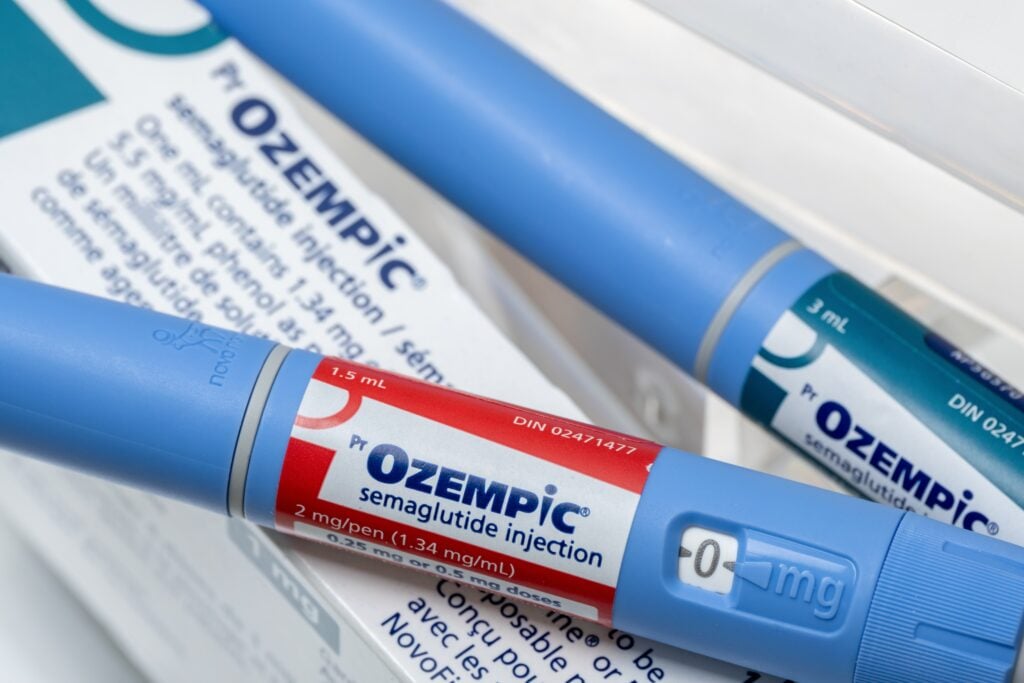
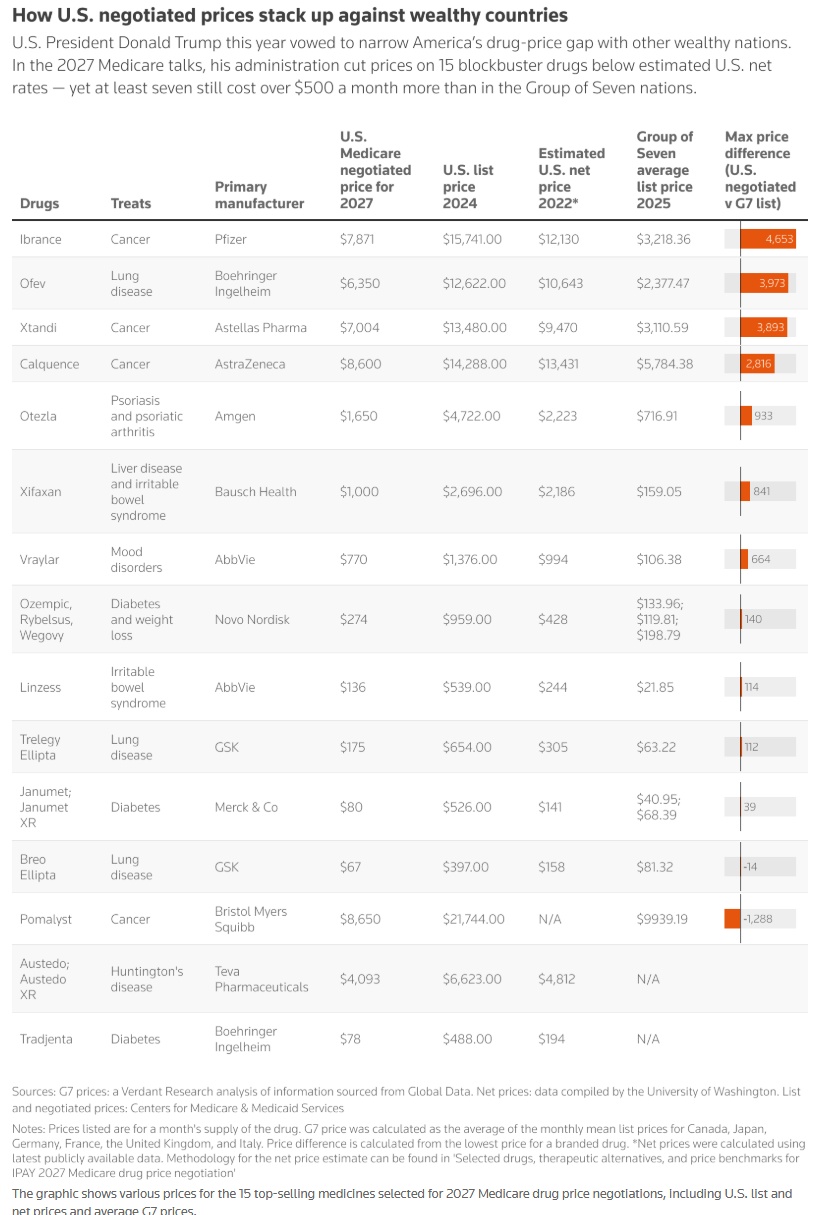
Core Insights - The recent Medicare negotiations are expected to save approximately 36% on the prices of 15 high-cost drugs, translating to around $8.5 billion in net reimbursement costs [1][3][10] - The new prices will take effect in 2027, with significant reductions for popular drugs like semaglutide, which will drop over 70% to about $274 per month [1][4] - The negotiations are part of the Inflation Reduction Act signed by President Biden in 2022, which allows Medicare to negotiate drug prices for the first time [2][11] Drug Price Reductions - The estimated net prices for drugs like Calquence, Ofev, and Ibrance have been reduced by over $4,000 each in the latest negotiations [2][4] - The new pricing for other drugs includes Trelegy Ellipta at $175 (down from $654) and Linzess at $136 (down from $539) [4][10] - The average negotiated prices for these drugs are still higher than those in the Group of Seven (G7) nations, with some drugs costing over $500 more than their G7 counterparts [7][11] Comparison with Previous Negotiations - The 36% savings in the current negotiations surpasses the 22% savings achieved in the previous year's negotiations for 10 different drugs [3][10] - The pricing strategy has become more efficient, with newer products potentially having greater flexibility in pricing [4][10] Industry Response - The pharmaceutical industry has expressed strong opposition to government price negotiations, arguing that such policies are detrimental [5][10] - Industry representatives claim that government pricing policies like the Inflation Reduction Act and the Most-Favored-Nation pricing are misguided [5][12] Future Implications - The Medicare negotiations are expected to influence other payers to seek similar pricing from drug manufacturers [10] - Future negotiations will include an additional 15 drugs, with discussions set to begin in February [12]


和铂医药:将更新与深化推进其与阿斯利康的全球战略合作
Cai Jing Wang· 2025-11-25 08:13
Core Insights - The announcement highlights the deepening global strategic collaboration between Heptares Therapeutics and AstraZeneca established in March 2025 [1] - The partnership focuses on the discovery and development of next-generation biotherapies, including antibody-drug conjugates (ADCs) and T-cell engagers (TCEs) [1] Collaboration Details - AstraZeneca will nominate research projects to Heptares Therapeutics annually over the next four years, demonstrating the ongoing commitment to the partnership [1] - Heptares Therapeutics is eligible to receive option fees, exercise fees, development and commercial milestone payments, as well as tiered royalties based on future net sales of licensed projects [1]
脱发药龙头蔓迪国际递表港交所;和铂医药深化与阿斯利康的合作|医药早参
Mei Ri Jing Ji Xin Wen· 2025-11-25 00:09
Group 1 - Heptagon Pharma announced an update to its global strategic collaboration with AstraZeneca, focusing on the discovery and development of next-generation biotherapies, including antibody-drug conjugates (ADCs) and T-cell engagers (TCEs) [1] - AstraZeneca will nominate research projects to Heptagon Pharma annually for the next four years, granting them licensing options for these projects [1] - The collaboration reflects the strengthening partnership between Heptagon Pharma and AstraZeneca, highlighting the integration of Chinese biotech companies into the global pharmaceutical ecosystem [1] Group 2 - Prolog Pharma's subsidiary received a drug registration certificate for Cefdinir dry suspension, marking it as the first domestic generic drug approved under the consistency evaluation of quality and efficacy [2] - This approval allows Cefdinir to participate in national medical insurance negotiations, enhancing its market competitiveness [2] Group 3 - Sinovac's recombinant shingles vaccine has received clinical trial approval from the National Medical Products Administration, targeting individuals aged 40 and above [3] - The market for shingles vaccines in China is currently limited, with existing products facing low public willingness for vaccination [3] Group 4 - AstraZeneca announced a $2 billion investment to expand its manufacturing operations in Maryland, marking its fourth major manufacturing investment in the U.S. this year [4] - The company plans to invest $50 billion in the U.S. by 2030 to enhance its manufacturing and R&D capabilities, which is expected to create tens of thousands of jobs [4] Group 5 - Mandi International has submitted its application for listing on the Hong Kong Stock Exchange, focusing on skin health and weight management solutions, with its core brand being a hair loss treatment product [5] - Mandi has ranked first in the Chinese hair loss medication market for ten consecutive years, holding a market share of 57% in 2024 [5] - The company's revenue is highly dependent on a single product, making its IPO progress a point of interest for investors [5]

脱发药龙头蔓迪国际递表港交所;和铂医药深化与阿斯利康的合作 | 医药早参
Mei Ri Jing Ji Xin Wen· 2025-11-24 23:51
Group 1 - Heptagon Pharma announced an update to deepen its global strategic cooperation with AstraZeneca, focusing on discovering and developing next-generation biotherapies, including antibody-drug conjugates (ADC) and T cell engagers (TCE) [1] - AstraZeneca will nominate research projects to Heptagon Pharma annually for the next four years, granting them licensing options for these projects [1] - The partnership reflects the strengthening relationship between Heptagon Pharma and AstraZeneca, showcasing the integration of Chinese biotech companies into the global pharmaceutical ecosystem [1] Group 2 - Prolog Pharma's subsidiary received a drug registration certificate for Cefdinir dry suspension, marking it as the first approved generic antibiotic in China that meets quality and efficacy consistency evaluation [2] - This approval allows the product to participate in national medical insurance negotiations, enhancing its market competitiveness [2] Group 3 - Sinovac's recombinant shingles vaccine has received clinical trial approval from the National Medical Products Administration, targeting individuals aged 40 and above [3] - There are currently two approved shingles vaccines in China, but both have faced poor sales performance, raising concerns about public willingness to vaccinate and the commercialization of high-priced self-funded vaccines [3] Group 4 - AstraZeneca announced a $2 billion investment to expand its manufacturing operations in Maryland, marking its fourth major manufacturing investment in the U.S. this year [4] - The company plans to invest $50 billion by 2030 to enhance its manufacturing and R&D capabilities in the U.S., which is expected to create tens of thousands of jobs [4] Group 5 - Mandi International has submitted its application to the Hong Kong Stock Exchange, focusing on skin health and weight management solutions, with its core brand being the hair loss treatment product Mandi [5] - Mandi has ranked first in the Chinese hair loss medication market for ten consecutive years, with a projected market share of 57% in 2024 [5] - The company faces revenue dependency on a single product, making its IPO progress a point of interest for investors [5]
AstraZeneca Doubles Down On US Biologics Buildout As Drug Discovery Partnership Grows
Benzinga· 2025-11-24 17:58
Core Insights - Harbour BioMed has announced an update on its strategic collaboration with AstraZeneca, which was initially established in March 2025 [1][4] - The collaboration focuses on the discovery and development of next-generation biotherapeutics, including antibody-drug conjugates and T cell engagers [2][5] Collaboration Details - AstraZeneca will nominate discovery programs to Harbour BioMed annually over the next four years, with the option to license these programs for further development [3][6] - Harbour BioMed is set to receive up to $175 million in upfront and milestone payments, along with potential additional payments of up to $4.4 billion and tiered royalties on future net sales [6][7] - AstraZeneca will acquire 9.15% of the newly issued shares of Harbour BioMed as part of the collaboration [7] Financial Framework - The economic terms of the collaboration are consistent with the financial framework established in March 2025 [4] - The collaboration includes a $105 million equity investment by AstraZeneca in Harbour BioMed [5] Future Prospects - The initial phase will focus on ongoing research programs, with the potential for additional programs to be included over the next five years [6][7] - There is an option to extend the terms of the agreement for an additional five years upon mutual agreement [7]
四次联手阿斯利康,和铂医药的底牌是什么?
Xin Lang Cai Jing· 2025-11-24 11:06
Core Insights - The article discusses the deepening global strategic collaboration between Heptares Therapeutics and AstraZeneca, focusing on the development of next-generation biotherapies such as antibody-drug conjugates (ADCs) and T-cell engagers (TCEs) in oncology and autoimmune diseases [1][3]. Group 1: Collaboration Details - The updated agreement allows AstraZeneca to nominate R&D projects annually for the next four years, retaining the option for licensing these projects, with potential total earnings for Heptares reaching up to $4.4 billion [4]. - This collaboration marks the fourth interaction between the two companies since 2022, highlighting a strong strategic alignment in AstraZeneca's operations in China [5]. Group 2: Financial Framework - The financial framework established in the previous agreements remains intact, reflecting both parties' long-term confidence in the collaboration model [4]. - Previous agreements included a $25 million upfront payment and a total of up to $325 million for the TCE dual antibody drug HBM7022, as well as a $190 million upfront payment for a preclinical monoclonal antibody project [5]. Group 3: Technological Advancements - Heptares' proprietary technology platforms, such as Harbour Mice® and HBICE®, are central to their competitive advantage, enabling the development of innovative antibody therapies [7][8]. - The Harbour Mice® platform allows for the generation of both classic and unique human heavy-chain antibodies, enhancing drug efficacy and specificity [8]. Group 4: Strategic Positioning - Heptares positions itself as a technology-driven innovative pharmaceutical company, focusing on refining its technology while leaving commercialization to partners, which has led to sustained profitability over three consecutive years [8].
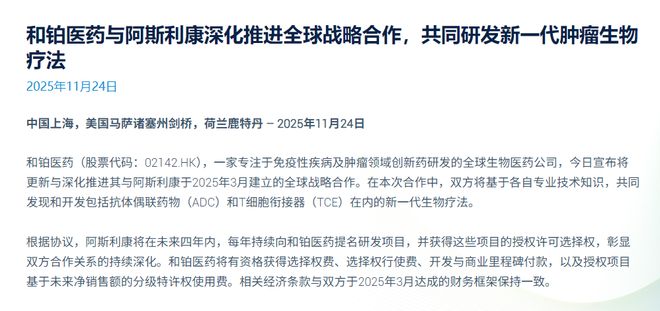
和铂医药:与阿斯利康深化合作,共同研发新一代肿瘤生物疗法
Xin Lang Cai Jing· 2025-11-24 00:30
Core Viewpoint - The collaboration between Heptares Therapeutics and AstraZeneca aims to advance the discovery and development of next-generation biotherapies, including antibody-drug conjugates (ADCs) and T cell engagers (TCEs) [1] Group 1: Collaboration Details - Heptares Therapeutics will update and deepen its global strategic collaboration with AstraZeneca established in March 2025 [1] - AstraZeneca will nominate research and development projects to Heptares annually over the next four years, retaining the option to license these projects [1] - Heptares is eligible to receive option fees, exercise fees, development and commercial milestone payments, as well as tiered royalties based on future net sales of licensed projects [1] Group 2: Financial Terms - The economic terms of the collaboration remain consistent with the financial framework agreed upon by both parties in March 2025 [1]
国际医药创新公园迎“新”记
Xin Hua She· 2025-11-22 03:17
Core Insights - Bayer has established its first innovation center in China, located in the International Pharmaceutical Innovation Park in Beijing, aimed at fostering local pharmaceutical innovation and enhancing clinical research capabilities [1][2] - The park is part of a broader strategy to attract global pharmaceutical companies and create a collaborative ecosystem for drug development, with significant infrastructure already in place [2][3] Group 1: Bayer's Innovation Center - The Bayer Innovation Center will incubate local pharmaceutical companies and facilitate their international expansion [1] - The center aims to collaborate with high-level research and clinical institutions to improve basic research and clinical translation capabilities [1] Group 2: International Pharmaceutical Innovation Park - The park covers an area of 5.8 square kilometers and is divided into four functional zones: headquarters cluster, medical-engineering integration area, R&D transformation area, and pharmaceutical manufacturing area [2] - The existing built-up area of the park is 280,000 square meters, with ongoing construction of supporting facilities for pharmaceutical R&D [2] Group 3: Future Developments - By 2026, a new batch of leading innovative pharmaceutical and medical device companies is expected to settle in the park [3] - The park is also focusing on developing an AI healthcare industry cluster, with plans for key infrastructure such as a supercomputing base and trusted data spaces for the healthcare and pharmaceutical sectors [3]

