BeiGene(BGNE)

Search documents
大摩:未来医药在创新升级、制造升级及消费升级方面均有较大发展潜力 医药长期投资逻辑稳固
Zhi Tong Cai Jing· 2025-07-24 13:15
Group 1 - Morgan Stanley's fund manager Wang Dapeng expresses optimism about the pharmaceutical industry, highlighting its potential for innovation, manufacturing, and consumption upgrades [1][3] - The second quarter report shows a strong performance in the equity market, with a focus on A-share and Hong Kong stock innovative drugs, benefiting from better-than-expected business development in representative innovative drug companies [2][3] - The top ten holdings of the fund as of June 30, 2025, include companies like Innovent Biologics and BeiGene, accounting for 79.90% of the fund's net asset value, an increase of over 11 percentage points from the previous quarter [2] Group 2 - The pharmaceutical sector is expected to benefit from a stable growth trend in medical insurance and supportive policies for innovative drug payments, leading to a return to endogenous growth [3] - Policy support includes increased pensions and healthcare subsidies, as well as ongoing normalization of centralized procurement and industry restructuring, which are expected to favor the development of innovative drugs [3] - Long-term growth in the pharmaceutical industry is anticipated due to factors such as an aging population, rising income levels, and increased health awareness, with expected growth rates surpassing GDP growth [3]


基金控盘升级,126股成“抱团”新宠
Huan Qiu Wang· 2025-07-24 03:51
Group 1 - The core viewpoint of the article highlights the significant increase in fund holdings in certain core assets, with 126 stocks having a fund holding ratio exceeding 10%, indicating enhanced "control" by funds over these assets [1][3] - The stock with the highest fund holding is Nine Company, with 216 funds collectively holding 195 million shares, accounting for 35.24% of its circulating stock [1] - Other notable stocks include BeiGene and Innovent Biologics, with fund holding ratios of 33.47% and 32.70% respectively, and 17 stocks have fund holding ratios exceeding 20%, reflecting high recognition from funds [1][3] Group 2 - In Q2, funds were active in adjusting their holdings, with 85 out of 126 stocks seeing increased fund holdings, particularly notable increases in Puyuan Precision, Huahong Semiconductor, and Yuanjie Technology, with increases of 409.08%, 354.96%, and 317.64% respectively [3] - Conversely, 41 stocks experienced reductions in fund holdings, with Hengxuan Technology, Stone Technology, and Nairui Radar seeing decreases of 37.29%, 32.21%, and 30.98% respectively [3] - The "hugging" phenomenon is prominent among high holding ratio stocks, with 44 stocks held by over 100 funds and 32 stocks held by 50 to 99 funds, with Ningde Times leading at 1,775 funds holding 14.49% of its shares [3][4] Group 3 - From a valuation perspective, among the high holding ratio stocks, 42 stocks have a price-to-earnings ratio below 30, with Gujing Distillery having the lowest at 8.20 times [4] - Major sectors represented among these stocks include electronics, pharmaceuticals, and automotive, with 32, 21, and 12 stocks respectively [4] - Of the 24 stocks that have released half-year performance forecasts, 23 are expected to see profit increases, with Huaxia Airlines projecting a staggering 875.10% year-on-year profit growth [4]






公募基金科创板配置比例创新高
Shang Hai Zheng Quan Bao· 2025-07-23 18:08
Group 1 - The allocation ratio of actively managed equity funds in the Sci-Tech Innovation Board reached a historical high of 15.36% by the end of Q2, an increase of 0.19 percentage points from the end of Q1 [1] - The overall scale of Sci-Tech Innovation Board thematic funds has surpassed 300 billion yuan, indicating a rapid expansion of the thematic fund sector [1] - The proportion of equity investments in various Sci-Tech Innovation Board funds remains high, with some funds like Bosera's Sci-Tech Board three-year open mixed fund having an equity investment ratio of 97.77% [1] Group 2 - With the U.S. interest rates peaking and the Federal Reserve entering a rate-cutting phase, domestic asset valuations are gradually entering an upward range, leading funds to maintain high positions in hard technology investments [2] - A significant number of Sci-Tech Innovation Board stocks have entered the top 50 holdings of public funds, with 230 funds heavily invested in SMIC, totaling over 8 billion yuan in market value [2] - The thematic fund sector has rapidly expanded since the implementation of the "Eight Articles of Sci-Tech Innovation Board," with a comprehensive range of index tools now available [2] Group 3 - As of July 23, the number of Sci-Tech Innovation Board thematic ETFs has increased to 88, with a total scale of approximately 267.4 billion yuan [3] - More than 50 new Sci-Tech Innovation Board thematic ETFs have been listed in the past year, indicating strong market interest and growth potential [3] - The optimistic outlook for A-share technology growth sectors is driven by multiple favorable factors, including advancements in artificial intelligence and improvements in the innovative drug sector [3]


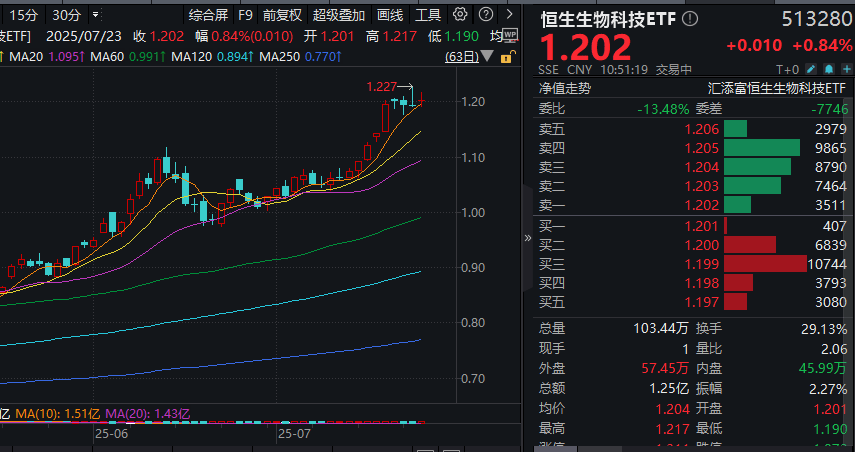
CRO强势回归!轻舟已过万重山?恒生生物科技ETF(513280)、生物药ETF(159839)冲高!机构:长期关注“创新+复苏”主线!
Sou Hu Cai Jing· 2025-07-23 03:52
Group 1 - The core viewpoint of the news highlights the strong performance of the Hang Seng Biotechnology ETF (513280), which has seen a continuous inflow of funds and is the only ETF in its index to achieve net inflow this year [1][8] - WuXi AppTec announced a projected revenue growth of over 60% and an adjusted net profit growth of over 67% for the first half of 2025, driven by strong downstream demand for antibody-drug conjugates and a solid market position [3][5] - The performance of the underlying stocks in the Hang Seng Biotechnology ETF is mixed, with notable gains in the CRO sector, including WuXi AppTec rising over 10% and WuXi Biologics increasing nearly 3% [3][4] Group 2 - Zhongtai Securities indicates that the CRO and CDMO sectors have exceeded expectations in their mid-year performance, suggesting a recovery in demand and potential for profit and valuation increases [5][6] - The report emphasizes the importance of focusing on the recovery of the CRO and CDMO sectors, with signs of improving orders and a gradual recovery in the investment environment [6][7] - The innovation and recovery themes are highlighted as key investment lines, with a focus on innovative drugs and medical devices, as well as the recovery of the CXO sector [7][8]

中证香港生物科技主题指数报1976.09点,前十大权重包含百济神州等
Jin Rong Jie· 2025-07-21 10:51
作者:行情君 从中证香港生物科技主题指数持仓样本的行业来看,化学药占比40.88%、生物药品占比39.81%、制药 与生物科技服务占比16.53%、医疗器械占比2.77%。 资料显示,指数样本每半年调整一次,样本调整实施时间分别为每年6月和12月的第二个星期五的下一 交易日。权重因子随样本定期调整而调整,调整时间与指数样本定期调整实施时间相同。在下一个定期 调整日前,权重因子一般固定不变。特殊情况下将对指数进行临时调整。当样本退市时,将其从指数样 本中剔除。样本公司发生收购、合并、分拆等情形的处理,参照计算与维护细则处理。 从指数持仓来看,中证香港生物科技主题指数十大权重分别为:百济神州(13.72%)、信达生物 (12.08%)、药明生物(9.08%)、康方生物(8.04%)、中国生物制药(6.18%)、石药集团 (5.78%)、三生制药(4.55%)、翰森制药(3.4%)、药明康德(2.82%)、科伦博泰生物-B (2.45%)。 从中证香港生物科技主题指数持仓的市场板块来看,香港证券交易所占比100.00%。 本文源自:金融界 金融界7月21日消息,上证指数高开高走,中证香港生物科技主题指数 (港股生物 ...
医药生物行业双周报:《2024年全国医疗保障事业发展统计公报》发布第十一批集采规则优化-20250721
Great Wall Glory Securities· 2025-07-21 09:24
Investment Rating - The investment rating for the industry is "Positive" and the rating has been maintained [2] Core Insights - The pharmaceutical and biotechnology industry index increased by 5.89%, ranking third among 31 primary industries, outperforming the CSI 300 index which rose by 1.92% [5][17] - The sub-industries of medical research outsourcing and chemical preparations saw significant gains of 13.94% and 8.43% respectively, while offline pharmacies experienced a decline of 3.91% [5][17] - As of July 18, 2025, the overall PE (TTM) for the pharmaceutical and biotechnology industry is 30.09x, up from 28.52x in the previous period, indicating an upward trend in valuation but still below the average [6][22] - The top three sub-industries by PE (TTM) are vaccines (57.37x), hospitals (37.75x), and other biological products (36.95x), while pharmaceutical circulation has the lowest valuation at 15.84x [6][22] Industry Review - The report highlights that 37 listed companies in the pharmaceutical and biotechnology sector experienced a net reduction in shareholder holdings amounting to 2.182 billion yuan, with 4 companies increasing their holdings by 145 million yuan and 33 companies reducing theirs by 2.328 billion yuan [6] Important Industry News - The National Medical Products Administration (NMPA) approved the BCL-2 inhibitor "Lisatinib" for market entry, marking it as the first domestic product of its kind [8] - The NMPA also approved "Recombinant Human Albumin Injection (Rice)" as the first of its kind in China [8] - The eleventh batch of national procurement rules has been optimized, significantly reducing policy uncertainty for innovative drugs [9] Investment Recommendations - The report suggests continued attention to pharmaceutical companies with innovative capabilities and those with high-end and cost advantages in generic drugs, especially in light of the optimized procurement rules that favor high-quality production and cost-effective generics [9]
港股创新药概念板块集体走低,百济神州(06160.HK)跌超5%,三生制药(01530.HK)、四环医药(00460.HK)跌超4%,绿叶制药(02186.HK)、先声制药(02096.HK)、中国生物制药(01177.HK)跌超3%。
news flash· 2025-07-21 01:54
港股创新药概念板块集体走低,百济神州(06160.HK)跌超5%,三生制药(01530.HK)、四环医药 (00460.HK)跌超4%,绿叶制药(02186.HK)、先声制药(02096.HK)、中国生物制药(01177.HK)跌超3%。 ...
港股创新药概念股盘初调整,百济神州跌超5%
news flash· 2025-07-21 01:48
港股创新药概念股盘初调整,百济神州跌超5%,歌礼制药、山东新华制药(000756)股份、昭衍新药 (603127)跌超4%,君实生物、诺诚健华等股跌超3%。 ...


港股创新药ETF继续扛旗
Zhong Guo Zheng Quan Bao· 2025-07-20 20:20
Group 1 - The innovation drug and AI computing sectors showed strong performance, with related ETFs rising significantly, such as the Huatai-PB Hang Seng Innovation Drug ETF increasing over 13% [1][2] - The first batch of 10 Sci-Tech Bond ETFs launched on July 17, attracting nearly 60 billion yuan in net inflows over two trading days, increasing total scale from under 29 billion yuan to over 88 billion yuan [2][3] - Major pharmaceutical companies in China are expanding their business development efforts due to the upcoming patent cliff for multinational corporations, indicating a strengthening of China's innovation drug sector [1] Group 2 - The AI computing sector also performed well, with stocks like New Yisheng rising nearly 40%, and several ETFs in this space increasing over 10% [2] - Fund managers are applying for their Sci-Tech Bond ETFs to be included in the repurchase pledge library, which could enhance market liquidity and attract more long-term capital [3] - The leading broad-based ETFs experienced significant outflows, with a total net outflow of nearly 20 billion yuan for ETFs tracking major indices [3] Group 3 - The A-share market remains strong due to stable policy expectations, which have created a "buffer" against macroeconomic disturbances [4] - There is a focus on low-valuation cyclical stocks in the short term, while mid-term opportunities lie in sectors benefiting from supply-side improvements and policy support [4] - The outlook for the Chinese stock market is positive, driven by favorable policies and potential reallocation opportunities in sectors like AI and emerging industries [5]

“沸了”!韩国股民狂买中国股票
凤凰网财经· 2025-07-20 10:57
Core Insights - Korean investors show a strong preference for overseas markets, with China ranking as the second most favored market after the United States as of July 17, 2025 [1][14] - The total trading volume of Chinese stocks by Korean investors reached approximately $5.514 billion, second only to the U.S. market's $32.244 billion [14] Group 1: Investment Trends - Korean investors are particularly enthusiastic about Hong Kong stocks, with Xiaomi Group-W being the most held stock as of July 18, 2025 [2][3] - The total amount available for stock purchases by Korean investors reached 66.7 trillion KRW, indicating potential for further investment [2][18] Group 2: Net Buying Rankings - Over the past year, the top ten net bought Hong Kong stocks by Korean investors included Xiaomi Group-W ($160 million), BYD Company ($62.44 million), and CATL ($60.85 million) [3][4] - In the past month, the leading net bought stocks were Old Peking Gold ($2.94 million), followed by Sanhua Intelligent Controls ($2.09 million) and Xiaomi Group-W ($1.99 million) [4][5] Group 3: Recent Weekly Trends - From July 11 to July 18, 2025, Alibaba-W topped the net buying list among Korean investors with a net purchase of $13.38 million [7][8] Group 4: Market Capitalization - As of July 18, 2025, the top ten stocks held by Korean investors by market value included Xiaomi Group-W ($251 million), Tencent Holdings ($217 million), and Alibaba-W ($176 million) [9][10] Group 5: Market Sentiment and Leverage - The KOSPI index has increased by 32.89% this year, driven by improved corporate governance and optimistic market sentiment [18] - The amount of margin loans outstanding reached 21.6 trillion KRW, indicating a high level of leverage among retail investors [18]