BeiGene(BGNE)

Search documents
百济神州(06160.HK)授出合共2.13万股美国存托股份受限制股份单位
Ge Long Hui· 2025-12-04 08:52
Core Viewpoint - BeiGene (06160.HK) announced the grant of a total of 21,274 restricted stock units to 147 grantees under the 2016 option and incentive plan, equivalent to 276,562 shares, representing approximately 0.02% of the company's total issued shares as of the announcement date [1] Summary by Category - **Company Actions** - The board's compensation committee granted restricted stock units to 147 individuals [1] - The total number of restricted stock units granted is 21,274 [1] - **Shareholder Impact** - The granted units correspond to 276,562 shares [1] - This represents about 0.02% of the total issued shares of the company as of the announcement date [1]
百济神州(06160) - 授出受限制股份单位
2025-12-04 08:49
2016期權及激勵計劃項下的受限制股份單位 香港交易及結算所有限公司及香港聯合交易所有限公司對本公告的內容概不負責,對其準確性 或完整性亦不發表任何聲明,並明確表示概不就因本公告全部或任何部分內容而產生或因依賴 該等內容而引致的任何損失承擔任何責任。 BeOne Medicines Ltd. 百濟神州有限公司 (根據瑞士法律註冊成立的公司) (股份代號:06160) 授出受限制股份單位 本公告乃根據上市規則第17.06A、17.06B以及17.06C條作出。於2025年11月28 日,董事會薪酬委員會根據2016期權及激勵計劃的條款向一百四十七名承授人授 出涉及合共21,274股美國存託股份的受限制股份單位。 於2025年11月28日,董事會薪酬委員會根據2016期權及激勵計劃的條款授予一百 四十七名承授人合共21,274股美國存託股份受限制股份單位。該等受限制股份單 位相當於276,562股股份,約佔本公告之日公司發行股份總數的0.02%。 授出受限制股份單位詳情 受限制股份單位詳情如下: 1 授出日期: 2025年11月28日 承授人數目: 一百四十七名 已授出受限制股份單位涉及的 相關股份數目: 276 ...
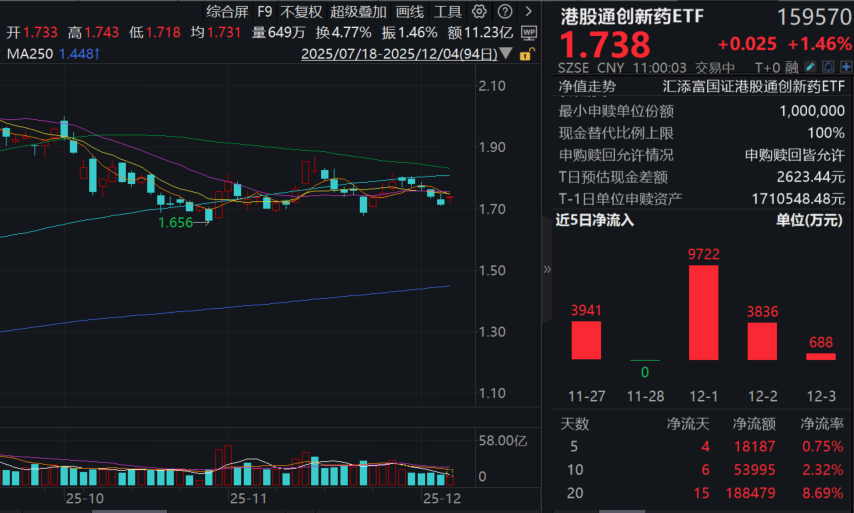
信立泰创新药获批!港股通创新药ETF(159570)四连跌后反弹1.5%,近5日净流入超1.8亿!2026年展望:首版商保创新药目录落地在即!
Xin Lang Cai Jing· 2025-12-04 03:54
Group 1: Market Performance - The Hong Kong Innovation Drug ETF (159570) rebounded by 1.5% after four consecutive declines, with trading volume exceeding 1.2 billion [1] - The ETF has seen a net inflow of over 180 million in the past five days, with a total size exceeding 23.2 billion as of December 3 [1] - Major stocks within the ETF, such as Kangfang Biotech and Kintor Pharmaceutical, experienced gains of over 3% [3] Group 2: Regulatory Developments - On December 3, Xinlitai received approval from the drug regulatory authority to conduct clinical trials for its innovative small molecule drug SAL0140 for chronic kidney disease [3] Group 3: Policy Environment - A significant policy shift is expected in 2025, with the introduction of a commercial insurance innovation drug directory aimed at expanding coverage beyond basic medical insurance [5] - The overall policy direction encourages innovation and aims to alleviate payment pressures, which is expected to positively impact industry sentiment and fundamentals [5] Group 4: Financial Outlook - Leading innovative drug companies are projected to achieve breakeven within the next two years, enhancing market confidence in their profitability [8] - The financial performance of the covered biotech companies indicates a sustained recovery in the pharmaceutical sector [8] Group 5: Investment Trends - The overseas investment environment for innovative drugs remains strong, with record-high transaction numbers and amounts in 2025 [11] - By the end of Q3 2025, 103 outbound transactions were completed, totaling over 92 billion, surpassing the total for 2024 by 77% [11] Group 6: Capital Flow - Both domestic and foreign investments in the Hong Kong pharmaceutical sector have increased, with domestic holdings at 22.1% and foreign holdings at 38.1% as of November 10 [12] - The pharmaceutical sector is expected to attract more capital due to its valuation being below historical averages [12]


利好创新药 中国药品价格登记系统上线
2 1 Shi Ji Jing Ji Bao Dao· 2025-12-03 23:05
Core Viewpoint - The launch of the China Drug Price Registration System marks a significant step towards a globalized pricing framework for innovative drugs, enhancing market-oriented pricing capabilities for pharmaceutical companies and supporting the development of a new pricing ecosystem that aligns drug prices with innovation value and market demand [1][2][6]. Group 1: Drug Price Registration System - The new system allows domestic and international pharmaceutical companies to independently register drug prices, ensuring accountability for price authenticity [1][3]. - The system operates under the principle of "one location acceptance, nationwide sharing, global openness," and is managed by a state-owned enterprise in Beijing [1][3]. - The first batch of companies to register prices includes major players such as China National Pharmaceutical Group, Beijing Tongrentang, and Roche, indicating strong industry participation [3]. Group 2: Impact on Pharmaceutical Industry - The system is expected to enhance the pricing strategies of pharmaceutical companies, allowing them to adjust prices based on clinical value, supply-demand dynamics, and competitive landscape [3][4]. - The dual mechanism of registration and query will promote transparency in drug pricing, moving away from previous opaque practices [4]. - The establishment of this system is anticipated to create a comprehensive pricing structure that encompasses innovative drugs, insurance payment prices, and generic drug prices, benefiting the innovative drug sector [5]. Group 3: Global Market Development - The China Drug Price Registration System is designed to facilitate the international expansion of Chinese innovative drugs and attract high-quality foreign drugs into the Chinese market [2][5]. - Data indicates that the total amount of overseas licensing transactions by Chinese pharmaceutical companies exceeded $92 billion in the first three quarters of 2025, highlighting the growing global presence of Chinese innovative drugs [2]. - The system aims to address significant price discrepancies between domestic and international markets, influenced by factors such as currency exchange rates and pricing mechanisms [5]. Group 4: Long-term Industry Implications - The implementation of the drug price registration system is expected to enhance the global competitiveness of China's biopharmaceutical industry and drive high-quality innovation within the sector [6].



鼓励创新药出海,中国药品价格登记系统上线:我国药企授权出海交易超920亿美元
Mei Ri Jing Ji Xin Wen· 2025-12-03 13:24
Core Insights - The launch of the Chinese Drug Price Registration System on December 2 is seen as a significant positive development for the innovative drug sector, facilitating the international expansion of domestic innovative drugs [1][4]. Group 1: Drug Price Registration System - The Chinese Drug Price Registration System was launched on December 2, with nine pharmaceutical companies participating in the initial registration, including both multinational and traditional Chinese medicine firms [2]. - The system currently includes limited information, with only 10 drug entries available, indicating a nascent stage of development [2]. - The system allows for independent pricing by companies outside of the National Medical Insurance (NMI) framework, which is a notable shift in policy [1][5]. Group 2: Innovative Drugs Highlighted - Four drugs showcased on the system are recognized as either the first of their kind in China or globally, including innovative treatments like Toripalimab and Icaritin [3]. - For instance, Toripalimab is the first Chinese PD-1 monoclonal antibody approved in both Europe and the U.S., while Icaritin is the first CAR-T therapy targeting BCMA approved in China [3]. Group 3: Market Implications - The establishment of the registration system is expected to enhance the global pricing framework for Chinese innovative drugs and attract high-quality foreign drugs to the Chinese market [4][5]. - Data indicates that in the first three quarters of 2025, Chinese pharmaceutical companies completed 103 license-out transactions totaling $92.03 billion, highlighting the growing importance of the Chinese market in the global pharmaceutical industry [4]. - The NMI's non-interference in pricing for the non-NMI market is seen as a positive step towards respecting market dynamics and enhancing the pricing power of domestic companies in international markets [5].

创新药龙头公司三季报验证景气度,前瞻布局构建全球竞争力
Xin Lang Cai Jing· 2025-12-03 13:20
Core Insights - The Chinese innovative drug sector is experiencing strong growth driven by accelerated new drug approvals and increased business development (BD) activities [1][13] - In the first half of 2025, the total transaction amount in China reached $60.8 billion, a significant year-on-year increase of 129%, while the cumulative transaction amount for the first three quarters reached $93.7 billion, up 64% year-on-year [1][13] - The commercialization of innovative drugs is boosting overall revenue recovery and improving corporate profitability, indicating a transition to a new phase of high-quality development in the industry [1][13] Company Performance Highlights 1. BeiGene - In Q3 2025, BeiGene's revenue exceeded 10 billion yuan for the first time, with a year-on-year growth of 41.1%, and adjusted net profit increased by 489% [2][14] - The gross margin for global product revenue under GAAP was 85.9%, up 3.1 percentage points from the same period in 2024, primarily due to increased sales of Zanubrutinib [2][14] 2. HengRui Medicine - HengRui Medicine achieved revenue of 7.427 billion yuan in Q3 2025, a year-on-year increase of 12.72%, with net profit growing by 9.53% [4][15] - The company has made significant strides in international BD transactions, with over $800 million in upfront payments from innovative drug licensing agreements in the first three quarters of the year [5][15] 3. WuXi AppTec - WuXi AppTec reported total revenue of 12.057 billion yuan in Q3 2025, a year-on-year increase of 15.26%, with net profit rising by 53.27% [6][17] - The company has adjusted its full-year revenue guidance upward, expecting sustained double-digit growth in its core business [7][17] Industry Future Trends - The Chinese innovative drug industry is undergoing a paradigm shift from "domestic substitution" to "global value creation" and "international ecological collaboration," marking the entry into an international 2.0 era [8][18] - The focus on internationalization is becoming more pronounced, with strategic collaborations extending beyond late-stage assets to include early-stage technology platforms [8][18] Strategic Recommendations for Companies - Companies should build globally-oriented differentiated R&D pipelines, shifting focus from filling domestic gaps to addressing unmet clinical needs globally [9][19] - Developing dual-capacity international BD capabilities is essential, treating international expansion as a core strategic capability rather than a one-time transaction [10][20] - Establishing a lean and efficient global operational system is crucial for maintaining cost and efficiency advantages in the competitive international market [10][20]

我国药企授权出海交易超920亿美元
Mei Ri Jing Ji Xin Wen· 2025-12-03 12:49
Core Insights - The launch of the Chinese Drug Price Registration System on December 2 is seen as a significant positive development for the innovative drug sector, facilitating the international expansion of domestic innovative drugs [1][4] - The system allows for independent pricing by companies outside of the National Medical Insurance (NMI) market, which is expected to foster a more competitive environment [1][5] Group 1: Drug Price Registration System - The Chinese Drug Price Registration System was launched on December 2, with nine pharmaceutical companies participating in the initial registration, including both multinational and domestic firms [2] - The system currently includes limited data, with only 10 drug entries available, indicating a nascent stage of development [2] - The system is designed to respect the pricing autonomy of companies in the non-NMI market, which is a shift from previous perceptions that equated the NMI market with the entire Chinese pharmaceutical market [5] Group 2: Innovative Drugs Highlighted - Four drugs showcased on the system's homepage hold either domestic or global "first" status, including innovative treatments like the first Chinese PD-1 monoclonal antibody approved in Europe and the U.S. [3] - Specific pricing examples illustrate the disparity between NMI reimbursement prices and companies' self-reported prices, such as the self-reported price of 10,688 yuan for a PD-1 monoclonal antibody compared to the NMI price of 1,253.53 yuan [3] Group 3: Market Implications - The establishment of the drug price registration system is expected to enhance the global pricing framework for Chinese innovative drugs and attract high-quality foreign drugs to the Chinese market [4] - Data indicates that Chinese pharmaceutical companies completed 103 license-out transactions worth 9.203 billion USD in the first three quarters of 2025, highlighting the growing importance of the Chinese market in the global pharmaceutical industry [4] - The NMI's non-interference in pricing for the non-NMI market is viewed as a positive step towards empowering companies to set prices that reflect market conditions, potentially increasing their influence in international markets [5]
医药跌势未止,抄底资金再出动!医疗ETF再创4个月新低,单日逾亿元增仓,港股创新药四连跌,520880放量溢价
Xin Lang Cai Jing· 2025-12-03 12:03
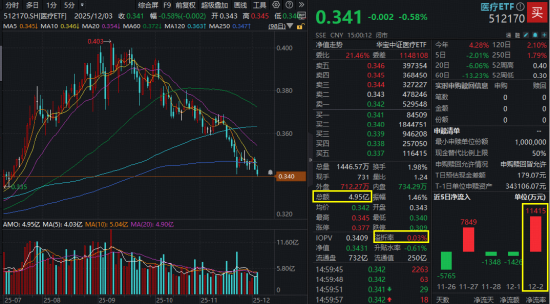
Core Viewpoint - The A+H pharmaceutical sector continues to adjust, with significant fluctuations in the market, particularly in innovative drugs, indicating potential investment opportunities as bottom-fishing capital emerges [1][5][16]. Group 1: Market Performance - The largest medical ETF in the market (512170) and the only drug ETF (562050) fell by 0.58% and 0.19% respectively, while the Hong Kong innovative drug ETF (520880) dropped by 1.43% [1][5]. - A-share medical leaders mostly declined, with WuXi AppTec down 2.01%, and both Aier Eye Hospital and Tigermed down over 1%, while some stocks like Yingke Medical and New Industry saw gains [1][12]. - The medical ETF (512170) hit a four-month low during intraday trading, closing below all moving averages, but saw over 1.14 billion yuan in net subscriptions as investors sought to buy the dip [1][16]. Group 2: Sector Analysis - The pharmaceutical sector in A-shares showed relative resilience, with the drug ETF (562050) outperforming the market, primarily due to gains from traditional Chinese medicine leaders like Pian Zai Huang and Yunnan Baiyao [3][12]. - The innovative drug sector displayed divergence, with Yifan Pharmaceutical surging by 6.11%, while major stocks like BeiGene fell by 1.59% [3][12]. - The drug ETF (562050) has about 25% weight in traditional Chinese medicine, which helps mitigate the high volatility of innovative drugs, thus reducing the overall volatility and drawdown of the pharmaceutical index [3][12]. Group 3: Future Outlook - The innovative drug sector is expected to be a major upward trend heading into 2026, as the industry continues to experience strong demand and unmet needs, with increased R&D investments from pharmaceutical companies [7][16]. - Analysts suggest that the current adjustment phase may present a favorable long-term investment opportunity in pharmaceutical assets, particularly as the sector shows signs of recovery [16]. - The Hong Kong innovative drug ETF (520880) is recommended for balanced internal allocation strategies, with a focus on improving fundamentals in the innovative drug supply chain [7][16].
创新药行情有望持续,PROTAC专题:蛋白降解东风起,国内产业链迎新机
2025-12-03 02:12
Summary of Key Points from Conference Call Records Industry Overview - The pharmaceutical sector experienced a correction in 2025 but rebounded towards the end of the year, with the innovative drug market expected to continue its momentum into 2026, presenting investment opportunities [1][6][10]. - Current industry hotspots include the flu epidemic, policy support, and breakthroughs in innovative fields such as small nucleic acid drugs, GLP-1, and BCL-2 inhibitors [1][7][8]. Core Insights and Arguments - The overall performance of the pharmaceutical sector in November 2025 was weak, with a decline of 3.6%, underperforming the CSI 300 index by approximately 1.16 percentage points [3]. - The application of AI technology in healthcare, including AI medicine and brain-computer interfaces, is gaining attention and is expected to present opportunities in 2026 [4][12]. - The release of the medical insurance negotiation directory and commercial insurance innovation directory will significantly impact the sales of related products once they enter the insurance system [10]. - Investment recommendations for 2026 include focusing on cutting-edge technologies such as dual antibodies, multi-antibodies, ADC, PROTAC, small nucleic acids, and GLP-1, as well as large companies with strong R&D capabilities and biotech firms with best/first-in-class potential [9][11]. Notable Developments - The flu data has reached new highs, driving up the stock prices of related testing drugs and vaccines [7]. - The third-party laboratory sector is expected to see performance bottoming out in Q4 2025, with a recovery starting in Q1 2026, aided by accelerated payment collection from companies like KingMed and Dian Diagnostics [4][19]. - The PROTAC technology is highlighted for its ability to degrade target proteins, addressing issues of drug resistance, with leading companies like Pfizer, BMS, and BeiGene making significant progress [4][16][17]. Investment Opportunities - Companies such as KingMed and Dian Diagnostics are recommended for investment due to their improving cash flow and potential recovery in the IVD industry [19][20]. - Jichuan Pharmaceutical is included in the December portfolio due to its expected performance rebound driven by flu season demand and low inventory levels [21]. - The CRO industry is poised for growth, with expectations of increased outsourcing rates and improved margins due to a decrease in new entrants [22][23]. Future Trends - The medical device sector is showing positive trends, with expectations for improvement in the consumer healthcare segment in 2026 [2][11]. - The potential for significant growth in the insulin business of companies like Lianbang Pharmaceutical is anticipated, with a projected revenue of 20 billion yuan in 2025 [32][35]. - The upcoming KMR data in December is expected to act as a catalyst for the global PROTAC market, with a focus on companies with substantial technology platforms [18]. Conclusion - The pharmaceutical and healthcare sectors are navigating through a period of adjustment, with various innovative technologies and market dynamics presenting both opportunities and challenges. Investors are advised to keep a close watch on regulatory developments, clinical trial outcomes, and emerging technologies that could shape the future landscape of the industry [1][6][10].


11月公募扎堆调研,都在看哪些股?
3 6 Ke· 2025-12-03 01:32
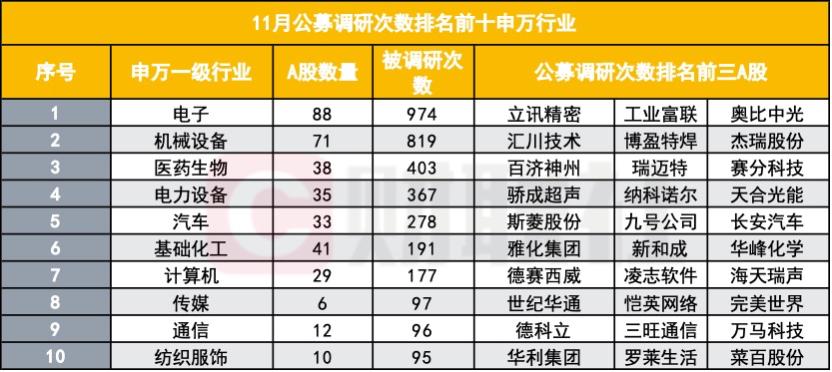
Core Insights - Despite a cautious market sentiment in November, public fund research enthusiasm remains strong, with 154 public funds participating in 4,298 research instances covering 506 stocks across 30 industries [1][2] - The stocks under research showed significant resilience, outperforming the CSI 300 index by 1.89 percentage points, with 186 stocks achieving positive returns, and 66 stocks rising over 10% [1][2] - Leading the gains was Huasheng Lithium with a monthly increase of 132.48%, while the electric equipment sector performed strongly, with Hai Lu Heavy Industry and Fengyuan Co. also making the top gainers list [1][4] Industry Focus - The electronic industry led the research activities with 974 instances covering 88 stocks, with Luxshare Precision, Industrial Fulian, and Aobi Zhongguang being the most researched [2][3] - The mechanical equipment sector followed closely with 819 research instances covering 71 stocks, focusing on companies like Huichuan Technology and Bo Ying Special Welding [2][3] - The pharmaceutical and biological sector ranked third with 403 research instances covering 38 stocks, highlighting companies like BeiGene and Ruimai Technology [2][3] Research Frequency and Performance - The top researched stocks included Luxshare Precision (142 instances), Huichuan Technology (81 instances), and Bo Ying Special Welding (71 instances) [4][7] - Notably, the stocks with the highest price increases also included multiple companies from the electronic and electric equipment sectors, indicating a correlation between research frequency and stock performance [5][6] - The research data reflects a trend where public funds are increasingly focusing on companies with potential technological breakthroughs and favorable market conditions [8][9] Institutional Activity - A total of 85 public funds conducted at least 20 research instances, with 25 funds exceeding 50 instances, indicating strong interest from leading institutions [6][7] - The top three funds by research frequency were Bosera Fund (111 instances), Huaxia Fund (101 instances), and Guotai Fund (93 instances) [6][7] - The research paths of these leading institutions showed a high degree of overlap, particularly focusing on Luxshare Precision, Huichuan Technology, and Bo Ying Special Welding [7][8] Trends and Insights - The research data reveals two key trends: a strong interest from top public funds in the electronic and mechanical equipment sectors, and an increasing resonance between research activities and market performance [9] - The focus of research is shifting towards more detailed and refined insights, emphasizing industry dynamics and technological innovations [9]