GLOBALFOUNDRIES(GFS)

Search documents
前瞻全球产业早报:全国首个高海拔岩洞式算力舱智算中心投运
Qian Zhan Wang· 2025-12-22 11:33
Group 1: Industry Developments - The national biomanufacturing industry in China has reached a total scale of 1.1 trillion yuan, with bioproducts accounting for over 70% of global production [2] - The first high-altitude rock cave computing power cabin intelligent computing center in China has been officially launched, with a total investment of 350 million yuan and the capacity to perform 60 quintillion floating-point operations per second [3] - The "15th Five-Year Plan" proposal from Anhui Province emphasizes strengthening original innovation and tackling key core technologies, particularly in fields like integrated circuits and biomanufacturing [4] Group 2: Artificial Intelligence and Technology - Shandong Province aims for its artificial intelligence terminal industry to exceed 450 billion yuan by 2027, with a focus on producing over 100 million units and nurturing leading enterprises [5][6] - The National Medical Products Administration held a meeting to advance brain-computer interface medical devices, emphasizing safety and innovation in regulatory methods [7] - ByteDance is collaborating with hardware manufacturers like Vivo and Lenovo to integrate AI capabilities into smartphones, aiming to enhance user engagement [7] Group 3: Scientific Breakthroughs - The journal "Science" has identified the growth of global renewable energy as the top scientific breakthrough for 2025, with significant contributions from China [4] - Other breakthroughs include advancements in gene editing for rare diseases and new treatments for gonorrhea, marking significant progress in health-related research [4] Group 4: Financial and Market Insights - Guizhou Moutai retains its position as the most valuable company in China's food industry, valued at 1.9 trillion yuan, with a 1% increase from the previous year [10] - OpenAI is reportedly planning to raise up to 100 billion dollars, potentially reaching a valuation of 830 billion dollars [14] - ChatGPT mobile application has surpassed 3 billion dollars in user spending since its launch in May 2023 [15]







onsemi to Develop Next-Generation GaN Power Devices with GlobalFoundries
Globenewswire· 2025-12-18 13:50
Core Viewpoint - onsemi has entered a collaboration agreement with GlobalFoundries to develop and manufacture advanced gallium nitride (GaN) power devices, starting with 650V, to meet the increasing power demands in various high-growth markets [3][4][5] Group 1: Collaboration Details - The collaboration aims to combine onsemi's expertise in silicon drivers and controllers with GlobalFoundries' 200mm eMode GaN-on-silicon process to create high-performance GaN devices [3][4] - The partnership will focus on delivering optimized GaN devices for applications in AI data centers, electric vehicles, renewable energy, and aerospace, defense, and security [3][6] Group 2: Product Development and Applications - onsemi's GaN portfolio will include power supplies, DC-DC converters, onboard chargers, solar microinverters, energy storage systems, and motor drives, catering to the needs of high-density systems [6][7] - The collaboration is expected to accelerate the development of high-efficiency solutions and resilient supply chains for critical markets [5][6] Group 3: Technical Advantages - GaN technology allows for higher frequency operation, reducing component count and system size while improving efficiency and thermal performance [8] - Integrated functionality of GaN FETs with drivers and controllers in a single package enhances design cycles and reduces electromagnetic interference [9] Group 4: Timeline and Future Outlook - onsemi plans to begin sampling the new GaN devices in the first half of 2026, with a rapid scale-up to volume production anticipated thereafter [4][10]
纳斯达克:6家公司即将被纳入纳斯达克100指数


Xin Lang Cai Jing· 2025-12-13 01:15
Core Viewpoint - Nasdaq announced changes to the Nasdaq-100 index, with six companies being added and six companies being removed, effective December 22 [1] Group 1: Companies Added - The following six companies will be added to the Nasdaq-100 index: - Enliven Therapeutics - Ferrovia Group - Insmed - Monolithic Power Systems - Seagate Technology Holdings - Western Digital [1] Group 2: Companies Removed - The following six companies will be removed from the Nasdaq-100 index: - Biogen - CDW - GlobalFoundries - Lululemon Athletica - ON Semiconductor - The Trade Desk [1]
在消费性电子与AI新品驱动下,3Q25前十大晶圆代工产值季增8.1%
Xin Lang Cai Jing· 2025-12-12 14:14
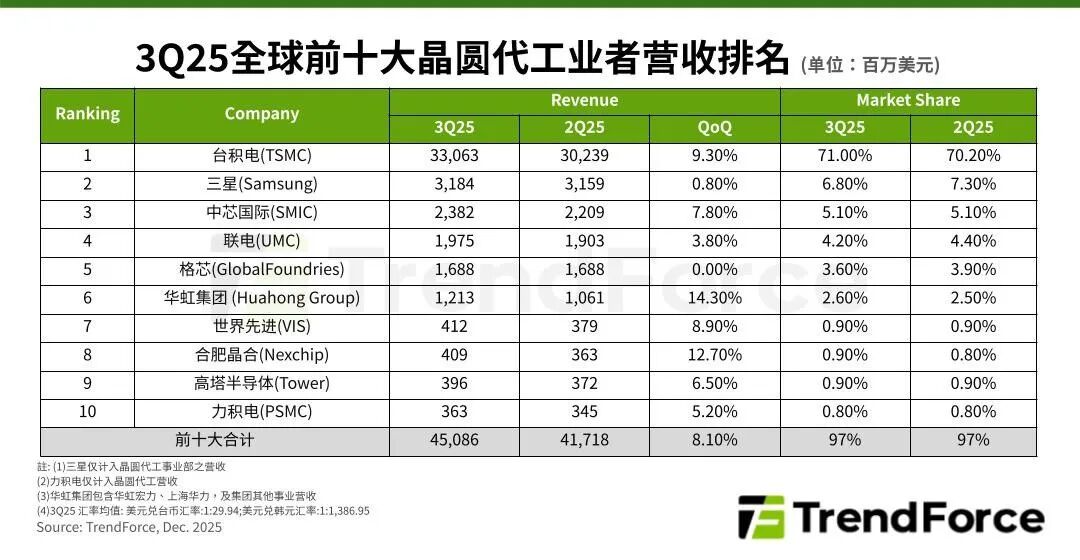
Industry Insights - The global wafer foundry industry is expected to continue benefiting from AI high-performance computing (HPC) and demand for new consumer electronics chips, with advanced processes (7nm and below) significantly contributing to revenue, leading to a quarterly revenue increase of 8.1% for the top ten foundries, reaching nearly $45.1 billion in Q3 2025 [1][7] - Despite the positive outlook for Q3 2025, the industry anticipates a conservative demand shift for mainstream terminal applications in 2026 due to international conditions, with limited growth momentum for capacity utilization in Q4 2025 [1][7] Company Performance - TSMC (Taiwan Semiconductor Manufacturing Company) reported a revenue of approximately $33.1 billion in Q3 2025, a 9.3% increase from the previous quarter, supported by strong demand from smartphones and HPC, increasing its market share to 71% [2][8] - Samsung's revenue remained stable at about $3.2 billion, with a slight increase in capacity utilization but limited contribution to revenue, maintaining a market share of 6.8% [3][9] - SMIC (Semiconductor Manufacturing International Corporation) achieved a revenue of $2.4 billion, a 7.8% increase, driven by improved capacity utilization and wafer shipments [3][9] - UMC (United Microelectronics Corporation) reported a revenue of nearly $2 billion, a 3.8% increase, benefiting from demand for ICs related to smartphones and PCs, with a market share of 4.2% [3][9] - GlobalFoundries maintained its revenue at approximately $1.7 billion, with a slight decline in market share to 3.6% due to competitive pressures [3][9] - HuaHong Group's revenue grew to over $1.2 billion, a 14.3% increase, with improved wafer shipments and ASP [3][9] - Nexchip (合肥晶合) saw a revenue increase of 12.7% to $409 million, surpassing Tower Semiconductor to become the eighth largest foundry [4][10] - PSMC (Powerchip Semiconductor Manufacturing Corporation) reported a revenue growth of 5.2% to $363 million, driven by strong demand for DRAM and improved foundry prices [4][10]




Siemens and GF partner on AI-driven semiconductor manufacture
Yahoo Finance· 2025-12-12 08:38
Core Insights - Siemens and GlobalFoundries (GF) have formed a partnership to integrate AI-driven technologies into semiconductor manufacturing, aiming for enhanced efficiency and reliability in production processes [1][3] - The collaboration will focus on advanced AI-enabled software, sensors, and real-time control systems to improve equipment availability and streamline chip production workflows [2][3] Group 1: Partnership Details - The partnership is formalized through a memorandum of understanding (MoU) and will cover areas such as fab automation, electrification, and digital solutions throughout the semiconductor lifecycle [1][4] - Both companies plan to pilot their AI-driven solutions in their manufacturing operations, with the potential to extend successful approaches to other advanced technology sectors [2][3] Group 2: Industry Context - The agreement comes in response to a surge in demand for semiconductors in critical areas like AI, defense, energy infrastructure, and global connectivity platforms [3] - Siemens and GF aim to enhance industrial resilience and secure supply chains through automation [3][5] Group 3: Contributions and Expertise - Siemens offers a range of technologies for industrial, energy, and building automation, as well as software for chip design and manufacturing process management [4][5] - GF contributes specialized process technology and design expertise, particularly through its subsidiary MIPS, which focuses on RISC-V processor IP [6]
欧盟批准德国提供国家援助支持芯片工厂
Xin Lang Cai Jing· 2025-12-11 11:33
Group 1 - The European Commission has approved a €623 million ($729.16 million) aid package from the German government to support the construction of two semiconductor manufacturing plants in Germany [1][2] - The aid consists of two grants, valued at €495 million and €128 million, respectively [1][2] - The larger grant will be provided to GlobalFoundries, a semiconductor foundry that manufactures semiconductor devices for other companies [2] - The second grant will be allocated to X-FAB to support the construction of a new open foundry at its existing site in Erfurt, Germany [2] Group 2 - The European Commission stated that these measures will promote economic activity in Europe and that the facilities will be pioneering [2] - The Commission also noted that these initiatives will have a broader positive impact on the European semiconductor ecosystem [2]
GlobalFoundries names Sam Franklin as CFO after interim stint
Reuters· 2025-12-10 23:25
Group 1 - GlobalFoundries appointed Sam Franklin as the new chief financial officer [1] - Sam Franklin succeeds David Reeder, who stepped down earlier this year [1]

GlobalFoundries Appoints Sam Franklin as Chief Financial Officer
Globenewswire· 2025-12-10 22:30
Core Insights - GlobalFoundries (GF) has appointed Sam Franklin as Chief Financial Officer, effective immediately, to support the company's growth and profitability [1][2] - Franklin has extensive financial leadership experience and a proven track record in operational excellence and strategic growth, having joined GF in 2022 [2][3] - The company aims to capitalize on the increasing demand for semiconductors and is focused on delivering essential chip technologies to its customers [3] Company Overview - GlobalFoundries is a leading manufacturer of essential semiconductors, providing high-performance products for various high-growth markets, including automotive and IoT [4] - The company operates globally with a manufacturing footprint across the U.S., Europe, and Asia, emphasizing security, longevity, and sustainability in its operations [4]

GLOBALFOUNDRIES Inc. (GFS): A Bull Case Theory
Yahoo Finance· 2025-12-05 21:55
Core Thesis - GLOBALFOUNDRIES Inc. (GFS) is positioned as a key player in the U.S. semiconductor industry, particularly in the context of national security and self-sufficiency efforts [2][4] Company Positioning - GFS has inherited its "trusted foundry" status from IBM, making it one of the few Department of Defense-designated suppliers for secure chips in critical applications [2][3] - The company has a diverse manufacturing footprint that includes radio frequency, power management, and automotive semiconductors, which are essential for defense and infrastructure [3] Financial Backing and Contracts - GFS has received over $1.5 billion in funding from the CHIPS Act and government-backed loans to expand its U.S. manufacturing capabilities [3] - The company has secured long-term contracts with government and industrial clients, ensuring stable cash flow and high visibility in its operations [3][4] Competitive Advantage - GFS is executing its operational strategy effectively, contrasting with competitors like Intel, which are still in the process of scaling their operations [4] - The company's alignment with U.S. semiconductor industrial policy emphasizes its role in providing secure and reliable domestic semiconductor production [4]
CPO收割战,全面开打
半导体行业观察· 2025-12-05 01:46
Core Viewpoint - CPO (Co-Packaged Optics) technology is set to revolutionize the external bandwidth of AI data centers, significantly enhancing data transmission speeds and reducing power consumption, marking a shift in computational infrastructure [1][3]. Industry Trends - The silicon photonics industry is on the brink of explosive growth, with over 150 companies forming a diverse ecosystem from upstream SOI/Epi-wafer to downstream cloud computing and AI factories [1][3]. - The competition among foundries is intensifying, with significant investments in silicon photonics capacity and technology, as companies race to establish themselves in the CPO market [3][4]. Foundry Dynamics - Foundries are crucial in transitioning silicon photonics from design to large-scale production, focusing on integrated manufacturing capabilities that combine photonic and electronic components [4][5]. - Samsung is aggressively investing in silicon photonics to challenge TSMC's dominance, positioning CPO technology as a key competitive advantage in the advanced packaging market [5][6]. Strategic Acquisitions - GlobalFoundries' acquisition of Advanced Micro Foundry (AMF) aims to solidify its leadership in silicon photonics, enhancing its manufacturing capabilities and supply chain reliability [7]. - Tower Semiconductor is expanding its production capacity significantly, driven by the surging demand for silicon photonics, with a focus on providing comprehensive delivery packages [8]. Design Services and Integration - Companies like Broadcom are transforming silicon photonics into platform businesses, integrating optical engines directly into their networking solutions to facilitate scalable deployment [12][13]. - Marvell's acquisition of Celestial AI is a strategic move to enhance its optical interconnect capabilities, aiming to provide a comprehensive connectivity platform for AI infrastructure [17][19]. XPU Manufacturers' Role - XPU manufacturers, particularly NVIDIA, are pivotal in driving the commercialization of CPO technology, with NVIDIA's CPO solutions expected to generate significant revenue by 2026 [21][22]. - AMD is also positioning itself in the silicon photonics space through strategic acquisitions and partnerships, focusing on AI interconnect needs [23]. Intel's Foundation - Intel has established itself as a foundational player in the silicon photonics ecosystem, having commercialized the technology early and built a robust supply chain [24][25]. Conclusion - The competition in the "optical chip" space is not just about manufacturing capacity but also about reshaping the interconnect architecture for AI data centers, with CPO technology expected to be fully commercialized by 2027 [26].