iPhone系列

Search documents
内存芯片短缺将致2026年全球智能手机市场萎缩13%,廉价手机时代或终结
Hua Er Jie Jian Wen· 2026-02-26 21:17
Core Viewpoint - The global smartphone market is facing its most severe crisis in decades, with a projected 12.9% decline in shipments by 2026 due to an unprecedented shortage of memory chips, surpassing the impacts of tariff crises and the COVID-19 pandemic [1][2]. Group 1: Market Forecast - IDC predicts that global smartphone shipments will drop to approximately 1.1 billion units in 2026, down from 1.26 billion units in the previous year, effectively erasing years of market growth [1]. - The situation is expected to remain challenging until at least mid-2027, with the demand for advanced memory driven by artificial intelligence continuing to tighten global supply [2]. Group 2: Impact on Entry-Level Smartphones - The shortage of memory chips is significantly impacting the entry-level smartphone market, with IDC estimating that shipments of smartphones priced below $100 will be around 170 million units in 2025, indicating a struggle for this price segment [3]. - The rising costs of DRAM and NAND chips are squeezing the already thin profit margins of many Android brands, particularly in the price-sensitive entry-level market where memory costs constitute a higher proportion of total material costs [4]. Group 3: Manufacturer Responses - Major Chinese manufacturers like Xiaomi and Oppo are investing heavily in flagship models while their entry-level product lines are becoming increasingly vulnerable under current cost pressures [4]. - In response to ongoing cost challenges, smartphone manufacturers are generally compressing product specifications, eliminating low-margin entry-level models, and guiding consumers towards higher price segments [4]. Group 4: Supply Chain and Pricing Dynamics - Qualcomm's CEO highlighted that the availability of memory will determine the overall scale of the smartphone market, indicating a critical supply gap that may extend until 2027 [5]. - IDC forecasts that even if supply issues are resolved, the likelihood of a return to previous low pricing structures is minimal, suggesting a fundamental reshaping of the smartphone market's scale, average price, and competitive landscape [6].
2025年11月高端手机市场格局:苹果华为领跑,小米vivo激烈角逐
Xin Lang Cai Jing· 2025-12-24 10:32
Core Insights - The sales performance of smartphones priced above 4000 yuan in November 2025 highlights the competitive landscape in the high-end market, with Apple and Huawei leading due to strong brand influence, while Xiaomi and Vivo follow closely, indicating a multi-player competition [1][4] High-End Market Overview - In the mainstream high-end segment (4000 to 6000 yuan), there is a clear trend of market concentration, with Apple and Huawei at the forefront, while Xiaomi and Vivo maintain their positions [1][4] - In the ultra-high-end segment (above 6000 yuan), Apple retains a dominant position with its iPhone series, holding a market share of 76%, while Huawei and Xiaomi follow, collectively accounting for 94% of the market share in this price range [1][4] Competitive Dynamics - In the 5000 to 6000 yuan price range, the market ranking remains consistent with the ultra-high-end segment, where Apple, Huawei, and Xiaomi hold a combined market share of 82%, indicating high concentration and limited penetration for other brands [3][4] - The 4000 to 5000 yuan price segment has become a focal point of competition, with Huawei surpassing Apple to take the lead in sales, followed by Vivo and Xiaomi, with the top three brands holding 68% of the market share [3][5] Market Trends - The share of high-end smartphones (priced above 4000 yuan) in total sales has risen to 42% in November 2025, reflecting an increasing consumer preference for flagship models and indicating that premiumization is a key trend in market development [3][5] Overall Market Performance - In the overall smartphone market, Apple leads with a share of 23.22%, followed by Xiaomi at 15.89%, Vivo at 15.63%, OPPO at 15.16%, Huawei at 13.48%, and Honor at 11.58%, with other brands collectively holding 5.04%, showcasing a competitive landscape with narrowing gaps among leading brands [4][5]


在消费性电子与AI新品驱动下,3Q25前十大晶圆代工产值季增8.1%
Xin Lang Cai Jing· 2025-12-12 14:14
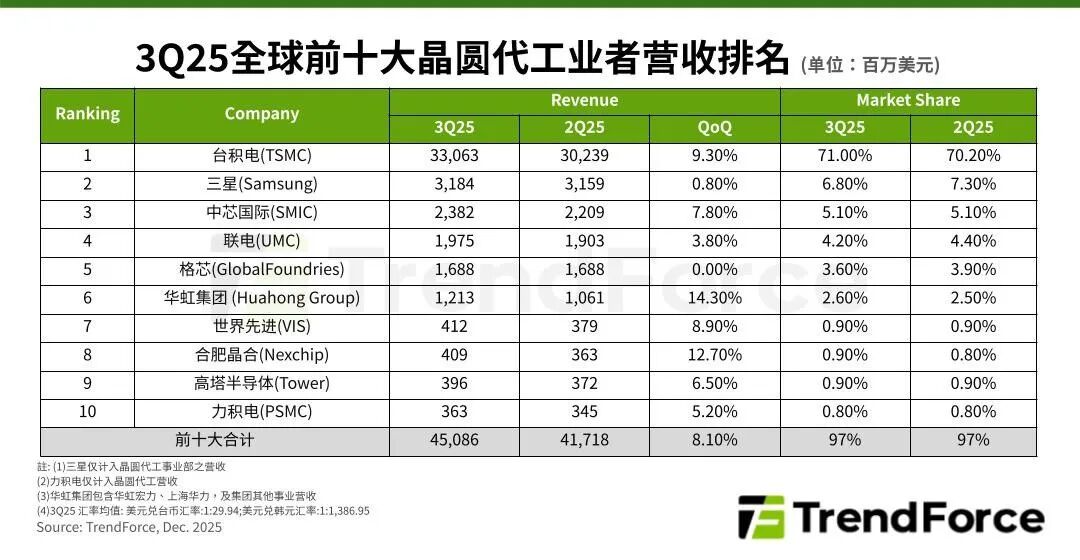
Industry Insights - The global wafer foundry industry is expected to continue benefiting from AI high-performance computing (HPC) and demand for new consumer electronics chips, with advanced processes (7nm and below) significantly contributing to revenue, leading to a quarterly revenue increase of 8.1% for the top ten foundries, reaching nearly $45.1 billion in Q3 2025 [1][7] - Despite the positive outlook for Q3 2025, the industry anticipates a conservative demand shift for mainstream terminal applications in 2026 due to international conditions, with limited growth momentum for capacity utilization in Q4 2025 [1][7] Company Performance - TSMC (Taiwan Semiconductor Manufacturing Company) reported a revenue of approximately $33.1 billion in Q3 2025, a 9.3% increase from the previous quarter, supported by strong demand from smartphones and HPC, increasing its market share to 71% [2][8] - Samsung's revenue remained stable at about $3.2 billion, with a slight increase in capacity utilization but limited contribution to revenue, maintaining a market share of 6.8% [3][9] - SMIC (Semiconductor Manufacturing International Corporation) achieved a revenue of $2.4 billion, a 7.8% increase, driven by improved capacity utilization and wafer shipments [3][9] - UMC (United Microelectronics Corporation) reported a revenue of nearly $2 billion, a 3.8% increase, benefiting from demand for ICs related to smartphones and PCs, with a market share of 4.2% [3][9] - GlobalFoundries maintained its revenue at approximately $1.7 billion, with a slight decline in market share to 3.6% due to competitive pressures [3][9] - HuaHong Group's revenue grew to over $1.2 billion, a 14.3% increase, with improved wafer shipments and ASP [3][9] - Nexchip (合肥晶合) saw a revenue increase of 12.7% to $409 million, surpassing Tower Semiconductor to become the eighth largest foundry [4][10] - PSMC (Powerchip Semiconductor Manufacturing Corporation) reported a revenue growth of 5.2% to $363 million, driven by strong demand for DRAM and improved foundry prices [4][10]




存储器涨价等因素扰动供应链转趋保守 机构预计第四季晶圆代工产值季增幅收窄
Zheng Quan Shi Bao Wang· 2025-12-12 12:52
Core Insights - The global wafer foundry industry is experiencing growth driven by the AI boom, with the top ten foundries' revenue increasing by 8.1% to nearly $45.1 billion in Q3 2025 [1][2] - However, due to international conditions and rising memory prices, the supply chain is becoming conservative regarding demand for mainstream terminal applications in 2026, leading to a forecasted slowdown in capacity utilization growth in Q4 [1][7] Group 1: Industry Performance - The top ten foundries' revenue growth in Q3 2025 was significantly supported by high-performance computing (HPC) and consumer electronics, particularly from advanced processes of 7nm and below [2] - TSMC's revenue reached approximately $33.1 billion, a 9.3% increase, with a market share rise to 71%, driven by smartphone and HPC demand [2] - Samsung's revenue remained stable at about $3.18 billion, with a market share of 6.8%, while SMIC's revenue grew by 7.8% to $2.38 billion, ranking third [2] Group 2: Future Outlook - The wafer foundry industry is projected to grow by 19% in 2026, with AI-related demand driving advanced process markets to a 28% annual increase [2] - TSMC is advancing to 2nm production and plans to move towards 1nm technology, with advanced packaging capacity expected to grow by 27% next year [3] - The semiconductor industry is focusing on increasing capacity and technological trends, especially with the rise of ASIC chips and domestic chip innovations from companies like Huawei and Cambrian [3] Group 3: Consumer Electronics Impact - Consumer electronics are a significant driver for wafer foundry performance, affecting the rankings of the top ten foundries [4] - Nexchip's revenue increased by 12.7% to $409 million, allowing it to surpass Tower Semiconductor to rank eighth [4] - UMC's revenue grew by 3.8% to nearly $1.98 billion, benefiting from demand for smartphones and PCs, while GlobalFoundries' revenue remained stable at about $1.69 billion [5] Group 4: Q4 Expectations - The growth rate for Q4 is expected to slow due to conservative demand forecasts influenced by international conditions and rising memory prices [7] - SMIC's Q4 revenue guidance indicates a modest growth of 2%, reflecting cautious customer production planning amid price pressures [7] - Hua Hong Group anticipates Q4 sales revenue between $650 million and $660 million, with limited growth expected [8]
集邦咨询:第三季前十大晶圆代工厂合计营收环比增8.1% 接近451亿美元
Zhi Tong Cai Jing· 2025-12-12 08:13
Core Insights - The global wafer foundry industry saw a revenue increase of 8.1% quarter-over-quarter in Q3 2025, reaching nearly $45.1 billion, driven by demand from AI high-performance computing (HPC) and consumer electronics [1] Group 1: Major Players' Performance - TSMC's revenue was supported by smartphone and HPC demand, with a quarterly increase of 9.3% to nearly $33.1 billion, resulting in a slight market share increase to 71% [2] - Samsung's revenue remained flat at approximately $3.18 billion, with a market share of 6.8%, despite a slight increase in capacity utilization [2] - SMIC's revenue grew by 7.8% to $2.38 billion, ranking third due to improved capacity utilization and wafer shipments [2] - UMC's revenue increased by 3.8% to nearly $1.98 billion, supported by demand for ICs from smartphones and PCs, with a market share of 4.2% [2] Group 2: Other Notable Companies - GlobalFoundries' revenue held steady at approximately $1.69 billion, maintaining its fifth position, but its market share slightly decreased to 3.6% due to competitive pressures [3] - HuaHong Group's revenue exceeded $1.21 billion, with a market share of 2.6%, benefiting from increased wafer shipments and ASP growth [4] - Vanguard's revenue increased by 8.9% to $412 million, driven by demand for PMICs from smartphones and PCs [4] - Nexchip's revenue rose by 12.7% to $409 million, surpassing Tower Semiconductor to become the eighth-largest player, supported by increased customer market share and demand [4] - Tower's revenue was approximately $396 million, with a quarterly increase of 6.5%, ranking ninth [4] - PSMC's revenue grew by 5.2% to $363 million, driven by stronger demand for DRAM and improved foundry pricing [4]

研报 | 在消费性电子与AI新品驱动下,3Q25前十大晶圆代工产值季增8.1%
TrendForce集邦· 2025-12-12 07:48
Core Insights - The global wafer foundry industry continues to benefit from high-performance computing (HPC) and demand for new consumer electronics, with the top ten foundries experiencing a revenue increase of 8.1% quarter-over-quarter in Q3 2025, reaching approximately $45.1 billion [2][3]. Revenue Performance - TSMC (Taiwan Semiconductor Manufacturing Company) reported a revenue of $33.1 billion in Q3 2025, a 9.3% increase from the previous quarter, maintaining a market share of 71% [3][6]. - Samsung's revenue remained stable at approximately $3.2 billion, with a slight market share decrease to 6.8% [3][6]. - SMIC (Semiconductor Manufacturing International Corporation) achieved a revenue of $2.4 billion, up 7.8% quarter-over-quarter, holding a market share of 5.1% [3][6]. - UMC (United Microelectronics Corporation) reported a revenue of nearly $1.98 billion, a 3.8% increase, with a market share of 4.2% [3][6]. - GlobalFoundries maintained its revenue at approximately $1.69 billion, with a slight market share decline to 3.6% [3][7]. - HuaHong Group's revenue exceeded $1.21 billion, with a market share of 2.6% [3][8]. - Vanguard (VIS) reported a revenue increase of 8.9% to $412 million, maintaining a market share of 0.9% [3][8]. - Nexchip's revenue grew by 12.7% to $409 million, surpassing Tower Semiconductor to become the eighth-largest foundry [3][9]. - Tower Semiconductor's revenue was approximately $396 million, a 6.5% increase, with a market share of 0.9% [3][9]. - PSMC (Powerchip Semiconductor Manufacturing Corporation) reported a revenue of $363 million, a 5.2% increase, with a market share of 0.8% [3][9]. Market Trends - The demand for advanced process nodes (7nm and below) is driving significant revenue contributions, particularly from HPC and consumer electronics [2]. - The industry anticipates a conservative outlook for 2026 due to international market conditions and a cautious approach to mainstream terminal applications [2].
集邦解析 明年第1季存储器显著涨价效应 智能机、NB 销量恐下修
Jing Ji Ri Bao· 2025-12-11 23:29
Core Insights - TrendForce forecasts a significant increase in memory prices by Q1 2026, leading to cost challenges for global end products, which will force smartphone and laptop industries to raise product prices and lower specifications, resulting in a downward revision of sales outlook [1] - The impact of memory on the bill of materials (BOM) for consumer electronics like smartphones and PCs is rapidly expanding, with Apple's iPhone series also expected to see a notable increase in BOM cost share, prompting a reassessment of new device pricing [1] - The rise in memory prices will lead laptop brands to adjust their product mix, procurement strategies, and regional sales layouts, particularly affecting high-end lightweight laptops that cannot easily change specifications due to design constraints [1] - The consumer laptop market, while sensitive to changes in specifications and pricing, currently benefits from existing inventory of finished products and low-cost memory, allowing for short-term price stability, but a price adjustment period is anticipated in the PC market by Q2 2026 [1] Industry Adjustments - "Specification reduction" or "postponing upgrades" has become a necessary strategy for smartphone and laptop brands to balance costs [2]
11月26日隔夜要闻一览
Sou Hu Cai Jing· 2025-11-25 23:14
Group 1 - U.S. stock indices rose for the third consecutive trading day, with the Dow Jones up 1.43%, S&P 500 up 0.91%, and Nasdaq Composite up 0.67%. The Nasdaq China Golden Dragon Index increased by 0.35% [1] - Dell's Q3 FY2025 earnings report showed revenue below Wall Street expectations, but the company forecasts that fourth-quarter performance will exceed market expectations driven by growth in AI sales [5] - According to Counterpoint Research, Apple is set to reclaim the title of the world's largest smartphone manufacturer for the first time in over a decade, thanks to the successful launch of the new iPhone series and a surge in consumer upgrades [6] Group 2 - Concerns have arisen on Wall Street regarding Nvidia's dominance in the AI infrastructure sector due to reports of Meta negotiating the use of Google's chips in data centers, although Nvidia claims its GPUs are "a generation ahead" of Google's AI chips [4] - Tesla's electric vehicle registrations in Europe for October were reported at only 6,964 units, a significant decline of 48.5% compared to the same period last year, according to the European Automobile Manufacturers Association [8]
芯片之王易主?英伟达市值破5万亿美元 分析师警告:90%份额恐不保
Sou Hu Cai Jing· 2025-10-31 11:02
Group 1: Nvidia - Nvidia's market capitalization recently surpassed $500 billion, marking a historic high and reflecting strong market confidence in artificial intelligence technology [1] - The stock price of Nvidia rose by 5.2% during trading, reaching $211.47 per share, achieving this milestone just four months after crossing the $400 billion mark [1] - The rapid growth is attributed to Nvidia's leading position and continuous innovation in the AI sector, with CEO Jensen Huang announcing new collaboration plans to meet global demand for AI infrastructure and solutions [1] - Investment firm Fort Pitt Capital Group's CIO Dan Eye noted that investors are beginning to recognize the importance of not overly focusing on short-term valuation fluctuations in AI stocks [1] - Eye also mentioned that while Nvidia currently holds a significant share of the AI chip market, this share may face downward pressure in the long term due to increasing competition from rivals like AMD and Broadcom [1] Group 2: Apple - Apple achieved a significant milestone with its market capitalization surpassing $400 billion, becoming the third company to reach this level after Nvidia and Microsoft [3] - The rise in Apple's stock price, which increased by approximately 25% over the past three months, was driven by strong demand for its latest iPhone series [3] - Analysts have mixed views on Apple's long-term strategy in the AI sector, with some believing its unique advantages in hardware design and ecosystem development will help maintain competitiveness, while others point out its cautious approach to AI may impact long-term growth potential [3] Group 3: Technology Industry Trends - The recent performance of the technology sector indicates that AI-related technologies are becoming a key driver of market growth, with increasing demand for AI chips, software, and services as industries accelerate digital transformation [3] - Global markets are intensifying investments in domestic technology industries, which may have profound implications for the future competitive landscape of the global tech sector [4] - Analysts suggest that while the innovation potential in the tech sector remains strong, investors should remain cautious and thoroughly understand each company's technological capabilities, business models, and sustainability [4]

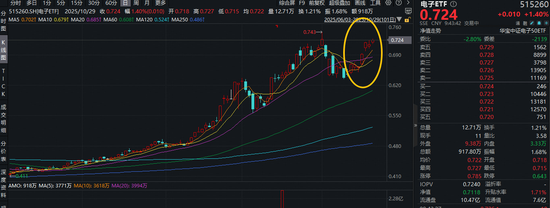
果然大涨!苹果挺进四万亿美元俱乐部!果链含量43%的电子ETF(515260)盘中涨逾1.6%冲击日线7连阳!
Xin Lang Ji Jin· 2025-10-29 01:52
Group 1 - Apple's stock price reached a new high of $269.98, with a market capitalization surpassing $4 trillion, making it the third company to join the "trillion-dollar club" after Nvidia and Microsoft [1] - Since the launch of the latest iPhone series on September 9, Apple's stock has increased by approximately 13%, marking a shift from decline to growth for the year [1] - Analysts believe that the strong demand for new products indicates that Apple is regaining growth momentum in its product cycle [1] Group 2 - The electronic ETF (515260) has a significant weight of 43.43% in Apple’s supply chain stocks, reflecting the strong performance of the "fruit chain" [1][5] - As of October 27, all 15 companies that disclosed their Q3 reports within the electronic ETF achieved profitability, with 14 companies reporting double-digit year-on-year growth in net profit [3] - Notable companies such as Shenghong Technology and Cambricon reported year-on-year net profit increases of 324% and 321%, respectively, indicating robust performance in the semiconductor sector [3] Group 3 - The semiconductor sector is experiencing a structural market driven by strong policy expectations and trends in the AI industry, with a focus on technological self-reliance and supply chain autonomy [3][4] - The upcoming peak season for consumer electronics, combined with the release of AI-related products, is expected to positively impact the electronic industry’s fundamentals [4] - The electronic ETF (515260) is designed to track the performance of the semiconductor and consumer electronics sectors, featuring major companies like Luxshare Precision and Semiconductor Manufacturing International [5]