HSBC HOLDINGS(HSBC)
Search documents
汇丰全盘剖析黄金逻辑:上涨动能或已接近极限
Hua Er Jie Jian Wen· 2025-07-01 12:20
Core Viewpoint - Gold prices have seen a significant pullback after reaching a historical high of $3,500 per ounce on April 22, 2025, with geopolitical factors and central bank purchases continuing to support gold, but prices may be nearing a peak due to weakening physical demand, increased supply, and a slower-than-expected rate cut by the Federal Reserve [1][6][12]. Group 1: Supply and Demand Dynamics - Total gold supply is projected to increase from 4,950 tonnes in 2023 to 5,190 tonnes in 2025, driven by mine production and old gold scrap recovery [2]. - Jewelry demand, which constitutes about half of global gold consumption, is expected to decline significantly, with a 21% year-on-year drop in Q1 2025 to 380.3 tonnes [21]. - Investment demand remains strong, with gold ETFs seeing a net increase of 7.94 million ounces in 2023, reaching 90.79 million ounces [14]. Group 2: Geopolitical and Economic Factors - Geopolitical risks have historically supported gold prices, but the market's response may have reached saturation, as evidenced by the failure to surpass the April high following tensions with Iran [6]. - The Federal Reserve's anticipated rate cuts are expected to be less aggressive than previously thought, which could negatively impact gold prices [12]. - Global trade growth is projected to slow, with only a 1.8% increase expected in 2025, which typically supports gold prices [9]. Group 3: Central Bank Purchases and Future Projections - Central bank demand for gold remains robust, with purchases expected to total 955 tonnes in 2025, although this is lower than previous years [28]. - HSBC has raised its average gold price forecast for 2025 to $3,215 per ounce, with a trading range of $3,100 to $3,600 per ounce [2]. - The forecast for gold prices in 2026 is set at $3,125 per ounce, indicating a potential decline in price momentum [2].
7月1日电,汇丰银行表示,将2026年黄金的平均价格预测上调至每盎司3,125美元,此前预测为每盎司2,915美元。
news flash· 2025-07-01 10:00
Group 1 - HSBC has raised its average gold price forecast for 2026 to $3,125 per ounce, up from the previous forecast of $2,915 per ounce [1]
汇丰:2025年全球经济承压下行,中国经济行稳致远
Sou Hu Cai Jing· 2025-07-01 06:06
Group 1 - Global trade growth is expected to slow down, with a projected increase of only 1.8% in 2025, while global economic growth may decelerate to 2.5% [1] - China's economy remains resilient, with GDP growth expected to exceed 5% in the first half of 2025, supported by ongoing macroeconomic policies [3] - The increase in tariffs is anticipated to have a negative impact on trade in the short term, leading to a restructuring of industrial chains and changes in trade and investment flows in the long term [4] Group 2 - China's position as the largest exporter is maintained, with a projected 14.6% share of global exports in 2024, while the U.S. remains the largest importer with a 13.6% share [4] - The largest export destination for China has shifted from the U.S. to ASEAN, and Mexico has become the largest source of imports for the U.S. [4] - Chinese manufacturing is undergoing a value chain upgrade, with an increasing proportion of capital goods and intermediate goods in exports, indicating a trend towards higher value-added production [4]
汇丰:全球经济-不均衡态势
汇丰· 2025-07-01 00:40
Investment Rating - The report does not explicitly provide an investment rating for the industry Core Insights - The global economic outlook remains uncertain due to ongoing US tariffs and geopolitical tensions, particularly regarding Iran and its nuclear ambitions [3][4][24] - US tariffs are expected to have a significant impact on both US and global growth, with a projected decline in global GDP from 2.8% in 2024 to 2.5% in 2025 [8][22] - The average effective tariff rate for US consumers has reached 15.8%, the highest since 1936, indicating a substantial increase in trade costs [9][46] Summary by Sections Key Forecasts - Global GDP growth is forecasted to slow from 2.8% in 2024 to 2.5% in 2025 and further to 2.3% in 2026 [22] - Developed economies are expected to grow at a slower pace compared to emerging markets, with the US GDP growth projected at 1.8% for 2025 [22] Economic Environment - The report highlights the volatility in global trade data due to frontloading ahead of US tariffs, which has led to a surge in imports followed by a sharp decline [12][52] - US tariffs are anticipated to slow trade growth, with global trade growth projected at just 1.8% in 2025 and 0.6% in 2026 [12][71] Tariff Implications - US tariffs are described as a multi-purpose tool that will likely lead to higher inflation and lower growth in the US, with ongoing uncertainty regarding future tariff negotiations [11][50] - The report notes that countries with lower exposure to US tariffs may benefit, particularly those positioned to supply components currently sourced from mainland China [13][74] Consumer Spending and Inflation - US consumer spending is expected to slow due to weaker employment and slower real wage growth, while inflation pressures may persist despite a general slowdown in growth [15][16] - The report anticipates sticky core inflation in the US, influenced by supply shocks from tariffs and lower immigration [16] Central Bank Actions - The Federal Reserve and European Central Bank are expected to pause rate changes during the summer, amidst ongoing global economic uncertainty [17][31] - Divergences in central bank policies are noted, with the Fed likely to cut rates modestly by the end of 2026 [17] Fiscal Policy and Trade Negotiations - Ongoing US fiscal negotiations are highlighted as critical, with potential implications for economic growth depending on the outcomes [18][19] - The report emphasizes the importance of monitoring trade negotiations and their impact on global economic dynamics [20][33]
HSBC's Arm to Exit German Custody Business Under Simplification Plan
ZACKS· 2025-06-30 17:06
Core Viewpoint - HSBC Holdings Plc's subsidiary, HSBC Continental Europe, has agreed to sell its custody operations in Germany to BNP Paribas as part of its simplification strategy to focus on being a leading corporate and institutional bank in Germany and Europe for international clients [1][10] Group 1: Details of the Transaction - The custody business in Germany provides domestic custody, clearing, and depository services for German institutional clients [2] - The financial terms of the agreement are undisclosed, but it involves the complete transfer of custody operations, including all assets and related clients, to BNP Paribas, with a phased execution starting in early 2026 [3][4] - The completion of the transaction is subject to regulatory and antitrust approvals, as well as negotiations with the Works Council in Germany [4] Group 2: Strategic Alignment - The divestiture aligns with HSBC's simplification strategy announced in October 2024, which includes winding down investment banking activities in the UK, Europe, and the US, and divesting from its French life insurance arm and private banking business in Germany [5] - HSBC has also sold its business in South Africa and completed sales in various countries including the US, Canada, and New Zealand in recent years [6][7] Group 3: Financial Impact - HSBC aims to achieve $1.5 billion in annualized savings by the end of 2026 through these divestitures and cost realignment efforts, with expected upfront charges of nearly $1.8 billion [8] - The bank plans to reallocate an additional nearly $1.5 billion of costs from non-strategic activities to priority growth areas over the medium term [8] Group 4: Market Performance - Over the past year, HSBC shares have increased by 38.2%, outperforming the industry's growth of 32.2% [9]
HSBC U.S. CEO on company growth, global trade and U.S. trade volumes
CNBC Television· 2025-06-30 16:04
Business Focus - The firm is focused on two main businesses: corporate and institutional banking, and wealth and private banking, assisting clients with international needs [3] - The firm banks 90% of the Fortune 100 companies [3] - The firm also supports innovation economy startups, including 1,200 innovation clients globally across five core markets, acquired through SVB two years ago [4] Geopolitical Uncertainty and Trade - The firm helps clients navigate geopolitical uncertainty, including trade tariffs, currency hedging, and supply chain repositioning [2] - The firm sees increased global trade volumes despite challenges, with clients cautiously optimistic [5] - US import duties with a 10% baseline tariff will be challenging for some American companies [5] - Trade is not expected to collapse; instead, different corridors and cost equations may emerge, managed through innovation [9] Currency and Payments - The firm's payments business processed 550 trillion in payments across 130 currencies last year, assisting clients with hedging [8] - Currency hedging is increasing as clients seek agility, especially with the dollar at a three-year low [7][8] Strategic Responses to Cost Impact - Companies may respond to cost impacts by passing them on to consumers, absorbing them in margin, or negotiating with suppliers [7] Growth Corridors - The firm is helping clients navigate new growth corridors, with significant volume between the US and UK, US and India (up 22% last year), and US and Middle East [6] Client Sentiment - Approximately 93% of the clients in the US are optimistic overall [9]
Barclays vs. HSBC: Which Global Bank is the Smarter Buy Today?
ZACKS· 2025-06-27 16:11
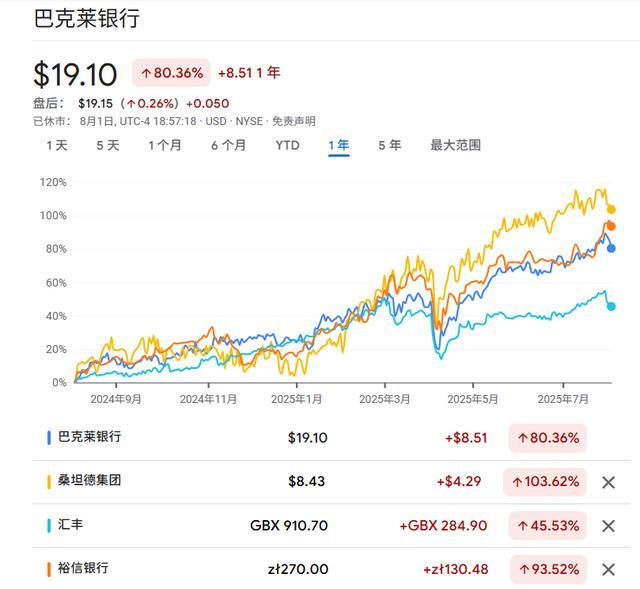
Core Insights - Barclays PLC and HSBC Holdings PLC are prominent foreign banks based in London, both focusing on streamlining operations to enhance efficiency and core business focus [1][2] Barclays Overview - Barclays is implementing a three-year cost savings plan aimed at enhancing operational efficiency and reallocating capital into higher-growth markets, including a recent sale of its consumer finance business in Germany [3][4] - The bank achieved gross savings of £1 billion in 2024 and £150 million in Q1 2025, with a target of £0.5 billion in gross efficiency savings for the current year and £2 billion by 2026 [4][5] - Barclays is investing in high-growth areas, including a £400 million collaboration with Brookfield Asset Management and a £210 million capital injection into its India operations [5][6] - The bank's net interest income and other income have shown improvement, indicating that its strategic refocus is yielding positive results [6][7] HSBC Overview - HSBC is executing a $1.5 billion cost-saving plan focused on organizational simplification, with an additional $1.5 billion to be redeployed from underperforming areas into strategic priorities [8][9] - The bank has divested operations in several countries, including the U.S., Canada, and Argentina, and is reviewing its presence in various markets to improve returns [9][11] - HSBC is concentrating on its Asia-focused strategy, aiming to become a leading wealth manager in the region, with significant expansions planned in mainland China and India [11][12] - Despite these efforts, HSBC has faced subdued revenue generation and weak earnings performance expectations due to a challenging macroeconomic environment [13][24] Comparative Analysis - Barclays is projected to have earnings growth of 21.2% in 2025 and 23.3% in 2026, while HSBC's earnings growth is expected to be only 4.2% in 2025, with a decline of approximately 1% in 2026 [10][14] - Year-to-date, Barclays shares have increased by 37.9%, outperforming HSBC's 22.3% gain [18][20] - In terms of valuation, Barclays is trading at a P/TB of 0.77, while HSBC is at 1.09, indicating that Barclays is currently less expensive [20][26] - HSBC has a higher return on equity (ROE) of 12.55% compared to Barclays' 8.04%, reflecting more efficient use of shareholder funds [21][27] Investment Outlook - Barclays is viewed as a better investment opportunity due to its stronger near-term earnings outlook, attractive valuation, and superior stock performance [23][27] - HSBC's long-term strategy in Asia and wealth management may yield significant gains, but current revenue growth and earnings performance concerns present challenges [24][27]
Sale of Custody Business in Hsbc Germany
Globenewswire· 2025-06-27 11:20
Core Viewpoint - HSBC Continental Europe has agreed to sell its custody business in Germany to BNP Paribas, aligning with its strategy to focus on corporate and institutional banking for international clients in Europe [2][3]. Group 1: Transaction Details - The sale is part of HSBC's simplification strategy announced in October 2024, aimed at enhancing leadership and market share in areas of competitive advantage [3]. - The custody business in Germany provides domestic custody, clearing, and depository services for German institutional clients, with all staff, assets, and clients transferring to BNP Paribas [4]. - The completion of the transaction is subject to regulatory and anti-trust approvals, as well as negotiations with the Works Council in Germany [4]. Group 2: Transition Plan - A phased transfer of staff and clients is expected to begin in early 2026, with both HSBC and BNP Paribas focused on ensuring a smooth transition [5]. Group 3: Company Background - HSBC Continental Europe operates across various European countries, providing corporate and institutional banking, private banking, insurance, and asset management services [7]. - HSBC Holdings plc, the parent company, is one of the largest banking organizations globally, with assets of approximately USD 3,054 billion as of March 31, 2025 [9]. - BNP Paribas is a leading European banking and financial services provider, operating in 64 countries with a strong presence in corporate and institutional banking [10][11]. Group 4: Securities Services Overview - BNP Paribas' Securities Services business is a global custodian with a custody network covering over 90 markets, managing USD 15.4 trillion in assets under custody as of March 31, 2025 [12].
汇丰控股(00005) - 翌日披露报表

2025-06-27 08:30
FF305 翌日披露報表 (股份發行人 ── 已發行股份或庫存股份變動、股份購回及/或在場内出售庫存股份) 表格類別: 股票 狀態: 新提交 公司名稱: HSBC Holdings plc 滙豐控股有限公司 呈交日期: 2025年6月27日 如上市發行人的已發行股份或庫存股份出現變動而須根據《香港聯合交易所有限公司(「香港聯交所」)證券上市規則》(「《主板上市規則》」)第13.25A條 / 《香港聯合交易所有限公司GEM證券 上市規則》(「《GEM上市規則》」)第17.27A條作出披露,必須填妥第一章節 。 | 第一章節 | | | | | | | | | | --- | --- | --- | --- | --- | --- | --- | --- | --- | | 1. 股份分類 | | 普通股 | 股份類別 | 不適用 | 於香港聯交所上市 | | 是 | | | 證券代號 (如上市) | | 00005 | 說明 | 普通股(每股0.50美元) | | | | | | A. 已發行股份或庫存股份變動 | | | | | | | | | | | | | 已發行股份(不包括庫存股份)變動 | | 庫存股 ...
汇丰:中东冲突_对石油、市场、经济、股市等的看法
汇丰· 2025-06-27 02:04
Investment Rating - The report indicates that the biggest economic risk to economies and markets remains via an oil shock, with oil prices expected to spike above USD 80 per barrel due to potential closure of the Strait of Hormuz [8][3]. Core Insights - The conflict in the Middle East, particularly the US strikes on Iranian nuclear sites, has intensified uncertainty in global economies and markets [2]. - Oil prices are projected to rise significantly, with a potential increase to above USD 80 per barrel, reflecting a higher probability of a Hormuz closure, which is critical as approximately 18% of the world's oil passes through this strait [3][8]. - The report outlines four key risk channels for global equity markets: oil prices, freight and trade, geopolitical risk premiums, and tourism [4][33]. Summary by Sections Oil Market - Following US strikes on Iran, oil prices are expected to rise due to increased risk premiums, with forecasts suggesting Brent prices could reach USD 67 per barrel in Q2/Q3 and USD 65 per barrel thereafter if supplies are not disrupted [14][8]. - If oil supplies are disrupted, there would be an upside risk to oil prices, although this may eventually be capped by ample OPEC+ spare capacity [14]. Economic and Market Impact - The direction of exchange rates will largely depend on oil prices and the speed of their increase, with potential strengthening of the USD as a safe-haven currency [25]. - The report suggests that while the conflict does not pose a meaningful threat to economic stability in the Gulf, increased uncertainty may negatively impact sentiment, particularly in travel, trade, and tourism sectors [4][26]. Geopolitical Risks - The escalation of conflict between Israel and Iran poses downside risks to emerging market equities, with investors potentially rotating from Gulf Cooperation Council (GCC) countries to Latin America [33]. - The report emphasizes that the biggest risk to economies and markets remains through an oil shock, with trade costs and tourism impacts also being significant [14][32].