IBM(IBM)

Search documents
IBM(IBM.US)发布Power11芯片:零停机维护+AI加速,重塑企业级计算安全标准
Zhi Tong Cai Jing· 2025-07-09 02:32
Core Insights - IBM officially launched the next-generation Power11 chip and accompanying server products on July 8, 2025, marking its first major technological upgrade since the Power10 release in 2020 [1] - The Power11 server, set to be globally available on July 25, 2025, offers a hybrid cloud solution with enhanced availability, flexibility, and scalability through comprehensive innovations in processors, hardware architecture, and virtualization software stack [1] System Reliability - Power11 achieves 99.9999% system availability, supporting zero planned downtime maintenance through self-healing and automatic load transfer technologies [2] - The built-in IBM Power Cyber Vault security solution can detect and respond to ransomware threats within one minute, providing a robust data resilience framework that meets international standards, particularly crucial for the financial services industry [2] Chip Technology Architecture - Power11 utilizes a 7-nanometer process technology, integrating eight high-performance cores per chip, each with 4.5MB of L2 cache, totaling 36MB of cache capacity [3] - The L3 and L4 caches have been expanded to 360MB and 2.88GB, respectively, improving large-scale data processing efficiency by 40% compared to previous generations [3] - Global AI server spending is projected to reach $140 billion by 2025, with 80% concentrated in hardware, positioning Power11 to capitalize on the trend towards liquid-cooled data centers [3] Server Specifications - Power11 is the first Power server to support the Spyre Accelerator, achieving breakthroughs in AI computing power with a 75W PCIe Gen5 interface and 32 dedicated cores [4] - The system can deliver 24 TOPS of computing power per card, with memory bandwidth reaching 1.6TB/s through parallel deployment of eight cards, catering to complex language model inference needs [4] - Despite a slight 0.5% increase in IBM's stock price on the launch day, analysts remain cautious about long-term growth due to a ten-year low in annual dividend growth and a high price-to-earnings ratio near 23 times, alongside a $58.4 billion debt burden [4] Market Response - The launch is described by IBM Power Systems General Manager Tom McPherson as a "game changer for enterprise computing" [5] - Power11 integrates the Red Hat OpenShift AI ecosystem and the watsonx data platform, supporting both on-premises deployment and seamless virtual server options with IBM Cloud [5] - With the dual drivers of surging AI computing demand and green data center construction, Power11's comprehensive advantages in performance, security, and energy efficiency are expected to inject new momentum into IBM's competitive position in the hybrid cloud market [5]
IBM发布新一代Power芯片
半导体行业观察· 2025-07-09 01:26
Core Insights - IBM's Power11 chips are 55% faster than the previous Power9 generation, which debuted in 2017, and are designed for various applications beyond supercomputers [3][4] - The Power11 architecture supports up to 30 cores per socket, with a maximum of 240 threads due to simultaneous multithreading, offering competitive performance against AMD and Intel [3][4] - IBM claims that Power11 delivers twice the performance per watt compared to x86 systems, emphasizing energy efficiency and system resilience [5][4] Product Features - Power11 introduces resource groups to enhance utilization and performance without increasing energy consumption, along with a power-saving mode that can improve efficiency by 28% [4] - The architecture allows for 99.9999% uptime, with features like hot-swappable components for maintenance without downtime [5] - Power11 systems will include AI accelerators capable of running large and small language models, indicating a focus on AI integration [5][6] System Configurations - The top-tier IBM E1180 can support up to 64 cores and 512 threads, with a maximum memory capacity of 16TB using DDR5 [7][26] - The E1150 model shares many features with the E1180 but can support up to 120 cores, showcasing flexibility in configurations [8][30] - Smaller configurations like the S1124 and S1122 are designed for reliability in compact environments, with varying core and memory capacities [32][34] Market Positioning - IBM aims to provide a modern platform that enhances performance and functionality for existing customers while attracting new ones [37] - The introduction of PowerVS hybrid cloud services allows enterprises to manage both on-premises and cloud servers seamlessly, addressing deployment challenges in the IBM POWER ecosystem [21] - The company is focusing on expanding its custom accelerators from IBM Z to POWER servers, enhancing its competitive edge in the market [19][16]

美国总统特朗普:雷神和IBM都将投票角逐联邦航空管理局(FAA)的改革。

news flash· 2025-07-08 17:14
Group 1 - The core point of the article is that President Trump has announced that Raytheon and IBM will be competing for the opportunity to influence the reform of the Federal Aviation Administration (FAA) [1]
IBM launches Power11 chips and servers with focus on AI, uptime and security
Proactiveinvestors NA· 2025-07-08 15:31
About this content About Emily Jarvie Emily began her career as a political journalist for Australian Community Media in Hobart, Tasmania. After she relocated to Toronto, Canada, she reported on business, legal, and scientific developments in the emerging psychedelics sector before joining Proactive in 2022. She brings a strong journalism background with her work featured in newspapers, magazines, and digital publications across Australia, Europe, and North America, including The Examiner, The Advocate, ...

IBM Power11 Raises the Bar for Enterprise IT
Prnewswire· 2025-07-08 11:00
Core Insights - IBM Power11 is designed to support enterprises in the AI era with simplified operations and hybrid cloud flexibility, addressing the complexities of one billion new logical applications expected by 2028 [1][2] - The Power11 server boasts a remarkable uptime of 99.9999%, zero planned downtime for maintenance, and rapid ransomware threat detection in under one minute [2][5] - Power11 will be the first to support the IBM Spyre Accelerator, enhancing AI workload performance and scalability across hybrid cloud environments [3][4] Performance and Efficiency - Power11 offers up to 55% better core performance compared to Power9 and up to 45% more capacity in entry and mid-range systems compared to Power10 [4][6] - The server provides twice the performance per watt compared to comparable x86 servers and up to 28% better efficiency in Energy Efficient Mode [6][15] Automation and AI Integration - Power11 features autonomous operations that enable zero planned downtime, allowing critical applications to remain online during maintenance [5][6] - The integration of AI capabilities, including the IBM Spyre Accelerator and tools like watsonx Code Assistant, aims to modernize application development and enhance productivity [5][6] Market Availability - IBM Power11 is set to be generally available on July 25, 2025, with the IBM Spyre Accelerator expected in Q4 2025 [6]

美日科研成果 量子计算与传统超算联袂模拟分子行为
Huan Qiu Wang Zi Xun· 2025-07-08 02:00
Core Insights - IBM and RIKEN researchers successfully simulated quantum behaviors of various molecules by combining quantum and supercomputing technologies, paving new paths for chemical and pharmaceutical research [1][2] Group 1: Research Collaboration - IBM's "Eagle" quantum computer collaborated with Japan's "Fugaku" supercomputer to simulate the quantum states of nitrogen molecules and two iron-sulfur compounds using a spatial quantum dynamics algorithm [1] - The quantum computer performed core calculations while the supercomputer acted as a "quality inspector," correcting errors in real-time [1] Group 2: Performance and Future Prospects - Although the hybrid model has not yet surpassed the independent performance of supercomputers, it has demonstrated competitive capabilities in computational chemistry [2] - Kenneth M. Moritz from Cleveland Clinic noted that the improved spatial quantum dynamics algorithm can simulate molecular behavior in solution, making chemical modeling more realistic [2] - There is optimism that the combination of quantum and classical computing could show significant advantages within a year after further algorithm optimization [2] Group 3: Industry Developments - NVIDIA has developed a software platform supporting hybrid computing, while Microsoft emphasizes the transformative potential of the combination of quantum computing, supercomputing, and artificial intelligence in chemistry and materials science [2] - Caution is expressed by Markus Reiher from ETH Zurich, who highlights the need to observe the method's performance in large molecule simulations before it can be considered the preferred approach for quantum chemical calculations [2] Group 4: Ongoing Improvements - The RIKEN laboratory has upgraded to a new IBM quantum processor with lower error rates, and the research team is working on optimizing the spatial quantum dynamics algorithm and enhancing the collaboration efficiency between "Eagle" and "Fugaku" [2]


量子产业化,日本下血本了
Hu Xiu· 2025-07-08 01:29
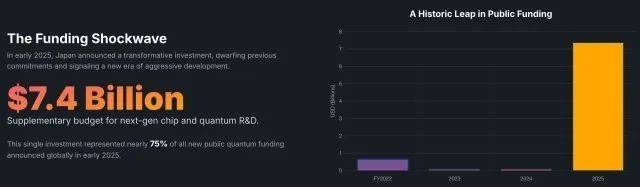
Group 1 - Japan's government has committed $7.4 billion (approximately 1.05 trillion yen) to quantum technology this year, which is more than three times the total investment over the past five years [1][2] - This investment represents a strategic shift driven by deep-seated concerns about historical failures in technology leadership, particularly in the semiconductor industry [3][4] - The Japanese government aims to transition from basic research to industrialization, with a clear goal of making quantum technology a pillar of future economic prosperity and national security [5][10] Group 2 - The investment is seen as a "preventive and high-risk" intervention to avoid being left behind in the global competition for technology leadership [7][9] - The government hopes to stimulate systemic change, encouraging research institutions, large enterprises, and potential startups to engage in the quantum race [8][9] - Japan's approach is characterized by a "collaborative giant ship" model, where the government leads and industrial giants collaborate, forming a powerful alliance [12][14] Group 3 - Major Japanese corporations like Toyota, NEC, and Fujitsu are expected to benefit significantly from government contracts and participation in core research projects [43][44] - The focus on building a self-sufficient supply chain for quantum technology components is a key aspect of Japan's strategy, aiming to avoid reliance on foreign suppliers [20][23] - The mixed quantum-classical computing strategy is seen as a pragmatic approach to leverage existing capabilities while aiming for quick results in various applications [17][18][19] Group 4 - Japan's commitment to quantum technology is likely to provoke responses from other major players, including the U.S. and China, potentially escalating a new round of "quantum arms race" [39][40][42] - The success of Japan's strategy will depend on overcoming challenges such as fostering a vibrant startup ecosystem and effectively translating research into marketable products [25][29][31] - Attracting and retaining top talent in the competitive global landscape is crucial for Japan to realize its quantum ambitions [32][34][38]

量子计算与传统超算联袂模拟分子行为
news flash· 2025-07-07 22:14
Core Insights - IBM collaborates with scientists from the RIKEN Institute in Japan to successfully simulate quantum behaviors of various molecules using a combination of quantum and supercomputing technologies [1] Group 1 - The research results are published in the journals "Science Advances" and "Physical Chemistry B," indicating a significant contribution to the fields of chemistry and drug development [1]
芯片产业的下一个颠覆性突破!
半导体芯闻· 2025-07-07 09:49
Core Viewpoint - The article discusses the future of semiconductor technology, emphasizing the transition from traditional silicon-based materials to two-dimensional (2D) semiconductor materials as a key focus for innovation and development in the industry [2][12][53]. Group 1: Industry Trends and Predictions - IMEC predicts that by 2039, the second generation of 2D Field Effect Transistors (2DFET) will become mainstream, highlighting the growing importance of 2D materials in semiconductor technology [4][53]. - The global market for 2D semiconductor materials is expected to reach $1.8 billion in 2024, with graphene being the largest segment, accounting for 45% of the market share [16]. - The market is projected to grow at a compound annual growth rate (CAGR) of 24%-26.5% from 2025 to 2030, driven by demand in 5G communication, AIoT, and high-performance computing [16]. Group 2: Material Innovations - The transition to 2D semiconductor materials is seen as a solution to the challenges posed by traditional silicon-based devices, which face physical limitations such as quantum tunneling and short-channel effects [5][12]. - 2D materials, such as graphene and transition metal dichalcogenides (TMDs), offer unique electrical properties and the potential for higher integration densities, with vertical field-effect transistors (VFETs) achieving densities ten times that of FinFETs [6][14]. - Research has shown that 2D materials can be engineered to exhibit a wide range of electronic properties, making them suitable for various applications, including neuromorphic devices and quantum computing [9][12]. Group 3: Industrial Applications and Developments - Companies like TSMC, Intel, and Samsung are investing heavily in the research and integration of 2D semiconductor materials, pushing the industry from laboratory experiments to large-scale production [16]. - The first domestic engineering demonstration line for 2D semiconductors has been launched, aiming to develop commercial production lines within three years [17]. - Significant advancements have been made in the development of flexible integrated circuits based on 2D materials, with successful demonstrations of medium-scale circuits that integrate over 100 transistors [45][50]. Group 4: Challenges and Solutions - The integration of 2D materials into existing semiconductor processes presents challenges, including the need for compatible substrates and the management of high-temperature growth processes [54][57]. - Researchers are exploring various methods to overcome these challenges, such as using low-resistance source/drain contacts and alternative doping techniques to enhance the performance of 2D devices [58][59]. - The industry is also focusing on developing heterogeneously integrated chip technologies that leverage existing silicon ecosystems while incorporating 2D materials [59].


IBM's Neudesic Boosts Cloud Security Capabilities: An Ace Up Sleeve?
ZACKS· 2025-07-04 15:16
Group 1: Company Developments - Neudesic, a subsidiary of IBM, has renewed its Cloud Security Specialization with Microsoft to enhance enterprise-grade security solutions across hybrid and multi-cloud environments [1][7] - The renewal of the Microsoft certification validates Neudesic's capability to protect critical infrastructure and data across Azure and on-premises systems [1][3] - IBM's acquisition of Neudesic in February 2022 significantly expanded its portfolio of hybrid multi-cloud services, enhancing its digital transformation offerings across various industries [2] Group 2: Market Position and Performance - Neudesic's Microsoft certification provides clients with confidence in reducing risk and improving resiliency, which is expected to strengthen its leadership position in cloud security and potentially increase revenues for IBM [3][7] - IBM's stock has surged 65.9% over the past year, outperforming the industry's growth of 8.9% [6] - IBM currently trades at a forward price-to-sales ratio of 4, which is above the industry average [8] Group 3: Industry Context - Other tech firms like Rubrik and CDW have also achieved Microsoft Cloud Security Specialization, showcasing their capabilities in securing Azure-based environments and implementing multi-layered protection [4][5] - The Microsoft certification for these firms indicates a competitive landscape in cloud security, emphasizing the importance of advanced security solutions in hybrid environments [4][5] Group 4: Future Outlook - The Zacks Consensus Estimate for IBM's earnings for 2025 has been on the rise over the past 60 days, indicating positive market sentiment [9]