JP MORGAN CHASE(JPM)

Search documents
JPMorgan CEO Sees Consumers ‘Doing Fine' Despite Job Troubles
PYMNTS.com· 2025-12-08 02:20
Core Insights - The American consumer is showing resilience despite a cooling job market and ongoing inflation, according to JPMorgan Chase CEO Jamie Dimon [2][3] - Jobless claims are at their lowest level in three years, but companies are planning more layoffs, indicating a mixed labor market [4] - Concerns about artificial intelligence (AI) potentially leading to job cuts are present, but Dimon believes AI will ultimately benefit society [5][6] Consumer Behavior - Consumers continue to spend, although they are trading down and focusing on value channels due to economic pressures [4] - Recent labor reports indicate rising uncertainty among hourly workers, yet spending remains steady [3][4] Labor Market Dynamics - Jobless claims are at their lowest in three years, but there are indications of planned layoffs by companies [4] - Wages for the 60 million workers in the Labor Economy have fallen, contributing to consumer behavior changes [4] Impact of Artificial Intelligence - Dimon acknowledges that AI could eliminate jobs but emphasizes the need for proper regulation as its adoption grows [6] - Concerns about job security due to AI are particularly pronounced among Generation Z, with 38% expressing worry about its impact on employment [6][7]


JPMorgan Chase's Jamie Dimon claims AI will not cause major job losses next year — as long as it's properly regulated
New York Post· 2025-12-08 01:54
Core Viewpoint - JPMorgan Chase CEO Jamie Dimon expresses an optimistic outlook on artificial intelligence (AI), suggesting it will not significantly reduce jobs in the next year if properly regulated [1][2]. Group 1: Job Impact and Regulation - Dimon believes that while AI may eliminate some jobs, it will not dramatically reduce employment in the short term [2][3]. - He emphasizes the need for proper regulation of AI to mitigate potential downsides, similar to other technologies like airplanes and pharmaceuticals [3][7]. - Dimon acknowledges that job losses may occur but insists that AI can also facilitate retraining and relocation of workers [10][11]. Group 2: Advice for Workforce Preparation - Dimon advises individuals to focus on critical thinking, emotional intelligence (EQ), and communication skills to remain competitive in the job market [6][9]. - He suggests that the government and corporations must develop a phased approach to AI adoption to minimize negative impacts on employment [7]. - Dimon reassures that the next job may be better, but individuals must be willing to learn new skills to adapt [8].

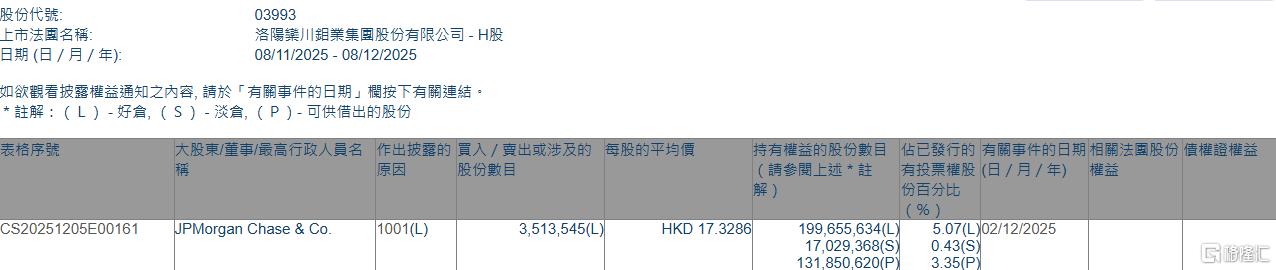
洛阳钼业(03993.HK)获摩根大通增持351.35万股

Ge Long Hui· 2025-12-07 23:56
| 原信息 | 大股東/董事/最高行政人員名 作出披露的 買入 / 賣出或涉及的 每般的平均價 | | | | 持有權益的股份數目 佔已發行的 有關事件的日期相 | | --- | --- | --- | --- | --- | --- | | | 股份數目 | | | (請參閱上拉*詩 | 有投票權限(日 / 月 / 年) | | | | | | 日年 3 | 分自分市 | | CS20251205E00161 | UPMorgan Chase & Co. | 1001(L) | 3,513,545(L) | HKD 17.3286 199,655,634(L) | 5.07(L)02/12/2025 | | | | | | 17,029,368(S) | 0.43(S) | | | | | | 131,850,620(P) | 3.35(P) | 增持后,JPMorgan Chase & Co.最新持好仓数目为199,655,634股,持好仓比例由4.98%上升至5.07%。 | 股份代號: | 03993 | | --- | --- | | 上市法國名稱: | 洛陽缮川姐業集團股份有限公司 - H股 | ...
JPMorgan Chase Backs Resident-Owned Communities To Boost Housing Affordability Nationwide
Yahoo Finance· 2025-12-07 21:31
Core Insights - The article discusses the initiative supported by JPMorgan Chase to help residents of manufactured home communities purchase their land, providing them with long-term stability and control over their living conditions [1][5]. Group 1: Resident Ownership Benefits - Residents like Lorena Vargas faced challenges with annual rent increases and lack of security until their community purchased its lots for $26.5 million [2][3]. - Resident ownership allows for predictability and control over living conditions, protecting communities from sudden changes in rent or management [4]. Group 2: JPMorgan Chase's Support - JPMorgan Chase has collaborated with ROC USA for over a decade, committing more than $5 million in philanthropic funding and $15 million in flexible loans to support resident-owned communities [5][6]. - The bank's involvement aligns with its strategy to enhance housing affordability and economic stability for low- and moderate-income households [5]. Group 3: ROC USA's Impact - Since 2008, ROC USA has assisted over 24,000 homeowners in 22 states to collectively purchase 356 manufactured home communities [7]. - The communities supported include culturally significant areas and large cooperatives, demonstrating the diverse impact of the initiative [7].
X @Ivan on Tech 🍳📈💰
Ivan on Tech 🍳📈💰· 2025-12-07 19:46
RT Watcher.Guru (@WatcherGuru)🇪🇺 JPMorgan CEO Jamie Dimon says "Europe has real problem.""They've driven business out, they've driven investment out, they've driven innovation out." https://t.co/m9tvYcD3I0 ...
中信建投:美国银行板块的历史归因是估值驱动还是基本面驱动?
智通财经网· 2025-12-07 10:01
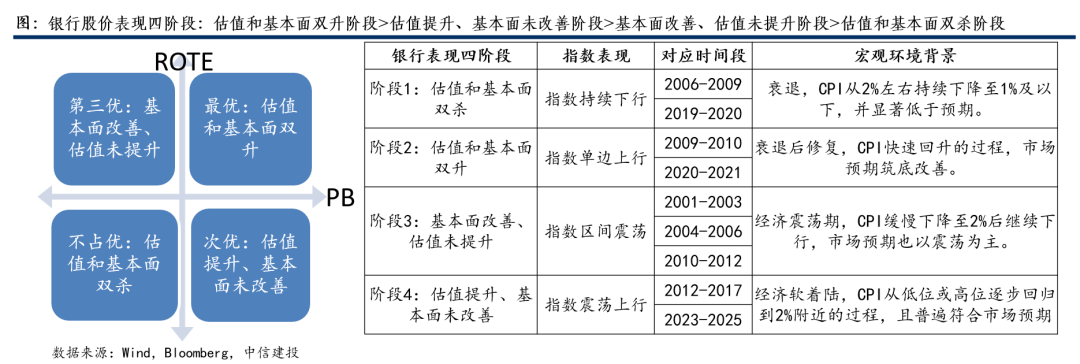
Core Viewpoint - The price movement of U.S. banks is driven more by valuation than by performance, indicating that valuation has a greater direct elasticity on stock prices compared to fundamentals. Valuation determines whether prices rise and the absolute returns, while fundamentals dictate how much prices rise and the relative returns [1][5]. Summary by Stages Stage 1: Dual Decline of Valuation and Fundamentals - This stage occurs during systemic crises, such as the subprime mortgage crisis and global pandemic, where stability is key. Banks with stronger fundamentals experience smaller price declines, while those with similar fundamentals but lower valuations also see less decline [2][9]. Stage 2: Dual Rise of Valuation and Fundamentals - This stage typically follows systemic crises, characterized by significant recovery in both valuation and fundamentals. Banks with substantial positive improvements in fundamentals and lower valuations see greater price increases. Smaller banks perform better when either fundamentals or valuations dominate [3][17]. Stage 3: Improvement in Fundamentals without Valuation Increase - This stage occurs when supportive policies are in place, but market expectations about the economy remain divided. While fundamentals improve across the board, valuations do not rise, making the ability to increase valuation crucial for individual stocks. The two main sources for valuation increases are positive fundamental trends and event-driven catalysts [4][24]. Stage 4: Valuation Increase without Improvement in Fundamentals - This stage generally happens when economic expectations are clear, but monetary policy and operating environments do not favor banks. In this phase, strong fundamentals are the primary driver of excess returns, while low valuations serve as a secondary factor. The best-performing banks are those that achieve a combination of good fundamentals and low valuations [28][30]. Future Outlook - Currently, the U.S. banking sector is in a phase of valuation increase with stable fundamentals. The macroeconomic environment shows no signs of significant recession, with inflation gradually decreasing and expectations for a controlled interest rate environment. The banking sector's return on tangible equity (ROTE) is stabilizing at high levels, supported by a favorable capital market and low credit costs [35][39].



摩根大通黄健:技术迭代加速 资本配置效率将影响创新成败
2 1 Shi Ji Jing Ji Bao Dao· 2025-12-07 08:53
Group 1 - The core viewpoint of the articles emphasizes the deep interconnection between technological development and capital market transformation, highlighting how advancements in technology, particularly artificial intelligence, are reshaping the financial industry and capital markets [1] - Historical context is provided, illustrating that significant technological breakthroughs have often been supported by precise capital allocation, from the steam engine to the internet and now to artificial intelligence [1] - The article notes that the cycle of technological iteration has shortened from years to months, making capital allocation efficiency a critical variable for the success of innovation [1] Group 2 - Morgan Stanley's specific practices include assisting Xiaomi in completing a $5.5 billion "old-to-new" Hong Kong stock placement, marking the largest stock placement transaction in the global TMT sector since April 2021 [2] - The company has also supported several Chinese tech firms in issuing various bonds overseas, providing comprehensive services throughout their lifecycle [2] - Morgan Stanley aims to leverage its global network and local business platform to act as a bridge between Chinese and global markets, offering full financial services to clients, particularly in the tech sector [2]

JPMorgan CEO Jamie Dimon says Europe has a ‘real problem’
Fortune· 2025-12-06 23:27
Core Insights - Jamie Dimon, CEO of JPMorgan Chase, highlighted the economic risks posed by a "weak" Europe, emphasizing that slow bureaucracy has driven business, investment, and innovation out of the continent [1][2] - Dimon called for a long-term strategy from the US to support a stronger Europe, stating that a weak Europe negatively impacts the US [2] - JPMorgan is increasing its investment in national defense, committing $1.5 trillion over the next decade to enhance US economic security, which is $500 billion more than previously planned [2][3] Group 1 - Dimon criticized Europe's bureaucracy for hindering business and innovation, while acknowledging some European leaders' awareness of these issues [1] - He expressed concern that a fragmented Europe would harm US interests, as Europe is a key ally sharing common values [2] - The bank's investment strategy will focus on supply chain, defense, energy independence, and strategic technologies [3] Group 2 - JPMorgan plans to invest up to $10 billion of its own capital to assist companies in expanding and innovating [4] - Dimon praised the current administration for efforts to reduce bureaucratic obstacles that hinder American progress [5]

JPMorgan CEO Jamie Dimon Says Europe Has a ‘Real Problem’
MINT· 2025-12-06 21:17
Core Viewpoint - JPMorgan Chase & Co. CEO Jamie Dimon highlighted the economic risks posed by a "weak" Europe, emphasizing the need for the US to support European strength to safeguard mutual interests [1][2]. Group 1: Economic Risks and Challenges - Dimon pointed out that Europe is facing significant issues, including slow bureaucracy, which has led to a decline in business, investment, and innovation [1]. - He warned that a fragmented Europe could negatively impact the US, as Europe is a major ally sharing common values [2]. - Dimon noted that the reduction in military efforts and difficulties in reaching agreements within the EU are threatening the continent's stability [1]. Group 2: US Support and Investment Strategy - Dimon called for a long-term strategy from the US to help strengthen Europe, stating that a weak Europe is detrimental to US interests [2]. - JPMorgan plans to invest $1.5 trillion over the next 10 years in sectors that enhance US economic security, which is $500 billion more than previously planned [2]. - The bank will also allocate up to $10 billion of its own capital to assist companies in expanding and innovating [4]. Group 3: Focus Areas for Investment - The investment strategy will concentrate on four key areas: supply chain and advanced manufacturing, defense and aerospace, energy independence and resilience, and frontier and strategic technologies [3]. - Dimon emphasized the need to reduce reliance on unreliable sources for critical minerals and manufacturing [3]. Group 4: Bureaucracy and Government Efficiency - Dimon praised the current administration for efforts to reduce bureaucratic obstacles that hinder American progress [5]. - He expressed that it is possible to streamline bureaucracy while ensuring safety in essential sectors like food and banking [5].

Banks Split On Copper Outlook As Citi, JPMorgan Turn Bullish And Goldman Counters - United States Copper Index Fund ETV (ARCA:CPER)
Benzinga· 2025-12-06 16:16
Core Viewpoint - Copper prices have surged, with benchmark futures exceeding $11,700 a ton, marking the strongest rally since last summer, driven by expectations of phased copper tariffs starting in 2027 [1] Supply Dynamics - Tightening supply and dislocated inventories are contributing factors, with traders front-loading shipments to the US to take advantage of higher domestic prices and hedge against future import levies, leading to increased price volatility [2] Market Predictions - Citigroup projects a target price of $13,000 a ton by Q2 2026, citing a structural deficit due to a mismatch between new supply and rising demand from sectors like grid upgrades and energy transition [3][4] - JP Morgan aligns with a bullish outlook, forecasting a refined copper deficit of approximately 330,000 tons in 2026 and prices reaching around $12,500 a ton in Q2 2026, averaging just over $12,000 for the entire year [5] Contrarian Views - Goldman Sachs presents a contrasting perspective, arguing that current price levels exceed fundamentals and that sufficient metal is available to meet demand [5][6] Inventory Movements - Mercuria has withdrawn about $500 million worth of copper from LME warehouses, significantly tightening available exchange stocks, with recent inventory cancellations being among the largest in over a decade [7] - The situation has led to a paradox where headline stocks are rising while deliverable metal outside the US is decreasing, highlighting a critical feature of the current market cycle [7] Future Concerns - Mercuria's Global Head of Metals & Minerals warns of potential critical shortages of copper cathodes outside the US as early as Q1, emphasizing the likelihood of tightness and higher prices if current trends continue [8][9]