
Lilly(LLY)

Search documents
Top Pharmaceutical Companies Shaping the Future of Healthcare
Etftrends· 2025-11-01 12:04
Core Insights - Pharmaceuticals are experiencing renewed investor interest due to strong pipelines, reduced policy risks, and growing demand, making large-cap pharma attractive [2][12] - Recent U.S. drug pricing negotiations have decreased policy uncertainty, enhancing sentiment and leading to a sector re-rating as valuations align with broader market levels [2][10] Industry Overview - The pharmaceutical sector is positioned at the intersection of innovation and defensiveness, where scientific advancements translate into cash flows, supported by global demand [2][10] - Aging populations and improved healthcare access are key long-term growth drivers, with a notable increase in FDA drug approvals over the past decade [10][12] Key Holdings in PPH - **Eli Lilly and Company (LLY)**: Holds a 19.89% weight, leading in obesity and diabetes treatments with a strong GLP-1 portfolio and expanding late-stage pipeline [4] - **Novartis AG (NVS)**: Accounts for 9.71% weight, focusing on innovative medicines and cost efficiency, with promising therapies in oncology and cardiovascular disease [5] - **Novo Nordisk A/S (NVO)**: Represents 7.72% weight, central to the weight-loss drug market with strong global demand and upcoming new formulations [6] - **Merck & Co., Inc. (MRK)**: Comprises 7.43% weight, recognized for its oncology leadership and sustained growth through investments in new therapies [7] - **Pfizer Inc. (PFE)**: Holds a 5.10% weight, stabilizing its share price as it transitions to a diversified pipeline post-pandemic [11] Market Dynamics - The GLP-1 drug market presents a multi-year growth opportunity in metabolic diseases, with potential expansions into related therapeutic areas [10][17] - Large pharmaceutical companies are actively pursuing mergers and acquisitions to refresh their pipelines and enhance manufacturing capabilities [10][17]


S&P 500 Giants JPMorgan, Eli Lilly Lead Five Stocks Near Buy Points
Investors· 2025-11-01 12:00
Group 1 - The stock market has shown a rising trend but has been characterized as tricky, with significant earnings reports expected from companies like Palantir, Robinhood, and AMD this week [1][2] - Eli Lilly (LLY) and JPMorgan Chase (JPM) are highlighted as key stocks to monitor, alongside Interactive Brokers (IBKR), MongoDB (MDB), and Nu Holdings (NU), with the latter just below a buy point [1][4] - Eli Lilly has received an upgrade in its IBD stock rating, indicating strong performance and expectations surpassing market forecasts [4] Group 2 - The overall market sentiment is influenced by major earnings reports, with stocks like Amazon and Apple showing positive movements while others like Meta face challenges due to AI spending concerns [4] - Nu Holdings is recognized as the largest fintech in Latin America and is considered breakout ready, reflecting potential growth in the fintech sector [4]


2025国谈第三日下午:诺华、罗氏、贝达药业等企业代表入场
Xin Lang Cai Jing· 2025-11-01 06:33
Core Viewpoint - The 2025 National Medical Insurance Directory negotiations are ongoing, focusing on pricing discussions for innovative drugs, particularly in the chronic disease medication sector [1] Group 1: Negotiation Details - The third day of the national negotiations began at approximately 1:40 PM, with participation from companies such as Novartis, Gensai, Roche, and Betta Pharmaceuticals [1] - The morning session emphasized negotiations on chronic disease medications, with Eli Lilly and Sinopharm bringing significant products to the discussions [1]


跨国药企三季报密集披露,多家企业上调今年业绩指引
Bei Ke Cai Jing· 2025-11-01 03:53
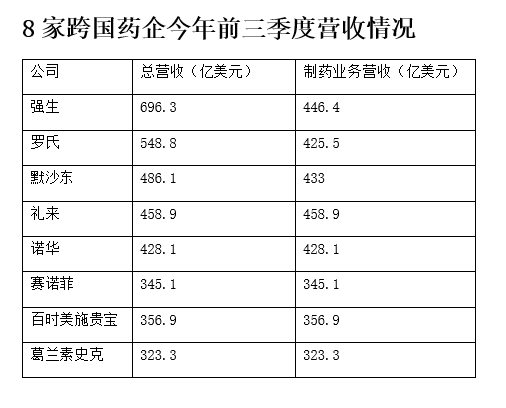
Core Insights - The competition for the title of "King of Drugs" is intensifying, with Eli Lilly's weight loss drug, Tirzepatide, leading sales in the first three quarters of the year, surpassing Merck's Keytruda [2][3] - Major pharmaceutical companies, including Johnson & Johnson, Roche, and Merck, have raised their annual revenue guidance following strong third-quarter performances [5][6][7] Group 1: Company Performance - Johnson & Johnson reported total revenue of $69.63 billion, leading the industry, with pharmaceutical revenue at $44.64 billion [4] - Eli Lilly achieved pharmaceutical revenue of $45.89 billion, driven by Tirzepatide, which generated $24.8 billion in sales [3][5] - Merck's total revenue reached $48.61 billion, with pharmaceutical revenue at $43.3 billion; however, sales growth for Keytruda has slowed [7] Group 2: Drug Sales Highlights - Tirzepatide's sales for the first three quarters reached $24.84 billion, with a significant increase in sales for its diabetes version, Mounjaro, which saw a 109% year-on-year growth [3] - Keytruda's sales were $23.30 billion, reflecting an 8% growth, but the growth rate is slowing down [7] - Roche's Phesgo saw a 54% increase in sales, contributing to a pharmaceutical revenue of approximately $42.55 billion [6] Group 3: Revenue Guidance Adjustments - Eli Lilly raised its full-year revenue guidance to between $63 billion and $63.5 billion [5] - Johnson & Johnson adjusted its revenue forecast to grow by 4.8% to 5.3%, targeting $93 billion to $93.4 billion [5] - Roche also increased its annual revenue expectations based on strong third-quarter results [6]


Eli Lilly Seen In 'Pole Position' For Growth, Analysts Say
Benzinga· 2025-10-31 18:46
Core Insights - Eli Lilly and Co. reported better-than-expected third-quarter earnings, with quarterly revenue of $17.60 billion, a 54% year-over-year increase, surpassing the consensus of $16.02 billion [1] - The adjusted earnings per share reached $7.02, significantly up from $1.18 a year ago, and exceeded the consensus estimate of $5.70 [2] Financial Performance - Revenue growth was driven by a 62% increase in volume, although partially offset by a 10% decrease due to lower realized prices [1] - The company's implied FY25 guidance is between $63.0 billion and $63.5 billion, indicating a potential sequential decline in outside U.S. Mounjaro revenue of $3 billion from the third quarter [4] Analyst Perspectives - Goldman Sachs views Eli Lilly as well-positioned for the launch of orforglipron, a significant new product cycle, maintaining a Buy rating and raising the price forecast from $879 to $951 [3] - BofA Securities also rates Eli Lilly as Buy, citing its durable growth potential compared to peers and a strong catalyst path at a reasonable valuation [5] Competitive Landscape - Eli Lilly is focused on defending and expanding its lead in the obesity treatment market, with a broad portfolio of current and emerging treatments [5] - Despite expected competition, analysts express confidence in Eli Lilly's innovative capabilities and execution, noting that the company remains highly scaled [7] Stock Performance - Eli Lilly shares increased by 2.39% to $864.70 at the time of publication [7]

Eli Lilly Has A Solid Upside Now After Its Q3 Earnings (NYSE:LLY)
Seeking Alpha· 2025-10-31 14:52
Core Insights - Eli Lilly and Company (LLY) has experienced a price increase of 9.51% since June 2025, which is underperforming compared to the S&P 500 index [1]. Group 1: Company Overview - Eli Lilly and Company is highlighted as a subject of investment analysis, with a focus on its stock performance relative to broader market indices [1]. Group 2: Investment Analysis - The analysis emphasizes the importance of accessing high-quality equity research reports to make informed investment decisions, suggesting that subscriptions to platforms like Beyond the Wall Investing can lead to significant savings [1].
Eli Lilly Has A Solid Upside Now After Its Q3 Earnings
Seeking Alpha· 2025-10-31 14:52
Core Insights - Eli Lilly and Company (LLY) has experienced a price increase of 9.51% since June 2025, which is underperforming compared to the S&P 500 index [1]. Group 1: Company Overview - Eli Lilly and Company is highlighted as a subject of investment analysis, with a focus on its stock performance relative to broader market indices [1]. Group 2: Investment Analysis - The analysis emphasizes the potential for significant savings on equity research reports through subscriptions to investment platforms, suggesting a cost-effective approach for investors [1].
Eli Lilly's obesity and diabetes treatments fuel growth and spark bidding war
Fastcompany· 2025-10-31 14:11
Core Insights - The market for obesity and diabetes treatments is experiencing significant growth, generating billions in sales for Eli Lilly and leading to increased competition among drugmakers [1] Industry Overview - The obesity and diabetes treatment market is described as "scorching hot," indicating a high demand and lucrative opportunities for companies involved in this sector [1] - The competitive landscape is intensifying, as evidenced by a bidding war for another drugmaker, highlighting the strategic importance of this market segment [1] Company Focus - Eli Lilly is a key player in the obesity and diabetes treatment market, benefiting from substantial sales figures that contribute to its financial performance [1]

摩根士丹利:将礼来目标价上调至1069美元
Ge Long Hui A P P· 2025-10-31 12:03
Group 1 - Morgan Stanley raised the target price for Eli Lilly (LLY.US) from $1023 to $1069 [1]
德意志银行将礼来目标价上调至955美元

Ge Long Hui A P P· 2025-10-31 11:17
Core Viewpoint - Deutsche Bank raised the target price for Eli Lilly from $900 to $955 [1] Group 1 - The adjustment in target price reflects a positive outlook on Eli Lilly's performance [1]