
Morgan Stanley(MS)

Search documents
黄金缘何彻底爆发?答案就在六个字
Feng Huang Wang· 2025-10-09 07:53
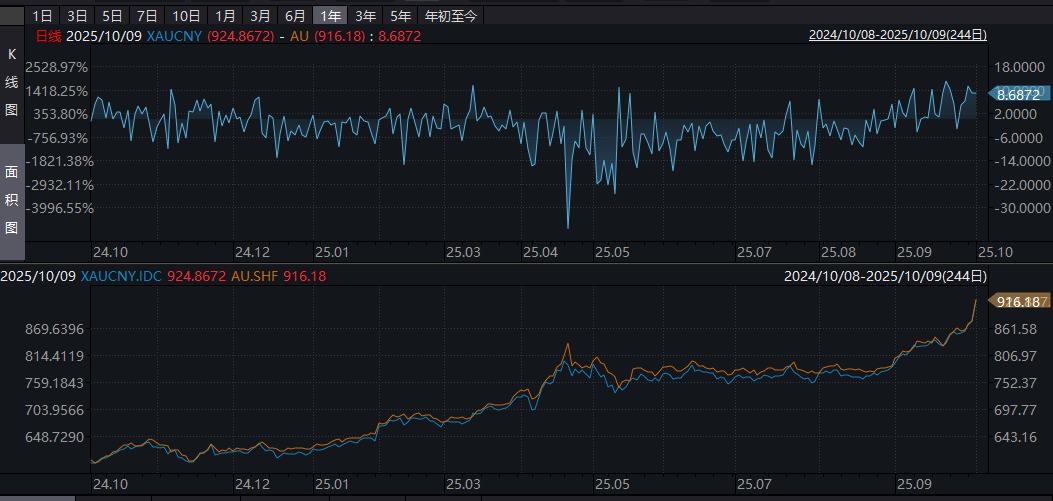
Core Viewpoint - The recent surge in international gold prices, which broke the $4000 mark, is primarily driven by Western investors, particularly during a period when Chinese investors were absent due to the National Day holiday [1][3]. Group 1: Market Dynamics - The price of spot gold rose nearly $200 from around $3860 to over $4000 during the Chinese holiday, indicating a significant market movement [1]. - The premium for domestic gold in China has shifted from positive to negative, suggesting a decrease in local investor interest compared to Western markets [3]. - The trend of Western investors leading the gold price increase reflects a broader shift in global investment dynamics, with a notable decline in interest from non-US regions [3]. Group 2: Investment Sentiment - The concept of "debasement trade" has gained traction among investors, indicating a strategy to hedge against the depreciation of all fiat currencies, not just the US dollar [3][5]. - The stability of the US dollar since August has not deterred gold's rise, suggesting a loss of confidence in fiat currencies overall [5]. - Political events, such as the election of Japan's new prime minister advocating for economic stimulus, have contributed to currency fluctuations, further driving gold prices [6]. Group 3: Historical Context - The current gold price surge can be divided into three phases, starting from the onset of the Russia-Ukraine conflict, followed by the US-China trade war, and culminating in recent signals from the Federal Reserve regarding interest rate cuts [9][10][12]. - The rise in gold prices is increasingly seen as a speculative trend rather than solely based on fundamental factors, with its traditional role as a safe-haven asset being emphasized [12][13]. Group 4: Debt and Economic Factors - High levels of debt in developed economies, nearing or exceeding 100% of GDP, are creating a backdrop for increased gold investment as a hedge against economic instability [15]. - The sustainability of debt is under scrutiny, with rising interest rates and inflation posing challenges to fiscal health, which could further drive investors towards gold [15][16]. - The political landscape, particularly in the US and Europe, is complicating fiscal measures needed to manage debt, leading to a potential increase in gold's appeal as a safe asset [16][17].


跨资产简报 - 中国股市涨势是否可持续?5 分钟了解关键争论 -Cross-Asset Brief-Is the Rally in Chinese Equities Sustainable Key Debates In Under 5 Minutes – September 2025
2025-10-09 02:00
Summary of Key Points from the Conference Call Industry or Company Involved - The discussion primarily revolves around the **Chinese equities market** and broader **macro-economic trends** affecting various regions, including the **US** and **Japan**. Core Points and Arguments 1. **Sustainability of the Chinese Equity Rally** - The sustainability of earnings growth in China is promising, with critical sectors such as internet, tech, and pharma showing positive revision trends. The risk of significant misses in consensus earnings is decreasing, indicating stable or higher-than-expected growth in the coming months [24][25][26] 2. **US Dollar Outlook** - The expectation is for the DXY to weaken by approximately **7%**, driven by a combination of the USD's weakening and debates surrounding its safe-haven status. This could lead to increased attractiveness of FX-hedging USD assets [8] 3. **US Consumer Spending Trends** - Consumer spending is slowing, with nominal consumption forecasted to decelerate to **3.8%** in 2025 from **5.7%** in 2024. The spending is increasingly bifurcated, with upper-income groups driving resilient consumption while younger cohorts face challenges due to a weaker labor market and higher living costs [17][18] 4. **Impact of Fed Cuts on US Housing Market** - It is unlikely that another **5 Fed cuts** will revive the US housing market. A significant drop in primary rates (by **100bp or more**) is needed for a sustained increase in existing sales. Current affordability issues in the housing market persist, limiting the effectiveness of lower mortgage rates [21][24] 5. **Japanese Bonds and Fiscal Expansion** - Potential fiscal expansion in Japan is not expected to weigh heavily on Japanese bonds. The fiscal metrics have improved, and the fiscal term premium has retreated. Long-end JGBs may sell off if certain political candidates win, but no additional JGB issuance is anticipated [12][15] Other Important but Possibly Overlooked Content - The **China Earnings Revision Breadth (ERB)** is currently the highest among major markets, indicating a positive outlook for Chinese equities compared to the US [25] - The report highlights the importance of understanding the bifurcation in consumer spending, which could have implications for various sectors and investment strategies [17][18] - The analysts emphasize the need for investors to consider multiple factors in their investment decisions, as Morgan Stanley may have conflicts of interest due to its business relationships with covered companies [5][34]
亚洲面临日益严峻的青年失业挑战
2025-10-09 02:00
Summary of Key Points from the Conference Call Industry Overview - **Industry**: Youth Unemployment in Asia - **Key Countries**: China, India, Indonesia Core Insights and Arguments 1. **High Youth Unemployment Rates**: Youth unemployment rates in Asia are significantly higher than overall unemployment rates, typically 2-3 times higher, with youth unemployment ranging from 4% to 18% while overall unemployment is between 2% and 7% [5][6][10] 2. **Specific Rates**: As of August 2025, youth unemployment rates are particularly high in China (16.5%), India (17.6%), and Indonesia (17.3%) [5][10][51] 3. **Economic Challenges**: Economic slowdown, "anti-globalization" policies in China, and the impact of AI and automation are contributing to structural challenges in the job market [5][6][10] 4. **Need for Policy Reform**: Policymakers are urged to implement reforms to shift growth models and increase investment ratios in India and Indonesia, while addressing labor market mismatches in China [5][10][61] 5. **Social Stability Risks**: There is a potential risk to social stability if youth unemployment continues to rise, which may lead to redistribution measures by policymakers [5][10][61] Additional Important Insights 1. **Labor Market Conditions**: Despite a seemingly stable youth unemployment rate, the underlying conditions of the labor market are deteriorating, with declining wages for entry-level positions in China and employment challenges in India and Indonesia [6][10][18][32] 2. **Mismatch in Supply and Demand**: In China, the rapid increase in graduates (from 8.2 million in 2019 to 11.7 million in 2024) is not matched by job creation, leading to a significant mismatch in the labor market [22][23][30] 3. **Investment Trends**: Indonesia's investment-to-GDP ratio has decreased from 32% pre-pandemic to 29% as of June 2025, indicating a decline in investment that could hinder job creation [51][55] 4. **Informal Employment**: A significant portion of employment in Indonesia (59%) is in the informal sector, which is a typical indicator of underemployment [51][59] 5. **Future Projections**: The youth labor force in Indonesia is expected to grow by 12.7 million over the next decade, exacerbating the employment challenges if investment and job creation do not keep pace [57][58] Conclusion - The youth unemployment crisis in Asia, particularly in China, India, and Indonesia, requires urgent attention from policymakers to implement reforms that can stimulate job creation and address the structural issues in the labor market. Failure to act may lead to increased social instability and economic challenges in the region [5][10][61]
全球经济-停摆、债务与赤字-Global Economic Briefing-The Weekly Worldview Shutdowns, Debt, and Deficits
2025-10-09 02:00
Summary of Key Points from the Conference Call Industry Overview - The analysis focuses on the **advanced economy debt** landscape, highlighting deteriorating debt levels, interest costs, and fiscal deficits across various countries, particularly the **US** and **France** [2][10]. Core Insights and Arguments - The **debt sustainability analysis (DSA)** framework was updated, indicating that the relationship between the cost of debt (R) and nominal growth (G) is critical for assessing debt sustainability. When R exceeds G, risks increase significantly [3][10]. - The **debt-to-GDP ratio** for developed markets (DM) is projected to reach approximately **130% by 2030**, which is **3 percentage points higher** than previous projections made 18 months ago [4][10]. - The **cost of debt** has risen by approximately **23 basis points**, and nearly half of the countries analyzed need to achieve a primary fiscal surplus to prevent rising debt levels [10][12]. - The **US** is projected to exceed a **140% debt-to-GDP ratio by 2030** unless it can achieve a primary surplus, which is currently forecasted at a **-3.8% of GDP** deficit for 2026 [11][13]. - The **French government** is also facing significant fiscal challenges, with the need for a primary balance or surplus to stabilize its debt levels [12][13]. Additional Important Insights - The **US government shutdown** has created market volatility, primarily due to delays in data releases rather than immediate fiscal implications. The potential for larger government spending cuts is being discussed in light of increasing deficits [2][10]. - Historical patterns suggest that when nominal growth softens and debt tenors shorten, markets may react negatively, indicating a potential risk for future debt sustainability [15]. - The **political landscape** in countries like the US and France complicates efforts to achieve fiscal balance, with significant challenges in moving from deficits to surpluses [12][13]. Conclusion - The current fiscal outlook for advanced economies is concerning, with rising debt levels and the need for substantial fiscal reforms to ensure sustainability. The interplay between growth, debt costs, and political will will be crucial in determining future outcomes [10][11][12].
Institutional Wave Pushes Bitcoin ETFs Toward Record Quarter
Yahoo Finance· 2025-10-08 19:25
Core Insights - Spot Bitcoin ETFs are experiencing unprecedented institutional investment, with projections indicating they could reach $30 billion by year-end [2][3] - The surge in Bitcoin ETF activity is closely linked to Bitcoin's price movements, particularly as it surpassed $100,000 [3][4] - Major financial institutions are expanding their offerings of crypto ETFs, enhancing access for advisors and clients [6] Group 1: ETF Performance and Trends - By the end of Q3, Bitcoin ETFs had attracted $22.5 billion, with a single-day trading volume of $7.5 billion indicating strong liquidity [2] - BlackRock's IBIT has become the most profitable Bitcoin ETF, generating $244.5 million annually from a 0.25% fee and nearing $100 billion in assets under management [5] - All 11 spot ETFs, including $GBTC, reported positive performance, reflecting a strong market sentiment [3] Group 2: Institutional Adoption and Market Drivers - Morgan Stanley's new guidance allows advisors to allocate up to 4% of portfolios to crypto, potentially channeling trillions into regulated products [3] - Major brokerages like Wells Fargo and Merrill Lynch are now offering crypto ETFs directly to clients, increasing institutional participation [6] - The trend of investing in scarce assets like Bitcoin is driven by concerns over currency debasement and fiscal expansion [6]


Business Insider's 2025 Rising Stars of Wall Street break down their jobs in plain English
Yahoo Finance· 2025-10-08 17:15
Business Insider's Rising Stars of Wall Street hold important yet complex jobs. We asked them to break down what they do in a way anyone could understand. See top responses from Rising Stars at firms like Blackstone, Moelis, and Goldman Sachs. Credit solutions, secondaries, private capital advisory. Business Insider's Rising Stars of Wall Street have impressive but complicated jobs. This year's list features investors, traders, and dealmakers working in the hottest finance fields, from private len ...

JPM or MS: Which IB Stock to Buy Amid Optimistic Industry Prospects?
ZACKS· 2025-10-08 14:11
Key Takeaways JPMorgan's IB fees jumped 36% in 2024, with continued gains expected as deal-making rebounds.Morgan Stanley's 2024 IB revenues also rose 36%.JPM offers stability and lower valuation, while MS shows stronger earnings and revenue growth prospects.When it comes to Wall Street heavyweights, few names wield more influence than JPMorgan (JPM) and Morgan Stanley (MS) . These financial powerhouses stand as cornerstones of global finance, boasting deep expertise in investment banking, from advising on ...

[Earnings]Earnings Outlook: Financials Dominate Next Week’s Reports
Stock Market News· 2025-10-08 13:13
Financial Earnings Overview - Next Tuesday and Wednesday are expected to be significant for the market due to a concentration of financial earnings reports from major banks [1] - Key banks reporting on Tuesday include JPMorgan Chase & Co., Wells Fargo & Company, Goldman Sachs Group Inc., and Citigroup Inc., along with Johnson & Johnson from the healthcare sector [1] - The earnings reports will continue on Wednesday with Bank of America Corporation, Morgan Stanley, ASML Holding N.V. from the semiconductor industry, and Prologis Inc. from the real estate sector [1] - Additionally, PepsiCo Inc. is scheduled to report earnings on Thursday [1]



Tenth Avenue Petroleum Announces Name Change To Decimus Oil Corp. and New Stock Trading Symbol
Thenewswire· 2025-10-08 12:00
Core Points - The company is changing its name from Tenth Avenue Petroleum Corp. to Decimus Oil Corp. to better reflect its focus on acquiring, optimizing, and developing Mannville-focused assets in Southern Alberta [1] - The name change was approved by shareholders at the annual general and special meeting on September 17, 2025, and will be effective on October 10, 2025 [3] - The company will commence trading under the new name and trading symbol "WCSB" on the TSX Venture Exchange starting October 10, 2025 [4] Company Overview - Decimus Oil Corp. is engaged in the acquisition, development, and production of oil and gas in the Western Canadian Sedimentary Basin, focusing on Mannville development in Southern Alberta [8] - The company has grown its land base to over 26,000 gross acres and 16,000 net acres since recapitalizing in late 2020, while also increasing production through strategic acquisitions and optimization activities [6] - The company aims to unlock significant resources in place by deploying modern completion techniques and advancing a low-risk acquisition strategy [8]

Morgan Stanley: Q3 Earnings May Be Lower But Premium May Be Justified
Seeking Alpha· 2025-10-08 12:00
The last time I covered Morgan Stanley (NYSE: MS ) was in January of 2024. Since my prior coverage, the stock price has increased by more than 71%, and when including dividends, the total return jumped up toFinancial analyst by day and a seasoned investor by passion, I've been involved in the world of investing for over 15 years and honed my skills in analyzing lucrative opportunities within the market.I specialize in uncovering high quality dividend stocks and other assets that offer potential for long ter ...
