Oracle(ORCL)

Search documents
甲骨文,自高点以来已跌超40%
财联社· 2025-11-21 15:23
以下文章来源于科创日报 ,作者潇湘 科创日报 . 科创圈都在关注的主流媒体,上海报业集团主管主办,《科创板日报》出品。 今日美股盘中, 甲骨文股价 跌幅扩大至5%,创6月以来新低,股价自9月高点已跌去42%。 对于许多市场人士而言,甲骨文正扮演这轮AI热潮里"煤矿中的金丝雀"角色——这家曾经保守的数 据库巨头,如今已借贷数百亿美元,不仅将自身命运与人工智能热潮紧密相连,同时也正迅速成为 信贷市场乃至全球股市衡量AI风险的风向标。 近月来,交易员们不断蜂拥买入甲骨文的信用违约互换(CDS)合约。鉴于该公司正大规模投入人工 智能领域、在错综复杂的交易网络中扮演核心角色,且信用评级逊于微软和谷歌母公司Alphabet等 同行,这些因素使其CDS合约成为市场对冲乃至做空AI热潮的首选工具。 根据洲际交易所(ICE)数据服务公司的统计,近几个月来,防范该公司未来五年债务违约的成本已攀 升了两倍 ——周三甲骨文5年期CDS利差达到111个基点,相当于每保障1000万美元本金每年需支付 约11.1万美元。 注:甲骨文CDS报价已升至近三年新高(黑线),橙线为CDS指数 巴克莱银行信用策略师Jigar Patel指出,随着人 ...



甲骨文股价跌幅扩大至5%,创6月以来新低,股价自9月高点已跌去42%
Mei Ri Jing Ji Xin Wen· 2025-11-21 15:16
每经AI快讯,甲骨文股价跌幅扩大至5%,创6月以来新低,股价自9月高点已跌去42%。 ...
甲骨文(ORCL.US)跌逾4% 激进的资本支出或导致信用状况紧张
Zhi Tong Cai Jing· 2025-11-21 15:11
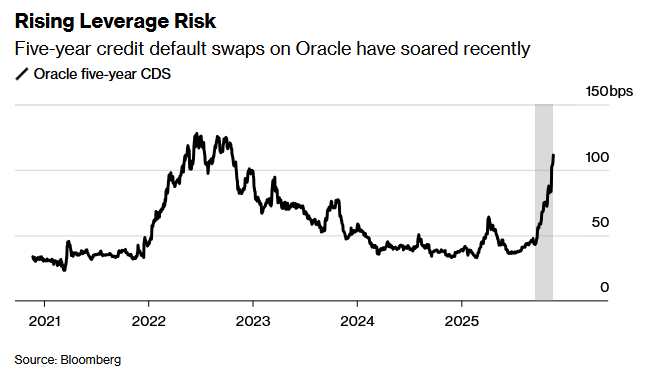
Core Insights - Oracle's stock dropped over 4% to $201.44 after issuing $18 billion in investment-grade bonds to increase AI spending, with related banks initiating a $38 billion debt issuance for Oracle's data centers [1] - Since reaching an all-time high on September 10, Oracle's stock has fallen 33% as investors reassess the impact of aggressive capital expenditures on its balance sheet and how it will finance these expenditures [1] - Oracle forecasts capital expenditures of $35 billion for the current fiscal year, primarily for its cloud business, but this spending is negatively affecting its balance sheet, with expected free cash flow of negative $9.7 billion this year [1] - The company is projected to see further declines in free cash flow over the next two fiscal years, potentially reaching negative $24.3 billion by fiscal year 2028 [1] - S&P Global Ratings has revised Oracle's outlook to "negative" due to anticipated capital expenditures and debt issuance aimed at funding accelerated growth in AI infrastructure, leading to tighter credit conditions [1] Leverage Risks - Oracle's five-year credit default swaps (CDS), reflecting leverage risk, have surged to their highest level in three years [2] - A global macro strategist noted that the rise in Oracle's CDS is not surprising given the company's significant capital expenditures financed through debt, indicating potential for greater stock volatility [2]
美股异动 | 甲骨文(ORCL.US)跌逾4% 激进的资本支出或导致信用状况紧张
智通财经网· 2025-11-21 15:05
Core Insights - Oracle's stock has dropped over 4% to $201.44 after a significant rise in September, following the issuance of $18 billion in investment-grade bonds to increase AI spending and a $38 billion debt issuance related to data centers [1] - Since reaching an all-time high on September 10, Oracle's stock has fallen 33% as investors reassess the impact of aggressive capital expenditures on its balance sheet and how it will finance these expenditures [1] - The company forecasts capital expenditures of $35 billion for the current fiscal year, primarily for its cloud business, which is negatively affecting its balance sheet with projected free cash flow of negative $9.7 billion this year [1] - Oracle's free cash flow is expected to further decline over the next two fiscal years, potentially reaching negative $24.3 billion by fiscal year 2028 [1] - S&P Global Ratings has revised Oracle's outlook to "negative" due to anticipated capital expenditures and debt issuance aimed at funding accelerated growth in AI infrastructure, leading to tighter credit conditions [1] Leverage Risks - Oracle's five-year credit default swaps (CDS), reflecting leverage risk, have surged to their highest level in three years [2] - Analysts note that the increase in Oracle's CDS is not surprising given the company's substantial capital expenditures and debt financing commitments, indicating potential for greater stock volatility [2]
Compensation Management Software Evolves with AI and Analytics to Drive Workforce Strategies, ISG Says
Businesswire· 2025-11-21 15:00
Core Insights - Total compensation management (TCM) software is now central to enterprise compensation programs, integrating various functions to meet financial and talent needs [1][13] - The decisions regarding compensation have shifted to a continuous and cross-functional approach, necessitating collaboration among finance, business, and human resources [2][4] TCM Software Evolution - The TCM software category has expanded to address complex enterprise requirements, increasingly incorporating analytics and AI to enhance talent management and retention [3][5] - TCM platforms utilize analytics for both retrospective reporting and proactive diagnosis of compensation practices, focusing on pay equity and regulatory compliance [4][5] Software Provider Evaluation - ISG evaluated 23 software providers for its 2025 Buyers Guide for Total Compensation Management, assessing them across four platform categories: Total Compensation Management, Compensation Insights, Compensation Operations, and Compensation Planning [7][8] - Oracle emerged as the top Overall Leader in all four categories, followed by ADP and Salary.com, with all three rated as Exemplary [8][10][11] Emerging Providers - The 2025 Buyers Guide for Compensation Emerging Providers assessed 11 software providers, with Pave recognized as the top Overall Leader, followed by Lattice and Leapsome [12] - Emerging providers are noted for faster iteration and innovative features that cater to specific enterprise needs [6][12] Market Trends - Enterprises are increasingly looking for compensation management software to help retain talent and provide insights for operational and planning processes, especially in a competitive talent market [13]



美国科技巨头疯狂发债为AI梦想买单 泡沫担忧升温之际杠杆风险再“添柴”
Zhi Tong Cai Jing· 2025-11-21 13:45
Core Viewpoint - Concerns are rising on Wall Street regarding the high levels of debt that tech giants are incurring to build AI infrastructure, marking a shift from their previous practice of using cash reserves for capital expenditures [1][2]. Group 1: Debt Issuance and Market Reactions - The top five companies in AI spending—Amazon, Alphabet, Microsoft, Meta Platforms, and Oracle—are projected to raise a record $108 billion in debt by 2025, more than three times the average of the past nine years [2]. - Despite the surge in debt issuance, investors are currently not overly concerned about its impact on stock valuations, as the leverage ratios of these companies remain relatively low [2]. - The sudden increase in debt issuance has raised questions about the bond market's ability to absorb this influx, contributing to a significant pullback in U.S. stocks after six months of gains [2][6]. Group 2: Oracle's Debt and Financial Health - Oracle's recent issuance of $18 billion in investment-grade bonds to fund AI spending has drawn particular attention, with the company's stock experiencing a 33% drop since reaching a record high on September 10 [3][6]. - Oracle's projected capital expenditures for the current fiscal year are $35 billion, primarily for its cloud business, leading to an expected free cash flow of negative $9.7 billion [6]. - Standard & Poor's has revised Oracle's outlook to "negative" due to anticipated capital expenditures and debt issuance straining its credit profile [6]. Group 3: Broader Industry Implications - The trend of increasing debt among tech giants is indicative of a broader shift in the industry, with concerns about systemic risks arising from interconnected revenue relationships among companies with weaker balance sheets [7]. - The capital expenditure for AI is expected to rise significantly, with projections of $600 billion by 2027, up from over $200 billion in 2024 and nearly $400 billion in 2025 [8]. - Despite rising leverage, investors maintain a generally positive outlook on tech giants due to their sustained profit growth and strong competitive positions, with estimates suggesting that 80% to 90% of planned capital expenditures will come from their cash flows [8][9].
美股熊市论者“倾巢而出“!Wedbush力挺AI赢家:当下正是买入时
智通财经网· 2025-11-21 13:39
Core Viewpoint - Despite Nvidia's earnings exceeding expectations, AI-related stocks collectively declined due to investor skepticism regarding the sustainability of AI spending [1] Group 1: Market Sentiment - There is a growing bearish sentiment in the market, with numerous bearish opinions received via social media [1] - The current concerns revolve around signals from the market regarding Nvidia's technology clients and the sustainability of the AI transformation in the coming years [1] Group 2: Investment Recommendations - Wedbush Securities maintains an optimistic outlook for technology stocks in the coming year, suggesting that investors buy "AI winners" [1] - Analyst Dan Ives emphasizes that $3-4 trillion will be invested in the AI revolution over the next few years, which is essential for the future of automation and AI [1] - Recommended stocks for purchase at current levels include Nvidia (NVDA.US), Microsoft (MSFT.US), Oracle (ORCL.US), Palantir (PLTR.US), Google (GOOGL.US), Tesla (TSLA.US), Apple (AAPL.US), CrowdStrike (CRWD.US), Palo Alto Networks (PANW.US), and Amazon (AMZN.US) [1]





美国AI版“四万亿”,能给中国民间投资带来什么启示?
经济观察报· 2025-11-21 12:57
在人工智能等新科技领域竞争日趋激烈的情况下,提振民间投 资的政策应该进一步调整着力点,合理设置"红绿灯",让敢 投、能投、愿投的企业,挑起新增投资的大梁,成为在新科技 赛场上实现突破的关键力量。 作者:宋笛 封图:图虫创意 尽管美国AI(人工智能)投资是否存在泡沫还有待时间检验,但一个事实是:AI驱动的巨量投资, 已对美国宏观经济产生了显著影响。 2025年前两个季度,投资对美国GDP的贡献升至每季度年化1个百分点,创下2023年以来的最高 水平。美国经济的"三驾马车"中,消费长期占据主导地位,而2025年AI带动的投资,少见地让投 资对GDP增长贡献率逼近消费。这些投资主要投向了数据中心和相应设备领域。 主导这一轮投资的是美国头部企业。2025年第二季度,美股"七姐妹"( 苹果、微软、英伟达、 亚马逊、谷歌母公司Alphabet、Meta和特斯拉)的资本开支规模近1000亿美元,较三年前同期 规模翻倍,年增速接近65%。预计2025年全年,美国科技巨头的资本开支将达到5000亿美元。 摩根士丹利预测,从2025年至2028年,全球数据中心支出将接近3万亿美元,其中1.4万亿美元 来自科技巨头。 这俨然是一个 ...




Jitters over AI spending set to grow as US tech giants flood bond market
The Economic Times· 2025-11-21 11:37
Core Insights - Big tech firms are increasingly turning to public debt markets to finance AI-related investments, marking a shift from their traditional reliance on cash [1][14] - The surge in public bond issuance has raised concerns about the market's capacity to absorb this new supply, contributing to a pullback in U.S. stock prices [2][14] - Analysts indicate that while debt levels are rising, major tech companies remain lightly leveraged compared to their earnings [1][11] Debt Issuance Trends - Hyperscaler debt issuance has exceeded $120 billion in 2023, a significant increase from an average of $28 billion over the past five years [3][14] - Major companies involved include Alphabet ($25 billion), Meta ($30 billion), Oracle ($18 billion), and Amazon ($15 billion) [14] - The recent financing activities are seen as necessary to support the capital expenditures required for AI infrastructure [3][14] Market Reactions - Demand for tech bond deals has been strong, but investors are requiring higher premiums to absorb the new securities [8][15] - U.S. investment-grade credit spreads have increased slightly, reflecting concerns over the influx of new bond supply [9][15] - Despite the rise in debt, the overall leverage of these companies is expected to remain below 1x, indicating a manageable debt level relative to earnings [11][15] Future Projections - AI capital expenditure is projected to reach $600 billion by 2027, with net debt issuance expected to hit $100 billion in 2026 [6][14] - Analysts suggest that supply constraints or investor appetite may limit near-term capital expenditures more than cash flow or balance sheet capacity [12][15] - The top hyperscalers are anticipated to maintain a strong cash flow position, allowing them to absorb additional debt safely [12][15]



美股大型科技股盘前普跌
第一财经· 2025-11-21 10:51
Group 1 - Multiple AI concept stocks declined in pre-market trading, with Nvidia's drop expanding to 3%, TSMC down 2.9%, and AMD and Oracle falling over 2% [1] - Major tech stocks also experienced declines, including Apple, Tesla, Google, and Microsoft, all trading lower in pre-market [2] - In the Chinese concept stock sector, Xpeng Motors fell over 3%, Alibaba dropped over 2%, and Baidu Group decreased by 1.35% [3]