
Oracle(ORCL)

Search documents
汇丰坚定看多美国大型科技股:2026年AI前景与瓶颈并存 超级周期才刚开始
智通财经网· 2026-01-08 07:00
Core Viewpoint - HSBC Global Investment Research maintains ratings and target prices for major tech companies while highlighting challenges and opportunities in the AI industry chain by 2026 [1] Company Ratings and Target Prices - Ratings for major tech companies are as follows: Nvidia (Buy, $320), Google (Buy, $370), Amazon (Buy, $300), Meta (Buy, $905), Microsoft (Buy, $667), Oracle (Buy, $364), Apple (Hold, $250), and CoreWeave (Reduce, $44) [1] Key Trends for 2026 - Strong demand is leading to a persistent cloud computing capacity shortage, with major players like Amazon, Microsoft, and Google acknowledging this issue [2] - Multiple bottlenecks exist in industry development, particularly in power supply and chip capacity, which are expected to constrain revenue growth in the short term [2] - Capital expenditures are on a continuous upward trend, with a projected 44% year-over-year increase in global cloud computing capital expenditures in 2026 [3] - The rise of ASICs is noted, with Nvidia GPUs remaining the preferred choice for large-scale cloud computing firms, while ASICs are expected to gain market share [3] - The competitive landscape for advanced large models is anticipated to shift towards an oligopoly dominated by a few major players, with open-source models closing the gap with top proprietary models [3] - AI technology is expected to further penetrate consumer markets, particularly in smartphones and new hardware products, with data center infrastructure remaining the core driver of growth [4]





Evercore ISI Reaffirms Outperform on Oracle (ORCL) Amid Data Center Leases and Multicloud AI Solutions
Yahoo Finance· 2026-01-08 06:32
Oracle Corporation (NYSE:ORCL) ranks among the best big data stocks to invest in. On December 12, Evercore ISI reaffirmed its Outperform rating and $275 price target for Oracle Corporation (NYSE:ORCL), citing the company’s considerable data center lease contracts. The firm stated that Oracle’s multi-year data center leases are priced around $1.2 billion per month, with the capacity to sustain around 7.6 gigawatts of data center power. Pixabay/Public Domain Evercore ISI predicts that this network may cre ...
RBC Capital下调甲骨文目标价至195美元
Ge Long Hui A P P· 2026-01-08 03:08
格隆汇1月8日|RBC Capital将甲骨文的目标价从250美元下调至195美元,维持"与大市同步"评级。(格 隆汇) ...
Oracle Stock Just Made A Death Cross — Should Ken Fisher Be Worried?
Benzinga· 2026-01-07 17:19
Core Viewpoint - Oracle Corp's stock has recently printed a death cross, indicating a potential decline in momentum, with shares currently trading around $193, down significantly from a 52-week high of $345 [1][6]. Technical Analysis - The stock is trading below its eight-day and 20-day simple moving averages (SMAs), with the 50-day and 200-day SMAs positioned at $215.84 and $216.02 respectively, indicating overhead resistance [2]. - The MACD indicator shows a negative value of -6.03, suggesting increasing downside pressure, while the RSI is near 42, indicating that the stock has not yet reached oversold conditions [3]. Hedge Fund Activity - Ken Fisher's Fisher Asset Management holds approximately 9 million shares of Oracle, with an average buy price around $56, resulting in substantial gains despite the recent stock decline [4]. - Other hedge funds, such as AQR and Coatue, have increased their positions in Oracle during the third quarter at prices closer to current levels, which may be testing their patience as the stock trades below key trend lines [5]. Market Sentiment - Despite Oracle's strong position in the enterprise software sector, the current technical indicators are raising caution for short-term investors, suggesting that the timing is unfavorable for bullish positions [6][7].

These 5 Software Stocks Prove Profitability Beats Growth in 2026
247Wallst· 2026-01-07 14:08
Core Insights - Software stocks in 2026 have diverged into two categories: winners with expanding margins and accelerating growth, and losers with stagnant performance despite solid execution. The key differentiator is profitability at scale rather than just revenue growth [1] Group 1: Market Performance - The top five software stocks were ranked based on profitability metrics, revenue growth, and competitive positioning, highlighting the importance of companies that generate real earnings while growing faster than peers [2] - Microsoft leads with a market cap of $3.51 trillion, profit margins of 35.7%, and revenue growth of 18.4% year over year, showcasing a strong business model [12] - Palantir has seen a remarkable 139% increase in stock price over the past year, with revenue growth of 62.8% and profit margins of 28.1%, indicating a rare combination of hypergrowth and profitability [10] Group 2: Company Highlights - Fortinet boasts the highest return on equity in the software sector at 228%, with a P/E ratio of 32x, 14.4% revenue growth, and 28.6% profit margins, demonstrating peak efficiency in cybersecurity [3] - Intuit achieved 41% revenue growth year over year, with earnings per share increasing from $2.64 in fiscal 2015 to $16.97 in fiscal 2024, reflecting a 543% growth over nine years [5] - Oracle reported a 38.7% earnings beat in its latest quarter, with a market cap of $553 billion, 14.2% revenue growth, and 69% return on equity, validating its cloud transformation strategy [7] Group 3: Investment Implications - The market is rewarding companies that convert revenue into profit at scale, leading to premium valuations and strong stock performance, while struggling peers like Snowflake and CrowdStrike fail to achieve similar results [15]



美股风向突变!投资者撤离“七巨头”,标普493迎翻身良机?
Jin Shi Shu Ju· 2026-01-07 12:57
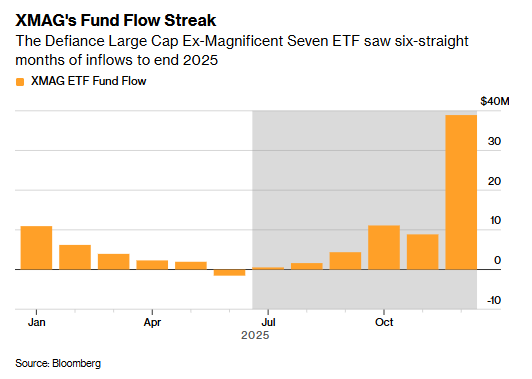
Core Viewpoint - The dominance of AI companies in the U.S. stock market, which has driven a 78% increase over the past three years, is facing skepticism as investors question the long-term profitability and transformative potential of AI technology [2] Group 1: Market Dynamics - Investors are shifting their focus from the "Magnificent Seven" tech giants to the remaining 493 companies in the S&P 500, particularly those that could benefit from an economic recovery [2] - The "Magnificent Seven" index has seen a decline of 2% since October 29 of the previous year, while the remaining S&P 493 index has increased by 1.8% during the same period [2] - The Defiance Large Cap Ex-Magnificent Seven ETF, which excludes the "Magnificent Seven," has experienced significant net inflows, with December's inflow being four times that of November [3] Group 2: Future Outlook - Ed Yardeni predicts impressive performance for the S&P 493 index in 2025, despite challenges such as government inefficiencies and a weak labor market [3] - If the economy improves, cyclical and growth-oriented sectors are expected to benefit, providing opportunities for investors looking to diversify away from large tech stocks [3] - Goldman Sachs forecasts that the contribution of the "Magnificent Seven" to S&P 500 earnings growth will decrease from 50% in 2025 to 46% in 2026, while S&P 493's earnings growth is expected to accelerate to 9% in 2026 [6] Group 3: Investment Sentiment - There is a growing sentiment of "AI fatigue," with investors becoming more selective about AI-related investments, as evidenced by Michael Burry's bearish bets on Nvidia and Palantir [5] - Concerns about the sustainability of capital expenditures and high valuations are leading to a more cautious approach among AI investors [4] - Analysts suggest that the healthcare sector, along with materials and non-essential consumer goods, may present attractive investment opportunities due to undervaluation relative to historical levels [6]



连华尔街都看腻了AI!美股资金正悄悄流向标普500其余493家公司
智通财经网· 2026-01-07 12:57
Core Viewpoint - The AI concept stocks have dominated the U.S. stock market over the past three years, leading to a cumulative increase of 78%, but investor enthusiasm is waning as concerns grow about the sustainability of this growth and the potential for a market shift away from the "Magnificent Seven" stocks [1] Group 1: Market Trends - A market style shift has begun, with the "Magnificent Seven" index down 2% since October 29, while the remaining 493 stocks in the S&P 500 have risen by 1.8% [2] - Funds are moving from high-growth stocks to more defensive and reasonably valued sectors, as evidenced by the Defiance Large Cap Ex Magnificent Seven ETF, which saw a threefold increase in net inflows in December compared to November [2] Group 2: Future Outlook - The performance of the remaining 493 S&P 500 stocks is expected to be "remarkable" in 2025, with high profit margins maintained despite economic challenges [5] - If economic conditions improve, cyclical and growth-oriented sectors may also benefit, providing opportunities for investors looking to move away from tech giants [5] - Historical examples suggest that once the dominance of the "Magnificent Seven" ends, the overall market may experience volatility [6] Group 3: Investment Sentiment - There is a growing sentiment of "AI fatigue," with warnings from various analysts about the potential end of the tech giants' dominance [7] - Goldman Sachs predicts that the contribution of the "Magnificent Seven" to S&P 500 earnings growth will decline from 50% in 2025 to 46% in 2026, while the growth rate for the remaining stocks is expected to rise from 7% to 9% [7] - Value investors are finding the remaining 493 stocks attractive due to significant valuation disparities and favorable macroeconomic conditions [7]
Oracle's Secret Weapon Against AI Customer Risk Has a Fatal Flaw
The Motley Fool· 2026-01-07 10:15
Core Viewpoint - Oracle is rapidly expanding its AI infrastructure capabilities through significant contracts, particularly with OpenAI, which has led to a substantial increase in its remaining performance obligations (RPO) to $523 billion [1][2]. Group 1: AI Infrastructure and Customer Contracts - Oracle has over 700 AI customers, with OpenAI being a major contributor to its RPO growth, attributed to a $300 billion cloud infrastructure deal [2]. - The company can quickly reallocate AI computing capacity between customers, taking only a few hours to do so, which minimizes customer concentration risk [5][7]. - Oracle's ability to shift capacity allows it to maintain high utilization rates, crucial for its gross margin, as downtime would negatively impact profitability [8]. Group 2: Market Risks and Future Outlook - While current demand for AI infrastructure exceeds supply, there is a potential risk of oversupply in the future, which could pose significant challenges for Oracle if a major customer fails to pay [9][10]. - Major tech companies are independently building substantial AI capacity based on optimistic demand forecasts, leading to concerns about future market saturation [11]. - Oracle's reliance on OpenAI for fulfilling its commitments raises concerns about financial stability in an oversupply scenario, which could become a significant risk in the coming years [12][13].
甲骨文创始人埃里森 3 亿出售豪宅,曾与英伟达黄仁勋、乔布斯遗孀作邻居
Xin Lang Cai Jing· 2026-01-07 10:08
据市政记录显示,这栋现代风格住宅由建筑师威廉・沃斯特 (William Wurster) 在大约 1958 年设计,建筑面积约 10,742 平方英尺 (约合 998 平方米),设有五 间卧室。 北京时间 1 月 7 日,据《华尔街日报》报道,就在派拉蒙 CEO 大卫・埃里森 (David Ellison) 积极竞购华纳兄弟之际,他的父亲、甲骨文创始人拉里・埃里 森 (Larry Ellison) 以 4500 万美元 (约合 3 亿元人民币) 的价格出售了位于旧金山黄金海岸的豪宅。 埃里森出售的豪宅 公共记录显示,这栋位于太平洋高地高端社区的房产通过非公开交易于去年 12 月完成交割,买家身份尚未披露。 拉里是甲骨文董事长,也是美国总统特朗普的密友。记录显示,他大约在 1988 年以 390 万美元(现汇率约合 2728.2 万元人民币)购入该房产。截至发稿, 拉里尚未就此置评。 近几周,拉里深入参与了派拉蒙对华纳兄弟的恶意收购交易。派拉蒙由其子大卫掌舵。去年 12 月,拉里为这笔交易的 404 亿美元股权融资提供了个人担 保。此前,华纳兄弟已同意以 720 亿美元的价格出售给 Netflix,这桩拟议合并 ...


瑞银:债务激增不足为虑 甲骨文(ORCL.US)投资级评级“不太可能”遭下调
Zhi Tong Cai Jing· 2026-01-07 03:39
Group 1 - UBS Group indicates that Oracle Corporation (ORCL.US) is likely to maintain its investment-grade rating in the short term despite taking on hundreds of billions in debt to expand its artificial intelligence business [1] - UBS strategist Matthew Mish noted that while Oracle's rating may be downgraded to the lowest tier of investment grade, concerns about it falling to "junk status" are likely overstated [1] - Oracle's outstanding debt is approximately $95 billion, making it the largest corporate bond issuer outside the financial sector in the Bloomberg high-rated corporate index [1] Group 2 - Oracle's decision to issue $18 billion in bonds last September for data center expansion aimed at capitalizing on the AI investment boom has led to ongoing market concerns regarding its rating sustainability [1] - The ability of Oracle to maintain its investment-grade status will ultimately depend on the prospects of its AI business and future borrowing plans [1] - All three major rating agencies currently rate Oracle two notches above junk status [1]