SoftBank(SFTBY)

Search documents
软银计划裁减愿景基金20%员工 资源转向AI押注
Ge Long Hui· 2025-09-18 23:14
Group 1 - SoftBank plans to cut nearly 20% of its Vision Fund team globally to redirect resources towards founder Masayoshi Son's large-scale AI investments in the US [1] - This marks the third round of layoffs for the flagship fund since 2022, following significant losses [1] - The fund currently has 44 employees, and this decision comes after the fund reported its strongest quarterly performance since June 2021 [1] Group 2 - Despite the layoffs, the fund will continue to make new investments, with remaining staff focusing more on ambitious AI initiatives [1] - A spokesperson for the Vision Fund confirmed the layoffs but did not provide further details [1]

Global Markets Abuzz: Nvidia’s $900M AI Talent Grab, SoftBank Vision Fund Cuts, and Key IPOs Drive Headlines
Stock Market News· 2025-09-18 23:08
Group 1: Corporate Developments - Nvidia has made a significant investment of over $900 million to acquire key personnel and technology from AI startup Enfabrica, reinforcing its leadership in the AI hardware sector [3][8] - SoftBank's Vision Fund plans to cut nearly 20% of its global staff, marking a strategic shift towards a concentrated focus on large-scale AI investments [4][8] - Pattern Group Inc. successfully priced its IPO at $14 per share, reflecting strong investor interest [6][8] - Zijin Gold International Co. is preparing for a substantial IPO in Hong Kong, aiming to raise approximately HK$24.9 billion (US$3.21 billion), potentially one of the largest listings in the city this year [7][8] Group 2: Economic Indicators - New Zealand's trade deficit widened significantly to NZ$1.19 billion in August, driven by a decline in exports, although the year-to-date trade deficit showed improvement [5][8]


SoftBank Vision Fund to lay off 20% of employees in shift to bold AI bets, source and memo say
Reuters· 2025-09-18 22:38
SoftBank Group will lay off nearly 20% of its Vision Fund team globally as it shifts resources to founder Masayoshi Son's large-scale artificial intelligence bets in the United States, according to a ... ...

英特尔一个月内“狂吸”160亿美元,美政府成最大赢家?
Xin Lang Cai Jing· 2025-09-18 13:39
来源:视频滚动新闻 1.软银:2025年8月19日,英特尔与日本软银集团联合宣布,软银将向英特尔注资20亿美元。根据协 议,软银将以每股23美元的价格购入英特尔普通股,这笔约占英特尔2%股权的投资将使软银跃居第六 大股东。软银这笔投资不要求董事会席位,不附带购置英特尔芯片的承诺。2.美国政府:2025年8月22 日,英特尔宣布与美国联邦政府达成协议,后者将向英特尔普通股投资89亿美元,以每股20.47美元的 价格收购4.333亿股英特尔普通股,相当于该公司9.9%的股份,成为公司最大股东。政府该部分股权没 有董事会席位/特别治理权。3.英伟达:英伟达周四宣布,将向英特尔普通股投入50亿美元,每股价格 为23.28美元。该协议包含英特尔与英伟达联合开发个人电脑及数据中心芯片的计划。交易并不涉及英 特尔的代工业务。此次交易后,英伟达可能拥有英特尔4%或更多的股份。4.值得一提的是,英伟达此 次收购英特尔普通股的价格高于美国政府,使美国政府上月的投资在不到一个月的时间里理论上升值了 约14%,年化收益率高达168%。 ...

【美股盘前】美联储降息25个基点,三大期指齐涨,国际金价上破3700美元后回落;热门中概股回调;诺和诺德涨超5%;马斯克谈太瓦级数据中心;丰田在美召回超...
Mei Ri Jing Ji Xin Wen· 2025-09-18 10:39
Group 1 - US stock index futures are up, with Dow futures rising by 0.75%, S&P 500 futures by 0.91%, and Nasdaq futures by 1.08% [1] - Quantum computing stocks continue their upward trend in pre-market trading, with IONQ up nearly 7%, QUBT up over 4%, and RGTI up 3% [1] - Popular Chinese stocks are experiencing a pullback in pre-market trading, with Bilibili and NIO down over 3%, Xpeng down over 2%, and Alibaba down nearly 2% [1] - Novo Nordisk shares are up over 5% in pre-market trading, as reports indicate that its product semaglutide has significant advantages over competitor Eli Lilly's obesity drug [1] - Toyota is recalling over 591,000 vehicles in the US due to a dashboard software malfunction that may increase the risk of accidents, leading to a nearly 1% drop in its stock [1] - SoftBank's joint venture with OpenAI, SB OpenAI Japan, is reportedly significantly behind schedule, with the company originally expected to be established by summer but now anticipated to announce progress in November [1] Group 2 - Elon Musk stated that for data centers exceeding 1 terawatt (1000 gigawatts), solar energy and batteries are the only realistic options, responding to a post about xAI's natural gas turbine capacity [2] - Morgan Stanley reported that early delivery times for the iPhone 17 series are comparable to or slightly longer than last year, indicating potential year-over-year demand growth, maintaining an "overweight" rating on Apple with a target price of $240 [2] - Following the Federal Reserve's decision to cut interest rates by 25 basis points, international gold prices initially surged past $3700 per ounce before retreating to $3671 per ounce [2]


软银(SFTBY.US)与OpenAI的日本AI合资计划被曝延期 预计11月公布新进展
Zhi Tong Cai Jing· 2025-09-18 08:08
知情人士透露,软银(SFTBY.US)计划与OpenAI合作成立一家合资企业,旨在为日本的企业客户提供人 工智能服务,但这一计划的进度严重滞后。知情人士表示,该合资企业原定于今年夏天成立,但筹备工 作进展比预期要慢,预计11月会有关于进展情况的最新消息。 软银表示相关准备工作正在推进,但拒绝透露具体细节。OpenAI尚未回应置评请求。 在6月份的股东大会上,软银电信部门首席执行官宫川淳一表示,目标是在7月底成立该合资企业。他还 表示,该企业将要推出的具体产品正在商讨之中。 在经历了因一系列科技投资失败而出现的紧缩期之后,孙正义再次大举投资,支持OpenAI和其他与人 工智能相关的企业。 软银集团首席财务官后藤义光上个月表示,耗资5000亿美元的"星际之门"项目因与各方的长期谈判以及 有关选址的决策问题而被推迟。 据悉,"星际之门"是由OpenAI、软银集团与甲骨文公司联合主导的美国数据中心项目。该项目于2025 年1月由特朗普政府宣布启动,计划四年内投资5000亿美元。 今年2月,软银集团首席执行官孙正义与OpenAI首席执行官萨姆.奥尔特曼宣布将成立合资公司SB OpenAI Japan。软银表示,这家合资 ...
Not All Upgrades Are Welcome: Moody’s Still Labels SoftBank Junk
MINT· 2025-09-18 07:39
Group 1 - Moody's upgraded SoftBank Group Corp.'s rating from Ba3 to Ba2, but the company criticized the rating as being based on subjective assumptions without factual basis [1][2] - Despite the upgrade, SoftBank's debt remains classified as non-investment grade, often referred to as "junk" in the bond market [1] - The CEO of Fujiwara Capital noted that the rating implies potential difficulties in debt repayment, which could mislead market perceptions [2] Group 2 - Criticism of credit ratings is not uncommon, with historical examples during the global financial crisis and Europe's sovereign debt crisis highlighting the backlash against rating agencies [2] - The "issuer pays" model used by many rating agencies raises concerns about conflicts of interest, although SoftBank's rating was unsolicited, which complicates the argument regarding its basis [2][3] - In Japan, regulations often require investment-grade status for bond purchases, contrasting with the more developed high-yield bond market in the US and other regions [3]


US Retail Sales Show Resilience Amidst Labor Market Headwinds, While Tech Giants Pour Billions into AI Infrastructure
Stock Market News· 2025-09-16 22:08
Consumer Spending and Economic Indicators - US retail sales increased by 0.5% in July, following a revised 0.9% increase in June, indicating strong consumer spending despite economic uncertainty [2][8] - Preliminary projections for August suggest a further increase of 0.2% in overall retail sales, or 0.4% when excluding automobile and gasoline sales [2][8] - The increase in July was driven by a 1.6% rise in motor vehicle sales, partly due to a rush for electric vehicle purchases before federal tax credits expired [3][8] - Online sales rose by 0.8%, supported by extended Prime Day promotions, while sectors like clothing and furniture saw gains, but building materials and electronics experienced declines [3] Labor Market Trends - The labor market shows signs of strain, with only 73,000 jobs added in July and the unemployment rate rising to 4.3% in August, the highest since 2021 [4][5][8] - Revisions to employment data indicate nearly 100,000 fewer jobs were created between March 2023 and March 2024 than initially estimated, highlighting persistent job growth weakness [5] Federal Reserve Response - The divergence between strong consumer spending and a weakening labor market has led to expectations of a 25-basis-point interest rate cut by the Federal Reserve [5][8] AI Infrastructure Investments - Major American technology companies are committing tens to hundreds of billions of dollars to expand AI infrastructure globally, with OpenAI signing a $300 billion data center agreement with Oracle [6][8] - OpenAI, Oracle, and SoftBank announced plans to create at least $100 billion in computing infrastructure in the US, with ambitions to expand to $500 billion [7] UK AI Investment - The UK is becoming a key beneficiary of AI infrastructure investments, with Microsoft pledging $30 billion and Google committing approximately $6.8 billion towards AI initiatives [10][11] - The "Stargate UK" project involves Nvidia, OpenAI, and Nscale, aiming to establish significant AI infrastructure in the UK [11] - Other investments include CoreWeave's plan to spend £1.5 billion ($2.04 billion) on UK AI data center capacity and Salesforce's additional $2 billion investment in its UK business through 2030 [11]





日经平均股指连续3天创新高,报收于4万4768点
日经中文网· 2025-09-12 08:00
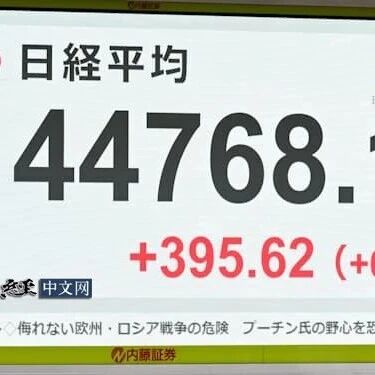
Group 1 - The Nikkei average index closed at 44,768.12 points on September 12, marking a continuous three-day rise and setting a new historical high, with an increase of 395.62 points (0.89%) from the previous trading day [2] - The rise in the Japanese stock market is driven by three main factors: sustained buying of AI-related stocks, increasing market expectations for the Federal Reserve to resume interest rate cuts, and the candidacy of former Economic Security Minister Takashi Saito in the Liberal Democratic Party presidential election [2] - The Philadelphia Semiconductor Index (SOX), which has a high correlation with the Nikkei average, has risen for six consecutive days, reaching new historical highs [4] Group 2 - SoftBank Group is collaborating with Oracle on a massive investment in AI infrastructure through the "Stargate" project [5] - As of the end of June, SoftBank's net asset value (NAV) was approximately 32 trillion yen, which is expected to have increased due to the rise in U.S. tech stocks this summer [5] - SoftBank's market capitalization has expanded to over 26 trillion yen [5]
历史新高!集体大涨
券商中国· 2025-09-11 14:51
Core Viewpoint - The recent surge in Japan's stock market, particularly driven by SoftBank Group, is linked to renewed investor enthusiasm for AI and cloud computing, following Oracle's significant stock price increase [1][2][3]. Group 1: Market Performance - On September 11, the Nikkei 225 index rose over 1%, reaching a historical high, with SoftBank Group's stock price increasing nearly 10%, resulting in a market capitalization growth of over 2 trillion yen [1][2]. - SoftBank Group's total market value surpassed 26 trillion yen, while other tech stocks, such as Advantest and Fujikura, also saw notable gains [2]. - Oracle's stock surged nearly 36% on September 10, marking its largest single-day increase since 1992, which contributed to the positive sentiment in the tech sector [2][3]. Group 2: SoftBank and AI Investments - SoftBank's recent stock performance is not only influenced by Oracle but also by the soaring valuation of OpenAI, which raised $40 billion in a funding round led by SoftBank, bringing its valuation to $300 billion [3]. - OpenAI's valuation is projected to reach $500 billion following a proposed sale of shares by current and former employees, indicating a significant increase of nearly 70% in a few months [3]. Group 3: Economic Concerns - Despite the stock market's rise, there are concerns regarding the overall optimism for Japan's economic outlook, as evidenced by the underperformance of bank stocks, which fell nearly 1% [4]. - Analysts express uncertainty about the Bank of Japan's interest rate path, with expectations of a potential rate hike before January 2024, but caution remains due to global economic uncertainties [5].