
UMC(UMC)

Search documents
【太平洋科技-每日观点&资讯】(2025-10-09)
远峰电子· 2025-10-08 14:28
Market Overview - The main board led the gains with notable stocks such as Dingxin Communication (+10.04%), Hengwei Technology (+10.02%), and Wangda Software (+10.01%) [1] - The ChiNext board saw significant increases with Jiangbolong (+20.00%) and Online and Offline (+15.08%) [1] - The Sci-Tech Innovation board was led by Dahong Technology (+20.00%) and Pinming Technology (+18.60%) [1] - Active sub-industries included SW Integrated Circuit Testing (+4.44%) and SW Digital Chip Design (+3.11%) [1] Domestic News - Wentai Technology announced a business adjustment due to significant market demand growth, leading to supply tightness and a temporary halt on shipments and price agreements [1] - Gaon Electronics plans to acquire 100% of Ruicheng Chip Micro for 2.174 billion yuan and 45.64% of Nengwei Micro, accelerating its transformation into a one-stop chip design solution platform [1] - TSMC announced its latest partner list for its Open Innovation Platform, with Gaon Electronics recognized for its modeling and simulation technology [1] - United Microelectronics Corporation (UMC) requested suppliers to propose executable price reduction plans exceeding 15%, effective from January 1, 2026 [1] Company Announcements - Yaxin Security received a government subsidy of 1,975,353.58 yuan, categorized as revenue-related [2] - Tuojing Technology announced a plan for shareholders to reduce their holdings by up to 2,811,639 shares, representing 1% of the total share capital [2] - Shida Group reported progress on acquiring assets from its indirect controlling shareholder, with audit and evaluation work completed [2] - Huibo Yuntong completed the transfer of equity in its wholly-owned subsidiary, receiving 60% of the transfer payment, amounting to 48 million yuan [2] International News - Raontech is expanding its supply of AR glasses optical solutions to major partners, integrating reflective waveguides with light engines [3] - Kioxia Holdings expects a 20% annual growth in NAND storage demand due to the expansion of AI data center operators [3] - Wolfspeed successfully completed its financial restructuring, reducing total debt by approximately 70% and extending debt maturity to 2030 [3] - Counterpoint Research indicates that the average selling price of global smartphones is projected to rise from $357 in 2024 to $370 in 2025, reaching $412 by 2029, with a compound annual growth rate of 3% [3]



United Microelectronics' ‘strong' September sales not enough to lift target price: analysts
Proactiveinvestors NA· 2025-10-07 15:39
Group 1 - Proactive provides fast, accessible, informative, and actionable business and finance news content to a global investment audience [1][2] - The news team covers key finance and investing hubs including London, New York, Toronto, Vancouver, Sydney, and Perth [2] - Proactive specializes in medium and small-cap markets while also covering blue-chip companies, commodities, and broader investment stories [2][3] Group 2 - The team delivers news and insights across various sectors including biotech, pharma, mining, natural resources, battery metals, oil and gas, crypto, and emerging technologies [3] - Proactive adopts technology to enhance workflows and improve content production [4][5] - All content published by Proactive is edited and authored by humans, ensuring adherence to best practices in content production and search engine optimization [5]

UMC Reports Sales for September 2025
Businesswire· 2025-10-07 08:00
Core Insights - United Microelectronics Corporation (UMC) reported unaudited net sales for September 2025, showing a year-over-year increase in revenues [1] Financial Performance - Revenues for September 2025 reached NT$ 19,927,175 thousand, compared to NT$ 18,942,714 thousand in September 2024, marking a year-over-year increase of NT$ 984,461 thousand, or 5.20% [1] - For the period from January to September 2025, total revenues amounted to NT$ 175,743,654 thousand, up from NT$ 171,916,474 thousand in the same period of 2024, reflecting a year-over-year increase of NT$ 3,827,180 thousand, or 2.23% [1]
Semiconductors Winners And Losers At The Start Of Q4 2025
Seeking Alpha· 2025-10-05 15:21
Group 1 - Semiconductor stocks were expected to have a weak quarter for most of Q3 2025, but a strong finish led to significant gains for many companies in the sector [1] - The positive performance of semiconductor stocks was supported by various factors that contributed to the strong end of the quarter [1]

United Microelectronics Stock: Cyclicality, Structure, And Dividends Assessed (NYSE:UMC)
Seeking Alpha· 2025-09-20 03:37
Group 1 - Investors currently have a negative sentiment towards United Microelectronics Corporation (NYSE: UMC), with the only analyst rating in the past 90 days being a Sell [1] - The Quant system also reflects a bearish outlook on UMC, indicating a lack of confidence among analysts [1] Group 2 - Robert F. Abbott, a freelance writer and investor, has been managing investments since 1995 and has experience with options trading since 2010 [1]

异动盘点0905|黄金股集体走高,优必选再涨超2%;Samsara涨超10%,American Eagle涨超37%
贝塔投资智库· 2025-09-05 04:10
Group 1: Hong Kong Stock Market Highlights - China Tobacco Hong Kong (06055) rose over 2% after announcing exclusive distribution agreements for brand cigars with Hubei and Shandong Tobacco [1] - Sportswear stocks generally increased, with Li Ning (02331) up nearly 1% and Tmall (06110) up nearly 2%, following a government directive to enhance the modern sports industry and boost consumption [1] - He Yu-B (02256) surged over 3% as the company announced multiple positive developments, including the approval of oral PD-L1 combined with Gorai Leisai for Phase II clinical trials [1] - Gold stocks collectively rose, with Lingbao Gold (03330) up over 4%, China Gold International (02099) up over 1%, and Zijin Mining (02899) up over 3%, amid expectations of a U.S. interest rate cut [1] - UBTECH (09880) increased over 2% after Citigroup reported that the company has received 400 million RMB in humanoid robot orders and secured a $1 billion strategic investment from a Middle Eastern fund [1] - Huimai Technology (01860) surged over 12%, reaching a historical high, with a year-to-date stock price increase of over 110% due to the continuous iteration of its AI-driven smart bidding system [1] Group 2: Other Notable Stocks - Wanka Yilian (01762) rose over 11% after announcing a comprehensive cooperation memorandum with Alibaba Cloud to create an AI marketing ecosystem [2] - Longpan Technology (02465) increased over 10%, with Citic Securities indicating potential opportunities in the battery sector due to an upcoming significant meeting [2] - Juzi Bio (02367) rose over 4%, with institutions optimistic about the recovery of live streaming during the upcoming Double Eleven shopping festival [2] - Shoucheng Holdings (00697) increased over 8% after its subsidiary announced additional investment in Songyan Power amounting to several million RMB [2] Group 3: U.S. Stock Market Highlights - Salesforce (CRM.US) fell 4.85% after reporting a 9.8% year-over-year revenue growth for Q2, with Q3 revenue guidance slightly below expectations [3] - American Eagle (AEO.US) surged 37.96% after exceeding expectations in its Q2 earnings report [3] - Hewlett Packard Enterprise (HPE.US) rose 1.49% with a 19% year-over-year revenue growth in Q3, marking a record high [3] - United Microelectronics (UMC.US) increased 3.46%, reporting a 1.86% year-over-year sales growth for the first eight months of the year [3] - ZTO Express (ZTO.US) continued to rise by 0.94%, with the logistics industry index in China at 50.9%, up 0.4 percentage points from the previous month [3] - Bilibili (BILI.US) rose 0.99%, with research indicating high growth in the gaming industry supported by policy, expecting continued quarter-over-quarter improvement [3] - Waterdrop (WDH.US) increased 2.25%, reporting nearly a 120% growth in net profit attributable to shareholders, driven by AI model empowerment [3] Group 4: Additional U.S. Stock Movements - Sanofi (SNY.US) fell 9.14% despite achieving all primary and secondary endpoints in a Phase III study for Amlitelimab, as results did not meet market expectations [4] - Toyota (TM.US) rose 2.40% after announcing plans to produce a pure electric vehicle model at its Czech factory, marking its first electric vehicle production in Europe [4] - Baidu (BIDU.US) increased 1.88% following the release of an action plan by the Ministry of Industry and Information Technology to enhance intelligent cloud services [4] Group 5: Earnings Reports and Forecasts - C3.ai (AI.US) fell 7.31% after reporting Q1 results and revenue guidance for FY2026 that fell short of expectations [5] - Samsara (IOT.US) rose over 10% with a 30% year-over-year revenue growth in Q2 [5] - UiPath (PATH.US) increased nearly 5%, reporting Q2 revenue of $362 million, a 14% year-over-year growth, and projecting FY2026 revenue between $1.571 billion and $1.576 billion [5] - DocuSign (DOCU.US) rose nearly 9% after reporting Q2 revenue of $800.6 million, a 9% year-over-year increase, with GAAP gross margin at 79.3% [5]


联电(UMC.US)涨近3% 1-8月营收同比增长1.86%
Zhi Tong Cai Jing· 2025-09-04 23:29
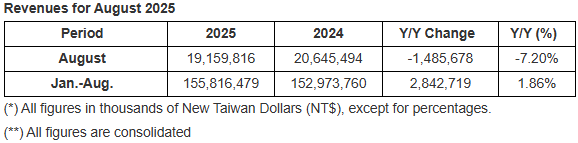
Core Viewpoint - UMC's stock rose nearly 3% to $6.835 following the announcement of its unaudited net sales data for August 2025, indicating a mixed performance in revenue growth [1] Revenue Performance - In August 2025, UMC reported a year-on-year revenue decline of 7.2%, amounting to approximately NT$19.16 billion [1] - For the period from January to August 2025, UMC's revenue reached NT$155.82 billion, reflecting a year-on-year growth of 1.86% [1]
美股异动 | 联电(UMC.US)涨近3% 1-8月营收同比增长1.86%
Zhi Tong Cai Jing· 2025-09-04 15:31
Core Viewpoint - UMC's stock rose nearly 3% to $6.835 following the announcement of its unaudited net sales data for August 2025, indicating a mixed performance in revenue growth [1] Group 1: Revenue Performance - UMC reported a year-on-year revenue decline of 7.2% in August, amounting to approximately NT$19.16 billion [1] - For the period from January to August 2025, UMC's revenue reached NT$155.82 billion, reflecting a year-on-year growth of 1.86% [1]
联电(UMC.US)8月营收191.6亿新台币 同比下降7.2%
Zhi Tong Cai Jing· 2025-09-04 11:45
Core Insights - UMC reported a year-over-year revenue decline of 7.2% in August 2025, with sales amounting to approximately NT$19.16 billion [1][2] - For the period from January to August 2025, UMC's revenue reached NT$155.82 billion, reflecting a year-over-year growth of 1.86% [1][2] Revenue Analysis - August 2025 revenue was NT$19.16 billion, down from NT$20.65 billion in August 2024, a decrease of NT$1.49 billion [2] - Cumulative revenue from January to August 2025 was NT$155.82 billion, compared to NT$152.97 billion in the same period of 2024, an increase of NT$2.84 billion [2]
美股异动|联电盘前涨近2% 今年1-8月销售额同比增长1.86%
Ge Long Hui· 2025-09-04 08:12
Core Viewpoint - UMC (United Microelectronics Corporation) reported a nearly 2% pre-market increase, reaching $6.78, despite a year-on-year decline in August sales [1] Sales Performance - UMC's sales for August were approximately NT$19.16 billion, representing a year-on-year decrease of 7.2% [1] - Cumulatively, UMC's sales from January to August totaled approximately NT$155.82 billion, showing a year-on-year growth of 1.86% [1] Market Position - According to the latest survey by TrendForce, UMC's market share in the second quarter was 4.4%, maintaining its position as the fourth largest foundry globally, driven by increases in wafer shipments and average selling prices (ASP) [1]