UnitedHealth(UNH)

Search documents
利好突袭!光伏板块集体飙升!美三大股指涨跌不一
Zheng Quan Shi Bao· 2025-08-16 07:17
Market Performance - On August 15, U.S. stock indices closed mixed, with the Dow Jones slightly up by 0.08% at 44,946.12 points, while the Nasdaq fell by 0.40% to 21,622.98 points, and the S&P 500 decreased by 0.29% to 6,449.80 points [1] - Major tech stocks showed varied performance, with Intel rising nearly 3%, while Tesla dropped over 1% [1] Retail Sales Data - July retail sales in the U.S. increased by 0.5%, aligning with market expectations, indicating healthy consumer spending despite concerns over tariffs potentially raising prices [2] - Excluding automobiles, retail sales grew by 0.3%, with motor vehicle sales surging by 1.6% and furniture sales increasing by 1.4% [2] - Year-over-year, July retail sales rose by 3.9% [2] Notable Stock Movements - UnitedHealth saw a significant increase of 11.98%, marking its largest single-day gain since October 2008, following Berkshire Hathaway's purchase of 5.04 million shares valued at approximately $1.6 billion [3] - Nvidia's stock fell by 0.86%, with a focus on its substantial investment in AI cloud computing services [3] - Tesla's stock decreased by 1.50%, with JP Morgan Chase increasing its holdings by 16.7%, making it one of Tesla's top five institutional shareholders [3] Solar Sector Performance - The solar sector experienced a collective surge, with Sunrun's stock rising by 32.82% and SolarEdge Technologies increasing by 17.10% [4] - Other solar-related stocks also saw significant gains, with Array Technologies up by 25.33% and Enphase Energy rising by 8.13% [4][5] Tax Credit Changes for Renewable Energy - New guidelines from the U.S. Treasury and IRS have altered the criteria for tax credits for solar and wind projects, moving away from the previous "5% standard" to requiring proof of substantial ongoing construction [7] - The changes are expected to positively impact over 2,500 potential solar and wind projects, equivalent to the capacity of 383 nuclear power plants [7]



Oscar Could Stem The Healthcare Tide
Seeking Alpha· 2025-08-16 06:05
Core Insights - The article emphasizes the importance of fundamental analysis in identifying undervalued, best-in-class companies, similar to the strategies employed by renowned investors like Warren Buffett and Peter Lynch [1]. Company and Industry Summary - The analyst has a long position in shares of OSCR, CNC, and UNH, indicating a positive outlook on these companies [2]. - The article does not provide specific financial metrics or performance data for the mentioned companies, focusing instead on the investment philosophy [1][2].

巴菲特减持苹果和美国银行|首席资讯日报
首席商业评论· 2025-08-16 04:34
Group 1 - The Trump administration is in talks to potentially acquire a stake in Intel to support its domestic manufacturing efforts, particularly for a planned factory cluster in Ohio [2] - The film "浪浪山小妖怪" has surpassed previous Japanese animated films to become the highest-grossing 2D animated film in Chinese history [3] Group 2 - Keling AI has launched a new feature for its 2.1 model, enhancing video generation capabilities and addressing issues like abrupt transitions and insufficient text responses, making it suitable for professional creative scenarios [4] - Berkshire Hathaway has reduced its holdings in Apple and Bank of America while initiating positions in companies like UnitedHealth and Nucor [5][6] Group 3 - As of the end of July, the nationwide unsold commercial housing area in China has decreased for five consecutive months, totaling 76,486 million square meters, down by 462 million square meters from June [7] - At the World Humanoid Robot Sports Competition, Yushun's robot H1 won first and third place in the 1500-meter race, with the CEO expressing excitement for future 100-meter races [8] Group 4 - The American Bitcoin company, backed by the Trump family, is looking to acquire a Japanese listed company and expand into the Hong Kong market [9] - Samsung's market share in DRAM memory and smartphone display panels has declined, with DRAM dropping from 41.5% to 32.7% and smartphone displays from 50.1% to 39.9% [10] Group 5 - Customs authorities in Dongguan seized 1,992 counterfeit "Labubu" blind boxes, indicating significant infringement concerns [11] - IDC predicts that China's spending on generative AI-related network hardware will increase from 6.5 billion yuan in 2023 to 33 billion yuan by 2028 [12] Group 6 - Huawei has launched the MatePad 11.5 S, starting at 2,199 yuan, featuring a high-precision screen designed to reduce environmental interference [13] - The China Consumers Association has released a draft of the "Green Consumption Guide" to promote sustainable consumption practices among consumers [14]





利好突袭!光伏板块集体飙升!
证券时报· 2025-08-16 00:56
Core Viewpoint - The solar energy sector in the U.S. experienced a significant surge, driven by new tax incentives and regulatory changes that favor solar and wind projects [8][12][13]. Economic Data - July retail sales in the U.S. increased by 0.5%, aligning with market expectations, indicating continued consumer spending despite concerns over tariffs and inflation [4]. - Year-over-year, retail sales rose by 3.9%, showcasing a healthy consumer environment [4]. Solar Sector Performance - Major solar companies saw substantial stock price increases, with Sunrun rising by 32.82% and SolarEdge Technologies by 17.10% [9]. - The Invesco Solar ETF gained 8.79%, marking its best single-day performance since May 2024 [10]. Regulatory Changes - New guidelines from the U.S. Treasury and IRS have altered the requirements for tax credits on solar and wind projects, moving from a "5% expenditure" standard to a requirement for demonstrable ongoing construction [13]. - Approximately 2,500 solar and wind projects in the U.S. could be affected, with a total generating capacity equivalent to 383 nuclear power plants [12].

道指盘中创新高!美股涨跌互现,联合健康大涨12%,应用材料大跌14%
Di Yi Cai Jing· 2025-08-16 00:16
Market Overview - The University of Michigan's preliminary consumer confidence index fell from 61.7 in July to 58.6 in August, with one-year inflation expectations rising from 4.5% to 4.9% and five-year expectations increasing from 3.4% to 3.9% [2] - U.S. retail sales grew by 0.5% in July, following a revised growth of 0.9% in June, with a year-on-year increase of 3.9%, down from 4.4% in June [2] - The labor market's weakness and tariffs-induced inflation have not yet reflected in overall consumer prices, leading investors to expect an 85% probability of a 25 basis point rate cut by the Federal Reserve next month [2] Company Performance - Application Materials saw a significant drop of 14% after providing a fourth-quarter guidance that fell below market expectations, leading Bank of America to downgrade its rating from buy to neutral [3] - UnitedHealth surged by 12% following a regulatory filing that revealed Berkshire Hathaway purchased over 5 million shares of the company in the second quarter [3] - Intel's stock rose by 2.9% amid reports that the Trump administration may take a stake in the chip manufacturer [4] Sector Movements - The Nasdaq China Golden Dragon Index increased by 0.7%, with Pinduoduo rising by 3.7%, Baidu by 1.2%, and JD.com by 0.4%, while NetEase and Alibaba fell by 0.4% and 0.8%, respectively [4] - International oil prices declined, with WTI crude oil near-month contract falling by 1.81% to $62.80 per barrel and Brent crude down by 1.48% to $65.85 per barrel [4] - Gold prices showed slight fluctuations, with COMEX gold futures for August delivery rising by 0.02% to $3336.00 per ounce [5]

“股神”巴菲特加持联合健康(UNH.US)暴涨 带动道指触及历史新高
Zhi Tong Cai Jing· 2025-08-15 23:19
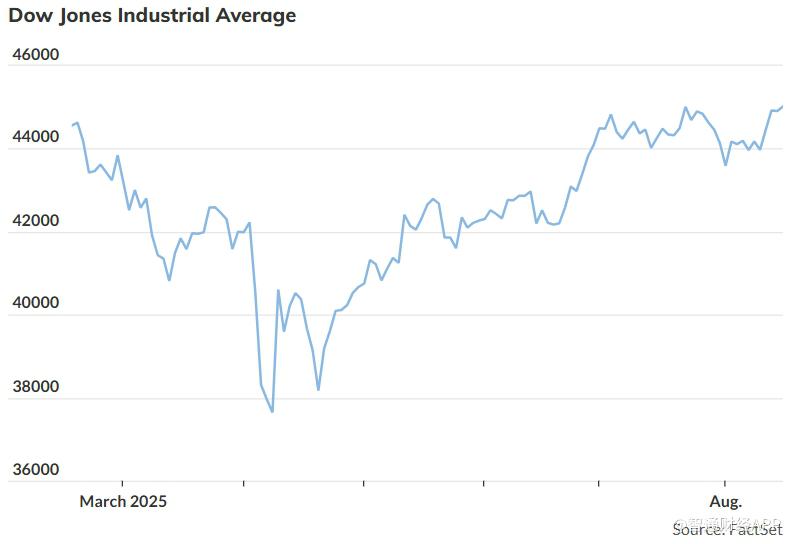
Group 1 - The Dow Jones Industrial Average (DJIA) reached an intraday all-time high of 45,203.52 points before closing nearly flat at 44,946.12 points, up only 34.86 points, indicating a less than 0.1% increase [2] - UnitedHealth (UNH.US) saw its stock price surge nearly 12%, marking its largest single-day gain since November 2020, largely due to Berkshire Hathaway's disclosed holdings in the latest quarterly filing [2] - Despite a year-to-date decline of over 40%, UnitedHealth's stock price fluctuations significantly impacted the DJIA, contributing over 167 points to the index's performance [2] Group 2 - The S&P 500 and Nasdaq Composite indices experienced declines of 0.29% and 0.40%, respectively, indicating a divergence in performance among the three major U.S. stock indices for the first time in 2025 [2] - Analysts noted that the DJIA, being a price-weighted index, is more susceptible to individual stock price movements compared to the market capitalization-weighted S&P 500 [3] - The limited number of components in the DJIA and its price-weighted nature mean it does not fully reflect the overall market value, leading to a cautious approach in its investment significance [3]
美股异动|联合健康股价狂飙11.98%巴菲特重拾医疗保险板块引领投资风潮
Xin Lang Cai Jing· 2025-08-15 23:18
Core Viewpoint - The significant rise in UnitedHealth Group's stock price, driven by Berkshire Hathaway's substantial investment, reflects market confidence in the company's long-term potential despite recent challenges [1][2]. Group 1: Stock Performance - On August 15, UnitedHealth's stock surged by 11.98%, reaching its highest point since July 2025 [1]. - Berkshire Hathaway purchased 5.04 million shares of UnitedHealth, valued at approximately $1.572 billion, marking its first investment in the healthcare insurance sector since 2010 [1]. Group 2: Market Context - UnitedHealth faced several challenges, including lowered profit expectations, the resignation of its CEO, and an investigation by the U.S. Department of Justice regarding its billing practices [1]. - The company experienced a nearly 50% stock price drop in the second quarter due to these issues, including a violent incident involving an executive [1]. Group 3: Investment Strategy - Berkshire Hathaway's investment is seen as a classic example of value investing, where the firm identifies long-term potential during periods of market pessimism [2]. - The ongoing focus on healthcare costs and adjustments in UnitedHealth's business model suggest potential for future growth, despite short-term challenges [2]. - Investors are encouraged to consider the company's long-term stability and competitive advantages in the U.S. healthcare insurance market [2].
隔夜美股 | 三大股指本周收涨 联合健康(UNH.US)涨近12%
智通财经网· 2025-08-15 23:14
Market Performance - Major U.S. indices showed mixed results, with the Dow Jones increasing by 34.86 points (0.08%) to close at 44,946.12, while the Nasdaq fell by 87.69 points (0.40%) to 21,622.98, and the S&P 500 decreased by 18.74 points (0.29%) to 6,449.80 [1] - For the week, the Dow Jones rose by 1.75%, the S&P 500 increased by 0.93%, and the Nasdaq Composite gained 0.79% [2] European Market - European indices had mixed results, with the Euro Stoxx 50 rising by 0.24%, the UK FTSE 100 declining by 0.44%, the French CAC40 increasing by 0.67%, the German DAX30 falling by 0.06%, and the Italian FTSE MIB rising by 1.11% [2] Asia-Pacific Market - The Nikkei 225 index rose by 1.71%, while the KOSPI index saw a slight increase, and the Indonesian Composite index fell by 0.41% [3] Commodity Prices - Crude oil prices fell, with NY light crude down by $1.16 to $62.80 per barrel (1.81% drop) and Brent crude down by $0.99 to $65.85 per barrel (1.48% drop) [3] - Spot gold increased by 0.04% to $3,336.74 per ounce, but saw a weekly decline of 1.79% [4] - Bitcoin decreased by 0.48% to $117,819, and Ethereum fell by 1.6% to $4,477.04 [4] Retail Sales - U.S. retail sales showed a comprehensive increase in July, with a month-over-month growth of 0.5%, and June's growth revised up to 0.9%. Nine out of thirteen categories recorded growth, led by significant increases in automobile sales [5] Consumer Confidence - The U.S. consumer confidence index fell by approximately 5% in August, primarily due to rising inflation concerns. Durable goods purchases dropped by 14%, marking the lowest level in a year [6] Semiconductor Industry - President Trump announced plans to impose tariffs on semiconductors, potentially as high as 300%, indicating a significant expansion of the tariff regime [7] - The Trump administration is considering using funds from the CHIPS Act to acquire equity in Intel (INTC.US), with discussions still in early stages [10] Company-Specific News - Meta Platforms (META.US) plans to restructure its AI business into four departments, indicating a significant organizational change [9] - Citigroup has removed Applied Materials (AMAT.US) from its focus list and lowered its target price to $205 [11]


Buffett sparks UnitedHealth's biggest weekly stock surge in 16 years
Fox Business· 2025-08-15 23:06
Group 1 - Warren Buffett has taken a $1.6 billion stake in UnitedHealthcare Group, which has positively impacted the company's share price [1][5] - UnitedHealth shares experienced the largest one-day percent increase since March 2020, with a weekly rise of over 21%, marking the best week since May 2009, although the stock is still down more than 50% over the past 12 months [2] - Investors have shown increased interest in healthcare-related ETFs, such as Vanguard Health Care Index Fund ETF and The Health Care Select Sector SPDR Fund, following Buffett's investment [2] Group 2 - UnitedHealthcare Group is currently under investigation by the Department of Justice, which has added pressure to the company amidst other challenges, including the fallout from the murder of executive Brian Thompson [6] - The recent developments have drawn attention to the healthcare insurance system in the U.S., highlighting potential vulnerabilities and risks within the industry [6]
UnitedHealth: Berkshire Bets, A Strategic Signal Investors Can't Ignore
Seeking Alpha· 2025-08-15 21:45
Group 1 - The author has a background in private credit and commercial real estate (CRE) mezzanine financing, indicating expertise in financial analysis and investment strategies [1] - The author has collaborated with prominent CRE developers, suggesting a strong network and experience in the real estate sector [1] Group 2 - The article expresses personal opinions and does not provide financial advice, highlighting the importance of independent research for investors [2][3][4]