
Vale(VALE)

Search documents
美股前瞻 | 苹果和亚马逊财报点燃股市 纳指期货涨超1%
Zhi Tong Cai Jing· 2025-10-31 12:41
Market Overview - US stock index futures are all up ahead of the market opening, with Dow futures rising by 0.24%, S&P 500 futures up by 0.87%, and Nasdaq futures increasing by 1.43% [1] - European indices are down, with Germany's DAX down by 0.47%, UK's FTSE 100 down by 0.32%, France's CAC40 down by 0.26%, and the Euro Stoxx 50 down by 0.34% [2][3] - WTI crude oil prices fell by 0.38% to $60.34 per barrel, while Brent crude oil dropped by 0.40% to $64.11 per barrel [4] Economic Events - The US stock market will enter winter time next week, adjusting trading hours, with pre-market trading from 5:00 PM to 10:30 PM Beijing time and regular trading from 10:30 PM to 5:00 AM Beijing time [4] Trade Relations - US Treasury Secretary stated that the US-China trade agreement could be signed as early as next week, with both sides agreeing to enhance economic cooperation [5] Corporate Earnings - ExxonMobil reported Q3 adjusted profits of $8.1 billion, exceeding analyst expectations, driven by increased production in Guyana and the Permian Basin [7] - Chevron's Q3 net profit was approximately $3.6 billion, a 20% year-over-year decline, but adjusted earnings per share surpassed expectations at $1.85 [8] - Apple reported Q4 earnings of $102.5 billion, a 7.9% year-over-year increase, with earnings per share of $1.85, exceeding analyst forecasts [9] - Western Digital's Q3 revenue grew by 27.4% to $2.82 billion, surpassing expectations, with adjusted earnings per share of $1.78 [10] - Amazon's Q3 net sales increased by 13% to $180.2 billion, with AWS sales growing by 20%, marking the fastest growth in three years [11] - Vale's Q3 revenue rose by 9% to $10.42 billion, with net profit increasing by 78% to $2.744 billion, exceeding analyst expectations [12] Strategic Partnerships - NVIDIA announced collaborations with Samsung, SK Group, and Hyundai to build AI factories in South Korea, supplying over 260,000 accelerator chips [13] - Nokia's stock surged after NVIDIA agreed to invest $1 billion, positioning Nokia as a key player in the European AI sector [14]



淡水河谷(VALE.US)Q3营收超预期 净利润同比大增78%
智通财经网· 2025-10-31 00:01
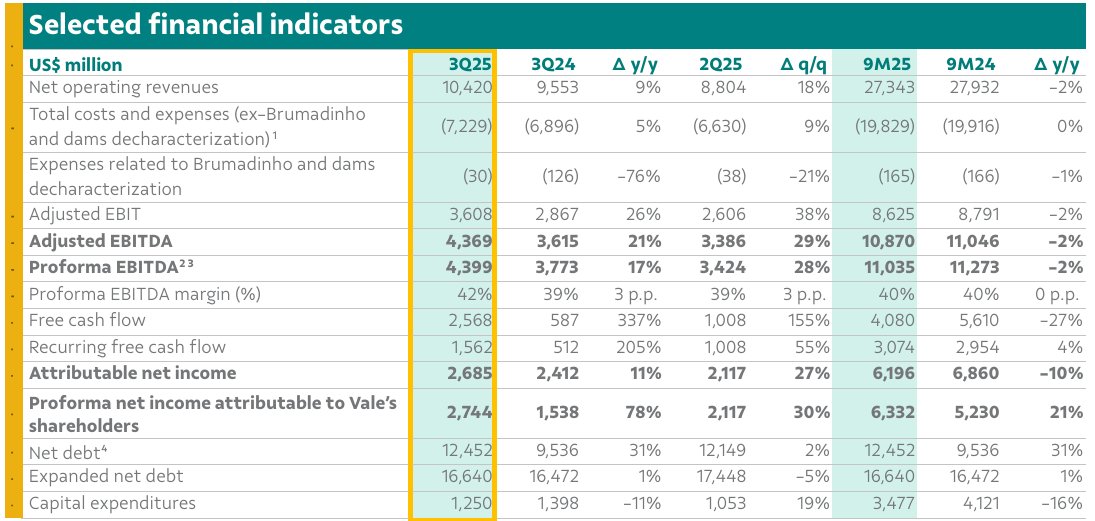
Core Viewpoint - Vale's Q3 2025 performance exceeded expectations, with significant revenue and profit growth driven by increased sales and cost efficiency improvements [1][2]. Financial Performance - Q3 revenue increased by 9% year-on-year to $10.42 billion, surpassing analyst expectations of $10.33 billion [1][2]. - Net income attributable to shareholders reached $2.744 billion, a 78% increase compared to the previous year, exceeding the forecast of $2.1 billion [1][2]. - Pro forma EBITDA was $4.399 billion, up 17% year-on-year, while adjusted EBITDA rose by 21% to $4.369 billion [1][2]. Segment Performance - Iron ore segment revenue was $8.423 billion, with adjusted EBITDA of $3.972 billion [2][3]. - The energy transition metals segment generated $1.997 billion in revenue, with adjusted EBITDA of $687 million [2][3]. Cost Management - Total costs and expenses (excluding Brumadinho-related costs) increased by 5% year-on-year to $7.229 billion [2]. - Expenses related to Brumadinho and dams decharacterization decreased by 76% to $30 million [2]. Production and Cost Outlook - Iron ore production reached its highest quarterly level since 2018, while copper production was the best since Q3 2019 [3]. - The company expects 2025 copper costs to range between $1,000 and $1,500 per ton, down from previous estimates of $1,500 to $2,000 [3]. - Nickel costs are projected to be between $13,000 and $14,000 per ton, lower than earlier forecasts of $14,000 to $15,500 [3].
Vale(VALE) - 2025 Q3 - Quarterly Report
2025-10-30 21:44
Financial Performance - Consolidated net operating revenue for the three-month period ended September 30, 2025, was R$56,701 million, an increase of 6.5% compared to R$52,978 million in the same period of 2024[13] - Gross profit for the nine-month period ended September 30, 2025, was R$51,610 million, a decrease of 0.8% from R$52,049 million in the same period of 2024[13] - Net income attributable to Vale S.A.'s shareholders for the three-month period ended September 30, 2025, was R$14,617 million, up from R$13,386 million in the same period of 2024, representing an increase of 9.2%[13] - Basic earnings per common share for the nine-month period ended September 30, 2025, was R$8.17, a decrease of 3.7% compared to R$8.48 in the same period of 2024[15] - Operating income for the three-month period ended September 30, 2025, was R$15,207 million, down from R$20,388 million in the same period of 2024, reflecting a decrease of 25.8%[13] - Comprehensive income attributable to Vale S.A.'s shareholders for the nine-month period ended September 30, 2025, was R$28,542 million, down from R$35,714 million in the same period of 2024, a decrease of 20.0%[17] - Cash flow from operations for the nine-month period ended September 30, 2025, was R$50,599 million, an increase of 2.2% compared to R$49,529 million in 2024[20] Costs and Expenses - Financial expenses for the nine-month period ended September 30, 2025, totaled R$6,674 million, an increase of 18.1% compared to R$5,651 million in the same period of 2024[13] - The total cost of goods sold and services rendered for the nine-month period ended September 30, 2025, was R$102,309 million, an increase of 8.2% from R$94,555 million in the same period of 2024[13] - The cost of goods sold and services rendered for the three-month period ended September 30, 2025, was R$36,077 million, up from R$34,827 million in 2024, reflecting an increase of approximately 3.6%[52] - Direct compensation for personnel increased to R$8,683 million in 2025 from R$7,224 million in 2024, a rise of 20.2%[26] - The company’s personnel costs for the three-month period ended September 30, 2025, were R$4,039 million, compared to R$3,920 million in 2024, indicating a rise of about 3%[54] - The company’s selling and administrative expenses for the three-month period ended September 30, 2025, were R$858 million, an increase from R$770 million in 2024, representing a growth of about 11.4%[55] Assets and Liabilities - Total assets as of September 30, 2025, amounted to R$484,953 million, a decrease from R$496,325 million at the end of 2024[22] - Total liabilities decreased to R$260,220 million from R$282,605 million at the end of 2024[22] - Cash and cash equivalents at the end of the period increased to R$31,391 million from R$25,039 million in 2024[22] - The company reported a total of R$10,092 million in assets from the Middle East, Africa, and Oceania as of September 30, 2024, which was a significant portion of the total assets[51] - Accounts receivable, net, as of September 30, 2025, was R$13,328 million, down from R$14,600 million as of December 31, 2024[81] - Consolidated financial liabilities for suppliers and contractors increased to R$30,054 million as of September 30, 2025, up from R$26,217 million on December 31, 2024, representing a growth of 6.8%[84] Investments and Capital Expenditures - The company’s investments in property, plant, and equipment were R$240,912 million, down from R$247,594 million at the end of 2024[22] - The company reported additions of R$20,332 million in property, plant, and equipment during the nine months ended September 30, 2025[115] - The total investment in associates and joint ventures was R$27,434 million as of September 30, 2025, down from R$28,158 million, indicating a decrease of 2.6%[95] Tax and Legal Matters - The effective income tax rate for the nine-month period ended September 30, 2025, was impacted by tax incentives amounting to R$4,731 million, compared to R$3,692 million in 2024[64] - As of September 30, 2025, the company reported uncertain tax positions totaling R$40,538 million, an increase from R$36,773 million at the end of 2024[68] - The company recognized provisions totaling R$10,423 million for obligations related to the Brumadinho dam failure as of September 30, 2025[154] - The likelihood of loss from ongoing legal proceedings is considered possible, but the potential loss amount cannot be reliably estimated at this time[181] Foreign Exchange and Financial Instruments - The company recognized a gain of R$8,906 million from foreign exchange and interest rate risk in the nine-month period ended September 30, 2025[121] - The fair value of foreign exchange and interest rate derivatives was R$3,325 million as of September 30, 2025, with a notional amount of US$9,394 million[123] - The company has financial guarantees issued by financial institutions amounting to R$5,927 million (US$1,114 million) as of September 30, 2025, a slight decrease from R$6,756 million (US$1,091 million) as of December 31, 2024[198] Operational Performance - The company recorded losses of R$59 million (US$10 million) and R$176 million (US$31 million) for operational stoppage and idle capacity in the Iron Solutions segment for the three and nine-month periods ended September 30, 2025, compared to R$184 million (US$36 million) and R$562 million (US$108 million) in the same periods of 2024, indicating a reduction in losses[196] - The company has suspended some operations due to safety concerns regarding geotechnical structures, impacting operational capacity and leading to financial losses[196]
铁矿石专题:四大矿山三季度产销数据简析
Hua Tai Qi Huo· 2025-10-29 01:57
Report's Investment Rating for the Industry There is no information provided regarding the report's investment rating for the industry. Core Views of the Report - Vale: In Q3, production and sales increased year-on-year, and the annual production target remained unchanged. The quarterly iron ore production was 94.4 million tons, a 12.9% increase quarter-on-quarter and a 3.8% increase year-on-year. The quarterly iron ore sales were 86 million tons, a 11.2% increase quarter-on-quarter and a 5.1% increase year-on-year. The company maintained its 2025 production target of 325 - 335 million tons [4][5]. - Rio Tinto: In Q3, production and sales were flat year-on-year, and the Simandou iron ore started loading in October. The iron ore production of Pilbara operations was 84.1 million tons, with a 0.4% quarter-on-quarter increase. The company expects to supply 50 - 100 million tons from Simandou this year [6][7]. - BHP: In Q3, iron ore production and sales were below expectations, and the fiscal year 2026 target was slightly raised. The iron ore production of Pilbara operations was 70.25 million tons, a 9.3% decrease quarter-on-quarter and a 1.9% decrease year-on-year. The fiscal year 2026 target was maintained at 284 - 296 million tons, an increase of 2 million tons from the previous fiscal year [8][9]. - FMG: In Q3, production and sales increased year-on-year, and shipments in Q4 are expected to remain at a high level. The total iron ore processing volume was 50.8 million tons, a 6.6% decrease quarter-on-quarter and a 5.8% increase year-on-year. The iron ore shipments reached 49.7 million tons, a 10% decrease quarter-on-quarter and a 4.2% increase year-on-year. The fiscal year 2026 shipment target was set at 195 - 205 million tons [10][11]. Summary by Company Vale - Production: Q3 production was 94.4 million tons, a 12.9% increase quarter-on-quarter and a 3.8% increase year-on-year. The production in the first three quarters of 2025 increased by 3.27 million tons or 1.3% year-on-year [4][17]. - Sales: Q3 sales were 86 million tons, a 11.2% increase quarter-on-quarter and a 5.1% increase year-on-year. The sales from January to September increased by 1.8% year-on-year [4][5]. - Shipping: As of October 17, the cumulative year-on-year increase in shipments was 200,000 tons, a decrease of nearly 2.2 million tons from the peak. The cumulative year-on-year decrease in arrivals at Chinese ports narrowed to about 930,000 tons [27][30]. Rio Tinto - Production: Q3 production of Pilbara operations was 84.1 million tons, a 0.4% increase quarter-on-quarter and flat year-on-year. The company expects to supply 50 - 100 million tons from Simandou this year [6][7]. - Sales: Q3 sales of Pilbara operations were 90.81 million tons, a 5.0% increase quarter-on-quarter and a 4.0% increase year-on-year. The 2025 shipment target for Pilbara iron ore remains unchanged at 323 - 338 million tons [36]. - Shipping: As of October 17, the cumulative year-on-year decrease in shipments was 2 million tons, a recovery of 3.2 million tons from the low point. The cumulative year-on-year increase in shipments to China was 2.59 million tons, a recovery of 4.65 million tons from the low point. The cumulative year-on-year increase in arrivals at Chinese ports was 610,000 tons [44]. BHP - Production: Q3 production of Pilbara operations was 70.25 million tons, a 9.3% decrease quarter-on-quarter and a 1.9% decrease year-on-year. The fiscal year 2026 target was maintained at 284 - 296 million tons, an increase of 2 million tons from the previous fiscal year [8][9]. - Sales: Q3 total sales of Pilbara operations were 70.59 million tons, an 8.0% decrease quarter-on-quarter and a 1.3% decrease year-on-year [9]. - Shipping: As of October 17, the cumulative year-on-year decrease in shipments was 2.27 million tons, a decrease of 800,000 tons from early July. The cumulative year-on-year decrease in shipments to China was 2.87 million tons, a decrease of 1.4 million tons from early July. The cumulative year-on-year decrease in arrivals at Chinese ports was 10.61 million tons [57]. FMG - Production: Q3 total iron ore processing volume was 50.8 million tons, a 6.6% decrease quarter-on-quarter and a 5.8% increase year-on-year. The Iron Bridge project contributed 2.1 million tons, a 12% decrease quarter-on-quarter and a 31.25% increase year-on-year [10]. - Sales: Q3 iron ore shipments reached 49.7 million tons, a 10% decrease quarter-on-quarter and a 4.2% increase year-on-year. The fiscal year 2026 shipment target was set at 195 - 205 million tons [10][11]. - Shipping: As of October 17, the cumulative year-on-year increase in shipments was 8.72 million tons, and the cumulative year-on-year increase in shipments to China was 8.93 million tons. The cumulative year-on-year increase in arrivals at Chinese ports was 540,000 tons [63].


3 Stocks Under $30: Where to Put $1,000 to Work Today
Yahoo Finance· 2025-10-28 17:25
Core Insights - The democratization of investing has made it easier for everyday investors to build portfolios with minimal upfront capital, allowing purchases of fractional shares for as little as $5 or $10 [1][2] Company Analysis Pfizer (PFE) - Pfizer is identified as a leading pharmaceutical company with a stock price under $25, making it accessible for a $1,000 investment to acquire approximately 40 shares [3] - The company has a trailing PE ratio of 13 and a forward PE under 8, indicating it is undervalued relative to its earnings potential [3] - Pfizer's stock price is at one of its lowest levels in over a decade, reflecting market adjustments post-COVID-19 boom [4] - The company offers a solid dividend yield of 6.94%, with an annual payout of $1.72 per share, potentially generating around $69 annually on a $1,000 investment [4] - Growth prospects are supported by its pipeline, including collaborations with BioNTech on mRNA technology and expansions in biosimilars [4] - Analysts have an average price target of $28.81 per share, suggesting over 16% potential upside, with a low beta of 0.50 indicating less volatility [4][5] - Recent ratings from Morgan Stanley reflect confidence in Pfizer's ability to manage patent expirations through acquisitions and R&D efforts [5] Vale (VALE) - Vale is a significant player in iron ore and nickel production, trading at $11.46 per share, allowing for approximately 87 shares with a $1,000 investment [6] - The company has a trailing PE of 9 and a forward PE of 6, indicating it is priced attractively amid commodity cycles [6] - Vale operates extensive mining complexes in Brazil and has logistics capabilities through railways and ports, positioning it well for infrastructure growth in emerging markets [7] - The company offers a dividend yield of 6.9%, with an annual payout of $0.73 per share, potentially yielding about $64 on a $1,000 investment due to strong cash flows [7]

Solis Announces Additional Cucho Exploration Concessions
Newsfile· 2025-10-28 16:27
Core Insights - Solis Minerals Limited has applied for additional exploration concessions surrounding the Cucho Copper Project in Peru, expanding its footprint in a significant copper district [2][6]. Company Developments - The CEO of Solis Minerals, Mitch Thomas, emphasized that the application for additional concessions is a strategic move to strengthen the company's position in a world-class copper district, with active participation from major players like Fortescue, Element 29, and Vale [3][6]. - The company is currently drilling at Ilo Este and has plans to commence drilling at Cinto in December 2025, Cucho in Q2 2026, and Canyon in Q3 2026 [3][20]. Exploration Activities - Solis Minerals has submitted applications for 4,000 hectares of exploration concessions adjacent to Cucho, enhancing access to additional exploration acreage [6]. - The company is progressing with permitting and drill planning for Cucho, with approximately 20 drill pads planned to target high-priority geophysical and geochemical anomalies [11][12]. - The Ficha Técnica Ambiental (FTA) permitting process has begun, expected to take about five to six months, with active engagement with local stakeholders to ensure timely approvals [12]. Geological Insights - Detailed geological modeling is being advanced using historical surface and drilling data to refine the understanding of mineralization controls and identify prospective zones for resource definition drilling [13]. - The exploration program aims to accelerate Cucho towards a potential maiden JORC resource estimate in 2026 [13]. Regional Context - The Cucho Project is strategically located near other significant copper projects, including Elida, which has an inferred resource of 321 million tonnes at 0.32% Cu, 0.03% Mo, and 2.61 g/t Ag [7][10]. - Vale's Umami project and Alpayana S.A.'s Antarumi project are also in proximity, indicating a competitive exploration environment in the region [8][9].

铁矿石周度观点-20251026
Guo Tai Jun An Qi Huo· 2025-10-26 11:39
Report Industry Investment Rating No relevant content provided. Core View of the Report - The iron ore price is under pressure due to the suppression of industrial chain profits and is expected to fluctuate at a low level. Although the downward space for downstream steel mill profits is limited and the iron water output has shown a downward inflection point, the strengthening of the coking coal and coke sectors has further eroded the industrial chain profits. However, potential macro - level positive factors may still materialize, so the iron ore price should be treated as fluctuating [3][5]. Summary by Directory Supply - Overseas shipments are relatively high year - on - year. Australian high - frequency shipment data shows both year - on - year and month - on - month increases. The global shipment volume in the recent week was 3333.5 million tons, a month - on - month increase of 126.0 million tons and a year - on - year increase of 446.2 million tons. Australian shipments were 1915.6 million tons, a month - on - month increase of 61.6 million tons and a year - on - year increase of 184.0 million tons. Brazilian shipments were 824.3 million tons, a month - on - month increase of 11.8 million tons and a year - on - year increase of 95.2 million tons. The shipments of Rio Tinto and Fortescue to China have increased significantly recently [4][5][15]. - Among non - mainstream mines, South African shipments have shown a seasonal decline. The capacity utilization rate of domestic mines in the southwest region has rebounded, bringing the overall operation back to a relatively normal level [20][27]. Demand - The iron water output has shown a downward trend at the inflection point, and the port cargo clearance volume has also declined recently. The iron water output of 247 enterprises was 239.90 million tons, a month - on - month decrease of 1.05 million tons but a year - on - year increase of 5.54 million tons. Recently, the price fluctuations of scrap steel and iron ore have been narrow, and the scrap - iron price difference has basically remained flat [4][29][33]. Inventory - The accumulation speed of port inventory has accelerated. The inventory of imported iron ore at 45 ports was 14423.6 million tons, a month - on - month increase of 145.3 million tons and a year - on - year decrease of 845.5 million tons [4][37][39]. Contract and Price Performance - The price of the main 01 contract fluctuated weakly, closing at 771.0 yuan/ton, with a position of 566,000 lots, an increase of 20,200 lots. The average daily trading volume was 281,000 lots, a week - on - week decrease of 88,200 lots. The spot price basically remained flat week - on - week [7][11]. Downstream Profit - The prices of coking coal and coke have rebounded, and the paper profit has been revised downwards [41]. Spot Category Spread - The inventory of fine ore has decreased recently, and the spread between PB lump and PB fine has slowly narrowed [43]. Futures Month Spread - The recent month spread has been relatively stable [48]. Basis Performance - The recent changes in futures and spot prices have been relatively consistent, and the basis has basically remained flat week - on - week [52].
Vale S.A. (VALE) Reports Production and Sales for Fiscal Q3 2025
Yahoo Finance· 2025-10-24 11:42
Core Insights - Vale S.A. reported strong operational performance in fiscal Q3 2025, with production reaching its highest level since 2018 in Iron Ore and improved price realization [1][2] - The company experienced year-over-year growth in Copper driven by Salobo, and Nickel production increased significantly due to operational advancements at Sudbury and Onça Puma [2][3] - Iron ore production totaled 94.4 million tons, a 4% increase year-over-year, while iron ore sales rose 5% to 86.0 million tons [3] Production and Sales Performance - Iron ore production reached 94.4 million tons, up 4% year-over-year, supported by key project ramp-ups and a new quarterly record at S11D [3] - Iron ore sales increased by 5% year-over-year to 86.0 million tons, indicating strong demand [3] - Copper production totaled 90.8 thousand tons, reflecting a 6% year-over-year increase [3] Business Segments - Vale S.A. operates in multiple segments, including Energy Transition Materials, Iron Solutions, and Coal and Others, producing and exporting pellets, iron ore, manganese, and iron alloys [3]
铁矿石专题报告:2025年三季度全球四大矿山产销梳理-20251024
Yin He Qi Huo· 2025-10-24 07:08
Industry Investment Rating - No relevant content found Core Viewpoints - No relevant content found Summary by Directory Second Part: Q2 Global Iron Ore Production and Sales Combing - The report presents multiple graphs related to the production and sales of four major global mining companies including VALE, Rio Tinto, BHP, and FMG [5][16][27][31] - For VALE, there are graphs showing production and sales statistics, sales by variety, production and sales of the S11D mining area, and production share by region [6][12] - For Rio Tinto, graphs display overall production and sales, production and sales of PB powder, and production and sales shares by variety [16][21] - For BHP, there are graphs about production and sales and production share by mining area [27] - For FMG, graphs show production and sales and the production of the Iron Bridge project [31]
综合晨报:二十届四中全会公报出炉,中美24-27日于马来西亚贸易-20251024
Dong Zheng Qi Huo· 2025-10-24 00:46
1. Report Industry Investment Ratings No specific industry investment ratings were provided in the report. 2. Core Views of the Report - Gold is in a corrective phase, with potential for further downside but increasing interest from bottom - fishing funds. The market is awaiting the results of Sino - US negotiations and APEC meetings, as well as US CPI data [12]. - The stock market was boosted by expectations of incremental policies from the Fourth Plenary Session, but trading volume declined slightly. Industrial policies will remain the focus, and there is a need to strengthen domestic demand expansion [2]. - The decline in US banking reserves provides a basis for the Fed to stop shrinking its balance sheet, leading to an increase in market risk appetite and a volatile US dollar [16]. - Intel's improved financial results have boosted the technology sector, and Sino - US trade negotiations have increased market risk appetite. However, the negotiation process may be bumpy, and market volatility may remain high [22]. - The bond market may face short - term downward pressure, but the risk of continuous decline is low. After November, there is potential for the bond market to rise. Investors are advised to look for opportunities to buy on dips [25]. - The price of cotton is affected by factors such as new cotton listings, downstream orders, and Sino - US trade negotiations. The upside space is limited [30]. - Concerns about palm oil supply in Indonesia have led to a rebound in prices, and investors are advised to buy on dips [33]. - The pig market is expected to experience seasonal demand improvement, but the supply surplus will continue until the first quarter of next year. Investors are advised to look for short - selling opportunities in the near - term contracts [34]. - The price of red dates is in a volatile state, and investors are advised to wait and see, focusing on price negotiations and acquisition progress in the production areas [38]. - The price of thermal coal is expected to be strongly supported due to the approaching cold wave in the north [40]. - The price of iron ore is expected to remain weakly volatile, with a seasonal increase in supply and pressure on demand [41]. - The price of steel products is expected to be volatile, with inventory reduction alleviating concerns about oversupply but limited demand restricting the upside space [44]. - The price of copper is supported by short - term macro - sentiment improvement but limited by fundamentals in the short term. Investors are advised to buy on dips [49]. - The price of lead is expected to remain high and volatile. Investors can consider short - selling on rallies, as well as mid - term spread and cross - market arbitrage opportunities [53]. - The price of zinc is expected to be in a wide - range volatile state. Investors are advised to wait and see, and consider mid - term positive spread arbitrage opportunities [58]. - The price of nickel is expected to have upward potential. Investors can look for opportunities to buy on dips and consider option strategies [61]. - The price of lithium carbonate is supported by inventory reduction during the peak season, but further upward movement depends on supply - side disruptions. Short - term range trading is recommended, and attention should be paid to arbitrage opportunities [64]. - The price of liquefied petroleum gas is expected to remain volatile in the short term [67]. - The price of asphalt is expected to fluctuate greatly due to the game between geopolitical support for oil prices and weak fundamentals [68]. - The price of methanol is currently supported by cost and downstream factors, but the fundamentals have not improved. If the price rises further, there may be short - selling opportunities [72]. - The price of natural gas is in a bearish pattern, and the current rebound is expected to be short - lived. Investors are advised to wait and see [73]. - The supply - demand pattern of caustic soda is weak, but the large discount on the futures market and potential demand pulses from new alumina capacity may limit the downside. Short - selling should be cautious [76]. - The price of PVC is expected to remain in a low - level volatile state, with limited further downward space [78]. - The price of styrene has rebounded due to supply disruptions and rising oil prices. Attention should be paid to the negative feedback from downstream industries and the potential reduction of the pure benzene - oil price spread [80]. - The price of soda ash is supported by coal prices in the short term, but the upside is limited by new capacity. The downward space depends on coal price fluctuations and new capacity launches [82]. - The price of float glass has risen slightly due to coal - price - driven bullish sentiment, but the market is under pressure due to continuous inventory accumulation and weak demand [83]. 3. Summaries by Directory 3.1 Financial News and Comments 3.1.1 Macro Strategy (Gold) - News: Sino - US trade negotiations will be held in Malaysia from October 24 - 27 [12]. - Comment: Gold prices rebounded slightly but are still in a corrective phase. The market is awaiting negotiation results and APEC meetings, as well as US CPI data. - Investment Advice: Gold is expected to be in an oscillatory phase with potential for further downside. Observe the support at the $4000 level [12]. 3.1.2 Macro Strategy (Foreign Exchange Futures - US Dollar Index) - News: US Senate Democrats blocked a Republican bill to pay military and federal employees during the government shutdown; US banking reserves decreased to $2.93 trillion; Trump plans to expand drug - fighting targets to land [13][14][15]. - Comment: The decrease in US banking reserves provides a basis for the Fed to stop shrinking its balance sheet, leading to increased market risk appetite and a volatile US dollar [16]. - Investment Advice: The US dollar index is expected to be volatile [17]. 3.1.3 Macro Strategy (Stock Index Futures) - News: Sino - US will hold trade talks in Malaysia from October 24 - 27; the Fourth Plenary Session of the 20th CPC Central Committee released its communique [18][19]. - Comment: The stock market was boosted by policy expectations, but trading volume declined slightly. Industrial policies will be the focus, and domestic demand expansion needs to be strengthened [2]. - Investment Advice: Allocate evenly among stock indices [20]. 3.1.4 Macro Strategy (US Stock Index Futures) - News: Sino - US will hold trade talks; Intel's Q3 revenue increased by 3% year - on - year, and it returned to profitability [22]. - Comment: Intel's results improved the technology sector, and Sino - US negotiations increased market risk appetite. However, the negotiation process may be bumpy, and market volatility may remain high [22]. - Investment Advice: The US stock market will be volatile in the short term due to Sino - US negotiation news but should be treated with a bullish outlook overall [23]. 3.1.5 Macro Strategy (Treasury Bond Futures) - News: The Fourth Plenary Session of the 20th CPC Central Committee released its communique; the central bank conducted 7 - day reverse repurchase operations worth 212.5 billion yuan [24]. - Comment: The bond market may face short - term downward pressure, but the risk of continuous decline is low. After November, there is potential for the bond market to rise [25]. - Investment Advice: Look for opportunities to buy on dips [26]. 3.2 Commodity News and Comments 3.2.1 Agricultural Products (Cotton) - News: EU clothing import growth declined in August; CCI cotton procurement in India is accelerating; Xinjiang cotton purchase prices are rising [27][29][30]. - Comment: The price of cotton is affected by new cotton listings, downstream orders, and Sino - US trade negotiations. The upside space is limited [30]. - Investment Advice: The upside space of Zhengzhou cotton is limited. Monitor new cotton acquisitions, downstream orders, and Sino - US negotiations [31]. 3.2.2 Agricultural Products (Soybean Oil/Rapeseed Oil/Palm Oil) - News: The Indonesian military seized palm plantations, affecting 30% of the country's palm oil - growing area [32]. - Comment: Concerns about palm oil supply in Indonesia have led to a rebound in prices [33]. - Investment Advice: Buy on dips [33]. 3.2.3 Agricultural Products (Pigs) - News: Wens Co., Ltd. reported a net profit of 5.256 billion yuan in the first three quarters; Tangrenshen is implementing its production plan [33][34]. - Comment: Seasonal demand improvement may lead to a short - term rebound in pig prices, but the supply surplus will continue until the first quarter of next year [34]. - Investment Advice: Look for short - selling opportunities in the near - term contracts and continue to monitor the reverse spread strategy [35]. 3.2.4 Agricultural Products (Red Dates) - News: The price of red dates in Hebei's Cui'erzhuang market is stable; Xinjiang red dates are in the drying stage, and the acquisition price will be determined in the next week [36][37]. - Comment: The price of red dates is in a volatile state, and the main trading logic is not clear [38]. - Investment Advice: Wait and see, and focus on price negotiations and acquisition progress in the production areas [39]. 3.2.5 Black Metals (Thermal Coal) - News: National railway coal shipments reached 1.553 billion tons from January to September [40]. - Comment: The price of thermal coal is expected to be strongly supported due to the approaching cold wave in the north [40]. - Investment Advice: The price of thermal coal is expected to be strongly supported [40]. 3.2.6 Black Metals (Iron Ore) - News: FMG's iron ore production in Q3 2025 was 50.8 million tons, with a 7% quarterly decline and a 6% annual increase [41]. - Comment: The price of iron ore is expected to remain weakly volatile, with a seasonal increase in supply and pressure on demand [41]. - Investment Advice: The price of iron ore is expected to remain weakly volatile and is relatively weak in the sector [41]. 3.2.7 Black Metals (Rebar/Hot - Rolled Coil) - News: China's rebar production in the first three quarters was 143.387 million tons; the inventory of five major steel products decreased by 2.741 million tons last week [42][43]. - Comment: The price of steel products is expected to be volatile, with inventory reduction alleviating concerns about oversupply but limited demand restricting the upside space [44]. - Investment Advice: Adopt a volatile trading strategy for steel prices [45]. 3.2.8 Non - Ferrous Metals (Alumina) - News: Century Aluminum's smelter in Iceland shut down temporarily due to a power equipment failure, affecting about 2 million tons of alumina demand annually [45]. - Comment: The overseas smelter shutdown has affected alumina demand, and the market is under pressure [45]. - Investment Advice: Wait and see [46]. 3.2.9 Non - Ferrous Metals (Copper) - News: A French highway tested the "charging - while - driving" technology for electric vehicles; Vale plans to invest 70 billion reais to expand copper production [47][48]. - Comment: The price of copper is supported by short - term macro - sentiment improvement but limited by fundamentals in the short term [49]. - Investment Advice: Buy on dips [49]. 3.2.10 Non - Ferrous Metals (Lead) - News: The number of car trade - in subsidy applications in 2025 exceeded 10 million; Qingyuan offers a 500 - yuan subsidy for electric bicycle trade - ins [50][51]. - Comment: The price of lead is expected to remain high and volatile. Investors can consider short - selling on rallies, as well as mid - term spread and cross - market arbitrage opportunities [53]. - Investment Advice: Short - sell on rallies, and consider mid - term spread and cross - market arbitrage opportunities [53]. 3.2.11 Non - Ferrous Metals (Zinc) - News: Boliden's Q3 2025 lead - zinc concentrate production increased; the number of car trade - in subsidy applications in 2025 exceeded 10 million [55][56]. - Comment: The price of zinc is expected to be in a wide - range volatile state. Investors are advised to wait and see, and consider mid - term positive spread arbitrage opportunities [58]. - Investment Advice: Wait and see, and consider mid - term positive spread arbitrage opportunities [58]. 3.2.12 Non - Ferrous Metals (Nickel) - News: Australia's Western Mines Group is conducting a general study on its Mulga Tank nickel project [59]. - Comment: The price of nickel is expected to have upward potential. Investors can look for opportunities to buy on dips and consider option strategies [61]. - Investment Advice: Look for opportunities to buy on dips and consider option strategies [61]. 3.2.13 Non - Ferrous Metals (Lithium Carbonate) - News: Do - fluoride plans to ship 30GWh of lithium batteries in 2026; EVE Energy's power battery shipments in the first three quarters of 2025 were 34.59GWh [62][63]. - Comment: The price of lithium carbonate is supported by inventory reduction during the peak season, but further upward movement depends on supply - side disruptions. Short - term range trading is recommended, and attention should be paid to arbitrage opportunities [64]. - Investment Advice: Short - term range trading, and pay attention to arbitrage opportunities [64]. 3.2.14 Energy Chemicals (Liquefied Petroleum Gas) - News: China's weekly liquefied petroleum gas production decreased by 2.65% week - on - week; the inventory rate decreased by 0.39 percentage points [65][66]. - Comment: The price of liquefied petroleum gas is expected to remain volatile in the short term [67]. - Investment Advice: The price is expected to remain volatile in the short term [67]. 3.2.15 Energy Chemicals (Asphalt) - News: China's weekly asphalt production decreased by 110,000 tons week - on - week, a 2% decline [68]. - Comment: The price of asphalt is expected to fluctuate greatly due to the game between geopolitical support for oil prices and weak fundamentals [68]. - Investment Advice: Wait and see [69]. 3.2.16 Energy Chemicals (Methanol) - News: Iran's Kimiya methanol plant restarted [70]. - Comment: The price of methanol is currently supported by cost and downstream factors, but the fundamentals have not improved. If the price rises further, there may be short - selling opportunities [72]. - Investment Advice: Wait and see. If the price rises further, there may be short - selling opportunities [72]. 3.2.17 Energy Chemicals (Natural Gas) - News: US natural gas inventory increased by 87Bcf week - on - week [73]. - Comment: The price of natural gas is in a bearish pattern, and the current rebound is expected to be short - lived [73]. - Investment Advice: Wait and see [74]. 3.2.18 Energy Chemicals (Caustic Soda) - News: The price of liquid caustic soda in Shandong decreased locally; the overall开工 load rate increased slightly [75]. - Comment: The supply - demand pattern of caustic soda is weak, but the large discount on the futures market and potential demand pulses from new alumina capacity may limit the downside. Short - selling should be cautious [76]. - Investment Advice: Short - selling should be cautious [76]. 3.2.19 Energy Chemicals (PVC) - News: The price of PVC in the domestic market was slightly volatile, and the overall开工 load rate decreased [77][78]. - Comment: The price of PVC is expected to remain in a low - level volatile state, with limited further downward space [78]. - Investment Advice: The price is expected to remain in a low - level volatile state, with limited further downward space [78]. 3.2.20 Energy Chemicals (Styrene) - News: China's weekly styrene production decreased by 124,000 tons week - on - week, a 3.65% decline [79]. - Comment: The price of styrene has rebounded due to supply disruptions and rising oil prices. Attention should be paid to the negative feedback from downstream industries and the potential reduction of the pure benzene - oil price spread [80]. - Investment Advice: Monitor the negative feedback from downstream industries and the potential reduction of the pure benzene - oil price spread [80]. 3.2.21 Energy Chemicals (Soda Ash) - News: The inventory of soda ash manufacturers decreased slightly on Thursday compared to Monday [81]. - Comment: The price of soda ash is supported by coal prices in the short term, but the upside is limited by new capacity. The downward space depends on coal price fluctuations and new capacity launches [82]. - Investment Advice: The downward space depends on coal price fluctuations and new capacity launches. Continue to monitor [82]. 3.2.22 Energy Chemicals (Float Glass) - News: The inventory of float glass manufacturers continued to increase, with a 3.64% week - on - week increase [83]. - Comment: The price of float glass has risen slightly due to coal - price - driven bullish sentiment, but the market is under pressure due to continuous inventory accumulation and weak demand [


