
Vale(VALE)

Search documents
前三季度四大矿山铁矿石产量实现增长 四季度仍将维持高位
Qi Huo Ri Bao· 2025-11-05 00:47
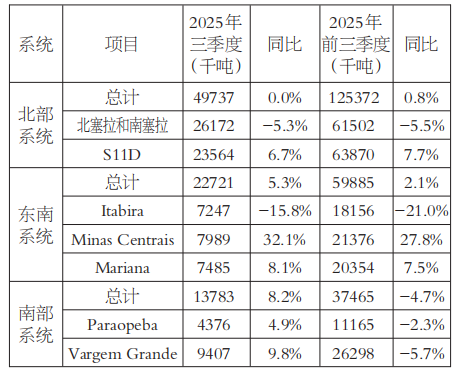
Group 1: Global Iron Ore Shipment and Production - In the first three quarters of 2025, global iron ore shipments reached 120.031 million tons, a year-on-year increase of 0.2% [1] - The four major mining companies collectively shipped 72.155 million tons, a 0.5% increase year-on-year, accounting for 60% of global shipments [1] - China's iron ore imports decreased by 1.8% year-on-year, totaling 96.889 million tons [1] Group 2: Vale's Production and Sales Performance - Vale's iron ore production in Q3 2025 was 94.4 million tons, a 3.8% increase year-on-year, with a cumulative production of 245.67 million tons, up 1.3% [4] - Vale's Q3 sales volume was 86 million tons, a 5.1% increase year-on-year, with iron concentrate sales showing strong performance [5] - The average price of Vale's iron ore in Q3 was $94.4 per ton, reflecting a $9.3 increase from the previous quarter [5] Group 3: Rio Tinto's Production and Project Updates - Rio Tinto's iron ore production in the Pilbara region for Q3 2025 was 84.1 million tons, a slight increase of 0.1% year-on-year, while shipments decreased by 0.2% [8] - The Guinea Simfer project has begun trial operations, with the first shipment expected in November 2025, which may impact the global iron ore supply structure [9] - Rio Tinto's new projects are progressing as planned, with several expected to reach full production by 2027 [10] Group 4: BHP's Production and Sales Insights - BHP's iron ore production in Q3 2025 was 70.25 million tons, a 1.9% decrease year-on-year, with cumulative production of 215.57 million tons, down 0.4% [15] - BHP's sales volume for Q3 was 70.59 million tons, a 1.3% decrease year-on-year, with block ore performing relatively well [17] - The company maintains its shipment guidance for FY2026 despite the decline in production [13] Group 5: Fortescue Metals Group (FMG) Performance - FMG's iron ore processing volume in Q3 2025 was 50.8 million tons, a 5.8% year-on-year increase, with shipments reaching 49.7 million tons [22] - The Iron Bridge project saw significant production increases, with processing volume up 62% year-on-year [22] - FMG's sales performance was strong across most product categories, with notable growth in the Iron Bridge product line [24]


淡水河谷中国区总裁谢雪: 持续供应创新低碳解决方案支持中国钢铁行业绿色转型
Zheng Quan Shi Bao· 2025-11-04 22:54
Core Insights - The China International Import Expo (CIIE) serves as a platform for high-level openness and global sharing, with Vale, a multinational mining giant from Brazil, participating for the eighth consecutive year [1][2] - Vale aims to enhance its brand image and promote sustainable mining practices through its participation in the CIIE, showcasing its commitment to carbon reduction [1][3] Company Overview - Vale, established in 1942 and headquartered in Brazil, is a leading global producer of iron ore, copper, and nickel, with a comprehensive logistics system for mining operations [1][2] - Since delivering its first shipment of iron ore to China in 1973, Vale has supplied over 3 billion tons of high-quality iron ore, along with copper and nickel [1] Product Highlights - At this year's CIIE, Vale is featuring a special area for energy transition metals, showcasing five high-quality products, including carbonyl nickel beads [1][2] - Carbonyl nickel beads, produced using carbonyl refining technology, are among the highest purity nickel products, widely used in aerospace, electronics, and nuclear energy sectors [2] - Other products displayed include nickel rounds, nickel powder, nickel-iron alloy, and copper concentrate, alongside various high-quality iron ore products [2] Interactive Exhibit - To celebrate its 40th anniversary of operations in the Amazon region, Vale presents an interactive installation called "Dynamic Amazon," featuring a large LED screen and touch screens to engage visitors [3] - The installation aims to raise awareness about forest protection and showcase the creativity of contemporary artists from Pará, Brazil, in anticipation of the upcoming UN Climate Change Conference [3] Future Commitment - Vale is committed to continuously supplying high-quality mineral products and innovative low-carbon solutions to support the development of China's steel industry and its green transition [3]
淡水河谷中国区总裁谢雪: 持续供应创新低碳解决方案 支持中国钢铁行业绿色转型
Zheng Quan Shi Bao· 2025-11-04 17:57
Core Insights - The China International Import Expo (CIIE) serves as a platform for high-level openness and is recognized globally as an international public good, with Vale being a notable participant for the eighth consecutive year [1][2] Company Overview - Vale, established in 1942 and headquartered in Brazil, is a leading global producer of iron ore, copper, and nickel, also producing iron ore pellets, platinum group metals, gold, silver, and cobalt [1] - The company has supplied over 3 billion tons of high-quality iron ore to China since its first shipment in 1973 [1] Product Highlights - At this year's CIIE, Vale showcased a special area for energy transition metals, featuring five high-quality products including carbonyl nickel beads, which are among the highest purity nickel products available [2] - Carbonyl nickel beads are produced using carbonyl refining technology and are widely used in demanding production scenarios such as aerospace and nuclear energy [2] - The carbon emissions intensity of Vale's carbonyl nickel beads produced in Canada is only 8.1 tons of CO2 equivalent per ton of nickel, making it one of the lowest carbon intensity nickel products globally [2] Interactive Exhibit - To celebrate 40 years of operations in the Amazon region, Vale presented an interactive installation called "Dynamic Amazon," featuring a large LED transparent screen and interactive touch screens to engage visitors [3] - The installation aims to raise awareness about forest protection and showcase the creativity of contemporary artists from Pará, Brazil, in anticipation of the upcoming 30th UN Climate Change Conference [3] Future Commitment - Vale is committed to continuously supplying various high-quality mineral products and innovative low-carbon solutions to support the green transformation of China's steel industry [3]
淡水河谷中国区总裁谢雪:持续供应创新低碳解决方案 支持中国钢铁行业绿色转型
Zheng Quan Shi Bao· 2025-11-04 17:46
Core Viewpoint - The China International Import Expo (CIIE) serves as a platform for high-level openness and is recognized globally as an international public good, with Vale, a multinational mining giant from Brazil, participating for the eighth consecutive year [2]. Group 1: Company Overview - Vale, established in 1942 and headquartered in Brazil, is a leading global producer of iron ore, copper, and nickel, also producing iron ore pellets, platinum group metals, gold, silver, and cobalt [2]. - Since delivering its first shipment of iron ore to China in 1973, Vale has supplied over 3 billion tons of high-quality iron ore to China, along with copper and nickel [2]. Group 2: Product Offerings - At this year's CIIE, Vale is showcasing a special area for energy transition metals, featuring five high-quality products, including carbonyl nickel spheres [2][3]. - Carbonyl nickel spheres, produced using carbonyl refining technology, are among the highest purity nickel products, widely used in aerospace, electronics, and nuclear energy sectors [3]. - Other products displayed include nickel cakes, nickel powder, NPI (Nickel Pig Iron), and copper concentrate, alongside various high-quality iron ore products [3]. Group 3: Environmental Commitment - Vale's carbonyl nickel spheres have a carbon emission intensity of only 8.1 tons of CO2 equivalent per ton of nickel, making it one of the lowest carbon emission nickel products globally [3]. - The company aims to support China's steel industry in achieving green transformation and sustainable development through the supply of quality mineral products and innovative low-carbon solutions [5]. Group 4: Interactive Exhibit - To celebrate 40 years of operations in the Amazon region, Vale has presented a large interactive installation called "Dynamic Amazon," featuring an 8.5-meter long LED transparent screen and two interactive touch screens [4]. - The installation aims to raise awareness about forest protection and showcase the creativity of contemporary artists from Pará, Brazil, in anticipation of the upcoming 30th UN Climate Change Conference [5].
Vale S.A. 2025 Q3 - Results - Earnings Call Presentation (NYSE:VALE) 2025-10-31
Seeking Alpha· 2025-10-31 22:01
Group 1 - The article does not provide any relevant content regarding company or industry insights [1]

X @Bloomberg
Bloomberg· 2025-10-31 17:52
Industry Dependence - China relies on foreign iron-ore deliveries due to its position as the world's largest buyer of the raw material [1] - China cannot afford to abandon key iron-ore suppliers [1]
Vale: Another LATAM Giant With Good Prospects (VALE)
Seeking Alpha· 2025-10-31 16:30
Core Insights - Vale S.A. is primarily engaged in the production and mining of minerals, focusing on iron ore, nickel, and copper due to its diverse portfolio of mines and deposits [1] Company Overview - Vale S.A. operates in the commodities sector, specifically in the mining industry, with a strong emphasis on iron ore production [1] - The company is recognized for its ability to generate sustained free cash flows, maintain low levels of leverage, and manage sustainable debt over time [1] Investment Focus - The company is positioned as a value investment opportunity, particularly for those interested in emerging markets and sectors that are often overlooked by the broader market [1] - It is noted for having high margins and presenting good investment opportunities in the medium to long term [1] Shareholder Value - Vale S.A. demonstrates a solid pro-shareholder attitude, maintaining consistent buyback programs and dividend distributions over time [1]
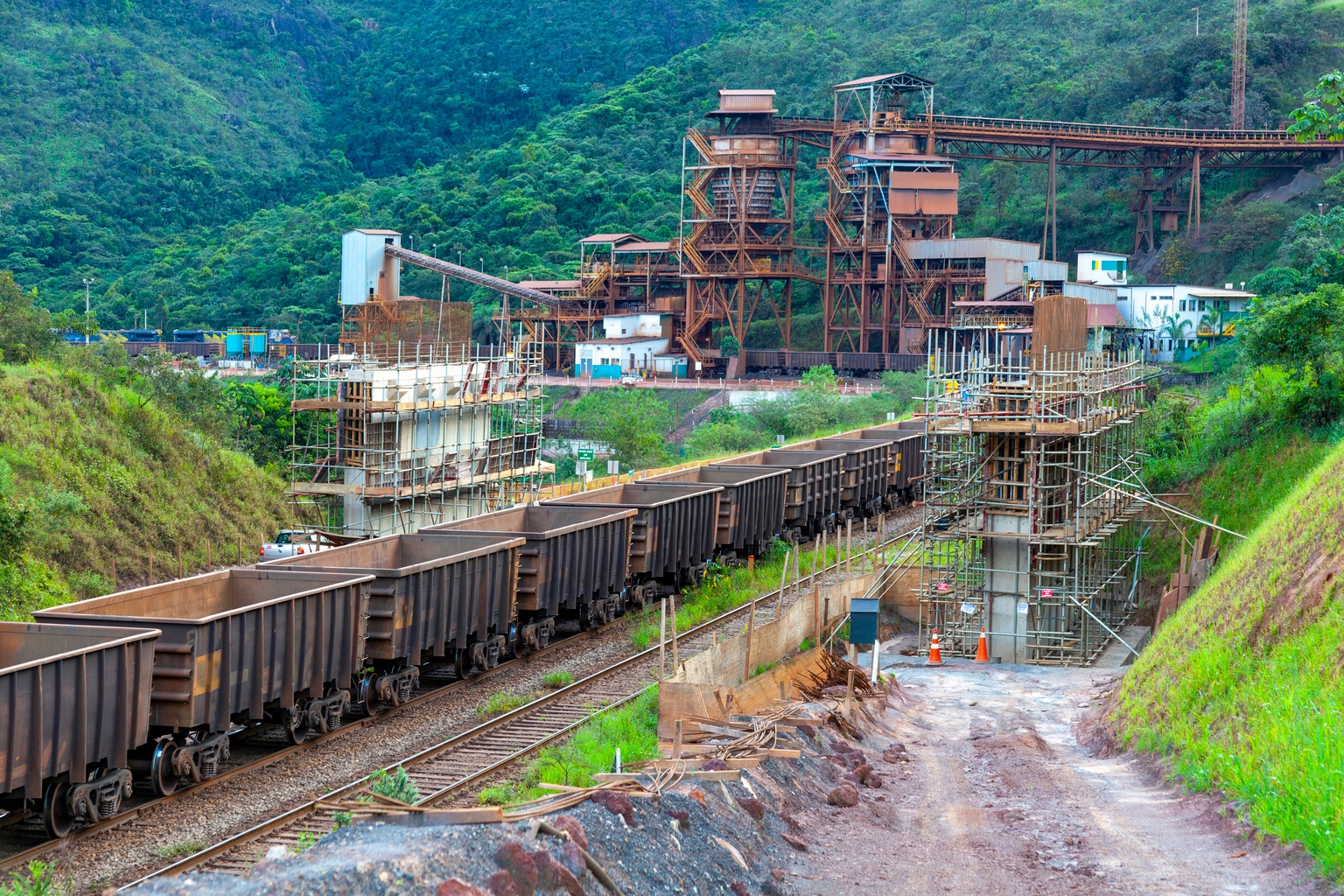
Vale: Another LATAM Giant With Good Prospects
Seeking Alpha· 2025-10-31 16:30
Core Insights - Vale S.A. is primarily engaged in the production and mining of minerals, focusing on iron ore, nickel, and copper due to its diverse portfolio of mines and deposits [1] Company Overview - Vale S.A. operates in the commodities sector, specifically in the mining industry, with a strong emphasis on iron ore production [1] - The company is recognized for its ability to generate sustained free cash flows, maintain low levels of leverage, and manage sustainable debt over time [1] Investment Focus - The company is appealing to investors looking for value opportunities, particularly in emerging markets where high margins and solid investment prospects exist [1] - There is a notable interest in companies that exhibit a pro-shareholder attitude, including consistent buyback programs and dividend distributions [1]

Vale(VALE) - 2025 Q3 - Earnings Call Transcript
2025-10-31 15:00
Financial Data and Key Metrics Changes - Proforma EBITDA reached $4.4 billion, an increase of 17% year on year and 28% higher than the previous quarter [12] - Recurring free cash flow was $1.6 billion, an increase of $1 billion year on year [18] - Expanded net debt decreased by $800 million quarter on quarter, reaching $16.6 billion [18] Business Line Data and Key Metrics Changes - Iron ore production increased to 94 million tons, up 4% year on year, marking the highest quarterly output since 2018 [4] - Copper production grew by 6% year on year, achieving the best third quarter results since 2019 [5] - Nickel production remained flat year on year, but unit costs were significantly reduced due to operational improvements [5] Market Data and Key Metrics Changes - Iron ore sales increased by 5% year on year, reaching 86 million tons, the highest level for a third quarter since 2018 [13] - Iron ore quality premium increased by nearly $2 per ton quarter on quarter, contributing to over $500 million improvement in EBITDA on an annualized basis [8][12] Company Strategy and Development Direction - The company aims to become a trusted partner with a competitive and resilient portfolio, focusing on operational excellence and disciplined capital allocation [3] - Key projects in the Carajás region are advancing, including the Bacaba copper project and the Serra Sul expansion [6][7] - The company is committed to safety and has made significant progress in dam safety management [9][10] Management's Comments on Operating Environment and Future Outlook - Management expressed confidence in the company's future and the value being created for shareholders and society [4] - The operational performance and cost reductions across all businesses reflect a focus on operational excellence [20] - The company is optimistic about the potential for extraordinary dividends due to strong cash flow generation [32] Other Important Information - The company has received various licenses for expansion projects, including the Serra Sul expansion and Bacaba copper project [6][7] - The company is actively monitoring regulatory changes in Brazil regarding dividend taxation [53] Q&A Session Summary Question: Insights on portfolio strategy and future expectations - Management highlighted the positive results from optimizing the product portfolio, with high premiums for specific products [26][30] Question: Future dividend considerations - Management indicated that strong cash flow and operational performance could lead to extraordinary dividends in the coming months [32] Question: Updates on participating debentures and implications for dividends - The company does not expect to revise the offering structure and believes the current pricing is reasonable [35] Question: Plans for accelerating copper growth initiatives - Management is excited about growth opportunities in the copper business and is dynamically reallocating resources to enhance growth [41][60] Question: Impact of potential changes in dividend taxation - The immediate impact of new regulations on dividends is limited, and the company is monitoring the situation closely [53][69] Question: Updates on Samarco and legal cases - Management expressed satisfaction with Samarco's operational performance and ramp-up of production, while legal cases are still being monitored [76]
Vale(VALE) - 2025 Q3 - Earnings Call Presentation
2025-10-31 14:00
Vale's 3Q25 Performance October 31st, 2025 Disclaimer To obtain further information on factors that may lead to results different from those forecast by Vale, please consult the reports Vale files with the U.S. Securities and Exchange Commission (SEC), the Brazilian Comissão de Valores Mobiliários (CVM) and in particular the factors discussed under "Forward-Looking Statements" and "Risk Factors" in Vale's annual report on Form 20-F." (a) the countries where we operate, especially Brazil, Canada and Indonesi ...