XIAOMI(XIACY)

Search documents
小米集团-W(01810)11月20日斥资5.08亿港元回购1350万股
智通财经网· 2025-11-20 11:21
Core Viewpoint - Xiaomi Group-W (01810) announced a share buyback plan, indicating confidence in its stock value and future prospects [1] Group 1 - The company will spend HKD 508 million to repurchase 13.5 million shares [1] - The buyback price per share ranges from HKD 37.38 to HKD 38.1 [1]
小米集团-W(01810.HK)11月20日耗资5亿港元回购1350万股
Ge Long Hui· 2025-11-20 11:17
格隆汇11月20日丨小米集团-W(01810.HK)公告,11月20日耗资5亿港元回购1350万股。 ...
小米集团-W(01810):3Q25汽车业务扭亏为盈,手机毛利率或受存储涨价影响
BOCOM International· 2025-11-20 11:10
Investment Rating - The report maintains a "Buy" rating for Xiaomi Group (1810 HK) with a target price of HKD 50.00, indicating a potential upside of 28.8% from the current closing price of HKD 38.82 [1][17]. Core Insights - The automotive business turned profitable in Q3 2025, while the smartphone segment's gross margin is expected to be impacted by rising storage prices [2][7]. - Revenue for Q3 2025 reached RMB 113.121 billion, a 22% year-on-year increase, while adjusted net profit was RMB 11.311 billion, up 81% year-on-year, exceeding market expectations [8][7]. - The report anticipates a decline in smartphone gross margin due to increased storage costs, projecting a smartphone gross margin of 9.4% for 2026, down from a previous estimate of 12.1% [7][9]. Financial Overview - Revenue projections for Xiaomi Group are as follows: RMB 270.97 billion in 2023, RMB 365.91 billion in 2024, RMB 466.58 billion in 2025, RMB 534.02 billion in 2026, and RMB 599.21 billion in 2027, with respective year-on-year growth rates of -3.2%, 35.0%, 27.5%, 14.5%, and 12.2% [3][18]. - Adjusted net profit is expected to grow from RMB 17.475 billion in 2023 to RMB 46.045 billion in 2027, with significant growth in 2025 projected at RMB 44.456 billion [3][18]. - The report highlights a decrease in the expected gross margin for the smartphone segment, projecting a gross margin of 22.3% for 2025, down from previous estimates [9][20]. Market Position and Valuation - The report employs a Sum-of-the-Parts (SOTP) valuation method, estimating the total valuation for Xiaomi Group at approximately RMB 1,280.046 million for 2026, based on a P/E ratio of 23 times for the smartphone and AIoT segment and a P/S ratio of 2.0 for the automotive and AI segment [10][9]. - The automotive business is projected to face increased competition and a reduction in gross margin due to a half reduction in purchase tax and rising raw material costs [7][9].
小米集团(01810) - 翌日披露报表
2025-11-20 11:09
FF305 翌日披露報表 (股份發行人 ── 已發行股份或庫存股份變動、股份購回及/或在場内出售庫存股份) 表格類別: 股票 狀態: 新提交 公司名稱: 小米集团 (於開曼群島註冊成立以不同投票權控制的有限公司) 呈交日期: 2025年11月20日 如上市發行人的已發行股份或庫存股份出現變動而須根據《香港聯合交易所有限公司(「香港聯交所」)證券上市規則》(「《主板上市規則》」)第13.25A條 / 《香港聯合交易所有限公司GEM證券 上市規則》(「《GEM上市規則》」)第17.27A條作出披露,必須填妥第一章節 。 第 1 頁 共 7 頁 v 1.3.0 | 第一章節 | | | | | | | | | | | --- | --- | --- | --- | --- | --- | --- | --- | --- | --- | | 1. 股份分類 | | 不同投票權架構公司普通股 | 股份類別 B | | | 於香港聯交所上市 | 是 | | | | 證券代號 (如上市) | 01810 | | 說明 | | | | | | | | 多櫃檯證券代號 | 81810 | | RMB 說明 | | | | | ...
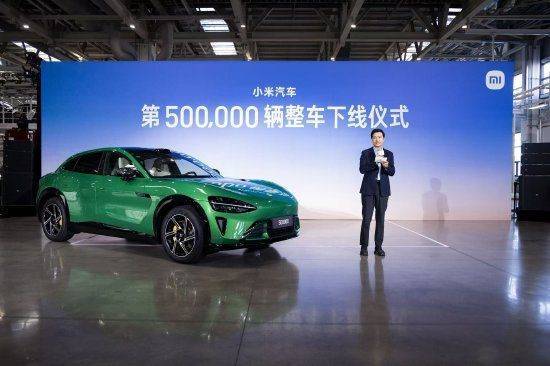
小米汽车第50万辆汽车下线,创全球最快纪录!小米集团CEO雷军最新发声:我们始终认为,安全是基础,是前提
Sou Hu Cai Jing· 2025-11-20 04:20
Core Insights - Xiaomi has achieved a significant milestone with the production of its 500,000th vehicle, marking the fastest record in the domestic new energy vehicle industry [1][3] - This achievement validates Xiaomi's capabilities across the entire automotive ecosystem, including R&D, manufacturing, sales, delivery, and service [3] - The company has seen strong consumer recognition, with its SU7 model becoming the best-selling sedan and the YU7 SUV surpassing the Model Y in sales [3] Production and Sales Performance - The production of 500,000 vehicles was accomplished in just over 1 year and 7 months, showcasing rapid growth [1][3] - Xiaomi initially set a delivery target of 300,000 vehicles for the year, which was later raised to 350,000, and the company is on track to exceed this target [3] - The latest forecast predicts that annual deliveries will exceed 400,000 vehicles by 2025 [3] Support and Collaboration - The success of Xiaomi's automotive division is attributed to the trust and support from users, partners, and suppliers [4] - The company acknowledges the critical role of its supply chain and the supportive business environment in Beijing, which fosters innovation and talent [4] Future Strategies - Xiaomi plans to focus on safety and delivery efficiency, emphasizing that safety is a foundational priority [5] - The company aims to increase its investment in technology and innovation, with R&D expenditures projected at 32 to 33 billion for the year and 200 billion over the next five years [5] - There is a commitment to integrating AI with smart manufacturing to enhance product efficiency and performance [5]

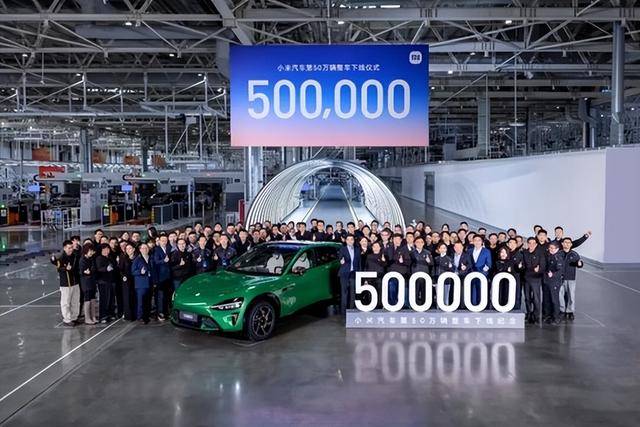
小米集团CEO雷军:最新预估小米汽车2025年全年预计交付将超过40万辆
Sou Hu Cai Jing· 2025-11-20 04:14
【免责声明】本文仅代表作者本人观点,与和讯网无关。和讯网站对文中陈述、观点判断保持中立,不 对所包含内容的准确性、可靠性或完整性提供任何明示或暗示的保证。请读者仅作参考,并请自行承担 全部责任。邮箱:news_center@staff.hexun.com 格隆汇11月20日|小米CEO雷军:最新预估小米汽车2025年全年预计交付将超过40万辆。 ...
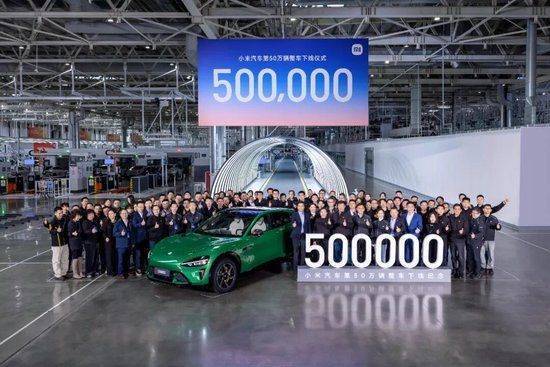
小米汽车第50万辆汽车下线,创全球最快纪录!小米集团CEO雷军最新发声:我们始终认为,安全是基础,安全是前提
Sou Hu Cai Jing· 2025-11-20 04:14
Core Insights - Xiaomi has achieved a significant milestone by rolling out its 500,000th vehicle, marking the fastest record in the domestic automotive industry, taking just over 1 year and 7 months to reach this figure [1][3] Group 1: Production and Sales Achievements - The achievement of 500,000 vehicles signifies the validation of Xiaomi's capabilities across the entire automotive ecosystem, including R&D, manufacturing, sales, delivery, and service [4] - The Xiaomi SU7 has become the best-selling sedan in the past year with over 200,000 units sold, while the Xiaomi YU7, which began deliveries in July, has become the best-selling SUV, surpassing the Model Y in the Chinese market [4] - The company initially set a delivery target of 300,000 vehicles for the year, which was later raised to 350,000, and it is expected to meet this target ahead of schedule [4] Group 2: Acknowledgments and Support - Xiaomi expresses gratitude to its users, partners, and the supportive environment in Beijing, which has contributed to its rapid growth in the automotive sector [5] - The company acknowledges the crucial role of suppliers in achieving production capacity and the importance of collaboration within the supply chain [5] Group 3: Future Plans and Innovations - Xiaomi plans to focus on safety and delivery, emphasizing that safety is the foundation for all operations [6] - The company aims to increase its investment in technology and innovation, with a projected R&D expenditure of 32 to 33 billion for the year and an anticipated 200 billion over the next five years [6] - There is a commitment to integrating AI with smart manufacturing, with upcoming advancements in assisted driving technology expected to enhance user experience [6]
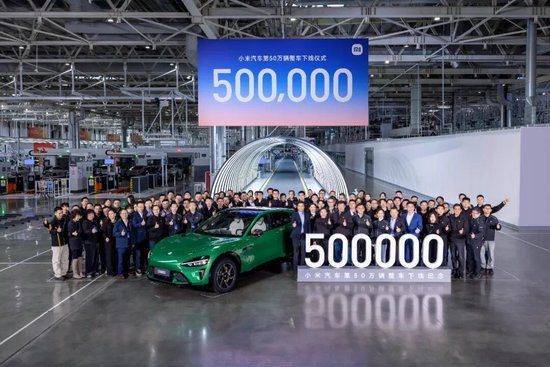
小米集团CEO雷军:仅用602天刷新全球新能源车企50万辆最快下线纪录!小米汽车下一步将抓安全、抓交付,用实际行动向大家交更好的答卷
Sou Hu Cai Jing· 2025-11-20 04:02
新浪科技讯 11月20日上午消息,第50万辆小米汽车在位于北京经济技术开发区的小米汽车超级工厂下 线。自2024年3月28日首款车型SU7正式发布,小米汽车仅用602天、不足20个月,就刷新了全球车企50 万辆下线的最快纪录。 雷军表示,下一步,小米汽车将坚持不懈抓安全、抓交付,在保证安全和品质的基础上全力以赴加快生 产;将持续加大科技创新能力,坚定不移推进核心技术的研发;将推进AI和智能制造的深度融合。 "大家对于小米汽车有很多期待,言胜于行,以行践言,我们会用实际行动向大家交出更好的答卷。"雷 军说。 来源:新浪网 【免责声明】本文仅代表作者本人观点,与和讯网无关。和讯网站对文中陈述、观点判断保持中立,不 对所包含内容的准确性、可靠性或完整性提供任何明示或暗示的保证。请读者仅作参考,并请自行承担 全部责任。邮箱:news_center@staff.hexun.com 小米集团创始人、董事长兼CEO雷军表示,50万辆下线标志着小米汽车包括研发、制造、销售、交付和 服务的完整体系能力得到了充分验证,也标志着小米汽车得到消费者的广泛认可,进入了规模化的新阶 段。 ...
小米集团:2025 年第三季度因电动汽车销量强劲及非运营收益超预期而每股收益超出预期;更新我们对关键投资者争议问题的看法;买入评级
2025-11-20 02:16
Xiaomi Corp. (1810.HK) Earnings Call Summary Company Overview - **Company**: Xiaomi Corp. (1810.HK) - **Market Cap**: HK$1.1 trillion / $136.0 billion - **Enterprise Value**: HK$859.5 billion / $110.6 billion - **12-Month Target Price**: HK$53.50, current price HK$40.78, implying 31.2% upside potential [1][4][7] Key Financial Highlights - **3Q25 Revenue**: Grew by 22% year-over-year (yoy) to Rmb46.0 billion, exceeding expectations [1][2] - **Adjusted Net Profit**: Increased by 81% yoy, driven by higher AIoT gross profit margin (GPM) and investment gains [1][2] - **Smartphone Revenue**: Declined by 3% yoy, with total shipments of 43.3 million units [28] - **AIoT Revenue**: Grew by 6% yoy to Rmb27.6 billion, with GPM increasing by 3.2pp yoy to 23.9% [47] Core Themes from Management 1. **Smartphones**: Focus on increasing average selling price (ASP) and market share in 2026 amidst rising memory costs and declining industry shipments [2][3] 2. **AIoT**: Prioritizing profitability over growth, with overseas AIoT revenue expected to drive growth after reaching record levels in 3Q25 [2] 3. **Electric Vehicles (EV)**: Achieved an IFRS net profit of Rmb0.7 billion in 3Q25, on track to meet full-year delivery target of 350,000 units [2] 4. **Artificial Intelligence (AI)**: Released multiple multi-modal large language models (MLLMs) to enhance smart home positioning [2] 5. **New Retail Strategy**: Focus on operational efficiency and store optimization in China while expanding Mi Home stores overseas [2] Forecast Changes - **Revenue Forecasts**: 2025E revenue remains unchanged at Rmb365.9 billion, with net profit for 2025E raised by 3% post 3Q beat [3] - **Net Profit Projections**: 2026E-27E net profit lowered by 4-5% due to increased smartphone GPM pressure [3][18] Market Position and Competitive Landscape - **Smartphone Market Share**: Maintained No.3 global ranking with 13.6% market share in 3Q25, despite a slight decline [28] - **Regional Performance**: - China: +7% yoy revenue growth, with market share increasing to 14.9% [28] - Overseas: Market share gains in Latin America, Southeast Asia, Africa, and Europe, but a decline in India [28] Valuation Insights - **Valuation Scenarios**: - Bull Case: HK$63.9 per share (57% upside) - Base Case: HK$53.5 per share (31% upside) - Bear Case: HK$37.0 per share (-9% downside) [20][21] - **12-Month Target Price**: Updated to HK$53.5, reflecting favorable risk-reward for investors [19][20] Additional Insights - **AIoT Connectivity**: Over 1 billion active connected devices, with a 20% yoy increase in connected devices [47] - **New Retail Expansion**: Added 1,000 Mi Stores in China, totaling 18,000, and expanded to 300 stores overseas [28] - **Smartphone GPM**: Expected to decline to 10.1% in 4Q25E due to rising memory costs [37] Conclusion Xiaomi Corp. is navigating a challenging market landscape with strategic focuses on profitability, innovation, and expansion across its product lines. The company shows potential for growth in AIoT and EV segments, while maintaining a competitive position in the smartphone market. The updated valuation reflects a positive outlook, although short-term challenges may persist.

南向资金今日净买入65.91亿港元,小米集团-W净买入23.94亿港元
Zheng Quan Shi Bao Wang· 2025-11-19 15:21
今日上榜个股中,小米集团-W、阿里巴巴-W、华虹半导体等7只股同时上榜港股通(深)、港股通(沪)成交活跃股, 小米集团-W合计成交额 105.78亿港元,成交净买入23.94亿港元,阿里巴巴-W合计成交额71.92亿港元,成交净买入20.96亿港元。盈富基金合计成交额14.98亿港元,成交 净卖出14.84亿港元,腾讯控股合计成交额37.84亿港元,成交净卖出1.04亿港元。 从连续性进行统计, 有3只股获南向资金连续3天以上净买入,连续净买入天数较多的有小米集团-W、华虹半导体、阿里巴巴-W,连续净买入天 数分别为16天、5天、5天。以其间净买入金额统计,净买入金额最多的是小米集团-W,合计净买入为130.55亿港元,其次是阿里巴巴-W合计净买 入为110.95亿港元,华虹半导体合计净买入为9.10亿港元。(数据宝) 11月19日南向资金成交活跃股 (原标题:南向资金今日净买入65.91亿港元,小米集团-W净买入23.94亿港元) 11月19日恒生指数下跌0.38%,南向资金全天合计成交金额为839.46亿港元,其中,买入成交452.68亿港元,卖出成交386.77亿港元,合计净买入 金额65.91亿港元。 ...