
XIAOMI(XIACY)

Search documents
小米集团跌超4%,股价跌破40港元/股
Mei Ri Jing Ji Xin Wen· 2025-11-19 01:55
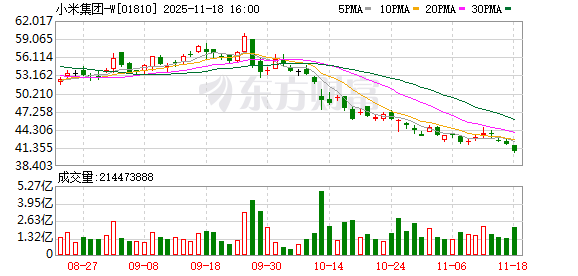
每经AI快讯,11月19日,小米集团跌超4%,股价跌破40港元/股,自今年6月27日高点(61.45港元)以 来累计跌超30%。 ...

小米集团20251118
2025-11-19 01:47
Xiaomi Group Q3 2025 Earnings Call Summary Company Overview - **Company**: Xiaomi Group - **Date**: Q3 2025 Earnings Call Key Financial Highlights - Total revenue reached **RMB 113 billion**, a **2.5%** year-over-year increase, marking a historical high [2][3] - Adjusted net profit was **RMB 11.3 billion**, up **81%** year-over-year, also a record [2][3] - Gross margin improved to **22.9%**, an increase of **2.5 percentage points** year-over-year [3] Smartphone Performance - Sales of the **Xiaomi 17 series** smartphones grew by **30%** compared to the previous generation, with high-end versions accounting for over **80%** of sales [2][4] - The **Pro Max** model achieved significant success in the **RMB 6,000+** price segment, indicating effective high-end strategy [4][7] - Xiaomi ranked among the top three in global smartphone shipments with a market share of **13.6%** [6] IoT and Smart Home Business - IoT revenue reached **RMB 27.6 billion**, showing continuous growth for seven consecutive quarters with a gross margin of **23.9%** [2][8] - The IoT platform connected over **1 billion devices**, indicating ongoing ecosystem expansion [8][21] - A new smart home appliance factory commenced production with an annual capacity of **7 million units** [8][12] Internet Services and User Engagement - Global monthly active users reached **742 million**, a **8.2%** increase year-over-year [2][9] - Internet services revenue was **RMB 9.4 billion**, up **10.8%**, with a gross margin of **76.9%** [2][11] - Advertising revenue grew to **RMB 7.2 billion**, reflecting a **17.4%** increase [2][12] Electric Vehicle (EV) Business - EV revenue amounted to **RMB 28.3 billion**, with **108,796** units delivered, averaging a post-tax price of **RMB 260,000** [5][14] - The EV segment is identified as a new growth driver for the company [5] Research and Development - R&D expenses reached **RMB 9.1 billion**, a **52.1%** increase year-over-year, with R&D personnel comprising **44.2%** of total employees [5][15] - The company plans to invest over **RMB 200 billion** in R&D over the next five years [10] Strategic Initiatives - Xiaomi aims to enhance product premiumization and intelligence through proprietary chip and operating system development [10] - The company targets entry into the top 100 of the Fortune Global 500 by **2030** [10] Market Position and Challenges - Xiaomi's market share in mainland China reached **14.9%**, with growth in all regions except India [6] - The company faces challenges from rising memory costs, which are expected to pressure gross margins in the coming years [19][30] - Strategies to mitigate cost pressures include price increases and product structure optimization [19] Sustainability and ESG Efforts - Xiaomi's MSCI ESG rating improved from B to A, marking the third consecutive year of improvement [18] Future Outlook - The company plans to continue expanding its overseas market presence, particularly in Southeast Asia and Latin America [27][32] - Xiaomi's strategy includes enhancing operational efficiency in existing stores rather than opening new ones [31][32] This summary encapsulates the key points from Xiaomi Group's Q3 2025 earnings call, highlighting financial performance, market position, strategic initiatives, and future outlook.

Making money from EVs is notoriously hard. Xiaomi just joined a tiny list of carmakers doing it.
Business Insider· 2025-11-18 16:13
Core Insights - Xiaomi's electric vehicle (EV) business has achieved quarterly profitability for the first time, reporting a gross profit of $98.5 million for the quarter ending in September [1][2] - The division's revenues reached a record high of $4 billion, with $3.98 billion coming from EV sales and $98.5 million from related businesses [2] - Xiaomi's SU7 sedan was a significant success, selling over 130,000 units last year, and its new model, the YU7, received 240,000 preorders within 24 hours of its launch [3] Company Performance - Xiaomi delivered over 100,000 EVs in the third quarter, a substantial increase from around 40,000 units during the same period last year [3] - The company has successfully navigated the challenging landscape of EV profitability, achieving this milestone in under two years, unlike many competitors [4] - Tesla took approximately ten years to report its first profitable quarter, while BYD has maintained consistent profitability by selling both hybrids and battery-electric vehicles [5][6] Industry Context - The EV market is characterized by fierce competition and price wars, making profitability difficult for many companies [7] - Notable competitors like Ford and GM are still incurring significant losses in their EV segments, while startups such as Lucid and Rivian reported losses of around $1 billion in the third quarter [6][7] - Other Chinese EV startups, like Nio and Xpeng, are also struggling, with Nio reporting a net loss of nearly $700 million in the second quarter of 2025 [7][8]


小米集团Q3营收1131亿元,卢伟冰回应存储成本上涨问题
Guo Ji Jin Rong Bao· 2025-11-18 15:48
Financial Performance - Xiaomi Group reported Q3 revenue of 113.1 billion yuan, a year-on-year increase of 22.3%, marking the fourth consecutive quarter of revenue exceeding 100 billion yuan [1] - Adjusted net profit reached 11.3 billion yuan, a significant increase of 80.9%, setting a new historical high [1] Business Segments - The mobile and AIoT segment generated revenue of 84.1 billion yuan, with a year-on-year growth of 1.6%, including smartphone, IoT, consumer products, and internet services [1] - Smartphone revenue was 46 billion yuan, with global smartphone shipments reaching 43.3 million units, achieving year-on-year growth for nine consecutive quarters [1] - IoT and consumer products revenue was 27.6 billion yuan, up 5.6% year-on-year, with a high approval rating for the newly launched washing machine [2] - Internet services revenue was 9.4 billion yuan, a year-on-year increase of 10.8%, with overseas internet revenue reaching 3.3 billion yuan, a historical high [2] Strategic Initiatives - Xiaomi is adopting a high-end strategy in response to rising memory costs, with the Xiaomi 17 series achieving approximately 30% higher sales compared to the previous generation [1][2] - The company has signed supply agreements with partners for the entire year of 2026 to mitigate supply issues related to rising memory prices [2] - Xiaomi's electric vehicle and AI innovation segment reported revenue of 29 billion yuan, with a year-on-year increase of over 199%, and the segment achieved operational profitability for the first time [3] R&D Investment - Xiaomi increased its R&D investment to 9.1 billion yuan in Q3, a year-on-year growth of 52.1%, setting a new historical high [3] - Cumulative R&D investment for the first three quarters reached 23.5 billion yuan, nearing the total planned for the entire year of 2024 [3]
港股公告掘金 | 小米集团-W第三季度经调整净利润创历史新高 达113.11亿元 智能手机出货量连续9个季度实现同比增长
Zhi Tong Cai Jing· 2025-11-18 15:28
Major Events - Universal Medical (02666) plans to invest 15.03 million yuan to establish a joint venture that will create a collaborative platform integrating policy alignment, technology transfer, and clinical validation [1] - Fosun Pharma (02196) subsidiary has had its drug registration application for polyethylene glycol electrolyte solution accepted by the National Medical Products Administration [1] - China Biologic Products (01177) received approval from NMPA for the clinical trial application of LM-350 "CDH17 ADC" [1] - Xianruida Medical-B (06669) has received approval from the National Medical Products Administration for the registration of its coronary overall exchange balloon dilation catheter [1] - Meili Tianyuan Medical Health (02373) subsidiary plans to acquire medical and beauty assets related to Nairuier for 40 million yuan, adding 19 direct-operated stores [1] - China Tongru (01763) has exported its self-produced irradiation equipment to the Latin American market for the first time [1] Operating Performance - Trip.com Group-S (09961) reported a third-quarter net profit of 19.89 billion yuan, an increase of 194.01% year-on-year [1] - H&H International Holdings (01112) reported a 12.0% year-on-year increase in total revenue for the first three quarters [1] - Weibo-SW (09898) reported a net profit attributable to shareholders of 454 million USD for the third quarter, an increase of 55.43% year-on-year [1] - Baidu Group-SW (09888) reported total revenue of 31.2 billion yuan in the third quarter, with AI new business revenue growing over 50% year-on-year [1] - Xiaomi Group-W (01810) achieved a record adjusted net profit of 11.31 billion yuan in the third quarter, with smartphone shipments increasing year-on-year for nine consecutive quarters [1] - China Oriental Group (00581) reported sales of approximately 2.1 million tons of self-produced steel products in the third quarter [1] - BOSS Zhipin-W (02076) reported an adjusted net profit of approximately 999.2 million yuan in the third quarter, an increase of 34.2% year-on-year [1]
小米集团-W获南向资金连续15天净买入
Zheng Quan Shi Bao Wang· 2025-11-18 14:12
证券时报·数据宝统计显示,11月18日港股通(包括沪市港股通及深市港股通)成交活跃股合计成交 386.62亿港元,净买入金额为71.85亿港元。 小米集团-W获南向资金连续15天净买入,累计净买入金额为106.60亿港元,股价累计下跌10.96%。 11月18日上榜的成交活跃股中,小米集团-W通过港股通渠道成交金额为45.92亿港元,净买入金额为 8.54亿港元,不仅如此,该股已连续15日出现成交净买入,累计净买入金额为106.60亿港元,其间股价 下跌10.96%。(数据宝) (文章来源:证券时报网) ...
XIAOMI(01810) - 2025 Q3 - Earnings Call Transcript
2025-11-18 12:32
Financial Data and Key Metrics Changes - Total revenue for Q3 2025 reached RMB 113.1 billion, up 22.3% year-on-year, marking the fourth consecutive quarter exceeding RMB 100 billion [4][17] - Gross profit margin increased to 22.9%, up 2.5 percentage points year-on-year, achieving a new record high [5][17] - Adjusted net profit reached RMB 11.3 billion, up 81% year-on-year, setting a new record high [5][23] Business Line Data and Key Metrics Changes - Revenue from the smartphone segment was RMB 46 billion, accounting for 40.6% of total revenue, with global smartphone shipments reaching 43.25 million units, marking a 0.5% year-on-year increase [17][18] - IoT business revenue was RMB 27.6 billion, with a gross margin of 23.9%, achieving seven consecutive quarters of year-on-year growth [10][19] - The smart EV, AI, and other new initiative segment generated revenue of RMB 29 billion, accounting for 25.6% of total revenue, with smart EV sales reaching RMB 28.3 billion [21][22] Market Data and Key Metrics Changes - Xiaomi ranked among the top three in global smartphone shipments with a market share of 13.6%, and achieved year-on-year market share growth in all regions except India [7][18] - In mainland China, smartphone market share reached 14.9%, with a 0.7 percentage point increase year-on-year [18] - The company ranked second in Latin America and the Middle East, with market shares of 17.9% and 16.9%, respectively [7] Company Strategy and Development Direction - The company aims to enhance its premiumization strategy, targeting the ultra-premium segment above RMB 6,000 as a new objective for the next five years [8][9] - The launch of Xiaomi HyperOS 3 is expected to improve user experience and drive product competitiveness [9] - The company plans to invest over RMB 200 billion in R&D over the next five years, with R&D expenses exceeding RMB 30 billion this year [14][23] Management's Comments on Operating Environment and Future Outlook - Management expressed confidence in ensuring stable raw material supply despite rising memory costs and supply-demand dynamics [10] - The company anticipates a decline in smartphone gross margins due to increased memory costs but plans to mitigate this through product mix upgrades and ASP increases [30][31] - Management remains optimistic about the growth of the IoT business and the expansion of overseas markets [12][19] Other Important Information - The company achieved a record high of 742 million global MAUs in September 2025, an 8.2% increase year-on-year [20] - The smart home appliance factory commenced operations, with a planned peak annual production capacity of 7 million units [11][19] - The company was named to the Fortune Global 500 list for the seventh consecutive year, ranking 297th [14] Q&A Session Summary Question: Concerns about memory cost impact on smartphone gross margin and EV delivery strategy - Management acknowledged the long cycle of memory cost increases and its impact on gross margins, stating that price increases and product structure optimization will be necessary to mitigate this [27][30] - For EVs, management noted rising delivery volumes and improvements in delivery schedules due to efficiency enhancements [33][34] Question: Future smartphone strategy and EV subsidies impact on gross margin - Management indicated that while smartphone prices may increase, the overall market may experience a downturn, and they aim to maintain a premium strategy [39][41] - Regarding EVs, management expects some impact on gross margin due to subsidies but believes current margins are healthy [42][43] Question: AIoT growth and large appliances strategy - Management highlighted the integration of AI with IoT devices and the importance of maintaining an open ecosystem for future growth [46][66] - For large appliances, management emphasized the importance of innovation and the impact of national subsidies, stating that they will adapt to changes in the market [50][51] Question: Autonomous driving advancements and overseas development - Management confirmed that autonomous driving is a critical focus for future EV development, with significant enhancements in technology and data utilization [56][57] - The company is expanding its overseas presence, particularly in East Asia and Southeast Asia, while maintaining good relationships with traditional distributors [58][59] Question: Inventory management and Miloco ecosystem plans - Management reassured that inventory levels are well-managed and that they will maintain an open ecosystem for Miloco while exploring AI integration [64][66] Question: Smartphone market stability and large appliance factory role - Management noted that the smartphone market is currently stable, with cost increases impacting all players, and emphasized the advanced capabilities of the new large appliance factory [70][73]
XIAOMI(01810) - 2025 Q3 - Earnings Call Transcript
2025-11-18 12:32
Financial Data and Key Metrics Changes - Total revenue for Q3 2025 reached RMB 113.1 billion, up 22.3% year-on-year, marking the fourth consecutive quarter exceeding RMB 100 billion [4][17] - Gross profit margin reached a record high of 22.9%, up 2.5 percentage points year-on-year [5][17] - Adjusted net profit reached RMB 11.3 billion, up 81% year-on-year, setting a new record high [5][23] Business Line Data and Key Metrics Changes - Revenue from the smartphone segment reached RMB 46 billion, accounting for 40.6% of total revenue, with global smartphone shipments at 43.25 million units, marking a 0.5% year-on-year increase [17][18] - IoT business revenue was RMB 27.6 billion, marking seven consecutive quarters of year-on-year growth, with a gross margin of 23.9% [10][19] - Revenue from the smart EV segment reached RMB 28.3 billion, with a gross profit margin of 25.5% [21][22] Market Data and Key Metrics Changes - Xiaomi ranked among the top three in global smartphone shipments with a market share of 13.6% [7][18] - In mainland China, smartphone market share increased to 14.9%, with significant growth in the premium smartphone segment [7][18] - IoT platform connected over 1 billion devices, with overseas IoT revenue reaching record highs [19][20] Company Strategy and Development Direction - The company aims to enhance premiumization, targeting the ultra-premium segment above RMB 6,000 as a new objective for the next five years [8][9] - The launch of Xiaomi HyperOS 3 aims to improve user experience and system fluidity, supporting the company's strategy to drive innovation [9][10] - The company plans to invest over RMB 200 billion in R&D over the next five years, with R&D expenses exceeding RMB 30 billion this year [14][23] Management's Comments on Operating Environment and Future Outlook - Management expressed confidence in ensuring stable raw material supply despite rising memory costs impacting smartphone gross margins [10][27] - The company is focused on maintaining profitability through product mix upgrades and ASP increases [10][29] - Management acknowledged the challenges posed by industry competition but emphasized the importance of innovation and product value [11][12] Other Important Information - The smart home appliance factory commenced operations, designed for a peak annual capacity of 7 million units [11][19] - The company was named to the Fortune Global 500 list for the seventh consecutive year, ranking 297th [14] - The MSCI ESG rating was upgraded from BBB to AA, marking the third consecutive year of improvement [23][24] Q&A Session Summary Question: Concerns about the impact of rising memory costs on smartphone gross margins - Management acknowledged the long cycle of cost increases for memory and its impact on gross margins, suggesting price increases and product structure optimization as solutions [27][29] Question: Strategy for EV deliveries and future development - Management highlighted the rising delivery volumes and improvements in delivery efficiency, with a focus on maintaining quality and expanding the sales network [32][33] Question: Adjustments to smartphone strategy and profitability - Management indicated that while price increases may impact the overall smartphone market, the focus remains on enhancing ASP and achieving premiumization targets [39][41] Question: Impact of subsidies on EV gross margins - Management noted that while there may be short-term impacts from subsidies, the current gross margin remains healthy, and efforts are being made to maintain delivery capabilities [42][43] Question: AIoT ecosystem and future plans - Management discussed the integration of AI with IoT devices and the commitment to maintaining an open ecosystem for future developments [46][67] Question: Expansion strategy for stores and overseas markets - Management outlined plans for store efficiency improvements and gradual expansion in overseas markets, emphasizing the complementary nature of AIoT products [82][84] Question: Operating expenses trends - Management explained that the increase in operating expenses is primarily due to R&D investments and the expansion of the retail network [85][86]
XIAOMI(01810) - 2025 Q3 - Earnings Call Transcript
2025-11-18 12:30
Financial Data and Key Metrics Changes - Total revenue for Q3 2025 reached RMB 113.1 billion, up 22.3% year-on-year, marking the fourth consecutive quarter exceeding RMB 100 billion [2][3] - Gross profit margin reached a record high of 22.9%, up 2.5 percentage points year-on-year [3][13] - Adjusted net profit reached RMB 11.3 billion, up 81% year-on-year, setting a new record high [3][18] Business Line Data and Key Metrics Changes - Revenue from the smartphone segment was RMB 46 billion, accounting for 40.6% of total revenue, with global smartphone shipments reaching 43.25 million units, marking a 0.5% year-on-year increase [13][14] - IoT business revenue was RMB 27.6 billion, with a gross margin of 23.9%, achieving seven consecutive quarters of year-on-year growth [8][15] - Revenue from the smart EV, AI, and other new initiatives segment reached RMB 29 billion, accounting for 25.6% of total revenue, with smart EV sales generating RMB 28.3 billion [16][17] Market Data and Key Metrics Changes - Xiaomi ranked among the top three in global smartphone shipments with a market share of 13.6%, and achieved year-on-year market share growth in all regions except India [4][14] - In mainland China, smartphone market share increased to 14.9%, while in Latin America and the Middle East, market shares increased to 17.9% and 16.9%, respectively [4][5] - The company ranked first in domestic smartphone sales during the Double 11 shopping festival for the third consecutive year [5] Company Strategy and Development Direction - The company aims to enhance its premiumization strategy, targeting the ultra-premium segment above RMB 6,000 as a new objective for the next five years [5][6] - Continuous investment in foundational core technologies is planned, with R&D expenses projected to exceed RMB 30 billion this year and RMB 200 billion over the next five years [11][18] - The launch of Xiaomi HyperOS 3 aims to improve user experience and system fluidity, supporting the company's strategy to drive innovation [6][12] Management's Comments on Operating Environment and Future Outlook - Management expressed confidence in ensuring stable raw material supply despite rising memory costs and supply-demand dynamics [7][8] - The company anticipates a decline in smartphone gross margins due to increased memory costs but plans to mitigate this through product mix upgrades and ASP increases [21][24] - Management remains optimistic about the growth potential in the EV market, with expectations for steady growth in delivery volumes [10][29] Other Important Information - The company achieved a record high of 742 million global MAUs for internet services, with revenue reaching RMB 9.4 billion, up 10.8% year-on-year [16] - The smart home appliance factory commenced operations, designed for a peak annual capacity of 7 million units, enhancing the company's manufacturing capabilities [9][15] - The company was named to the Fortune Global 500 list for the seventh consecutive year, ranking 297th [11] Q&A Session Summary Question: Concerns about smartphone gross margin due to rising memory costs - Management acknowledged the long cycle of memory cost increases and its impact on gross margins, indicating that solutions include price increases and product structure optimization [21][23][24] Question: EV delivery schedule and future development strategy - Management highlighted the rising delivery volumes and improvements in delivery efficiency, emphasizing ongoing efforts to enhance delivery capabilities [25][26] Question: Adjustments to smartphone strategy and premiumization - Management confirmed that premiumization remains a key focus, with a target of 30 million premium units in the future [28][29] Question: Impact of subsidies on EV gross margin - Management indicated that while subsidies may impact gross margins, the current gross margin remains healthy, and efforts are being made to maintain delivery capabilities [29][30] Question: AIoT ecosystem and future plans - Management discussed the integration of AI with IoT devices and the commitment to maintaining an open ecosystem for collaboration [31][42] Question: Role of the new large appliance factory - Management emphasized the advanced technology and automation in the new factory, which is expected to enhance production efficiency and quality [48][49]
小米集团(01810) - 2025 Q3 - 电话会议演示
2025-11-18 11:30
Financial Performance - Group revenue reached RMB 113.1 billion, a YoY increase of 22.3%[11] - Gross profit margin increased to 22.9%, up 2.5 percentage points YoY[11] - Adjusted net profit reached RMB 11.3 billion, a significant YoY increase of 80.9%[11] - Smart EV, AI and other new initiatives revenue reached RMB 29.0 billion, a substantial YoY increase of 199.2%[11] Smartphone and AIoT Business - Global smartphone shipments ranked among the top 3 for 21 consecutive quarters, with a market share of 13.6%[14] - Premium smartphone sales in Chinese Mainland increased to 24.1% of total smartphone units sold, a YoY increase of 4.1 percentage points[14] - IoT and lifestyle products revenue reached RMB 27.6 billion, up 5.6% YoY[85] Smart EV Initiatives - Delivered 108,796 Smart Electric Vehicles, representing a YoY increase of 173.4%[18] - Smart EV sales revenue reached RMB 28.3 billion, up 197.9% YoY[89] User Growth and AI - Global MAU reached 741.7 million[21] - Number of connected devices reached 1,035.5 million[26] R&D Investment - R&D expenses reached RMB 9.1 billion in Q3 2025[31]