XIAOMI(XIACY)

Search documents
小米集团发布2025年第三季度财报:净利大增超80%,汽车业务首次实现单季盈利
Xin Hua Wang· 2025-11-19 07:11
Core Viewpoint - Xiaomi Group continues to demonstrate strong growth in Q3 2025, with significant increases in revenue and net profit, marking a historic high for the company [1][2]. Financial Performance - Q3 revenue reached 113.1 billion yuan, a year-on-year increase of 22.3%, marking the fourth consecutive quarter exceeding 100 billion yuan [1]. - Adjusted net profit for the quarter was 11.3 billion yuan, a substantial year-on-year increase of 80.9%, achieving a historic high [1]. Automotive and New Business Growth - Xiaomi's automotive division achieved profitability for the first time in a single quarter, delivering over 100,000 new vehicles and generating an operating profit of 700 million yuan [2]. - The smartphone and AIoT segment generated revenue of 84.1 billion yuan, with smartphone revenue at 46 billion yuan and IoT and lifestyle products revenue at 27.6 billion yuan, reflecting a year-on-year growth of 5.6% [2]. Smartphone Market Performance - Xiaomi's global smartphone shipment reached 43.3 million units in Q3, marking nine consecutive quarters of year-on-year growth [3]. - The company aims for a total smartphone shipment target of 170 million units in 2025 [3]. R&D Investment and Innovation - R&D investment in the first three quarters reached 23.5 billion yuan, with Q3 investment alone at 9.1 billion yuan, a year-on-year increase of 52.1%, setting a new record [4]. - Xiaomi launched the Xiaomi-MiMo-Audio voice open-source model and upgraded its operating system to enhance user experience across its ecosystem [4]. Manufacturing and Production Capacity - The completion of the smart home appliance factory in Wuhan enhances Xiaomi's manufacturing capabilities, supporting high-end product production with a planned annual capacity of 7 million air conditioners [5]. - Xiaomi has established a comprehensive smart manufacturing system covering smartphones, automobiles, and smart home appliances, solidifying its leading position in the smart manufacturing sector [5].

港股午评:恒生科技指数跌0.98% 小米集团跌超4%
Zheng Quan Shi Bao· 2025-11-19 04:25
Group 1 - The Hang Seng Index closed down 0.45% [1] - The Hang Seng Tech Index fell by 0.98% [1] - Xiaomi Group experienced a decline of over 4% [1] - Li Auto and SMIC both dropped by over 2% [1]


港股AI走势分化,小米集团绩后重挫3%,阿里巴巴涨超2%!百亿港股互联网ETF(513770)半年线下方溢价揽筹
Sou Hu Cai Jing· 2025-11-19 03:55
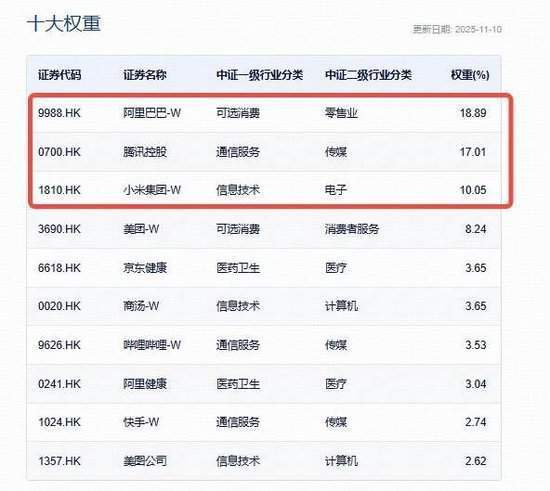
Group 1 - The core viewpoint of the articles highlights the strong performance of major Chinese tech companies, particularly in the AI sector, with significant revenue growth and market interest [1][2] - Alibaba's "Qianwen" app has gained popularity, ranking fifth in the Apple App Store's free applications shortly after its public beta launch, indicating strong user engagement and future potential for integration of various services [1] - Xiaomi Group reported impressive Q3 results with a revenue of 113.1 billion yuan, a year-on-year increase of 22.3%, and an adjusted net profit of 11.3 billion yuan, marking an 80.9% increase, showcasing the company's growth trajectory [1] Group 2 - The Chinese AI sector is expected to experience significant performance elasticity and potential, particularly in application areas that are rapidly developing, as noted by Citic Securities [2] - Minsheng Securities expresses optimism about the revaluation of Chinese AI companies, especially those with synergistic advantages in computing resources, model capabilities, and application scenarios, such as Tencent, Kuaishou, Alibaba, and Xiaomi [2] - The Hong Kong Internet ETF (513770) tracks the CSI Hong Kong Internet Index, which heavily weights leading internet companies, with Alibaba, Tencent, and Xiaomi being the top three holdings, collectively accounting for over 45% of the index [2][4] Group 3 - The valuation of the Hong Kong Internet sector remains low, with the CSI Hong Kong Internet Index trading at a PE ratio of 24.44, significantly lower than the NASDAQ-100 and S&P 500, indicating potential for future growth [5] - The Hong Kong Internet ETF has a substantial scale of over 11.6 billion yuan and an average daily trading volume exceeding 600 million yuan, reflecting strong liquidity [5] - The Hong Kong market has shown higher elasticity in the internet sector this year, with the CSI Hong Kong Internet Index outperforming the Hang Seng Technology Index [4][5]

小米集团-W(01810):发挥规模和品类优势,吸收存储超级周期影响
HTSC· 2025-11-19 03:18
Investment Rating - The report maintains a "Buy" rating for Xiaomi Group with a target price of HKD 53.8, down from HKD 65.4 [5][13]. Core Insights - Xiaomi's Q3 2025 performance showed a total revenue increase of 22% year-on-year to RMB 113.1 billion, aligning with expectations, while adjusted net profit surged by 80.9% to RMB 11.31 billion, exceeding Bloomberg consensus by 12.6% [1][5]. - The report highlights that the storage super cycle is a significant variable affecting Xiaomi's stock price and performance in 2026. Compared to other smartphone manufacturers, Xiaomi has advantages in smartphone shipment volume (third globally), high-end smartphone ratio, and a robust non-mobile business that is less impacted by storage costs [1][2]. - The report anticipates that storage price increases will affect Xiaomi's smartphone shipment volume, product pricing, and gross margins, leading to a downward revision of the 2026 smartphone shipment forecast to 165 million units from 182 million units, and gross margin to 10.7% from 12% [2][3]. Summary by Sections Smartphone/IoT/Internet Business - In Q3, Xiaomi's smartphone shipments reached 43.3 million units (+0.5% YoY), maintaining a global market share of 13.6%. Gross margin decreased by 0.6 percentage points to 11.1% amid rising storage costs [2]. - IoT business revenue grew by 5.6% YoY to RMB 27.6 billion, with gross margin improving by 1.4 percentage points to 23.9% [2]. - Internet business revenue increased by 10.8% YoY to RMB 9.4 billion, maintaining a high gross margin of 76.9% [2]. Automotive Business - The automotive segment began to turn profitable in Q3 2025, with deliveries reaching a record high of 109,000 units. Revenue increased by 37% quarter-on-quarter to RMB 25.9 billion, with a gross margin of 25.5%, up 8.4 percentage points YoY [2]. - The report maintains a 2026 automotive shipment forecast of 700,000 units, with expectations for continued profitability and growth driven by the company's high-end strategy and capacity ramp-up [2][3]. Profit Forecast and Valuation - The report revises revenue forecasts for 2025-2027 down by 0.3%/2.3%/1.9% and non-GAAP net profit forecasts down by 1.6%/7.6%/4.3% to RMB 43.4 billion, RMB 48.2 billion, and RMB 62.4 billion respectively [3][9]. - Using a sum-of-the-parts (SOTP) valuation method, the target price is set at HKD 53.8, corresponding to a 27x PE for 2026 [3][13].
小米集团绩后跌破40港元关口,电动汽车及AI等创新业务首次实现单季经营盈利
Mei Ri Jing Ji Xin Wen· 2025-11-19 03:13
Group 1 - The core viewpoint of the news highlights that Xiaomi Group's stock price has weakened following its Q3 2025 earnings report, with a significant drop below the critical HKD 40 mark [1] - Xiaomi's Q3 2025 revenue reached RMB 113.12 billion, representing a year-on-year growth of 22.3%, surpassing market expectations of RMB 112.50 billion [1] - The adjusted net profit for Q3 2025 was RMB 11.31 billion, showing an impressive year-on-year increase of 80.9%, exceeding market expectations of RMB 10.05 billion [1] Group 2 - Xiaomi's innovative business segments, including smart electric vehicles and AI, generated revenue of RMB 29 billion in Q3 2025, marking a historical high [1] - The smart electric vehicle segment alone contributed RMB 28.3 billion, while other related businesses accounted for RMB 700 million [1] - For the first time, Xiaomi's smart electric vehicle and AI segments achieved operational profitability in a single quarter, with an operating profit of RMB 700 million [1] Group 3 - Huatai Securities indicated that the storage supercycle is a significant variable affecting Xiaomi's stock price and performance in 2026 [2] - Compared to other smartphone manufacturers, Xiaomi holds advantages in smartphone shipment volume (third globally), high-end smartphone market share, and a robust non-mobile business scale less affected by storage prices [2] - The firm has lowered its profit forecasts for 2026 and 2027, reflecting the impact of rising storage prices on the smartphone business, while remaining optimistic about Xiaomi's opportunities in smart electric vehicles and smart home appliances [2]
第三季度业绩不及预期,小米集团盘中跌近5%
Huan Qiu Lao Hu Cai Jing· 2025-11-19 02:33
Core Insights - Xiaomi Group reported a total revenue of 113.12 billion yuan for Q3 2025, marking a year-on-year increase of 22.3% but a quarter-on-quarter decrease of 2.4% [1] - The adjusted net profit reached a record high of 11.31 billion yuan, reflecting an 80.9% year-on-year growth and a 4.4% quarter-on-quarter increase [1] Revenue Breakdown - The smartphone and AIoT segment generated revenue of 84.11 billion yuan, a year-on-year increase of 1.6%, accounting for 74.4% of total revenue [2] - The innovative business segment, including smart electric vehicles and AI, reported revenue of 29.01 billion yuan, a significant year-on-year increase of 199.2%, making up 25.6% of total revenue [2] Smartphone Performance - Xiaomi's smartphone revenue declined to 45.97 billion yuan, a year-on-year decrease of 3.1% [2] - Global smartphone shipments reached 4.33 million units, showing a slight year-on-year increase of 0.5% [2] - The gross margin for smartphones was 11.1%, down from 11.7% in the same period last year, attributed to a decrease in average selling price (ASP) from 1,102.2 yuan to 1,062.8 yuan [2][3] Automotive Business Highlights - The automotive segment achieved revenue of 28.3 billion yuan, with an operating profit of 700 million yuan, marking the first quarter of profitability for this business [3] - Cumulative deliveries of Xiaomi vehicles exceeded 260,000 units in the first three quarters of the year [3] - The ASP for smart electric vehicles increased by 9.0% from 238,600 yuan to 260,100 yuan, driven by the delivery of higher-priced models [3] Other Business Segments - Revenue from IoT and lifestyle consumer products reached 27.55 billion yuan, a year-on-year increase of 5.6%, with a gross margin of 23.9%, up by 3.1 percentage points [3] - As of September 30, the number of connected IoT devices on Xiaomi's AIoT platform surpassed 1 billion, reaching 1.036 billion, a year-on-year growth of 20.2% [3]
小米集团股价跌破40港元
Zheng Quan Shi Bao Wang· 2025-11-19 02:14
人民财讯11月19日电,截至发稿,小米集团跌超2%,股价跌破40港元/股,自今年6月27日高点(61.45港 元)以来累计跌超30%。 ...
小米集团跌超4%,股价跌破40港元/股
Mei Ri Jing Ji Xin Wen· 2025-11-19 01:55
每经AI快讯,11月19日,小米集团跌超4%,股价跌破40港元/股,自今年6月27日高点(61.45港元)以 来累计跌超30%。 ...
小米集团20251118
2025-11-19 01:47
Xiaomi Group Q3 2025 Earnings Call Summary Company Overview - **Company**: Xiaomi Group - **Date**: Q3 2025 Earnings Call Key Financial Highlights - Total revenue reached **RMB 113 billion**, a **2.5%** year-over-year increase, marking a historical high [2][3] - Adjusted net profit was **RMB 11.3 billion**, up **81%** year-over-year, also a record [2][3] - Gross margin improved to **22.9%**, an increase of **2.5 percentage points** year-over-year [3] Smartphone Performance - Sales of the **Xiaomi 17 series** smartphones grew by **30%** compared to the previous generation, with high-end versions accounting for over **80%** of sales [2][4] - The **Pro Max** model achieved significant success in the **RMB 6,000+** price segment, indicating effective high-end strategy [4][7] - Xiaomi ranked among the top three in global smartphone shipments with a market share of **13.6%** [6] IoT and Smart Home Business - IoT revenue reached **RMB 27.6 billion**, showing continuous growth for seven consecutive quarters with a gross margin of **23.9%** [2][8] - The IoT platform connected over **1 billion devices**, indicating ongoing ecosystem expansion [8][21] - A new smart home appliance factory commenced production with an annual capacity of **7 million units** [8][12] Internet Services and User Engagement - Global monthly active users reached **742 million**, a **8.2%** increase year-over-year [2][9] - Internet services revenue was **RMB 9.4 billion**, up **10.8%**, with a gross margin of **76.9%** [2][11] - Advertising revenue grew to **RMB 7.2 billion**, reflecting a **17.4%** increase [2][12] Electric Vehicle (EV) Business - EV revenue amounted to **RMB 28.3 billion**, with **108,796** units delivered, averaging a post-tax price of **RMB 260,000** [5][14] - The EV segment is identified as a new growth driver for the company [5] Research and Development - R&D expenses reached **RMB 9.1 billion**, a **52.1%** increase year-over-year, with R&D personnel comprising **44.2%** of total employees [5][15] - The company plans to invest over **RMB 200 billion** in R&D over the next five years [10] Strategic Initiatives - Xiaomi aims to enhance product premiumization and intelligence through proprietary chip and operating system development [10] - The company targets entry into the top 100 of the Fortune Global 500 by **2030** [10] Market Position and Challenges - Xiaomi's market share in mainland China reached **14.9%**, with growth in all regions except India [6] - The company faces challenges from rising memory costs, which are expected to pressure gross margins in the coming years [19][30] - Strategies to mitigate cost pressures include price increases and product structure optimization [19] Sustainability and ESG Efforts - Xiaomi's MSCI ESG rating improved from B to A, marking the third consecutive year of improvement [18] Future Outlook - The company plans to continue expanding its overseas market presence, particularly in Southeast Asia and Latin America [27][32] - Xiaomi's strategy includes enhancing operational efficiency in existing stores rather than opening new ones [31][32] This summary encapsulates the key points from Xiaomi Group's Q3 2025 earnings call, highlighting financial performance, market position, strategic initiatives, and future outlook.

Making money from EVs is notoriously hard. Xiaomi just joined a tiny list of carmakers doing it.
Business Insider· 2025-11-18 16:13
Core Insights - Xiaomi's electric vehicle (EV) business has achieved quarterly profitability for the first time, reporting a gross profit of $98.5 million for the quarter ending in September [1][2] - The division's revenues reached a record high of $4 billion, with $3.98 billion coming from EV sales and $98.5 million from related businesses [2] - Xiaomi's SU7 sedan was a significant success, selling over 130,000 units last year, and its new model, the YU7, received 240,000 preorders within 24 hours of its launch [3] Company Performance - Xiaomi delivered over 100,000 EVs in the third quarter, a substantial increase from around 40,000 units during the same period last year [3] - The company has successfully navigated the challenging landscape of EV profitability, achieving this milestone in under two years, unlike many competitors [4] - Tesla took approximately ten years to report its first profitable quarter, while BYD has maintained consistent profitability by selling both hybrids and battery-electric vehicles [5][6] Industry Context - The EV market is characterized by fierce competition and price wars, making profitability difficult for many companies [7] - Notable competitors like Ford and GM are still incurring significant losses in their EV segments, while startups such as Lucid and Rivian reported losses of around $1 billion in the third quarter [6][7] - Other Chinese EV startups, like Nio and Xpeng, are also struggling, with Nio reporting a net loss of nearly $700 million in the second quarter of 2025 [7][8]