
国开金融有限责任公司

Search documents
空港股份股东减持1.32%,子公司获担保及借款展期
Jing Ji Guan Cha Wang· 2026-02-13 07:54
Core Viewpoint - The company has announced significant shareholder changes, including a reduction in stake by a major shareholder and the provision of guarantees for its subsidiaries, alongside a leadership change in the board of directors [1][2]. Recent Events - The major shareholder, Guokai Financial, reduced its stake by 396.03 million shares, representing 1.32% of the total share capital, decreasing its ownership from 10.00% to 8.68%. This change does not affect the control of the company [2]. - The company’s board approved a guarantee for its wholly-owned subsidiary, Tiandi Property, for a bank credit application not exceeding 20 million yuan, which is aimed at meeting the subsidiary's operational funding needs. The total guarantee amount represents 4.03% of the company's latest net assets [2]. - The company’s controlling subsidiary, Tianyuan Construction, applied for a loan extension of 60 million yuan from the controlling shareholder, with an interest rate not exceeding 4.50%. This move is intended to alleviate financial pressure without requiring collateral [2]. - The company’s vice chairman, Wang Yawen, resigned due to work changes, and Liu Yipeng has been nominated as a new director candidate. The first temporary shareholders' meeting of 2026 is scheduled for March 3 to review the aforementioned guarantee, loan extension, and director election matters [2]. Stock Performance - Over the last five trading days (February 9 to 13), the company's stock price increased by 3.73%, closing at 12.50 yuan on February 13, with a daily increase of 1.13%. Technical analysis indicates that the stock price has broken through the 20-day moving average, showing a bullish trend in the short term [3]. - On February 12, there was a net inflow of 19.7256 million yuan from main funds, accounting for 21.39% of the total trading volume, indicating high trading activity with a turnover rate of 2.47% on that day [3].

年底,并购基金设立热潮未减
2 1 Shi Ji Jing Ji Bao Dao· 2025-12-11 02:37
Core Viewpoint - The establishment of merger and acquisition (M&A) funds in China is experiencing a significant surge, with local governments and state-owned enterprises leading the way, indicating a historic turning point in the M&A market [1][2][7]. Group 1: M&A Fund Establishment - In 2025, a 30 billion RMB M&A fund was announced in Beijing, with several other regions like Anhui and Jiangxi also launching similar funds [1]. - In the first three quarters of this year, local M&A funds have been established at an accelerated pace, with over 300 A-share listed companies participating in setting up industrial M&A funds [1][2]. - The total fundraising target for A-share listed companies' M&A funds is expected to exceed 270 billion RMB this year [2]. Group 2: Key Players and Trends - The current landscape of M&A funds in China features a diverse LP composition, with state-owned enterprises and listed companies taking a central role [2]. - State-owned M&A funds are crucial for supporting local industries and enhancing supply chains, with significant funds being established in key sectors like integrated circuits and biomedicine [2]. - VC/PE firms are increasingly engaging in M&A investments, marking a shift in their investment strategies [3]. Group 3: Characteristics of Current M&A Activities - The current wave of M&A is characterized as "industrial chain restructuring," with companies focusing on strategic alignment rather than aggressive financial returns [5]. - A significant portion of A-share listed companies' investments in M&A funds is concentrated in healthcare, new energy, and semiconductors, aligning with national strategies [5]. - Companies are now more cautious in their M&A activities, influenced by past experiences with inflated valuations and goodwill impairments [6]. Group 4: Policy and Market Drivers - The surge in M&A funds is driven by supportive policies at both national and local levels, including various regulatory measures aimed at revitalizing the M&A market [7][8]. - Recent regulatory changes have encouraged banks to participate in the M&A market, broadening the scope of M&A loans [3][8]. - The current economic environment and competitive pressures are creating a historic opportunity for M&A activities in China [8]. Group 5: Challenges and Opportunities - Despite the growth, the Chinese M&A market faces challenges such as a lack of long-term capital, insufficient quality control targets, and underdeveloped exit channels [9]. - The reliance on IPOs for exits highlights the need for diversified exit strategies in the M&A landscape [9]. - Strategies are being developed to enhance collaboration with listed companies and improve post-investment support for portfolio companies [10].
继续聊聊国家集成电路大基金(原创)
叫小宋 别叫总· 2025-09-06 12:46
Investment Strategy - The first phase of the National Integrated Circuit Industry Investment Fund (大基金一期) was established in 2014 with a registered capital of 98.7 billion, and actual funds received were approximately 120 billion [3] - The second phase (大基金二期) was established in 2019 with a registered capital of 204.2 billion, and actual funds received were around 220 billion [3] - Significant investments from both phases were directed towards wafer manufacturing, including companies like SMIC, Hua Hong Semiconductor, and Changjiang Storage [3] - Investments also extended to packaging segments, with companies such as Tongfu Microelectronics and Jiangsu Changjiang Electronics Technology [5] - The strategy focused on addressing the largest gaps in the semiconductor industry, particularly in manufacturing, while also investing in chip design, exemplified by companies like Huawei's HiSilicon [6][7] Management - The management of both phases is handled by Huaxin Investment Management Co., Ltd. (华芯), established in 2014 specifically for managing the fund [9] - The largest shareholder of Huaxin is the National Development Bank, which is also a significant contributor to the fund [9] - In the first phase, the Ministry of Finance was the largest contributor (36%), followed by the National Development Bank (22%), while in the second phase, the Ministry of Finance contributed 11.02% and the National Development Bank 10.78% [10] - The management structure raised questions about the dual role of the National Development Bank as both a manager and a major limited partner, reflecting a high level of trust from the state [10] - The first phase involved collaboration with other semiconductor investment institutions to mitigate risks, while the second phase saw a more mature investment capability with no additional management entities [10][11]

节能风电: 中节能风力发电股份有限公司2025年半年度报告摘要
Zheng Quan Zhi Xing· 2025-08-29 16:08
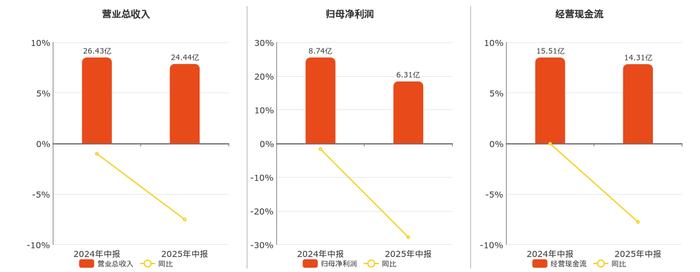
Core Viewpoint - 中节能风力发电股份有限公司 reported a decline in key financial metrics for the first half of 2025 compared to the same period in 2024, indicating potential challenges in revenue generation and profitability [1][2]. Financial Performance - Total assets as of June 30, 2025, amounted to CNY 44.46 billion, showing a slight increase of 0.89% from the previous year [1]. - Net assets attributable to shareholders reached CNY 17.76 billion, reflecting a 1.24% increase year-on-year [1]. - Operating revenue for the reporting period was CNY 2.44 billion, down 7.52% from CNY 2.64 billion in the same period last year [2]. - Total profit decreased by 24.49% to CNY 797.04 million, compared to CNY 1.06 billion in the previous year [2]. - Net profit attributable to shareholders was CNY 630.59 million, representing a decline of 27.86% from CNY 874.10 million [2]. - Net cash flow from operating activities was CNY 1.43 billion, down 7.76% from CNY 1.55 billion [2]. Shareholder Information - The total number of shareholders as of the reporting date was 196,686 [3]. - The largest shareholder, 中国节能环保集团有限公司, holds 48.25% of the shares, amounting to 3.12 billion shares [3]. Debt and Financial Ratios - The company has issued several bonds, including a carbon-neutral green bond with a maturity of 5 years and an interest rate of 2.65% [4]. - The debt-to-asset ratio at the end of the reporting period was 58.27%, slightly improved from 58.41% at the end of the previous year [4]. - The interest coverage ratio (EBITDA) was reported at 6.37, a slight decrease from 6.41 in the previous year [4].

节能风电(601016.SH):2025年中报净利润为6.31亿元、同比较去年同期下降27.86%
Xin Lang Cai Jing· 2025-08-29 01:52
Core Viewpoint - The company reported a decline in revenue and net profit for the first half of 2025, indicating challenges in its financial performance compared to the previous year [1][3] Financial Performance - The company's total revenue for the first half of 2025 was 2.444 billion yuan, a decrease of 199 million yuan or 7.52% year-on-year [1] - The net profit attributable to shareholders was 631 million yuan, down by 244 million yuan or 27.86% compared to the same period last year [1] - Operating cash flow was 1.431 billion yuan, a decline of 120 million yuan or 7.76% year-on-year [1] Financial Ratios - The latest debt-to-asset ratio stood at 58.27%, ranking 41st among peers, with a slight increase of 0.45 percentage points from the previous quarter but a decrease of 0.07 percentage points from the same period last year [3] - The gross profit margin was 47.14%, ranking 16th among peers, down by 3.67 percentage points from the previous quarter and 7.23 percentage points year-on-year [3] - Return on equity (ROE) was 3.55%, ranking 46th among peers, a decrease of 1.55 percentage points from the previous year [3] Earnings Per Share and Turnover Ratios - The diluted earnings per share were 0.10 yuan, ranking 56th among peers, a decrease of 0.04 yuan or 28.15% year-on-year [3] - The total asset turnover ratio was 0.06 times, ranking 75th among peers, down by 0.01 times or 10.97% year-on-year [3] - The inventory turnover ratio was 10.50 times, ranking 31st among peers, an increase of 0.97 times or 10.19% year-on-year, marking five consecutive years of growth [3] Shareholder Structure - The number of shareholders was 196,700, with the top nine shareholders holding 3.424 billion shares, accounting for 52.90% of the total share capital [3] - The largest shareholder, China Energy Conservation and Environmental Protection Group, held 48.25% of the shares [3]
空港股份: 空港股份简式权益变动报告书(国开金融)
Zheng Quan Zhi Xing· 2025-08-27 10:29
Core Points - The report details a reduction in shareholding by Guokai Financial Co., Ltd. in Beijing Airport Technology Park Co., Ltd. (Airports Co.) through centralized trading on the Shanghai Stock Exchange [1][2] - As of August 26, 2025, Guokai Financial holds 30,000,000 shares, representing 10% of the total share capital of Airports Co. [5][9] - The purpose of the share reduction is for financial resource allocation [6] Section Summaries Section 1: Definitions - "Information Discloser" refers to Guokai Financial Co., Ltd. - "Airports Co." refers to Beijing Airport Technology Park Co., Ltd. - "CSRC" refers to the China Securities Regulatory Commission [3] Section 2: Information Discloser Overview - Guokai Financial Co., Ltd. is a state-owned enterprise with a registered capital of approximately 9.49 billion yuan [4] - The company is located at 803, 8th Floor, Building B, Financial Street, Xicheng District, Beijing [4] Section 3: Purpose of Shareholding Change - The shareholding change is driven by the need for financial resource management [6] - There are no plans for increasing the shareholding in Airports Co. within the next 12 months, but further reductions may occur [6] Section 4: Shareholding Status - Guokai Financial acquired shares through a non-public offering in 2015 [6] - The shareholding decreased from 30,964,600 shares (10.3215%) on August 21, 2025, to 30,000,000 shares (10%) by August 26, 2025 [4][5] Section 5: Trading Activity - Guokai Financial has engaged in multiple share reductions through centralized bidding from April 2022 to August 2025, totaling 18,000,000 shares, which is 6% of the total share capital [6][9] Section 6: Control and Governance - The share reduction will not change the control or governance structure of Airports Co. [7] Section 7: Compliance and Disclosure - Guokai Financial confirms that the report is accurate and complete, with no misleading statements or omissions [2][8]
空港股份: 空港股份关于持股5%以上股东权益变动触及5%刻度的提示性公告
Zheng Quan Zhi Xing· 2025-08-27 10:29
Core Viewpoint - The announcement details a significant change in the shareholding structure of Beijing Airport Technology Park Co., Ltd, specifically regarding the reduction of shares held by a major shareholder, Guokai Financial Co., Ltd, which has decreased its stake from 10.57% to 10.00% [1][2]. Group 1: Shareholding Changes - Guokai Financial reduced its holdings by selling a total of 1,711,000 shares between August 21 and August 26, 2025 [1][2]. - Following the reduction, Guokai Financial now holds 30,000,000 shares, representing 10.00% of the total share capital of the company [1][2]. - The reduction in shareholding has triggered a notification as it touches the 5% threshold for significant changes in ownership [1][2]. Group 2: Compliance and Governance - The shareholding change does not impact the company's governance structure or ongoing operations significantly, and there will be no change in the controlling shareholder or actual controller [2][3]. - All shares involved in this transaction retain voting rights, and there are no restrictions on the transfer of these shares [2][3]. - The transaction complies with relevant laws and regulations, including the Securities Law of the People's Republic of China and the Management Measures for the Reduction of Shares by Shareholders of Listed Companies [2][3].
应对低利率:机遇与挑战 | 新刊亮相
清华金融评论· 2025-08-08 08:54
Core Viewpoint - The article discusses the challenges and opportunities presented by the ongoing trend of low interest rates in China, emphasizing the need for coordinated fiscal and monetary policies to enhance macroeconomic governance capabilities [3][10][11]. Summary by Sections Low Interest Rate Environment - China's interest rates have been declining due to multiple domestic and international factors, including structural issues like technological stagnation and demographic changes, as well as cyclical factors such as output and inflation gaps [3][10]. - The current low interest rate trend is expected to persist for a considerable period, influenced by both structural and cyclical factors, alongside a global trend of declining interest rates [10][11]. Policy Recommendations - It is essential to implement extraordinary counter-cyclical adjustment policies, focusing on more proactive fiscal policies and moderately loose monetary policies, drawing lessons from the macroeconomic policies of developed countries post-2008 financial crisis [5][9]. - The relationship between fiscal and monetary policies should be one of mutual support rather than conflict, enhancing policy coordination to improve macroeconomic governance [9][11]. Financial Sector Adaptation - Financial institutions must adapt to the changing economic landscape characterized by low interest rates, which affects the behavior of economic entities, leading to reduced credit demand and a shift towards low-risk assets [6][10]. - There is a need for financial institutions to provide better financial products and services to meet societal financial demands while guiding financial needs effectively [6][11]. Focus Areas for Financial Reform - The article highlights the importance of focusing on five key areas of financial reform: technology finance, green finance, inclusive finance, pension finance, and digital finance, to support high-quality economic development [7][12]. - Technological advancement is crucial for improving overall productivity and asset returns, necessitating a collaborative approach among different types of financial institutions to provide comprehensive financial services to technology enterprises and innovative projects [7][12]. Risk Management and Structural Reform - Addressing the challenges posed by low interest rates requires structural reforms to prevent financial risks, emphasizing the need for a robust financial supply-side structural reform [12]. - The article suggests that the financial sector should learn from international experiences to enhance its resilience and adaptability in the face of ongoing interest rate changes [12].

空港股份:股东国开金融减持0.91%股份
Ge Long Hui· 2025-07-30 12:20
Core Points - The company, Konggang Co., Ltd. (stock code: 600463.SH), announced that on July 30, 2025, it received a notification from its major shareholder, Guokai Financial Co., Ltd., regarding a reduction in shareholding [1] - Guokai Financial reduced its holdings by 2.7225 million shares, which represents 0.91% of the company's total share capital [1]
空港股份(600463.SH):股东国开金融减持0.91%股份
Ge Long Hui A P P· 2025-07-30 12:09
Core Viewpoint - The company, Konggang Co., Ltd. (stock code: 600463.SH), announced that its major shareholder, Guokai Financial Co., Ltd., has reduced its shareholding by 2.7225 million shares, accounting for 0.91% of the company's total share capital as of July 30, 2025 [1] Summary by Categories Shareholder Activity - Guokai Financial, holding more than 5% of the company's shares, informed the company about the reduction in shareholding [1] - The reduction occurred on July 30, 2025, with a total of 2.7225 million shares sold [1]