成都银行

Search documents
又一可转债,顺利摘牌!
券商中国· 2025-07-19 10:27
Core Viewpoint - Nanjing Bank's "Nan Yin Convertible Bond" has been forcibly redeemed and converted into A-shares, leading to an increase in the bank's total share capital and enhancing its capital strength for sustainable development [1][3][7]. Summary by Sections Announcement of Redemption - On July 18, Nanjing Bank announced the strong redemption and conversion of its "Nan Yin Convertible Bond," which has been delisted from the Shanghai Stock Exchange [1]. - The total amount of "Nan Yin Convertible Bond" converted into A-shares reached 199.96 billion yuan, resulting in 2.357 billion shares being converted [2][5]. Impact on Share Capital - Following the redemption, Nanjing Bank's total share capital increased to 12.364 billion shares [6]. - The conversion accounted for 23.55% of the bank's total A-shares before the conversion [5]. Financial Implications - The high conversion rate allows Nanjing Bank to further supplement its capital, which is beneficial for long-term sustainable development despite short-term dilution of earnings per share [3][7]. - The "Nan Yin Convertible Bond" achieved a conversion rate of 99.98%, indicating strong investor confidence in the bank's stock performance [11]. Market Context - Nanjing Bank is the fourth bank this year to complete forced redemption of convertible bonds, following Chengdu Bank, Suzhou Bank, and Hangzhou Bank [9]. - The overall market for bank convertible bonds is expected to reduce to seven after the completion of the redemption of "Qi Lu Convertible Bond" [10]. Stock Performance - Nanjing Bank's stock price has seen significant growth, with a 57.96% increase in 2024 and a 12.86% increase in 2025 as of July 18 [13]. - The banking sector has shown strong performance, with several banks experiencing notable stock price increases [14].



天风证券:如何看待银行股价和基本面的背离?
智通财经网· 2025-07-19 09:55
Core Viewpoint - The banking sector is currently under pressure, but the market's preference for high dividend strategies is driving a notable upward trend in bank stocks. The release of policy dividends, along with increased participation from insurance funds, active funds, and passive funds, is expected to provide stable incremental capital for bank stocks, enhancing the sustainability of valuation recovery [1][2]. Group 1: Current Banking Fundamentals - The banking sector's fundamentals are still under pressure but show signs of marginal improvement. The net interest margin is expected to decline significantly less in 2025 due to the expiration of high-interest liabilities and a slowdown in loan pricing declines. The estimated net interest margins for state-owned and joint-stock banks are projected to be 1.34% and 1.55%, respectively, down 12 and 9 basis points from the end of 2024 [2]. - The asset quality is expected to improve while remaining stable. As of Q1 2025, the non-performing loan ratio for commercial banks was recorded at 1.51%, only slightly up by 1 basis point from the end of 2024. The provision coverage ratio stands at 208%, down 3.06 percentage points, indicating ample room above the regulatory requirement of 150% [2]. Group 2: Valuation Recovery and Market Dynamics - The core logic driving the current market rally is the valuation recovery fueled by the funding environment. This trend is expected to continue, supported by low interest rates and an asset shortage, which highlight the advantages of high dividends and quasi-fixed income characteristics of bank stocks. As of July 11, the banking sector's dividend yield was 4.87%, significantly enhancing its investment appeal due to stable dividends and sound operations [3]. - Continuous inflow of incremental capital is driving a noticeable recovery in bank stock valuations. Policies such as the introduction of mid- to long-term capital into the market and new regulations for public funds have significantly increased the demand for bank stock allocations. As of July 11, the banking sector's price-to-book (PB) ratio was 0.75, indicating substantial room for recovery towards a PB of 1 [3].





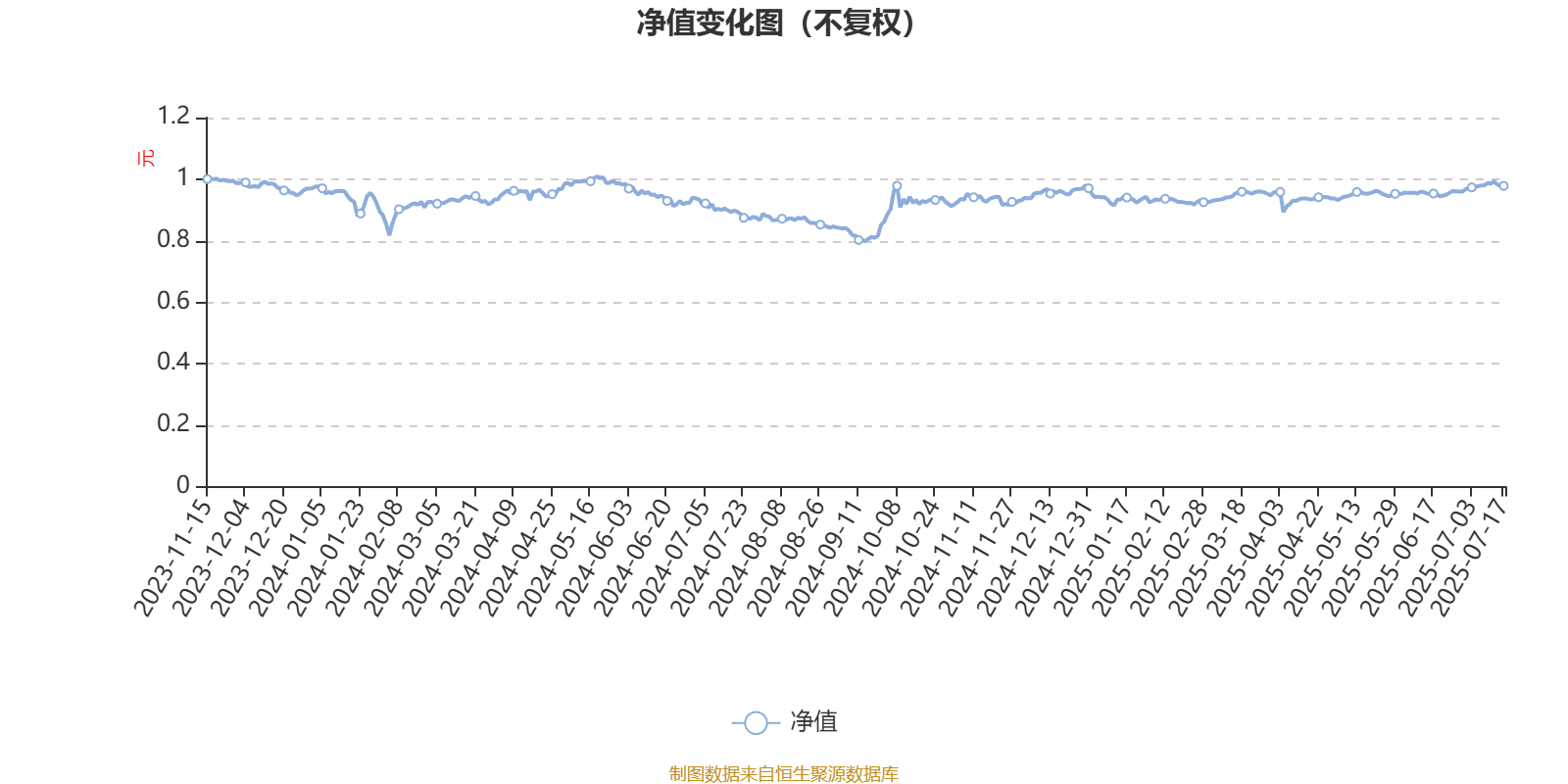
万家红利量化选股混合发起式A:2025年第二季度利润5.99万元 净值增长率1.26%
Sou Hu Cai Jing· 2025-07-18 11:07
Core Viewpoint - The AI Fund Wanjiarongli Quantitative Stock Selection Mixed Initiation A (019987) reported a profit of 59,900 yuan in Q2 2025, with a weighted average profit per fund share of 0.0119 yuan, and a net value growth rate of 1.26% during the period [3][4]. Fund Performance - As of July 17, the fund's unit net value was 0.978 yuan, with a three-month net value growth rate of 4.63%, ranking 539 out of 615 in its category [4]. - The fund's six-month net value growth rate was 4.02%, ranking 512 out of 615, and the one-year growth rate was 9.63%, ranking 450 out of 584 [4]. - Since inception, the fund has maintained a high average stock position of 92.4%, compared to the category average of 83.13% [14]. Fund Management Insights - The fund manager, Yin Hang, oversees seven funds and anticipates that market sentiment will focus on the performance of A-share companies as they disclose their semi-annual reports [3]. - The manager believes that sectors with better-than-expected performance or sustained growth will attract short-term attention [3]. - The fund's maximum drawdown since inception was 20.86%, with the largest quarterly drawdown occurring in Q1 2024 at 16.34% [11]. Fund Holdings - As of Q2 2025, the top ten holdings of the fund included Erdos, New China Life Insurance, Gree Electric Appliances, China Shenhua Energy, Huayang Co., China Merchants Highway, Shangu Power, Chengdu Bank, Chongqing Bank, and Qilu Bank [19].
银行投资跟踪:如何看待银行股价和基本面的背离?
Tianfeng Securities· 2025-07-18 08:11
证券研究报告 2025年07月18日 行业报告: 行业深度研究 银行 银行投资跟踪:如何看待银行股价和基本面的背离? 作者: 分析师 刘杰 SAC执业证书编号:S1110523110002 联系人 曹旭冉 1 行业评级: 上次评级: 强于大市 强于大市 维持 ( 评级) 请务必阅读正文之后的信息披露和免责申明 摘要 风险提示:宏观经济震荡、不良风险大幅上升、净息差下行压力加大、测算结果可能与现实情况存在差异。 2 ➢ 复盘历史,银行股价和基本面长期存在"背离"现象。这或是因为,在经济上行周期中,银行基本面表现较好,但银行股相较于其他高成 长板块可能缺乏对资金的吸引力;而在宏观经济表现相对承压时,银行基本面有所承压,银行板块的防御属性突出,反而拥有超额收益。 ➢ 目前银行基本面仍然承压,但市场偏好高股息策略下涨势亮眼。2025Q1商业银行净利润同比负增2.32%,较去年同期增速低2.97pct。而 银行股估值正攀升至近年较高水平,截止7月11日,银行板块PB为0.75倍,处于近十年50%的历史分位数水平。 ➢ 当前银行基本面持续筑底,但仍有边际改善。具体而言: • 一方面,受益于存量高息负债集中到期和贷款定价下 ...
科伦药业: 2025年度第一期超短期融资券发行结果的公告
Zheng Quan Zhi Xing· 2025-07-18 04:09
Core Points - Sichuan Kelun Pharmaceutical Co., Ltd. has received approval for the issuance of non-financial corporate debt financing tools, with a registered amount of RMB 4 billion for ultra-short-term financing bonds [1] - The company successfully issued its first ultra-short-term financing bond for 2025 on July 17, 2025, raising a total of RMB 800 million with a coupon rate of 1.6% [2] - The funds raised from this bond issuance will be used to repay interest-bearing debts and to supplement working capital [3] Summary by Sections Company Announcement - The board of directors approved the issuance of non-financial corporate debt financing tools on April 12, 2023, and it was subsequently approved by the shareholders' meeting on May 4, 2023 [1] - The company received a registration acceptance notice from the China Interbank Market Dealers Association on December 21, 2023, allowing the registration of ultra-short-term financing bonds [1] Bond Issuance Details - The first ultra-short-term financing bond for 2025 was issued on July 17, 2025, with a total issuance amount of RMB 800 million [2] - The bond has a maturity of 150 days, with an interest payment date set for December 14, 2025 [2] - The bond was rated AAA and was issued at a price of 100 yuan per 100 yuan face value [2] Fund Utilization - The proceeds from the bond issuance will be allocated for repaying interest-bearing liabilities and enhancing the company's liquidity [3]

首份上市银行半年度业绩快报亮相,中信证券:一季度或是年内业绩低点
Sou Hu Cai Jing· 2025-07-18 03:52
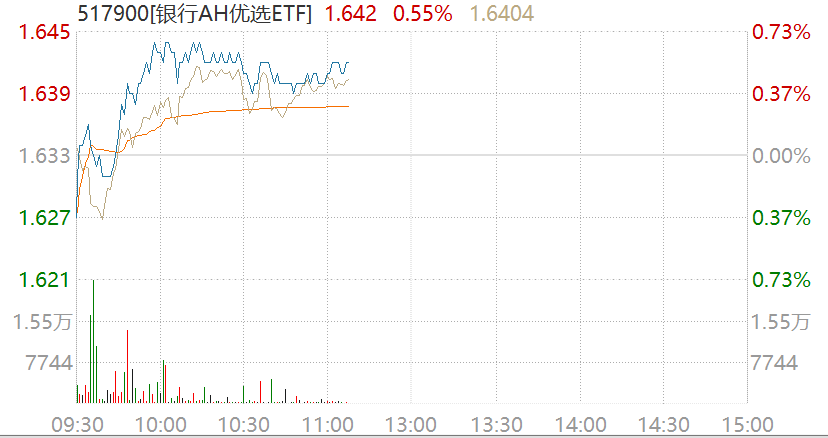
Core Viewpoint - The banking sector is experiencing a resurgence, with notable stock price increases for banks such as Xiamen Bank and Qilu Bank, alongside a positive performance of the Bank AH Preferred ETF [1][3]. Financial Performance - Hangzhou Bank reported a revenue of 20.093 billion yuan, a year-on-year increase of 3.89%, and a net profit attributable to shareholders of 11.662 billion yuan, reflecting a growth of 16.67% [3]. Valuation Analysis - The average Return on Equity (ROE) for the banking industry in 2024 is projected to be 9.3%, with high-quality city commercial banks like Hangzhou Bank and Chengdu Bank expected to maintain an ROE of around 15% over the next three years [6]. - The banking sector is currently undervalued, with an average valuation of 0.7 times Price-to-Book (PB) ratio, compared to stable industries like coal and utilities, which have an average valuation of around 2 times PB [6][9]. Dividend Yield - The average dividend yield for A-share listed banks is 3.7%, while the Bank AH Index has a dividend yield around 5%, significantly higher than the 1.65% yield of ten-year government bonds [15]. Market Trends - The Bank AH Preferred ETF (517900) has seen a net inflow of 770 million yuan this year, with a 589% increase in shares, indicating strong market interest [16]. - Since its inception on December 6, 2017, the Bank AH Total Return Index has increased by 101.7%, outperforming the CSI Bank Index by 26% [17]. Investment Strategy - The current low-interest-rate environment is creating a scenario where the dividend yield of banks exceeds risk-free rates, potentially sustaining the positive momentum in the banking sector [14].

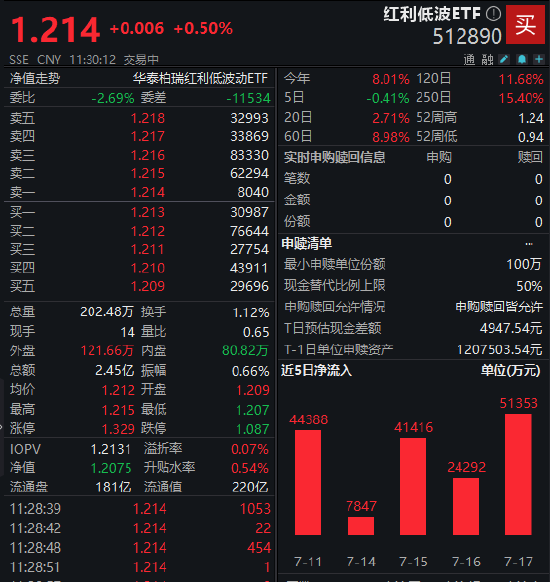
红利低波ETF(512890)半日吸金2.45亿 险资长钱或引爆高股息行情
Xin Lang Ji Jin· 2025-07-18 03:50
Core Viewpoint - The Reducing Volatility ETF (512890) has shown a positive performance with a 0.50% increase, reflecting strong investor interest and inflows, particularly from insurance funds seeking stable returns [1][2][3]. Fund Performance - As of July 18, the Reducing Volatility ETF (512890) closed at 1.214 CNY, with a half-day trading volume of 245 million CNY and a turnover rate of 1.12% [1][2]. - The ETF has experienced a net inflow of 1.693 billion CNY over the last five trading days and a cumulative net inflow of 2.147 billion CNY over the past ten trading days [1][2]. - The latest fund size for the Reducing Volatility ETF (512890) is 21.872 billion CNY as of July 17 [1]. Market Context - The Ministry of Finance issued a notice on July 11 aimed at guiding insurance funds towards long-term stable investments, which is expected to provide ongoing support for high-dividend sectors [1][3]. - Financial analysts believe that the new regulations will encourage insurance capital to increase equity allocations, particularly in bank stocks, which are characterized by high dividends and low volatility [1][3]. Top Holdings - The top holdings of the Reducing Volatility ETF (512890) include Chengdu Bank, Yageo, Industrial Bank, and Shanghai Bank, with respective price changes of +0.60%, +0.27%, +0.41%, and +0.92% [3][4]. - The fund's performance is benchmarked against the CSI Reducing Volatility Index, and it is managed by Liu Jun [3][5]. Investment Options - Investors seeking stable returns and low-risk alternatives can consider the Reducing Volatility ETF (512890) through its linked funds, which include various classes such as A, C, I, and Y [5].
银行板块年内涨幅超15%,大股东减持套现加剧顶部担忧
第一财经· 2025-07-17 04:46
Core Viewpoint - The A-share banking sector is experiencing significant pressure, with a notable decline in stock prices following a substantial increase earlier in the year, raising concerns about a potential market overheating [1][3]. Group 1: Market Performance and Trends - As of July 16, the Shenwan Banking Index has recorded a year-to-date increase of 15.20%, with all 42 A-share listed banks showing gains, and some like Xiamen Bank and Shanghai Pudong Development Bank exceeding 30% [3][9]. - The average dividend yield for A-share listed banks has dropped to approximately 3.8%, down from 5.01% a year ago, indicating a significant compression in yield [9]. - The price-to-earnings (PE) ratio of the China Securities Banking Index has risen to 7.4 times, the highest since April 2018, reflecting increased valuation levels [9]. Group 2: Shareholder Actions - China Life Insurance plans to completely divest its stake in Hangzhou Bank, which it has held for 16 years, potentially achieving an investment return of over 180% [2][5]. - Other banks, such as Changsha Bank and Qilu Bank, have also seen major shareholders announce plans to reduce their stakes, indicating a trend of profit-taking among large investors [6][7]. Group 3: Fundamental Analysis - In Q1 2025, the combined operating revenue of 42 A-share listed banks fell by 1.72% year-on-year, while net profit attributable to shareholders decreased by 1.2%, highlighting a trend of revenue growth without profit increase [10]. - The average net interest margin for listed banks is approximately 1.58%, remaining below the industry warning line of 1.8%, suggesting ongoing pressure on traditional lending profitability [10][11]. Group 4: Long-term Outlook - Despite short-term valuation pressures, many institutions maintain a positive outlook on the long-term investment value of bank stocks, citing the potential for asset quality improvement and continued appeal of high-dividend assets [13][14]. - Analysts suggest that the future performance of bank stocks will increasingly depend on individual banks' actual performance, emphasizing the need for selective investment in banks with competitive advantages [11][15].


银行股遭遇“牛回头”!后市怎么看?
券商中国· 2025-07-16 23:19
Core Viewpoint - The banking sector has experienced a recent pullback, impacting overall market indices, despite individual stock performance being mixed [1][4]. Market Performance - Over the past four trading days, the banking index has retraced approximately 2.54%, attributed to profit-taking by some investors and increased selling pressure due to dividend-related trading strategies [2][4]. - As of July 16, the banking sector's price-to-earnings (P/E) ratio stands at about 7.42 times, placing it in the 96.28th percentile over the past decade, while the price-to-book (P/B) ratio is approximately 0.74 times [3][14]. Stockholder Actions - Recent market sentiment has been affected by high-level share reductions by bank shareholders, such as China Life's planned reduction of 50.79 million shares in Hangzhou Bank [5][6][7]. Long-term Trends - The banking index has seen a year-to-date increase of 19.4%, and over 47% since September 24 of the previous year, indicating its role as a stabilizing factor in the A-share market [8]. - Several banks, including Xiamen Bank and Shanghai Pudong Development Bank, have recorded stock price increases exceeding 30% this year [8]. Fund Inflows - Multiple bank-themed ETFs have shown significant growth, with the Hua Bao CSI Bank ETF increasing by over 10.2 billion shares this year, reflecting strong investor interest [9][10]. - Institutional analysis suggests that the sustained rise in bank stocks is largely driven by capital inflows, particularly from insurance funds seeking stable returns in a low-interest-rate environment [11]. Future Outlook - The banking sector is expected to maintain its appeal due to its stable earnings and dividend characteristics, with a current dividend yield of 5.13% compared to a 10-year government bond yield of only 1.6% [12]. - The stability of banks' fundamentals is highlighted by a consistent return on equity (ROE) above 9% and a declining non-performing loan ratio [12][13]. - Analysts believe that banks may transition from being viewed solely as value stocks to stable growth stocks, driven by factors such as bond gains and stable net interest margins [13].

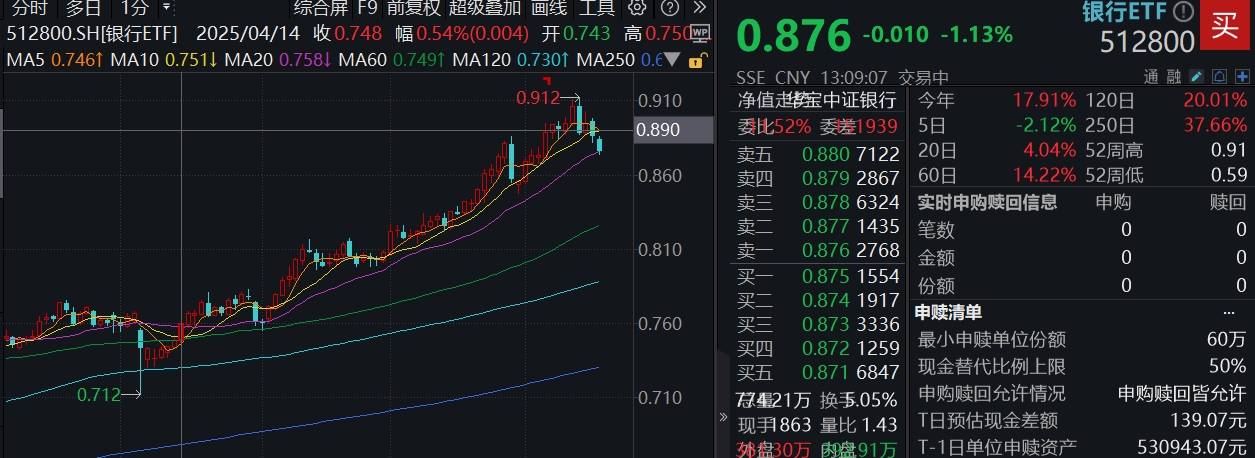
股东“高位清仓”?银行集体回调,银行ETF(512800)跌逾1%下探20日线,什么信号
Sou Hu Cai Jing· 2025-07-16 06:00
Group 1 - The banking sector is experiencing a pullback, with several banks, including Zhejiang Commercial Bank and Chongqing Bank, seeing declines of over 2% [1] - The Bank ETF (512800) has dropped by 1.13%, indicating a downward trend as it approaches the 20-day moving average [2] - Institutional investors express concerns about potential market peaks due to shareholder reductions, but overall sentiment remains positive with a focus on long-term investments [3] Group 2 - The domestic insurance fund size has reached 33 trillion, with only 11% currently invested in A-shares, suggesting significant room for growth in equity investments [3] - The Bank ETF (512800) tracks the China Securities Bank Index with a price-to-book ratio (PB) of 0.74, which is below historical averages, indicating potential value [4][3] - Recent data shows a net inflow of 8.94 billion into the Bank ETF over the past five days, highlighting strong investor interest [6] Group 3 - The Bank ETF (512800) is the largest and most liquid among the 10 bank ETFs in the market, making it an efficient investment tool for tracking the banking sector [8] - Investors are encouraged to consider the Bank ETF and its associated funds for exposure to the banking sector's performance [8]