
上海交通大学

Search documents
超62亿,43高校科研院所仪器采购意向汇总(2025年9月)
仪器信息网· 2025-10-14 09:09
Core Insights - The total budget for instrument procurement intentions from universities and research institutions in 2025 exceeds 62 billion [2] - The National Development and Reform Commission announced the issuance of 1,880 billion yuan in long-term special bonds to support equipment updates, with education being a key focus area [3] - There is a noticeable rebound in the demand for equipment updates, characterized by "policy-driven, high-end upgrades, and accelerated domestic substitution," which is expected to continue in the second half of the year [3] Procurement Summary - A total of 35 universities and research institutions have announced procurement plans with a budget exceeding 60 billion [4] - Notable procurement amounts include: - Peking University: 1.39 billion - Beijing Union Medical College: 3.14 billion - Tsinghua University: 1.83 billion - Chinese Academy of Sciences Nanhai Marine Research Institute: 6.1 billion [5][6][7] Historical Context - Previous months' procurement intentions included: - 40 billion from 35 universities in August 2025 - Over 57 billion from 48 universities in July 2025 - Over 45 billion from 37 universities in June 2025 - Over 34 billion from 34 universities in May 2025 - Over 42 billion from 32 universities in April 2025 - Over 46 billion from 30 universities in March 2025 - Over 23.5 billion from 13 universities in February 2025 [8]


超越ZIP的无损压缩来了,华盛顿大学让大模型成为无损文本压缩器
3 6 Ke· 2025-10-11 10:47
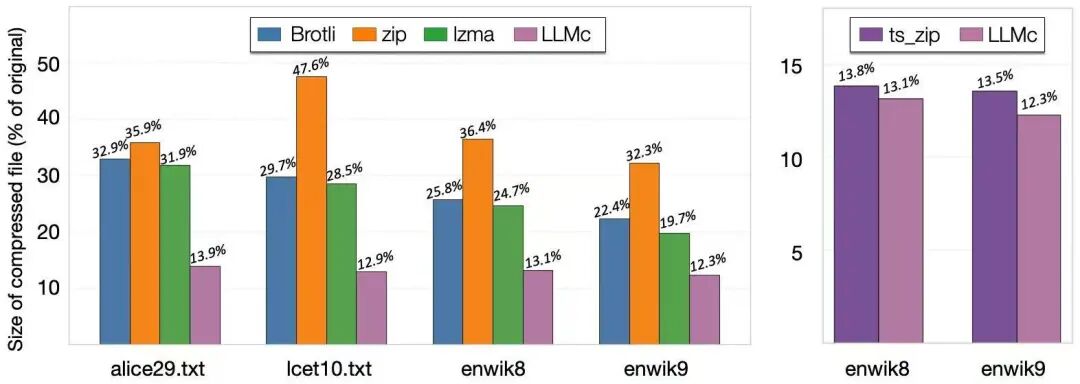
Core Insights - The article discusses the challenges of data storage arising from the generation of massive data by large language models (LLMs) and introduces an innovative solution called LLMc, which utilizes LLMs for lossless text compression [2][5]. Group 1: LLMc Overview - LLMc has demonstrated superior compression rates compared to traditional compression tools like ZIP and LZMA across various datasets, including Wikipedia, novels, and scientific abstracts [2]. - The project has been open-sourced, with the main author being Yi Pan, an undergraduate from Shanghai Jiao Tong University currently interning at the University of Washington [4]. Group 2: Compression Mechanism - The compression mechanism of LLMc is based on the principle of rank-based encoding, where the model predicts the next possible token and generates a probability distribution list [6]. - Instead of storing the token itself, LLMc stores the rank of the token in the probability list, which typically requires minimal storage space [6]. - During decompression, the same LLM and context are used to recreate the probability distribution, allowing for the accurate recovery of the original text using the stored rank [6]. Group 3: Challenges and Limitations - The research team identified several challenges with the current version of LLMc, including efficiency issues due to the quadratic relationship between LLM inference complexity and sequence length [7]. - The processing speed of LLMc is currently much lower than traditional compression algorithms due to its heavy reliance on large model inference [7]. - To ensure deterministic decompression, the system requires special kernels and integer encoding of token ranks instead of using logarithmic probabilities [8]. - The current implementation is primarily focused on natural language, with future exploration needed for extending its application to other modalities like images, videos, or binary data [9].
走进高校场馆,上一堂科学课
Ren Min Ri Bao· 2025-10-11 02:43
Core Points - The article highlights the importance of university museums in fostering scientific interest and innovation among students through exhibitions and storytelling of renowned scientists' contributions [2][3][4][5][6][7][8][9] Group 1: University Museums and Their Role - University museums serve as vital components of the scientific innovation system, providing students with immersive experiences in science and technology [2] - Exhibitions in these museums often showcase the historical contributions of scientists, inspiring students to pursue careers in science and technology [3][4][5][6] - The museums aim to instill a sense of national pride and responsibility among students, encouraging them to contribute to their country's development [3][4][6][9] Group 2: Student Experiences and Aspirations - Students express a deep emotional connection to the stories of scientists, which motivates them to commit to their studies and future careers [3][4][7] - Many students report that visiting these museums has solidified their academic and career aspirations, particularly in fields related to science and technology [4][8][9] - The museums provide a platform for students to engage with scientific knowledge actively, fostering a culture of inquiry and innovation [6][7][8]
校馆弦歌 | 上海交通大学钱学森图书馆:破壁归航的铭记与精神传承
Zhong Guo Xin Wen Wang· 2025-10-11 02:32
中新网上海10月11日电 (记者 许婧)这个国庆中秋假期,上海交通大学钱学森图书馆举办了"破壁者的越 洋归航"纪念钱学森归国70周年·国庆专场活动。特邀参演的上海好小囡少儿合唱团中有一位钱学森图书 馆的老朋友——来自上海外国语大学附属大境初级中学的黄开祺同学。2018年年底,一场上海交大师生 共同演绎的"我和我的祖国"快闪秀在央视新闻频道首播,黄开祺就是其中年龄最小的表演者。 钱学森是上海交大的杰出校友,他身上所凝聚的"爱国、创新、求实、奉献、协同、育人"的科学家精神 是交大宝贵的精神财富,深深感染和激励着每一名交大学子。参观钱学森图书馆、学习钱学森精神,也 是近年来每一名上海交大人的必修课。 在赵浩栋看来,理解钱学森精神,本质上是理解"如何做一个有信念、有能力、有担当的人",他期望将 自己的感受,真切地传递给参与活动的每一名新生,因为这种"传递"能让年轻人明白,真正的"好选 择",不仅是能让自己过得好,更是能通过所学报效国家。 钱学森图书馆相关负责人告诉记者,钱学森图书馆全新推出了"破壁者的越洋归航"2025级新生参观活 动,围绕钱学森归国70周年的主题讲解、"钱馆人说"专家导览、"学长说"历史沉浸式体验、 ...
走进高校场馆,上一堂科学课(校馆弦歌)
Ren Min Ri Bao· 2025-10-09 22:22
Core Points - The article highlights the importance of university museums in fostering scientific interest and innovation among students through engaging exhibits and stories of renowned scientists [2][3][4][5][8]. Group 1: University Museums and Their Role - University museums serve as vital components of the scientific innovation system, providing students with immersive experiences in science and technology [2]. - Exhibits in these museums often showcase the contributions of historical figures in science, inspiring students to pursue their academic and professional goals [3][4][5]. Group 2: Inspirational Stories of Scientists - The stories of scientists like Qian Xuesen and Yuan Longping are prominently featured, emphasizing their dedication to national development and the impact of their work on future generations [3][4]. - Students express how these narratives motivate them to contribute to their fields and serve their country, reflecting a strong sense of responsibility and ambition [4][9]. Group 3: Engaging Exhibits and Activities - Various universities organize activities and exhibitions that highlight significant scientific achievements, such as the development of nuclear energy and aerospace technology [5][6][7]. - The hands-on experiences and educational programs offered in these museums are designed to ignite students' passion for science and technology [8][9].
1.06亿元!上海交通大学采购大批仪器设备
仪器信息网· 2025-10-09 09:05
Core Viewpoint - Shanghai Jiao Tong University has announced procurement intentions for 12 types of scientific instruments and equipment, with a total budget of 106 million yuan, expected to be procured by October 2025 [2][3]. Procurement Overview - The procurement includes various advanced instruments such as electron beam lithography machines, ultra-low noise temperature control systems, ion beam etching equipment, vacuum multi-chamber magnetron sputtering systems, and wet dilution refrigerators [3][4]. - The total budget for these procurements is 106 million yuan, indicating significant investment in research and development capabilities [2][3]. Detailed Procurement List - **Electron Beam Lithography Machine**: 2 units, specifications include resolution ≤50 nm, acceleration voltage 1–100 kV, and spot size ≤16 nm, with a delivery period of 24 months from contract signing [4][5]. - **Ultra-Low Noise Temperature Control System**: 1 unit, with requirements such as equivalent noise density ≤5 nV/√Hz and a cooling power of ≥12 μW at 20 mK, also with a 24-month delivery period [4][5]. - **Ion Beam Etching Equipment**: 1 unit, specifications include ion energy 100–2000 eV and etching rate 1–100 nm/min, with a delivery period of 24 months [4][5]. - **Vacuum Multi-Chamber Magnetron Sputtering System**: 1 unit, requiring vacuum ≤6.7×10^-5 Pa and RF source power ≥500 W, with a 24-month delivery period [4][5]. - **Wet Dilution Refrigerator Scanning Probe Microscope System**: 1 unit, with a minimum temperature of ≤20 mK and a cooling power of 280 μW at 100 mK, also with a 24-month delivery period [6]. Additional Equipment Specifications - **Deep Silicon Etching Equipment**: 1 unit, with etching depth 10–500 µm and aspect ratio >20:1, delivery within 24 months [5]. - **Reactive Ion Etching Equipment**: 2 units, with specifications including working pressure 1 Pa to 10 Pa and etching resolution ≤50 nm, delivery within 24 months [5]. - **Laser Floating Zone Furnace**: 1 unit, with a laser power of 2KW and temperature >2500°C, delivery within 24 months [5]. - **Composite Coating System**: 1 unit, including electron beam evaporation and magnetron sputtering chambers, delivery within 24 months [5]. This procurement initiative reflects a strategic move by Shanghai Jiao Tong University to enhance its research infrastructure and capabilities in advanced materials and nanotechnology.

上海已设立博士后科研站点456个
Ren Min Ri Bao· 2025-10-08 23:01
Core Insights - Shanghai has established 456 postdoctoral research stations and has trained over 30,000 postdoctoral researchers, highlighting the city's commitment to nurturing high-level scientific talent [1][2] Group 1 - The postdoctoral system in China was initiated in 1985 at the suggestion of Professor Chen-Ning Yang, with Shanghai being one of the first implementation sites [1] - Currently, there are 273 postdoctoral research flow stations and 183 postdoctoral research workstations in Shanghai, with innovation practice bases established in all 16 districts [1] - The postdoctoral community in Shanghai, with nearly 10,000 active postdoctoral researchers, plays a crucial role in the city's high-level talent development and serves as a strong engine for deep integration of industry, academia, and research [1] Group 2 - The "China Postdoctoral Science Foundation Li Zhengdao Research Institute Special Grant" project was launched to support the training of outstanding postdoctoral talents focused on fundamental scientific issues and frontier scientific exploration [2] - A donation of a manuscript letter from Professor Li Zhengdao, advocating for the establishment of postdoctoral research flow stations in 1983, was made to the National Postdoctoral Management Committee Office and the Shanghai Talent Work Bureau [2]
把科学家精神融入大思政课
Zhong Guo Qing Nian Bao· 2025-10-03 18:38
Core Points - The Shanghai Jiao Tong University (SJTU) has introduced immersive ideological education courses, exemplified by a recent class where students acted out the life of Qian Xuesen, a foundational figure in China's electronic industry [1] - The Qian Xuesen Library, a national first-class museum and the only scientist memorial museum among 327 national first-class museums, serves as a significant educational and cultural hub [1][2] - The library features a comprehensive collection of over 62,000 items, including 16,000 classified cultural relics, and emphasizes the importance of the spirit of scientists in education [2][4] Educational Initiatives - The library has developed a rich educational framework that integrates the spirit of Qian Xuesen into a broader ideological education system, promoting a holistic approach to learning [3] - An immersive party class titled "Oath: The Transoceanic Return of the Breaker" was launched, involving students and volunteers in a theatrical presentation to enhance engagement [3] - The library organizes weekly "党员服务日" (Party Member Service Day) to facilitate micro-party classes, making ideological education accessible to a wider audience [4] Community Engagement - The library has established a youth volunteer group, the "Starry Sky Youth Explanation Group," which trains students to share stories about Qian Xuesen and the library, fostering a connection between youth and scientific heritage [3] - Over the past three years, the library has conducted 1,333 educational activities, reaching more than 2 million people, thereby promoting the spirit of scientists across various regions in China [4]

校馆弦歌丨心有大我 至诚报国——感受高校科学精神
Xin Hua Wang· 2025-10-01 08:22
Core Insights - The article emphasizes the integration of scientific spirit into education at various universities, fostering a sense of national pride and responsibility among students [1][2][3] Group 1: Educational Initiatives - Shanghai Jiao Tong University launched a series of scientific activities titled "The Return of the Wall Breakers Across the Ocean" to commemorate the 70th anniversary of alumni Qian Xuesen's return to China, using diverse formats to promote scientific spirit [1] - Tsinghua University's Science Museum showcases thousands of scientific artifacts, aiming to convey the stories of scientists and the underlying scientific spirit and national sentiment [2] - Zhejiang University's Art and Archaeology Museum hosts exhibitions that transform art history into an interactive experience, encouraging students to engage as active participants in cultural heritage [3] Group 2: Student Engagement - Students at Shanghai Jiao Tong University actively participate in historical experiences, deepening their understanding of Qian Xuesen's choices and contributions to science [1] - Tsinghua University aims to build a permanent science museum by 2027, with a vision to connect local, national, and global scientific narratives [2] - The educational approach at Zhejiang University emphasizes the role of museums as platforms for inquiry and cultural transmission, fostering critical thinking among students [3]
让公众与前沿科技第一时间“零距离”接触——科普如何“快半拍”?
Huan Qiu Wang Zi Xun· 2025-09-30 08:11
Core Insights - The first National Science Popularization Month in September saw over 500 million participants in various online science activities, with the topic "Millions of IPs Creating Science Popularization" generating over 13.85 billion views, indicating a growing public enthusiasm for cutting-edge science [1][2] - There is a significant mismatch between the increasing public demand for high-quality science exhibits and the slow supply of such resources, highlighting a pressing need for improved science communication and exhibition strategies [1][2][3] Group 1: Public Engagement and Demand - The China Science and Technology Museum's new exhibition "Innovation Foundation: Science Popularization for the People" was extremely popular, with rapid booking slots indicating high public interest [1] - Visitors expressed excitement over interactive exhibits showcasing recent technological advancements, such as wearable electronic fabrics and quantum computing models, emphasizing the public's desire for timely and relevant science education [2][3] Group 2: Supply Challenges and Content Gaps - Many existing science exhibitions lag behind current scientific advancements, leading to public frustration and a perception that science communication is outdated [2][3] - The need for timely updates in science exhibits is critical, as many visitors noted that previous exhibitions often featured outdated content, particularly in fields like AI and biotechnology [2][3] Group 3: Institutional Responses and Innovations - In response to the supply-demand gap, the China Science and Technology Museum has partnered with universities and research institutions to create science laboratories aimed at bridging the gap between laboratory research and public exhibitions [3][4] - New exhibits, such as the "Moon Life Canister," have been developed to provide interactive experiences that educate the public about recent scientific achievements, demonstrating a shift towards more engaging and informative science communication [5][6] Group 4: Recommendations for Improvement - Experts suggest establishing mechanisms to enhance the collaboration between scientific research and public education, including integrating science communication into research planning and evaluation [6][7] - There is a call for better recognition of science communication efforts in academic evaluations, which could incentivize researchers to engage more actively in public science education [7][8] - Funding for scientific research should include provisions for science communication, ensuring that research outcomes are effectively translated into public knowledge [8][9]