创想三维

Search documents
当“老东家”和“新黑马”摸向对方的“逆鳞”
3 6 Ke· 2025-11-26 11:31
Core Viewpoint - The industry is still in an upward phase, and the competition is characterized as a "zero-sum game" in a saturated market, indicating that the consumer-grade 3D printing sector may not yet be under significant stress [1]. Group 1: Investment and Competition - DJI has announced an investment in a consumer-grade 3D printing company, indicating confidence in the growth potential of the sector [3]. - The investment is perceived by the founder of TuoZhu Technology, Tao Ye, as a strategic move against his company rather than a genuine value investment, suggesting competitive tensions in the market [5][6]. - Talent migration from DJI to startups like TuoZhu is a significant factor, with many former employees choosing to join or establish competing firms [4][6]. Group 2: Market Dynamics and Growth - The global consumer-grade 3D printing market is projected to reach $4.1 billion by 2024, with a compound annual growth rate (CAGR) of 28% expected until 2029 [19]. - The number of consumer-grade 3D printers shipped is anticipated to grow from 4.1 million units in 2024 to 13.4 million units by 2029, reflecting a CAGR of 26.6% [21]. - The market is currently dominated by a few key players, often referred to as the "Four Little Dragons" of consumer-grade 3D printing, which includes TuoZhu Technology, indicating a concentrated competitive landscape [10]. Group 3: Company Performance and Strategy - TuoZhu Technology achieved revenues of approximately 5.5 to 6 billion yuan in 2024, with a net profit nearing 2 billion yuan, showcasing strong financial performance [10]. - The company has successfully positioned itself in the market by focusing on product quality and user experience, similar to DJI's approach in the drone industry [18]. - TuoZhu's community platform, MakerWorld, has become the largest 3D model community globally, enhancing user engagement and product accessibility [18]. Group 4: Technological Trends and User Engagement - The consumer-grade 3D printing market is characterized by a blend of hardware, software, and content, with a focus on lowering user barriers to entry [22]. - Advances in generative AI technology are expected to simplify 3D modeling, further broadening the user base and application scenarios [23]. - The target demographic for consumer-grade 3D printing remains tech-savvy young enthusiasts, whose engagement and feedback are crucial for product development [22].

申万宏源:AI赋能+技术突破+资金加码 持续看好消费级3D打印
智通财经网· 2025-11-26 06:52
Core Viewpoint - The report from Shenwan Hongyuan highlights the maturation of 2D to 3D model conversion technology, which is expected to enhance the "playability" of consumer-grade 3D printing and stimulate demand in this sector [1] Group 1: AI Empowerment - The NanoBanana Pro version has improved image quality and resolution, significantly enhancing text rendering capabilities and supporting the fusion of 14 images to create new visuals, providing flexible and efficient tools for 3D printing creators [1] - Meta is leading the commercialization of multi-modal models with the release of SAM 3D, which can convert segmented image slices directly into 3D models, allowing for individual reconstruction of objects even in the presence of occlusions [1] Group 2: Technological Breakthroughs - Traditional 3D printers face inefficiencies with color/material switching, leading to waste and low success rates; several companies are innovating in smart multi-color printing technology [2] - Snapmaker's U1 model reduces the waiting time for switching tools from about two minutes to just five seconds, significantly saving material costs, having raised $2.022 million on Kickstarter [2] - TuoZhu Technology's system can accommodate up to six replaceable hot ends and supports the use of up to 24 materials in a single print, showcasing industry-leading heating technology [2] Group 3: Investment and Industry Ecosystem - DJI has invested in Shenzhen Intelligent Technology Co., holding a 5% stake, which specializes in SLA and FDM 3D printing technologies [3] - Meituan has become a shareholder in Shenzhen Fast Technology Co., indicating a trend of major companies investing in the consumer-grade 3D printing sector to enhance the industry ecosystem [3] Group 4: Demand Outlook - In the first three quarters of 2025, China exported 3.491 million 3D printers, nearing the total of 3.778 million units expected for the entire year of 2024 [4] - The export value of 3D printers from January to September 2025 reached 7.514 billion yuan, close to the projected 8.163 billion yuan for the full year of 2024, with expectations of reaching 10.7 billion yuan in 2025 [4] Group 5: Key Industry Players - Key components include Jiepu Te and Ruike Laser (lasers), Jinchengzi (control cards + galvanometers) [5] - 3D scanners include Sikan Technology and Obsidian Light [5] - Material suppliers include Haizheng Shengcai (raw materials) and Jialian Technology (filaments) [5] - Notable machine manufacturers include TuoZhu Technology (unlisted), Chuangxiang Sanwei (in IPO process), Anker Innovation, and Huina Technology [5]

腾讯投资拓竹,3D打印市场卷疯了:大疆才是幕后超级赢家?
3 6 Ke· 2025-11-26 03:45
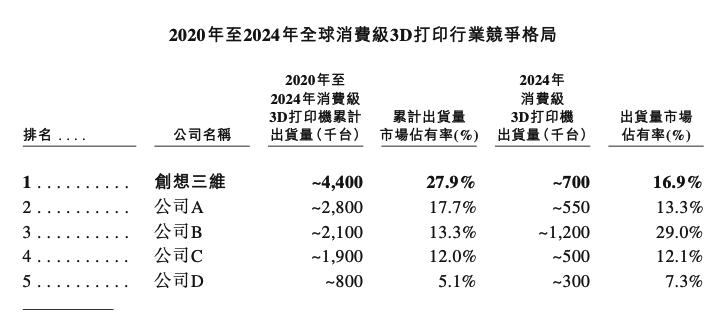
Core Insights - Bambu Lab, a rapidly growing company in the 3D printing sector, has achieved the highest sales in desktop 3D printers globally for three consecutive years and is valued at approximately $10 billion [1] - The global 3D printer market is projected to reach $24.61 billion in 2024, with a compound annual growth rate (CAGR) of 18.5% from 2024 to 2034 [3] - The consumer-grade 3D printer market is expected to see annual shipments grow from over 4 million units to 20 million units in the next five years, and then to 50 million units in the following five years [3] Company Overview - Bambu Lab's revenue is estimated to be around 6 billion RMB in 2024, with a shipment volume of approximately 1.2 million units, capturing about 29% of the global consumer-grade 3D printer market [1] - The company was founded by a team from DJI, which has contributed to its rapid growth and technological advancements in the 3D printing space [1][7] Market Dynamics - The competition in the consumer-grade 3D printer market is intensifying, with major players like Tencent and DJI investing in various companies, including Bambu Lab and Creality [5][12] - Bambu Lab has partnered with Tencent Cloud to integrate its 3D model platform MakerWorld with Tencent's 3D generation technology, which is seen as a key driver for market growth [3] Competitive Landscape - The "Shenzhen Four Kings" of consumer-grade 3D printers, which includes Bambu Lab, Creality, Zongwei Lifan, and Smart 3D, dominate approximately 95% of the entry-level 3D printer market [16][17] - Bambu Lab's current revenue significantly exceeds that of its competitors, with Smart 3D projected to reach 1.6 billion RMB in 2024 and 2.5 billion RMB in 2025 [13] Technological Advancements - Bambu Lab has leveraged technologies from its founders' experience at DJI, such as brushless motors and laser radar, to enhance the performance and capabilities of its 3D printers [7][9] - The integration of generative AI is lowering the barriers for users in 3D modeling, which is expected to further stimulate the growth of the 3D printing market [3] Future Outlook - The consumer-grade 3D printer market is still in its early development stages, with significant growth potential as major tech companies like Tencent and DJI continue to invest and innovate [22] - The market is being compared to the early days of the robotic vacuum cleaner industry, suggesting a potential for explosive growth in the coming years [22]

奥比中光(688322.SH):自2023年起,公司与消费级3D打印领军品牌创想三维建立深度战略合作
Ge Long Hui· 2025-11-25 07:48
Core Viewpoint - The company, Aobo Zhongguang (688322.SH), has established a deep strategic partnership with leading consumer-grade 3D printing brand Chuangxiang Sanwei since 2023, providing core underlying technology support for several industry benchmark products, including 3D printers and high-precision handheld 3D scanners, with significant progress in collaboration [1] Group 1 - The partnership with Chuangxiang Sanwei aims to enhance the application of 3D printing technology in various industries [1] - In 2024, the company plans to expand its application scenarios by collaborating with Peiji Glasses to launch a new product called "Magic Mirror Pro+", leveraging high-precision facial 3D scanning and modeling technology [1] - The new product will embody the personalized 3D printing customization concept of "one person, one mirror" [1]

拓竹几近完成新一轮融资,大厂参投,估值或达100亿美金|36氪独家
3 6 Ke· 2025-11-24 03:43
Core Viewpoint - The 3D printing company拓竹 is nearing the completion of a new financing round with Tencent participating, potentially valuing the company at $10 billion, although both companies have denied the accuracy of this information [1][2]. Company Overview -拓竹 is recognized as one of the most prominent unicorns in the primary market, with projected revenue of approximately 5.5 to 6 billion RMB and a net profit nearing 2 billion RMB for the previous year [2]. - The company has reportedly shipped over 1.2 million units, achieving a global market share of 29% [2]. Market Dynamics - The global 3D printing market is expected to reach a size of $24.61 billion (approximately 170 billion RMB) by 2024, with an annual growth rate of 18.5% from 2024 to 2034, indicating a rapid development phase for the industry [2]. - The competitive landscape has intensified, with nearly all mainstream 3D printer manufacturers launching their high-speed models in response to拓竹's innovations [5]. Technological Advancements -拓竹 has addressed key pain points in 3D printing, such as slow speed and complex operation, by integrating features like automatic leveling and a fully enclosed structure, significantly enhancing user experience [2][3]. - The introduction of multi-color printing has increased its penetration rate, creating a "technology window" of two years where拓竹 has rapidly advanced without significant competition [3]. Competitive Landscape - The entry of DJI, a former employer of拓竹's founder, into the 3D printing market through investment in智能派 highlights the growing competition, as DJI aims to leverage its manufacturing capabilities and software integration [6]. - The competition is shifting from hardware specifications to software stability, cloud services, and user-friendly ecosystems, marking a new focus in the industry [6].
东南亚多国调研精要,小米多模型构建AI端侧生态,3D打印高增
SINOLINK SECURITIES· 2025-11-23 11:39
Investment Rating - The report does not explicitly provide an investment rating for the industry Core Insights - The research highlights the significant generational differences in consumer behavior and production capabilities across Thailand, Vietnam, and Cambodia, with Thailand resembling a "miniature" version of the Western consumer market, Vietnam in a rapid growth phase, and Cambodia reflecting characteristics of less developed nations [1] - The report emphasizes the potential for investment in Southeast Asia, particularly in consumer goods and technology-driven sectors, as companies leverage local production capabilities and growing consumer markets [1][2] Summary by Sections 1. Industry Insights - Thailand is compared to a "miniature" Western market, showcasing a mature consumer culture and a well-developed service industry, making it a reference point for companies looking to expand into Western markets [1] - Vietnam is characterized as a rapidly developing economy, with a GDP projected to reach approximately 62.69 trillion VND (around 4,700 USD) in 2024, indicating a significant consumer market potential [1] - Cambodia is noted for its low average income and high income disparity, with consumer spending primarily focused on essential goods, suggesting a slower penetration of discretionary spending [1] 2. Segment Tracking - Xiaomi Group is exploring the future of smart home technology with its Xiaomi Miloco initiative, aiming to enhance user interaction and privacy through advanced AI models [9][10] - The pet food sector saw significant growth during the Double Eleven shopping festival, with sales for the brand Guibao exceeding 1 billion RMB, reflecting a trend towards premium pet products [11][12] - The AI and 3D printing industry is experiencing high demand, with companies like Tuozhu achieving record sales during major shopping events, indicating strong market potential [21][22] 3. Macro Consumption Data - In October, the Consumer Price Index (CPI) showed a year-on-year increase of 0.2%, with service sector prices rising, indicating a recovery in consumer spending [35] - The Producer Price Index (PPI) decreased by 2.1% year-on-year, but showed signs of improvement in the month-on-month trend, suggesting a potential stabilization in production costs [45] - Online sales data from major platforms indicated a decline in the home appliance sector, with specific brands like Ecovacs and Roborock showing positive growth despite overall market challenges [50]

800元一台,年入55亿,3D打印机杀疯了
3 6 Ke· 2025-11-20 12:06
Core Insights - The 3D printing market is experiencing rapid growth as young consumers showcase various printed products on social media, driven by lower prices and increased accessibility [2][3] - Major investments from companies like DJI, Meituan, and Hillhouse Capital indicate a competitive landscape in the 3D printing sector, with leading companies like Tuozhu Technology achieving a valuation exceeding 30 billion RMB and a global market share of 29% [2][8] - The market is characterized by high concentration, with the top five companies holding nearly 90% of the market share, leading to intensified competition [2][14] Market Dynamics - The price of consumer-grade 3D printers has significantly decreased, with many models available for around 800 RMB, making them more accessible to ordinary users [3][5] - The introduction of generative AI modeling tools has lowered the barriers for consumers, enhancing the appeal of 3D printing [3][5] - The sales channels for 3D printers are shifting from offline distributors to online platforms like Tmall and JD, with online sales expected to account for about 50% of total sales by 2024 [12] Financial Performance - Tuozhu Technology is projected to generate over 5.5 billion RMB in revenue in 2024, with a net profit margin of 30% [6][14] - The cost of raw materials for companies like Chuangxiang Sanwei has remained around 50% of sales costs, with a consistent gross margin of approximately 30% [9] Competitive Landscape - The entry of DJI into the 3D printing market has heightened competition, with significant investments in companies like Smart派 and others [7][8] - The leading companies in the market, referred to as the "Four Little Dragons," include Tuozhu Technology, Chuangxiang Sanwei, Zongwei Lifang, and Smart派, collectively dominating the global market [14][16] - The MakerWorld platform launched by Tuozhu Technology has attracted nearly 10 million active users, facilitating a content ecosystem that supports creators and enhances user engagement [8][9] Future Outlook - The global 3D printing market is expected to reach a size of 24.61 billion USD in 2024, with a projected CAGR of 18.5% over the next decade [16] - The challenge remains for companies to create more use cases and integrate 3D printing into everyday life, similar to the impact of smartphones [16]
五个大疆前员工攒了个3D打印公司,年入60亿,老东家坐不住了
3 6 Ke· 2025-11-20 00:20
Core Viewpoint - A competitive landscape is emerging in the 3D printing industry, particularly in Shenzhen, as DJI invests in a rival company, Smart Pie, raising concerns for its former employee, Tao Ye, founder of Tuo Zhu Technology [1][2][3]. Group 1: Investment and Market Dynamics - DJI has invested in Smart Pie, a domestic 3D printing company, indicating its confidence in the growth potential of the consumer-grade 3D printing market [4][12]. - The global 3D printing market is projected to reach $24.61 billion (approximately 1700 billion RMB) in 2024, with an expected annual growth rate of 18.5% over the next decade [12][13]. - The consumer-grade segment is anticipated to grow significantly, reaching $4.1 billion in 2024, accounting for 16% of the overall market, with a remarkable annual growth rate of 28% [15]. Group 2: Company Performance and Competition - Tuo Zhu Technology has rapidly grown, achieving revenues exceeding 5 billion RMB in just four years, outpacing DJI's growth trajectory during its early years [10][17]. - Tuo Zhu's revenue for 2024 is projected to be between 5.5 billion and 6 billion RMB, with a net profit nearing 2 billion RMB [17]. - The competitive landscape is dominated by four Shenzhen companies—Tuo Zhu Technology, Smart Pie, Zongwei Lifang, and Chuangxiang Sanwei—holding 90% of the global entry-level 3D printer market [16][26]. Group 3: Technological Advancements - Advances in technology and user experience have driven the explosion of consumer-grade 3D printing, with Tuo Zhu's innovations in hardware and software significantly improving product usability [20][22]. - Tuo Zhu's MakerWorld platform has become the largest 3D model community globally, with nearly 10 million monthly active users and over one million models available [23]. - The integration of AI in 3D design is lowering barriers for users, allowing for easier model generation and optimization, further accelerating market growth [25]. Group 4: Future Outlook - DJI's entry into the 3D printing market is seen as a potential turning point, signaling a shift from niche hobbyist products to mainstream consumer applications [27]. - The industry is expected to continue its rapid growth, with projections indicating that the consumer-grade 3D printing market could reach $16.9 billion by 2029, reflecting a compound annual growth rate of 33% [25].
大疆投资消费级3D打印 拓竹创始人称要靠产品说话
Mei Ri Jing Ji Xin Wen· 2025-11-19 12:44
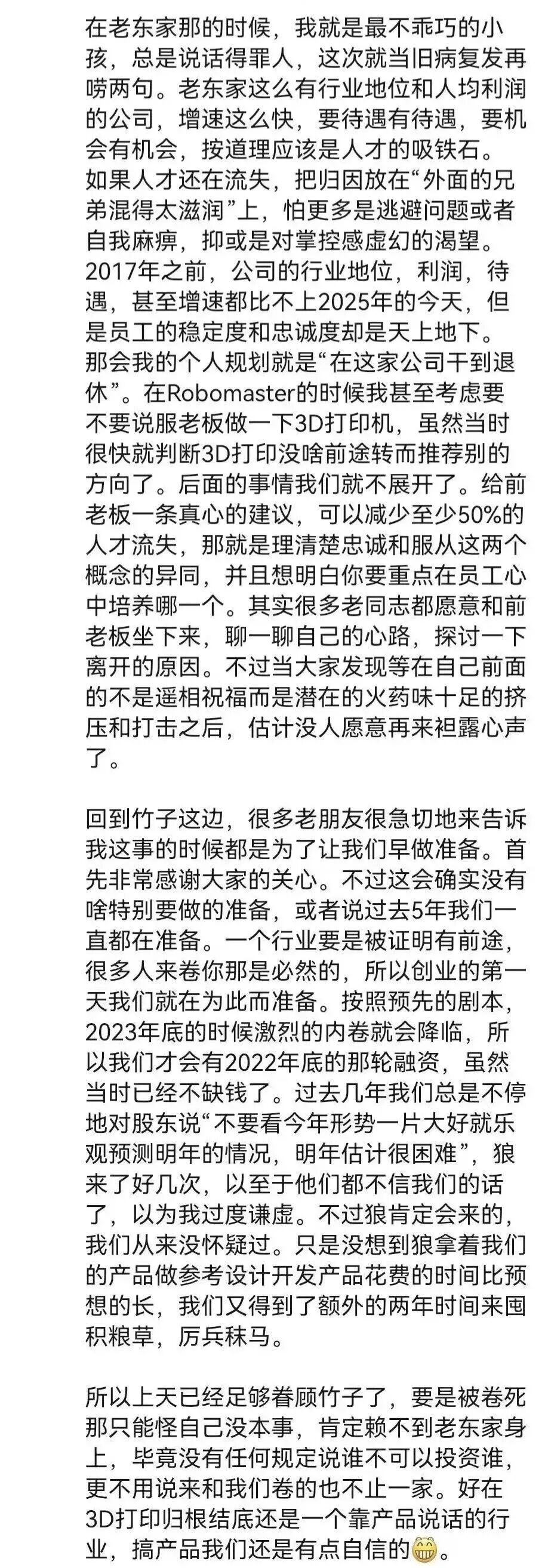
在消费级全景相机市场与影石创新短兵相接后,大疆又将目光投向了另一个高速增长的赛道——消费级 3D打印(被称作增材制造技术,是一种依据三维CAD数据通过逐层材料累加的方法,实现实体零件的 制造)。不过,这一次大疆并未选择亲自下场,而是以投资的方式切入这一领域。近日,大疆回应《每 日经济新闻》记者称:"本次投资是基于公司对消费级3D打印技术发展潜力、行业增长潜力的看好,符 合大疆对创新科技的一贯理念和前瞻性布局。" 尽管大疆未在回应中明确被投方名称,但据市场普遍说法,其投资对象为国内3D打印企业智能派。更 引人关注的是,这笔看似常规的投资,却因为投资协议中"专门安排了涉及拓竹科技的相关条款"而在业 内掀起波澜。 上周末,拓竹科技创始人陶冶一条朋友圈千字长文在业内广泛传播。他在文中直言,此次投资更像是老 东家对拓竹科技发起的"火力打击",而非纯粹的"价值投资"。 如今,随着大疆以投资方式与拓竹科技踏入同一战场,一场围绕技术、市场与人才的对决已然拉开序 幕。而业界关注的焦点是,大疆入局消费级3D打印领域,究竟能否撼动拓竹科技已建立的领先地位? 消费级3D打印增长劲爆 近年来,随着技术成熟与成本下降、产品体验显著提升, ...
3D打印引爆风口,机构“淘金”绩优概念股
Huan Qiu Wang· 2025-11-19 02:52
Group 1 - The 3D printing industry is experiencing a new wave of capital influx, with major companies like DJI entering the consumer-grade 3D printing market, indicating strong growth potential and industry prospects [1][2] - DJI's investment in the smart company specializing in light curing and fused deposition technology is expected to enhance market competitiveness and drive technological upgrades in the industry [1] - Other tech giants such as Meituan and Tencent are also deepening their investments in the 3D printing sector, with Meituan investing in Snapmaker and Tencent backing the company Creality, which aims to become the first publicly listed consumer-grade 3D printing company [1][2] Group 2 - The global 3D printing market is projected to reach approximately 170 billion RMB by 2024, with a compound annual growth rate of 18.5% over the next decade [2] - In the first quarter of 2025, global shipments of entry-level 3D printers are expected to exceed 1 million units, with Chinese suppliers contributing 95% of the market share [2] - In China, the production of 3D printing equipment increased by 40.5% year-on-year in the first three quarters, significantly outpacing growth in industrial robots and new energy vehicles [4] Group 3 - The demand for 3D printing is being driven by the IP economy and the trend of personalized collectibles, positioning 3D printing as a solution for the high demand for customized products [4] - A-share 3D printing concept stocks have shown strong performance, with over 90% of stocks in the sector experiencing price increases this year, and notable companies like Tiangong Co. seeing stock prices rise by approximately 374% [4] - Among 27 high-growth companies, 15 have recently attracted significant institutional interest, indicating a renewed recognition of the investment value in the 3D printing industry [5][6]