
思瑞浦

Search documents
半月11起 半导体并购新叙事如何走
2 1 Shi Ji Jing Ji Bao Dao· 2025-12-19 02:20
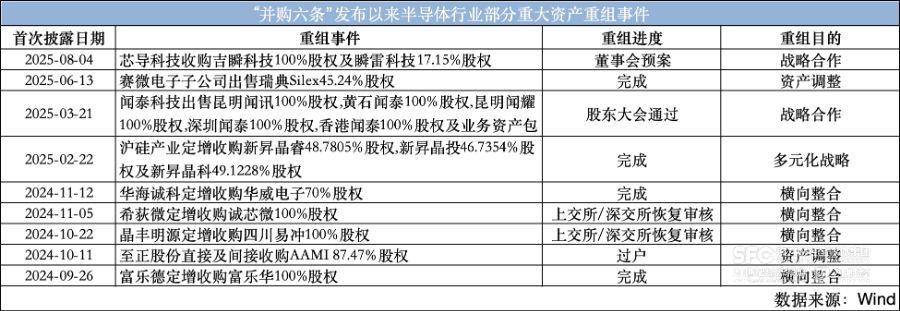
Group 1 - The semiconductor industry has become a hotbed for mergers and acquisitions, with 206 related events reported since the announcement of the "merger six rules" last September, averaging one event every two days, including 16 major asset restructurings [1][2] - However, since December, there has been a noticeable slowdown in A-share semiconductor mergers, with several companies, including Haiguang Information and SIRUI, announcing the termination of significant asset restructuring plans [1][5] - Cross-industry mergers are increasingly common, with companies from different sectors, such as outdoor brands and retail, entering the semiconductor space to diversify and seek new growth opportunities [1][8] Group 2 - The semiconductor sector is viewed as the foundation of digitalization and intelligence, making it a focal point for global competition and resource allocation [2][10] - Mergers and acquisitions are seen as essential for companies to overcome technological barriers and expand market share, necessitating clear industry judgment and effective post-merger integration capabilities [2][9] - Recent statistics indicate that 11 semiconductor-related merger announcements were made in early December alone, covering various fields such as semiconductor equipment and chip design [4] Group 3 - Notable recent mergers include the acquisition of a 49% stake in Zhuhai Noah Changtian Storage Technology by Puran Co., which aims to enhance its non-volatile storage product layout [4] - Conversely, several companies, including Haiguang Information and Chipone, have terminated their merger plans due to disagreements on core transaction terms and market conditions [5][7] - Industry experts suggest that the current trend of merger terminations is normal, as various factors influence negotiations, and future opportunities for mergers may still arise [7][12] Group 4 - The end-of-year surge in semiconductor mergers is attributed to a combination of capital market dynamics, policy support, and industry growth, with over 20 companies currently pursuing IPOs in the semiconductor sector [10][11] - The semiconductor industry is characterized by high research and development risks and significant capital requirements, making cross-industry mergers particularly challenging for traditional companies [12]


狂欢变翻车!半导体千亿并购突然刹车,原因太现实
Sou Hu Cai Jing· 2025-12-18 09:33
从芯原股份到中科曙光,千亿级交易说停就停,看似是条款谈不拢,实则背后全是资本的激烈博弈! 其实不止芯原股份,半导体圈的并购"黄了"的还真不少。海光信息和中科曙光的千亿级换股合并计划, 从今年5月末开始筹划,原本各方都在积极推进,但因交易规模大、涉及相关方多,方案论证耗时长, 叠加当前市场环境较筹划之初发生较大变化,最终宣告终止。在此期间,海光信息股价累计涨超50%还 创了历史新高,中科曙光股价也同步刷新历史高点;结果终止公告一出,中科曙光直接跌停。 这样的案例还有很多,比如帝奥微想收购荣湃半导体拓展产品线,核心条款谈不拢只能作罢;思瑞浦收 购奥拉半导体的计划,因并购条件不成熟,仅历时半个月就夭折了。 这一连串密集的并购终止公告,不仅暴露了当下半导体并购市场的共性难题,更折射出当前半导体行业 需求疲软、估值波动大的现状—— 买卖双方对定价、条款难达共识,叠加整合风险高企,不少并购案 只能无奈搁浅。 说到底,半导体并购看似是风口红利,实则暗藏估值博弈、条款分歧的多重陷阱,股民跟风入场极易沦 为"接盘侠"。盲目追高不如看清产业逻辑、警惕反转剧情。 最近半导体赛道那叫一个红红火火,本以为跟着并购消息能分享一波行业红利 ...
半导体并购案密集终止,什么信号
是说芯语· 2025-12-18 06:32
Core Viewpoint - The semiconductor industry is experiencing a significant slowdown in merger and acquisition (M&A) activities, with several high-profile deals being terminated due to valuation discrepancies and regulatory scrutiny [3][4][6]. Group 1: Termination of Mergers - Major asset restructuring plans, such as the merger between Zhongke Shuguang and Haiguang Information, have been called off, reflecting a broader trend in the semiconductor sector [1][3]. - The termination of the merger between Zhongke Shuguang and Haiguang Information was attributed to significant fluctuations in stock prices, with Zhongke Shuguang's stock rising by 61.76% and Haiguang Information's by 61.1% since the merger announcement [3][4]. - Chipone's acquisition of Xilinx was also halted due to unmet key conditions and misalignment of interests between the parties involved [4][5]. Group 2: Market Environment and Valuation Issues - The semiconductor sector is facing challenges related to high valuation expectations from sellers, which has led to failed M&A negotiations [5][9]. - The recent surge in M&A terminations is partly due to the introduction of new policies aimed at supporting acquisitions of high-quality, unprofitable tech companies, which has increased the number of disclosed M&A cases [5][6]. - The fluctuation in market demand and the tightening of regulatory scrutiny on semiconductor M&A activities have made companies more cautious about pursuing high-premium targets [6][9]. Group 3: Strategic Shifts in M&A - Despite the setbacks, companies like Chipone are actively seeking to enhance their technological capabilities through targeted acquisitions, as seen in their move to acquire Zhudian Semiconductor [8][9]. - The focus on strategic acquisitions is underscored by the belief that successful mergers can lead to significant synergies, with industry leaders advocating for a more collaborative approach to M&A [9]. - The semiconductor industry is encouraged to pursue consolidation as a means to strengthen market positions and achieve economies of scale, particularly in the fragmented analog chip sector [9].

半导体并购案密集终止,什么信号
2 1 Shi Ji Jing Ji Bao Dao· 2025-12-18 06:17
Core Viewpoint - The semiconductor industry in China is experiencing a significant slowdown in merger and acquisition (M&A) activities, with several high-profile deals being terminated due to various factors including valuation discrepancies and regulatory scrutiny [3][10]. Group 1: Termination of Mergers - Major asset restructuring plans involving domestic computing leader Zhongke Shuguang and Haiguang Information, as well as the acquisition of Chipmunk Technology by Chip Origin, have been announced as terminated [1][6]. - The termination of these deals reflects a broader trend in the semiconductor sector, where companies cite reasons such as "changes in market environment" and "failure to reach consensus on core terms" [3][6]. Group 2: Market Dynamics and Valuation Issues - The stock prices of Zhongke Shuguang and Haiguang Information saw significant fluctuations, with increases of 61.76% and 61.1% respectively since the announcement of the merger plan, complicating the share exchange proposal [5]. - The complexity of shareholder structures and differing interests among investors have made it challenging to reach agreements on valuations, contributing to the failure of M&A deals [7][10]. Group 3: Regulatory Environment - The regulatory landscape for semiconductor M&A is becoming increasingly stringent, with authorities scrutinizing cross-industry mergers more closely [8]. - Recent policies aimed at supporting acquisitions of high-quality, unprofitable tech companies have led to a surge in M&A activity, but also an increase in the number of terminated deals as expectations and valuations clash [6][10]. Group 4: Future M&A Strategies - Despite recent setbacks, companies like Chip Origin are actively seeking new acquisition opportunities, as evidenced by their plan to invest in and acquire control of ZD Semiconductor [10][11]. - The semiconductor industry is expected to continue pursuing M&A as a strategy for growth, with a focus on integrating core technologies and expanding into emerging markets [11][12].
半导体并购案密集终止,什么信号
21世纪经济报道· 2025-12-18 06:15
Core Viewpoint - The semiconductor industry is experiencing a significant slowdown in merger and acquisition (M&A) activities, with several high-profile deals being terminated due to market volatility and valuation discrepancies [1][4][5]. Group 1: Termination of Mergers - The merger between Zhongke Shuguang and Haiguang Information was terminated due to significant fluctuations in their stock prices since the announcement of the merger plan, with Zhongke Shuguang's stock rising by 61.76% and Haiguang Information's by 61.1% [4][5]. - Chipone Technology's acquisition of RISC-V unicorn ChipLai was also called off, attributed to unmet key conditions and differences in valuation expectations between the parties involved [5][6]. Group 2: Market Environment and Regulatory Factors - The semiconductor sector is facing a tightening regulatory environment, with increased scrutiny on M&A activities, particularly those involving cross-industry transactions [7][8]. - The recent surge in M&A activity in the semiconductor industry has led to a higher absolute number of terminated deals, as the market adjusts to new policies and valuation challenges [6][7]. Group 3: Strategic Shifts in M&A - Despite the termination of certain acquisitions, companies like Chipone Technology are actively seeking new opportunities, as evidenced by their plan to acquire control of ZD Semiconductor, indicating a strategic pivot towards enhancing their technology portfolio [10][11]. - The current market conditions are viewed as favorable for acquisitions, with industry leaders emphasizing the importance of achieving synergies that exceed the sum of individual company values [11].
半导体并购为何频频“刹停”?
Jin Rong Shi Bao· 2025-12-18 01:04
Group 1 - Several recent mergers and acquisitions in the A-share semiconductor sector have been halted, raising market concerns [1] - DiAo Micro announced the termination of its acquisition of Rongpai Semiconductor due to failure to reach consensus on key terms [1] - SiRuPu decided to terminate its acquisition of Ningbo Aola Semiconductor as the conditions for major asset restructuring were not fully mature [1] Group 2 - The majority of terminated transactions involve small and medium-sized private listed companies, primarily focusing on significant cash or share transactions [2] - The core issues leading to transaction terminations are the inability to agree on key terms and changes in market conditions that render transaction conditions immature [2] - The success rate of mergers and acquisitions in the Sci-Tech Innovation Board is over 70%, indicating that a certain percentage of terminated transactions may be a normal aspect of market-driven mergers [2] Group 3 - The high activity level in the semiconductor industry and the complexity of shareholder structures contribute to increased negotiation difficulties in mergers and acquisitions [3] - Market demand fluctuations and changes in the market environment have made companies more cautious in pursuing acquisitions to avoid operational risks [3] Group 4 - To protect investor interests, regulations have been established to enhance information disclosure and communication regarding terminated restructurings [4] - Companies that terminate restructurings have been proactive in disclosing reasons and potential impacts, often holding investor meetings to address market concerns [4] - Following the termination of restructurings, related companies' stock prices have seen an approximate decline of 4%, reflecting a stable market response without significant irrational fluctuations [4] Group 5 - The China Securities Regulatory Commission has proposed regulations to standardize merger and acquisition behaviors and clarify the responsibilities of financial advisors [5] - In 2024, regulatory authorities addressed 35 cases of insider trading related to mergers and acquisitions, demonstrating a strict regulatory approach [5] - The regulatory environment emphasizes a "zero tolerance" policy towards fraudulent activities in mergers and acquisitions, aiming to protect the rights of small investors [5]
估值倒挂、监管趋严 半导体并购“收油减速”
2 1 Shi Ji Jing Ji Bao Dao· 2025-12-17 12:57
Core Viewpoint - The semiconductor industry is experiencing a significant slowdown in merger and acquisition (M&A) activities, with several high-profile deals being terminated due to valuation discrepancies and regulatory scrutiny [3][4][5]. Group 1: Termination of Mergers - Zhongke Shuguang (603019.SH) and Haiguang Information (688041.SH) have terminated their planned merger, which aimed for deep integration through a stock swap absorption merger [1]. - Chipone Technology (688521.SH) has also abandoned its acquisition of RISC-V unicorn Chipwise due to unmet key conditions [1][4]. - Other semiconductor companies, such as Sierpo (688536.SH) and Diaowei (688381.SH), have similarly announced the termination of their M&A plans in December [2]. Group 2: Reasons for Termination - The primary reasons for the halted M&A activities include valuation mismatches and stricter regulatory environments [3][5]. - Haiguang Information's CEO noted significant fluctuations in stock prices since the merger announcement, with Zhongke Shuguang's stock rising by 61.76% and Haiguang's by 61.1% since the proposal [3]. - The complexity of shareholder structures and the large asset scale involved in these transactions have added further challenges to achieving consensus [3]. Group 3: Market Environment and Valuation Issues - The semiconductor sector has seen a decline in valuations due to changing market conditions, making it a challenging environment for M&A [4][9]. - The founder of Chipone Technology indicated that high seller valuation expectations have been a significant barrier to successful negotiations [4]. - The recent surge in M&A activity, driven by supportive policies for high-tech acquisitions, has also led to an increase in the number of terminated deals [5]. Group 4: Regulatory Scrutiny - Regulatory bodies are increasingly scrutinizing semiconductor M&A activities, particularly those involving cross-industry mergers [6][7]. - The Shanghai Stock Exchange has issued guidelines to prevent speculative mergers and ensure the quality of injected assets [7]. Group 5: Future M&A Trends - Despite recent setbacks, the trend towards consolidation in the semiconductor industry remains strong, with companies like Chipone Technology actively seeking new acquisition opportunities [8][9]. - The focus on acquiring high-quality assets and enhancing technological capabilities continues to drive M&A strategies in the sector [8][9].
估值倒挂、监管趋严,半导体并购“收油减速”
2 1 Shi Ji Jing Ji Bao Dao· 2025-12-17 12:53
Core Viewpoint - The recent trend in the semiconductor industry shows a significant slowdown in merger and acquisition (M&A) activities, with several high-profile deals being terminated due to valuation discrepancies and regulatory scrutiny. Group 1: Termination of Mergers - Major asset restructuring plans, such as the merger between Zhongke Shuguang and Haiguang Information, and the acquisition of Chipwise by Xinyuan Co., have been announced as terminated [1][2] - Other semiconductor companies, including SIRUI and Diao Wei, have also declared the termination of their M&A activities in December [2] Group 2: Reasons for Termination - The primary reasons for the halted M&A activities include valuation mismatches and stricter regulatory environments [3] - The stock price volatility of the involved companies has complicated the merger processes, with Zhongke Shuguang's stock rising by 61.76% and Haiguang Information's by 61.1% since the merger announcement [3] - The complexity of shareholder structures and differing interests among stakeholders have also contributed to the challenges in finalizing these deals [3] Group 3: Market Dynamics and Valuation Issues - The termination of the acquisition of Chipwise highlights the valuation conflicts between listed and unlisted companies, indicating that sellers often have inflated expectations [4] - The semiconductor sector has seen a decline in valuations due to a slowdown in IPO activities, making it a challenging environment for M&A [4][8] - The recent surge in M&A announcements has led to a higher absolute number of terminations, as the market adjusts to new policies and economic conditions [5] Group 4: Regulatory Environment - Regulatory scrutiny on semiconductor M&A has intensified, with the Shanghai Stock Exchange closely examining cross-industry mergers and acquisitions [6] - The exchange has highlighted the need for careful evaluation of transaction purposes and asset quality to prevent speculative activities [6] Group 5: Future M&A Trends - Despite recent setbacks, the semiconductor industry continues to view M&A as a strategic necessity for growth and technological integration [7][8] - Companies are actively seeking to acquire quality assets to enhance their technological capabilities and market position [7] - The industry consensus suggests that M&A will remain a critical pathway for achieving scale and strength in the semiconductor sector [8]
商业航天爆了!多家上市公司紧急声明
Shen Zhen Shang Bao· 2025-12-17 01:55
Group 1 - The core viewpoint of the articles highlights the recent surge in the commercial aerospace sector within the A-share market, with many companies disclosing that their main businesses do not involve commercial aerospace only after significant stock price increases [1][2][3] - Since mid-November, the A-share market has experienced a downturn, but the commercial aerospace concept rebounded on November 24, achieving an approximate 18% increase by December 15, while the overall market index only rose by 0.16% [1] - The National Space Administration has issued a development action plan for commercial aerospace from 2025 to 2027, establishing a dedicated regulatory body to promote high-quality development in the sector [2] Group 2 - Several companies, including Aerospace Information and Aerospace Engineering, have publicly stated that their main business does not involve commercial aerospace, despite significant stock price increases [3][4] - Aerospace Engineering's stock price rose over 50% since November 28, reaching a 10-year high, but the company only acknowledged its non-involvement in commercial aerospace on December 16 [3] - Aerospace Dynamics and other companies have also issued announcements clarifying their lack of involvement in commercial aerospace, even as their stock prices surged significantly [4][5]
思瑞浦:公司高度重视光模块业务的发展
Zheng Quan Ri Bao Wang· 2025-12-16 14:15
Core Viewpoint - The company emphasizes the importance of its optical module business, particularly the Analog Front-End (AFE) chips, which are critical components that directly affect the overall performance of high-speed optical modules [1] Group 1: Business Development - The company has established a complete capability from research and development to mass production for AFE chips [1] - High-value AFE products have been successfully integrated into the supply chains of leading industry clients, achieving stable delivery [1] Group 2: Market Trends - The ongoing growth in global data center and AI computing power demand is driving advancements in optical module technology towards higher speeds [1] - This evolution is expected to increase the technical barriers and product value of AFE chips, potentially injecting new momentum into the company's product structure and performance growth [1] Group 3: Strategic Focus - The company will continue to focus on technological innovation and customer needs to consolidate and expand its leading position in this important sector [1]