
监管趋严

Search documents
长江证券股价创60日新低,资金流出与行业情绪是主因
Jing Ji Guan Cha Wang· 2026-02-14 07:29
Company Performance - The company is expected to achieve a net profit of 3.695 billion yuan in 2025, representing a year-on-year increase of 101.37% [1] - The non-deducted net profit is projected to be 3.775 billion yuan, with a year-on-year growth of 108.60% [1] - In the first three quarters of 2025, the company reported total operating revenue of 8.49 billion yuan and a net profit attributable to shareholders of 3.37 billion yuan, with a weighted average return on equity of 9.23%, ranking first among listed securities firms [1] Stock Performance - On February 13, the company's stock price closed at 7.80 yuan, down 2.01%, marking a 60-day low, with a trading volume of 435 million yuan and a turnover rate of 1.0% [1] - The stock has cumulatively declined by 2.01% over the past five days and 8.34% over the past 20 days, with a year-to-date decrease of 4.29% [1] - Technical indicators show that the stock price has fallen below all major moving averages, with a negative MACD histogram value of -0.141 and a KDJ indicator K value of 8.50, indicating an oversold condition [1] Market Environment - The securities sector index fell by 1.03% on the same day, while the non-bank financial sector dropped by 1.26%, underperforming the broader market [2] - The China Securities Regulatory Commission announced penalties against Tianfeng Securities and other brokerages on February 14, indicating stricter regulations that have impacted industry sentiment [2] - The stock price hitting a 60-day low is attributed to a combination of technical adjustments, capital outflows, and industry sentiment, contrasting with the company's strong fundamentals [2]

市值23亿的通信大厂面临退市!
Xin Lang Cai Jing· 2026-02-12 12:23
Core Viewpoint - Yuan Dao Communication has been placed under investigation by the China Securities Regulatory Commission for suspected financial data falsification in its annual report, which may lead to a forced delisting risk if found guilty [1][14]. Company Overview - Yuan Dao Communication was a notable player in the telecommunications sector, covering network construction, maintenance optimization, and ICT services, with a strong client base including major operators and equipment manufacturers [2][15]. - The company reported a revenue of 2.111 billion and a net profit of 125 million in 2022, positioning it as a "high-performing stock" in the ChiNext market [2][16]. Financial Performance Decline - From 2022 to 2024, Yuan Dao Communication experienced a dramatic decline in financial performance, with revenue dropping from 2.111 billion to 1.282 billion, a nearly 40% decrease, and net profit falling from 125 million to 42 million, more than halving [6][22]. - The projected net profit for 2025 is expected to be between 10 million and 15 million, representing a decline of over 60% year-on-year, indicating systemic issues rather than mere business fluctuations [4][18]. Industry Issues - The challenges faced by Yuan Dao Communication reflect deeper issues within the telecommunications service industry, characterized by long cash flow cycles, high accounts receivable ratios, and relatively low profit margins, leading companies to manipulate financial data to meet performance expectations [5][19]. - The reliance on major state-owned enterprises as clients means that any financial misconduct can severely impact future business relationships, as these clients have strict financial requirements [8][20]. Industry Restructuring - Yuan Dao Communication's situation is indicative of a broader restructuring within the telecommunications service industry, where the end of the 5G construction boom has led to increased competition and a narrowing of growth opportunities [9][21]. - Companies that relied on superficial narratives and concept packaging are now being exposed, while those with genuine technical capabilities and strong customer loyalty are maintaining stability [9][21]. Regulatory Environment - The investigation into Yuan Dao Communication underscores the regulatory body's zero-tolerance stance on financial fraud within the ChiNext market, with increasing penalties for serious offenses [10][23]. - The trend of stricter regulations is seen as beneficial for investors, as it aims to eliminate companies that rely on deceptive practices to present themselves as high-value stocks [10][23]. Lessons for the Industry - The case of Yuan Dao Communication serves as a cautionary tale for other telecommunications service companies, emphasizing the importance of long-term development over short-term gains and the need for robust financial management systems [11][24]. - Companies are encouraged to focus on core competencies and build strong customer relationships, as the telecommunications sector requires solid technical foundations and effective project management [11][24].


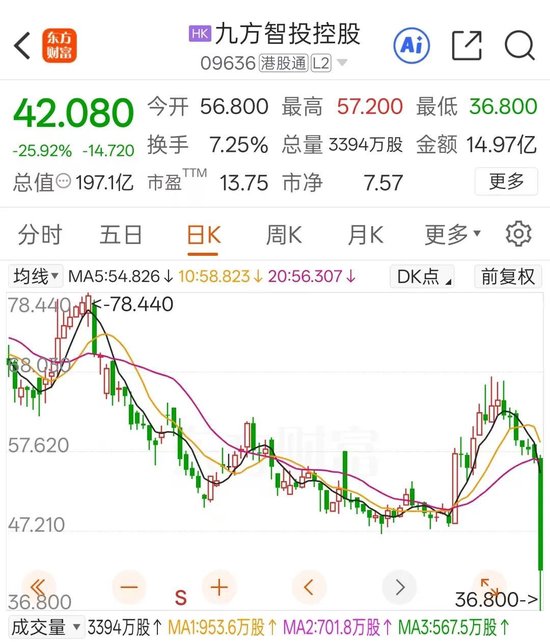
盘中暴跌超35%!知名投顾公司, 午后突然跳水!
Xin Lang Cai Jing· 2026-01-26 08:55
Core Viewpoint - Jiu Fang Zhi Tou Holdings experienced a significant stock price drop of over 35% in a single trading session, closing down 26.16% without any apparent negative news from the market or company response [4][9]. Company Performance - From September 2024 to August 2025, Jiu Fang Zhi Tou Holdings' stock price surged from a low of 4.82 HKD per share to a high of 83.54 HKD per share, marking a cumulative increase of over ten times. However, the stock has since declined nearly 50% from its peak [3][11]. - For the first half of 2025, the company reported total revenue of 2.1 billion HKD, a year-on-year increase of 134%. The net profit attributable to shareholders rose from a loss of 174 million HKD in the same period of 2024 to a profit of 865 million HKD [3][11]. Strategic Developments - In early January 2026, Jiu Fang Zhi Tou Holdings announced the completion of the acquisition of JF Financial (formerly Yintech Financial), including all its core business systems. This acquisition is viewed as a move to enhance the company's overseas business layout [5][12]. - JF Financial, established in December 2016, operates through licensed entities such as Fang De Securities and Fang De Capital, providing a range of financial services including trading and asset management [5][13]. Product Offerings - The company offers various products, including VIP products, stock learning machines, and the Jiu Fang Zhi Tou App. Notably, certain versions of the stock learning machine have been included in the first batch of the Shanghai 2025 electronic product purchase subsidy list [6][13]. Regulatory Environment - Since 2025, regulatory scrutiny on third-party investment advisory firms has intensified, with approximately 60 penalties issued against various firms for violations such as unlicensed operations and misleading marketing practices [7][14]. - Specific penalties this year include the suspension of new client acquisitions for three advisory firms, indicating a trend towards stricter compliance enforcement in the investment advisory sector [8][15].
泡沫挤出、监管趋严与估值回归,23家退市背后的医疗资本大考|2025中国经济年报
Hua Xia Shi Bao· 2025-12-24 04:36
Core Viewpoint - The Chinese capital market is undergoing a significant "cleansing" process in 2025, with numerous healthcare companies delisting from various exchanges, reflecting a shift towards stricter regulatory enforcement and a return to rational valuation in the industry [2][4][10] Group 1: Delisting Trends - As of December 2025, multiple healthcare companies have exited the market, with 23 A-share companies delisting this year, marking the second-highest number in six years [3][4] - The delisting cases this year are characterized by cross-market and cross-sector trends, with notable companies like Jiangsu Wuzhong, Nohow Health, Kexing Bio, and Kangji Medical facing various delisting reasons including financial fraud and operational difficulties [4][5] - The surge in delisting is attributed to a combination of factors, including the bursting of valuation bubbles and stricter regulations on financial misconduct [3][4] Group 2: Company-Specific Cases - Jiangsu Wuzhong faced forced delisting due to significant financial fraud, with inflated revenues reported from 2020 to 2023, amounting to a total of 494.26 million yuan [5] - Nohow Health, once valued at over 40 billion HKD, was delisted after being accused of fabricating 90% of its sales revenue, with actual sales in 2022 estimated at only 7.695 million yuan [6][7] - Kexing Bio's delisting crisis stemmed from internal conflicts and governance issues, leading to a Nasdaq delisting notice due to failure to submit financial reports on time [7][8] - Kangji Medical opted for voluntary privatization, completing its delisting in December 2025, with a cash offer that represented a 21.7% premium over its last trading price [8] Group 3: Regulatory and Market Implications - The delisting wave signifies a fundamental shift in regulatory attitudes, emphasizing a "zero tolerance" approach towards financial misconduct, which is expected to enhance compliance awareness among listed companies [9][10] - The exit of problematic companies is anticipated to create opportunities for high-quality firms, promoting a more professional and regulated healthcare industry [9][10] - The ongoing delisting trend encourages companies to reassess the value of being publicly listed, with privatization becoming a strategic choice for those facing valuation challenges [9][10]

半导体并购案密集终止,什么信号
2 1 Shi Ji Jing Ji Bao Dao· 2025-12-18 06:17
Core Viewpoint - The semiconductor industry in China is experiencing a significant slowdown in merger and acquisition (M&A) activities, with several high-profile deals being terminated due to various factors including valuation discrepancies and regulatory scrutiny [3][10]. Group 1: Termination of Mergers - Major asset restructuring plans involving domestic computing leader Zhongke Shuguang and Haiguang Information, as well as the acquisition of Chipmunk Technology by Chip Origin, have been announced as terminated [1][6]. - The termination of these deals reflects a broader trend in the semiconductor sector, where companies cite reasons such as "changes in market environment" and "failure to reach consensus on core terms" [3][6]. Group 2: Market Dynamics and Valuation Issues - The stock prices of Zhongke Shuguang and Haiguang Information saw significant fluctuations, with increases of 61.76% and 61.1% respectively since the announcement of the merger plan, complicating the share exchange proposal [5]. - The complexity of shareholder structures and differing interests among investors have made it challenging to reach agreements on valuations, contributing to the failure of M&A deals [7][10]. Group 3: Regulatory Environment - The regulatory landscape for semiconductor M&A is becoming increasingly stringent, with authorities scrutinizing cross-industry mergers more closely [8]. - Recent policies aimed at supporting acquisitions of high-quality, unprofitable tech companies have led to a surge in M&A activity, but also an increase in the number of terminated deals as expectations and valuations clash [6][10]. Group 4: Future M&A Strategies - Despite recent setbacks, companies like Chip Origin are actively seeking new acquisition opportunities, as evidenced by their plan to invest in and acquire control of ZD Semiconductor [10][11]. - The semiconductor industry is expected to continue pursuing M&A as a strategy for growth, with a focus on integrating core technologies and expanding into emerging markets [11][12].



估值倒挂、监管趋严,半导体并购“收油减速”
2 1 Shi Ji Jing Ji Bao Dao· 2025-12-17 12:53
Core Viewpoint - The recent trend in the semiconductor industry shows a significant slowdown in merger and acquisition (M&A) activities, with several high-profile deals being terminated due to valuation discrepancies and regulatory scrutiny. Group 1: Termination of Mergers - Major asset restructuring plans, such as the merger between Zhongke Shuguang and Haiguang Information, and the acquisition of Chipwise by Xinyuan Co., have been announced as terminated [1][2] - Other semiconductor companies, including SIRUI and Diao Wei, have also declared the termination of their M&A activities in December [2] Group 2: Reasons for Termination - The primary reasons for the halted M&A activities include valuation mismatches and stricter regulatory environments [3] - The stock price volatility of the involved companies has complicated the merger processes, with Zhongke Shuguang's stock rising by 61.76% and Haiguang Information's by 61.1% since the merger announcement [3] - The complexity of shareholder structures and differing interests among stakeholders have also contributed to the challenges in finalizing these deals [3] Group 3: Market Dynamics and Valuation Issues - The termination of the acquisition of Chipwise highlights the valuation conflicts between listed and unlisted companies, indicating that sellers often have inflated expectations [4] - The semiconductor sector has seen a decline in valuations due to a slowdown in IPO activities, making it a challenging environment for M&A [4][8] - The recent surge in M&A announcements has led to a higher absolute number of terminations, as the market adjusts to new policies and economic conditions [5] Group 4: Regulatory Environment - Regulatory scrutiny on semiconductor M&A has intensified, with the Shanghai Stock Exchange closely examining cross-industry mergers and acquisitions [6] - The exchange has highlighted the need for careful evaluation of transaction purposes and asset quality to prevent speculative activities [6] Group 5: Future M&A Trends - Despite recent setbacks, the semiconductor industry continues to view M&A as a strategic necessity for growth and technological integration [7][8] - Companies are actively seeking to acquire quality assets to enhance their technological capabilities and market position [7] - The industry consensus suggests that M&A will remain a critical pathway for achieving scale and strength in the semiconductor sector [8]
英国劳动力市场三大痼疾:成本高企、监管趋严和技能不足
Xin Hua Cai Jing· 2025-09-18 01:36
Core Points - The UK labor market is continuing to slow down, with employee wages rising by 4.8% year-on-year from May to July, down from 5% in the previous quarter [1] - There is a significant decline in labor demand across various industries, with 9 out of 18 industrial categories experiencing reduced demand [1] - The unemployment rate has reached 4.7%, the highest level in four years, indicating a slowdown in hiring momentum [1] Group 1: Labor Market Trends - The UK labor market has been experiencing a prolonged slowdown due to both cyclical economic factors and structural issues related to skill shortages [2] - Approximately 73% of surveyed companies believe that rising labor costs pose a significant threat to the competitiveness of the UK labor market [2] - The increase in labor costs is attributed to rising national insurance contributions and minimum wage hikes, costing businesses over £24 billion annually [2] Group 2: Regulatory Environment - Stricter regulations post-Brexit have made it more challenging for industries reliant on EU labor, such as hospitality and agriculture, to recruit suitable employees [3] - The Employment Rights Bill, which expands employee rights, is perceived by 78% of businesses as a potential hindrance to economic growth and investment [3] - Over 86% of respondents indicated that unfair dismissal rights could lead to increased legal challenges during the probationary period, prompting employers to be more cautious in hiring [3] Group 3: Skills Mismatch - Despite a soft labor market, many skill-intensive sectors are struggling to find qualified talent, with 76% of companies facing recruitment difficulties in Q1 [4] - The construction industry is particularly affected, with 76% of firms unable to find the necessary skilled workers, and 84% acknowledging a severe skills shortage [4] - The UK construction sector needs to recruit 239,300 new employees by 2029 to meet government housing targets [4] Group 4: Economic Implications - The interplay of insufficient labor demand and structural skill shortages is leading to a potential decline in wage growth, which may fall to around 4% by the end of the year [1][4] - The ongoing issues in the labor market are expected to contribute to further slowdowns in the coming months, posing challenges for the Bank of England in managing inflation [4]
2025年中国保险公司市场价值排行榜
13个精算师· 2025-08-25 10:09
Core Viewpoint - The market value of insurance companies reflects not only their current operational performance but also their future development potential, driven by economic growth, increasing insurance awareness, and improved industry regulation [1]. Group 1: Market Value Rankings - The article presents the 2025 market value rankings of 173 insurance companies in China, showcasing their market positions and value performance [2][3]. - The total market value of the listed insurance companies amounts to 88,202.23 billion [8]. Group 2: Pricing Model - The rankings are based on the Insurance Company Pricing Model (ICPM), which applies the Equity Asset Pricing Model (EAVM) to assess the market value of insurance companies [9]. - The ICPM considers various factors such as financial status, management quality, competitive advantages, profitability, growth potential, brand influence, and risk management capabilities [9]. Group 3: Industry Trends - Digital transformation is accelerating in the insurance industry, with companies investing in technologies like big data, AI, and blockchain to enhance operational efficiency and customer experience [11][13]. - The health and pension insurance markets are experiencing significant growth due to aging populations and rising health awareness, leading to increased demand for diverse and personalized insurance products [14]. - Stricter regulatory measures are promoting industry standardization, enhancing risk management, and encouraging consolidation among companies [15]. - Green insurance is gaining traction as a financial tool supporting environmental protection and sustainable development, with companies developing products that provide risk coverage for green initiatives [16]. Group 4: Uses of Rankings - The rankings serve multiple purposes, including reference for investors in secondary and primary markets, valuation during mergers and acquisitions, and assessment of management performance by company boards [18].
这一板块,大涨
Zhong Guo Ji Jin Bao· 2025-07-29 11:30
Market Overview - The Hong Kong stock market saw declines in its three major indices, with the Hang Seng Index down 0.15% to close at 25,524.45 points, the Hang Seng Tech Index down 0.35%, and the Hang Seng China Enterprises Index down 0.34% [2][3] - The pharmaceutical sector showed resilience, with Chinese brokerage stocks rebounding and semiconductor stocks attracting investment [2] Pharmaceutical Sector - The pharmaceutical sector was boosted by strong earnings, particularly in innovative drug stocks, with WuXi AppTec (603259) rising over 11% [4] - WuXi AppTec reported a revenue of 20.8 billion yuan for the first half of 2025, a year-on-year increase of 20.64%, and a net profit surge of 101.92% [4] - Other notable gainers included Kelun-Bio, InnoCare Pharma, BeiGene, and Kintor Pharma, all of which experienced significant stock price increases [4] Brokerage Sector - Chinese brokerage stocks saw a recovery in the afternoon, with notable increases in shares of CICC, China Merchants Securities, and China Galaxy, all rising over 1% [6] - The regulatory environment for the securities industry has tightened, with over 30 fines issued to brokerage firms for various violations, indicating a push for compliance and improved market order [6] Semiconductor Sector - Semiconductor stocks gained attention from investors, with Shanghai Fudan rising nearly 10% and other companies like SMIC and Hua Hong Semiconductor also seeing stock price increases [7] Banking Sector - The banking sector experienced widespread declines, with Chongqing Rural Commercial Bank falling over 3% and other major banks like China Merchants Bank and China Construction Bank also reporting losses [8] - Despite the current downturn, analysts suggest that the banking sector may benefit from a low-interest-rate environment and increasing long-term capital inflows, indicating potential for future recovery [8][9] Technology Sector - Major tech stocks, including NetEase and Bilibili, saw declines of over 1% [10] - Tencent Holdings and other tech companies also reported slight decreases in their stock prices [11] Gold Sector - Gold stocks continued to retreat, with China Silver Group dropping over 6% [11] - Fidelity International predicts that gold prices could rise to $4,000 per ounce by the end of next year due to factors such as U.S. interest rate cuts and increased central bank gold reserves [12] Market Regulation Changes - The Hong Kong stock exchange announced a reduction in the minimum price fluctuation for stocks, effective August 1, which aims to lower trading costs and enhance market efficiency [12][13]

10余人被罚没近6000万,一批监管罚单剑指内幕交易
Di Yi Cai Jing· 2025-06-23 10:39
Core Viewpoint - The China Securities Regulatory Commission (CSRC) has recently disclosed a series of administrative penalties targeting insider trading, with over 10 individuals penalized for utilizing sensitive information related to changes in control of listed companies, major contract signings, and performance forecasts, resulting in a total penalty of nearly 60 million yuan [1][2][4]. Summary by Relevant Sections Insider Trading Cases - The penalties involve individuals who traded based on insider information regarding control changes, major contracts, and performance forecasts, with a total of over 60 million yuan in fines [2][4]. - On April 23, 2023, a company announced a suspension due to a planned change in control, leading to penalties exceeding 16 million yuan for 9 individuals involved in insider trading during the sensitive period [2]. - On January 10, 2023, another company announced a major contract, resulting in penalties over 42 million yuan for 3 individuals who traded on insider information during the sensitive period [2]. - Chen Jinquan, who had multiple contacts with an insider, made a profit of 5.79 million yuan and faced a total penalty of 34.73 million yuan [2][3]. Regulatory Environment - The CSRC has intensified its crackdown on insider trading, with over 100 cases investigated annually in recent years, totaling 170, 194, and 178 cases from 2022 to 2024 respectively [4][5]. - In 2024, insider trading cases accounted for 24% of all cases, with specific actions taken against abnormal trading behaviors and the use of derivatives for insider trading [4][5]. Legal and Enforcement Measures - The regulatory framework has been strengthened to impose higher penalties for insider trading, with a focus on comprehensive accountability including criminal, administrative, and civil liabilities [5][6]. - Recent cases have highlighted the involvement of individuals in insider trading, with significant penalties imposed by courts, including a case where two individuals were sentenced for insider trading with illegal profits exceeding 4 million yuan [5][6]. Challenges and Recommendations - The evolving methods of information transmission pose new challenges for regulators, necessitating the use of technology to detect abnormal trading patterns [5]. - Recommendations include enhancing information disclosure and establishing channels for reporting the progress of investigations into insider trading to protect investor rights [5].