联影医疗

Search documents
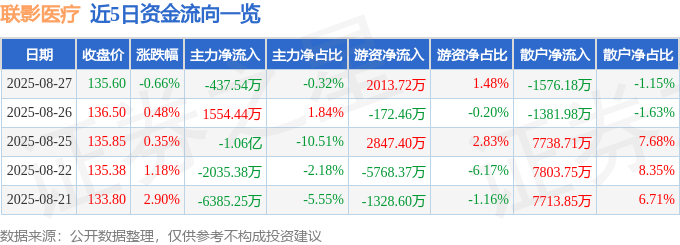
股票行情快报:联影医疗(688271)8月27日主力资金净卖出437.54万元
Sou Hu Cai Jing· 2025-08-27 13:02
Group 1 - The stock of United Imaging Healthcare (688271) closed at 135.6 yuan on August 27, 2025, down 0.66% with a turnover rate of 1.2% and a trading volume of 98,800 hands, resulting in a transaction amount of 1.365 billion yuan [1] - On August 27, the net outflow of main funds was 4.3754 million yuan, accounting for 0.32% of the total transaction amount, while the net inflow of retail funds was 20.1372 million yuan, accounting for 1.48% [1][2] - The company reported a total market value of 111.756 billion yuan, net assets of 20.283 billion yuan, and a net profit of 370 million yuan, ranking 2nd, 3rd, and 10th respectively in the medical device industry [3] Group 2 - The company's Q1 2025 report showed a main revenue of 2.478 billion yuan, a year-on-year increase of 5.42%, and a net profit attributable to shareholders of 370 million yuan, a year-on-year increase of 1.87% [3] - The average target price set by 17 institutions in the last 90 days is 149.48 yuan, with 12 buy ratings and 5 hold ratings [4] - The company's gross profit margin is 49.94%, while the industry average is 51.63%, indicating a competitive position within the sector [3]


AI在医疗领域应用会更广泛!国投创新看好医疗器械出海前景
Zheng Quan Shi Bao Wang· 2025-08-27 11:59
Core Viewpoint - The article highlights the advancements in AI-driven medical technology, specifically focusing on the automated vascular intervention surgery robot developed by Shenzhen Ruixin Intelligent Medical Technology Co., Ltd. (Ruixin Medical), which showcases the potential of AI in enhancing surgical precision and efficiency [1]. Company Overview - Ruixin Medical was founded in 2017 in Shenzhen by three co-founders, all of whom hold PhDs from renowned American universities and have extensive experience in the U.S. medical industry [1]. - The company has completed five rounds of financing, with investors including Guotou Innovation, Jingwei Venture Capital, and Tencent [1]. Market Potential - The AI+ medical market in China reached a scale of 31.5 billion yuan in 2023 and is expected to exceed 80 billion yuan by 2025, with a compound annual growth rate of 58.3% [1]. - Cardiovascular diseases account for the highest mortality rate globally, with over one million deaths annually in China, indicating a significant market demand for related medical technologies [3]. Investment Insights - Guotou Innovation has invested in nearly 70 companies in the medical sector, with an investment scale of approximately 15 billion yuan [2]. - The investment director of Guotou Innovation expressed optimism about the future of AI in healthcare, citing advancements in computing power and algorithms, as well as supportive national policies [2][7]. Competitive Landscape - The market for blood flow reserve measurement is still in its early stages, with domestic companies like Ruixin Medical and Beixin Life generating only a few hundred million yuan in sales [5]. - There are other companies in the field, such as Beixin Life and Hong Kong-listed Runmaide, but Ruixin Medical's approach to blood flow reserve measurement is distinct [4]. Technology and Innovation - Ruixin Medical's products can accurately assess the degree of vascular blockage from a functional perspective, which is more precise than traditional morphological assessments [3]. - The core team of Ruixin Medical has strong educational and professional backgrounds, enhancing the company's execution capabilities [3]. Future Trends - The increasing integration of AI in medical devices is expected to improve product performance, particularly in diagnostic areas where AI can enhance efficiency and consistency [7]. - The company aims to leverage its technological advantages to expand into international markets, potentially replicating the successful overseas expansion strategies seen in other industries like home appliances and automotive [8].
前瞻全球产业早报:深圳首家市内免税店正式开业
Qian Zhan Wang· 2025-08-27 11:54
Group 1: Artificial Intelligence Development - The State Council has issued opinions on the deep implementation of the "Artificial Intelligence +" initiative, aiming for AI to be widely integrated into six key areas by 2027, with a target application penetration rate of over 70% for new intelligent terminals and agents [2] - By 2030, AI is expected to fully empower high-quality development, with application penetration exceeding 90%, making the intelligent economy a significant growth driver for China's economy [2] - By 2035, China aims to enter a new stage of intelligent economy and society development, providing strong support for the realization of socialist modernization [2] Group 2: Energy Sector Participation - In the first half of the year, 10 private enterprises participated in five nuclear power projects, each holding over 10% of the shares, with the highest at 20% [3] - Private enterprises account for over 85% of the power facility construction sector, with an annual growth rate exceeding 15% [3] - The involvement of private enterprises in the energy sector's major technology equipment development projects has been significant, with half of the first four batches including private participation [3] Group 3: Technology and Innovation - The Ministry of Industry and Information Technology is set to issue the second batch of millimeter-wave private network frequency licenses, with more companies expected to receive licenses covering various verticals [4] - The first commercial operating system with a 6.6 kernel, "Yinhe Qilin V11," has been launched, achieving compatibility with major domestic CPUs and GPUs [5] - The world's first successful transplantation of gene-edited pig lungs into a human body has been reported by a Chinese research team, marking a significant milestone in the field [5] Group 4: Market Developments - Shenzhen has opened its first city duty-free shop, developed by a collaboration of several groups [6] - Alibaba Cloud has announced a reduction in the pricing of context caching for certain models, adjusting the cost of cached tokens to 20% of the previous input token price [7] - China Evergrande has officially delisted from the Hong Kong Stock Exchange, effective from August 25 [8] Group 5: Automotive Industry Changes - Nissan has announced the cessation of production for the R35 GT-R model, with a total production of approximately 48,000 units over its 18-year lifecycle [13] - German automaker Opel has abandoned its previous electric vehicle strategy, extending the supply time for fuel models due to customer demand [14]

填补高端分子影像领域空白 联影医疗获2024年度上海市科技进步奖一等奖
Zheng Quan Shi Bao Wang· 2025-08-27 11:19
Core Insights - The project "Independent R&D and Industrialization of Multimodal Molecular Imaging Equipment" by United Imaging Healthcare won the first prize in the 2024 Shanghai Science and Technology Progress Award, highlighting the recognition of the company's achievements in this field [1] - The company aims to enhance product performance and application coverage to improve accessibility to medical services, driven by clinical and research needs [1] Group 1: Project Achievements - The project has led to the development of several world-first and China-first products, filling a significant gap in China's high-end molecular imaging sector [2] - It has elevated China's PET technology to an internationally leading position and fostered the collaborative development of upstream and downstream enterprises in crystal materials [2] - The project has overcome all core technologies in multimodal molecular imaging, achieving breakthroughs in key technologies such as large-size LYSO crystal growth and high-performance digital PET detectors [2] Group 2: Technical Innovations - The molecular imaging team introduced a modular, multi-unit architecture to enable seamless system expansion, supporting large-scale data collection from 560,000 detectors [3] - The sensitivity of the uEXPLORER system was enhanced by 40 times through cross-unit composite technology, and a distributed parallel signal processing architecture based on GPU clusters was implemented to address massive data processing challenges [3] - Image reconstruction time was significantly reduced from one day to 23 minutes, providing substantial technical support for clinical applications [3] Group 3: Market Impact - The project has achieved 13 national Class III medical device registrations and 12 FDA and CE certifications, with over 600 molecular imaging devices installed globally across nearly 30 countries [3] - The PET/CT products have maintained the number one market share in China's molecular imaging market for nine consecutive years, while PET/MR products reached a domestic market share of over 60% in 2022 [3] - The project has successfully reversed the historical reliance on imported nuclear medicine molecular imaging equipment, increasing the domestic production rate of such devices to over 50% [3]
中国自主研发光子计数能谱CT获批上市 入驻医院进行临床医学研究
Zhong Guo Xin Wen Wang· 2025-08-27 09:29
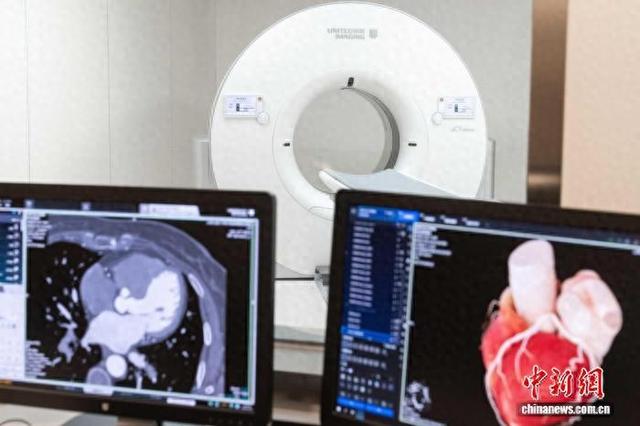
中新网上海8月27日电 (记者 陈静)记者27日在此间获悉,中国在医疗科技领域实现重大突破,企业与医 院等携手自主研发的中国首款光子计数能谱CT ——uCT Ultima获得国家药品监督管理局(NMPA)批准上 市。这也是中国"十四五"国家重点研发计划重点专项"光子计数能谱CT研发"项目取得的重大进展。 据悉,光子计数能谱CT一直是备受行业关注的下一代CT技术的革命方向。相比于传统CT,光子计数能 谱CT搭载了半导体探测器,具有更高空间分辨率成像、直接多能谱成像以及更低辐射剂量成像的优 势,极大程度推进了精准诊疗。然而囿于高筑的技术壁垒,此前全球范围内仅有两家外资企业实现了光 子计数能谱CT的商业化。 据介绍,相比传统CT,中国自主研发的光子计数能谱CT在实现超高分辨率成像时,探测器的像素面积 减小到原来的1/9,可以呈现更细微病变结构。同时,创新的校正算法和重建算法,解决了像素面积减 小导致的信号强度降低的问题,抑制噪声并保证了图像质量。针对光子计数能谱CT大数据量处理这一 痛点,研发单位也进行了全面的技术创新,实现全准直覆盖的超高分辨率成像,在心脏等需要大范围覆 盖的检查中可做更深一步的探索。除此外,光子 ...
决胜“十四五” 打好收官战|越来越多“中国造”——我国医疗装备实现新突围
Xin Hua She· 2025-08-27 09:11
Core Viewpoint - The Chinese medical equipment industry is experiencing significant growth and innovation, marking a shift towards self-sufficiency and high-end manufacturing, which is transforming both domestic and global healthcare landscapes [1][2][3]. Industry Growth - During the 14th Five-Year Plan period, the medical equipment industry in China has achieved a compound annual growth rate of approximately 10.7%, with the market size expected to reach 1.35 trillion yuan by 2024, maintaining its position as the second-largest market globally [2]. - By the end of 2024, the number of medical device manufacturing companies in China is projected to exceed 33,000, representing a 27.8% increase compared to the end of the 13th Five-Year Plan [2]. Technological Advancements - The industry is advancing towards high-end and intelligent medical equipment, with innovations such as zero-magnetic medical imaging devices and integrated radiation therapy technologies being introduced [3]. - Since the beginning of the 14th Five-Year Plan, 315 innovative medical devices have been approved, with 272 of these being domestic products, accounting for 86.3% [3]. - Key technologies such as carbon ion therapy systems and artificial hearts have achieved domestic production, reversing the previous scenario where imported devices dominated the high-end market [3]. Clinical Applications - The integration of artificial intelligence and advanced imaging technologies is enhancing the capabilities of medical equipment, with over 1.045 million patent applications filed in the medical equipment sector during the 14th Five-Year Plan [4]. - Innovations like the full-body PET/CT scanner have significantly reduced scanning times and improved imaging capabilities, demonstrating the effectiveness of domestic innovations in clinical settings [4]. Policy Support and Infrastructure - The Chinese government has implemented multiple policies to promote high-quality development in the medical equipment sector, including key projects and planning documents aimed at enhancing research, industry, and application [6]. - Continuous improvements in grassroots medical facilities are being made, with significant upgrades in medical equipment conditions and accelerated construction of county-level medical communities [6]. Accessibility and Affordability - The emergence of domestic surgical robots has led to a noticeable decrease in equipment prices, enabling more county-level hospitals to perform robotic surgeries [8]. - Advanced technologies such as AI-assisted diagnostics and remote surgery systems are breaking geographical barriers, allowing patients in rural areas to access quality medical services [8]. Conclusion - The ultimate goal of the development of medical equipment is to benefit public health, with ongoing efforts to ensure that more patients can access and afford high-quality domestic medical equipment [9].
决胜“十四五” 打好收官战丨越来越多“中国造”——我国医疗装备实现新突围
Xin Hua Wang· 2025-08-27 09:08
Core Viewpoint - The Chinese medical equipment industry is experiencing significant growth and innovation, marking a shift towards self-sufficiency and high-end manufacturing, which is transforming both domestic and global healthcare landscapes [1][2][3]. Industry Growth - During the 14th Five-Year Plan, the medical equipment industry in China has achieved a compound annual growth rate of approximately 10.7%, with the market size expected to reach 1.35 trillion yuan by 2024, maintaining its position as the second-largest market globally [2]. - By the end of 2024, the number of medical device manufacturing companies in China is projected to exceed 33,000, representing a 27.8% increase from the end of the 13th Five-Year Plan [2]. Technological Advancements - The industry is advancing towards high-end and intelligent medical equipment, with innovations such as zero-magnetic medical imaging devices and integrated radiation therapy technologies being introduced [3]. - Since the beginning of the 14th Five-Year Plan, 315 innovative medical devices have been approved, with 272 of these being domestic products, accounting for 86.3% [3]. - Key technologies such as carbon ion therapy systems and artificial hearts have achieved domestic production, reversing the previous trend where imported devices dominated high-end markets [3]. Clinical Applications - The integration of artificial intelligence and advanced imaging technologies is enhancing the capabilities of medical equipment, with over 1.045 million patent applications filed in the medical equipment sector during the 14th Five-Year Plan [4]. - Innovations like the full-body PET/CT scanner have significantly reduced scanning times and improved imaging capabilities, demonstrating the effectiveness of domestic innovations in clinical settings [4]. Policy Support and Infrastructure - The Chinese government has implemented multiple policies to promote high-quality development in the medical equipment sector, including key projects and planning documents aimed at enhancing research, industry, and application [6]. - Continuous improvements in medical equipment conditions at grassroots levels are being observed, with accelerated construction of county-level medical communities [6]. Accessibility and Affordability - The emergence of domestic surgical robots has led to significant price reductions, enabling more county-level hospitals to perform robotic surgeries [8]. - Advanced technologies such as AI-assisted diagnostics and remote surgical systems are breaking geographical barriers, allowing patients in rural areas to access quality medical services [8]. Future Outlook - The ultimate goal of medical equipment development is to benefit public health, with ongoing efforts to ensure that more patients can access and afford high-end domestic medical equipment [9]. - The industry is transitioning from reliance on imports to self-sufficiency, focusing on comprehensive solutions rather than single products, contributing to global healthcare advancements [9].
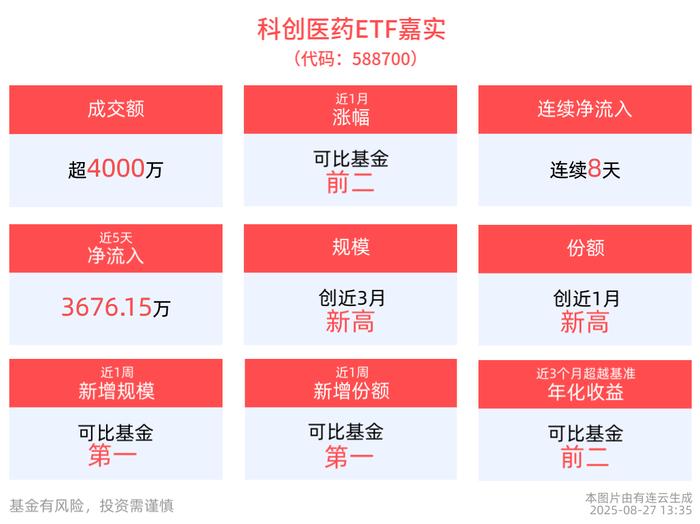
科创医药ETF嘉实(588700)红盘蓄势,成分股艾力斯20cm涨停,机构:创新+复苏+政策构成中长期三大主线
Xin Lang Cai Jing· 2025-08-27 05:54
Core Insights - The Shanghai Stock Exchange Sci-Tech Innovation Board Biopharmaceutical Index has shown a slight increase of 0.29% as of August 27, 2025, with notable stock performances from companies like Ailis and Maiwei Biotech [1] Group 1: Market Performance - The Sci-Tech Innovation Board Biopharmaceutical Index has seen significant stock movements, with Ailis reaching a daily limit increase of 20%, and Maiwei Biotech rising by 9.74% [1] - The market for the Jia Shi Sci-Tech Medicine ETF is active, with a turnover rate of 14.76% and a transaction volume of 45.3 million yuan [3] - Over the past week, the Jia Shi Sci-Tech Medicine ETF has averaged daily transactions of 70.77 million yuan, ranking first among comparable funds [3] Group 2: Fund Performance - The Jia Shi Sci-Tech Medicine ETF has reached a new high in scale at 304 million yuan, leading among comparable funds [3] - The fund's shares have also hit a one-month high of 248 million shares, again ranking first among its peers [3] - The ETF has experienced continuous net inflows over the past eight days, with a peak single-day net inflow of 15.48 million yuan, totaling 51.99 million yuan [3] - The net value of the Jia Shi Sci-Tech Medicine ETF has increased by 67.71% over the past year, with a maximum monthly return of 23.29% since its inception [3] Group 3: Industry Developments - Heng Rui Medicine has announced three business development collaborations with multinational pharmaceutical companies, with upfront payments totaling approximately 720 million USD and potential total transaction amounts exceeding 13.7 billion USD [4] - China National Pharmaceutical has indicated a significant external licensing deal involving potential products, enhancing its international research capabilities [4] - The biopharmaceutical industry is currently experiencing strong performance, with a focus on innovative drugs, medical devices benefiting from policy changes, and companies exceeding mid-year performance expectations [4] Group 4: Key Stocks - The top ten weighted stocks in the Sci-Tech Innovation Board Biopharmaceutical Index account for 49.14% of the index, with companies like United Imaging Healthcare and BeiGene among the leaders [5][7] - Notable stock performances include United Imaging Healthcare at 2.01% and Ailis at a significant 20% increase [7]

科创50增强ETF(588460)盘中涨近5%,机构持续看好科技板块成长潜力
Xin Lang Cai Jing· 2025-08-27 05:40
Group 1 - The core viewpoint highlights the significant rise in the technology sector, particularly the performance of the Sci-Tech 50 Enhanced ETF and its constituent stocks, driven by strong earnings and market sentiment [1][2] - The Sci-Tech 50 index includes 50 major companies from the Sci-Tech board, showcasing strong anti-cyclical capabilities and performance resilience amid increasing global tech competition [2] - As of July 31, 2025, the top ten weighted stocks in the Sci-Tech 50 index accounted for 54.71% of the index, indicating a concentrated market structure [2] Group 2 - The recent surge in the technology sector is attributed to two main factors: the opening of overseas computing power stocks and ongoing developments in the AI industry, which support the domestic substitution logic [1] - The technology growth style remains strong, although there may be short-term pullback pressures after recent gains; however, the long-term outlook for technological innovation remains positive due to continuous policy support [1] - The companies within the Sci-Tech 50 index are focused on their core operations, demonstrating resilience and adaptability in their respective fields [2]
马斯克起诉苹果与OpenAI|首席资讯日报
首席商业评论· 2025-08-27 05:28
Group 1 - A former executive from Kuaishou was involved in a corruption case, illegally embezzling 140 million yuan, which was intended as rewards for service providers and operators [2] - Anta and Li Ning responded to rumors regarding the acquisition of Puma, with Anta declining to comment and Li Ning denying any substantial negotiations [4] - Capgemini announced the acquisition of Cloud4C, a hybrid cloud platform service provider, with the financial terms undisclosed [5] Group 2 - The new generation of the Chinese operating system, Galaxy Kirin V11, was launched, featuring significant improvements in user experience, security, and ecosystem compatibility, with over 16 million deployments [6] - Cathay Pacific reported a 27% year-on-year increase in passenger volume for the first seven months of 2025, with a 24% increase in July alone [8] - Huawei and SAIC unveiled the first model of their car under the HarmonyOS system, the Shangjie H5, with a starting price of 169,800 yuan and impressive range capabilities [9] Group 3 - The first photon counting spectral CT developed by United Imaging Healthcare received approval for market launch, marking a significant advancement in China's medical technology sector [10] - Nvidia announced the mass production of its new system-on-chip, Thor, designed for robotics and autonomous driving, boasting a 7.5 times increase in computing power compared to its predecessor [11] - Google is negotiating with Fox regarding content partnership renewal, warning that Fox channels may be removed from YouTube TV if an agreement is not reached by the deadline [12]