
中国东航

Search documents
故意调低温卖毛毯?去年盈利22.7亿元,“国内最赚钱航司”回应
中国基金报· 2025-08-26 08:25
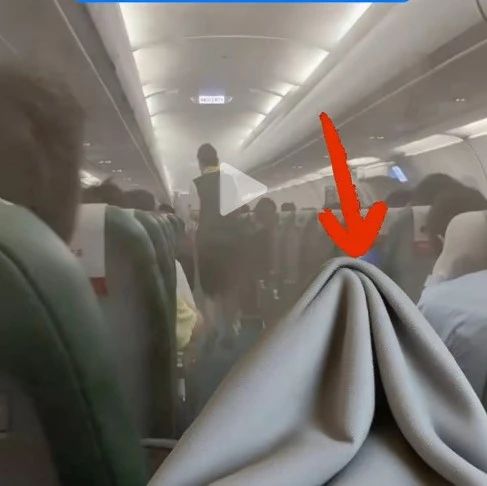
Core Viewpoint - Spring Airlines has issued a statement refuting false claims linking normal condensation phenomena in summer cabins to cabin sales, emphasizing that the condensation is a common physical reaction and not indicative of any deliberate temperature manipulation [2][3][4]. Group 1: Company Operations - Spring Airlines has clarified that it adheres to cabin temperature regulations to ensure passenger comfort and does not intentionally lower cabin temperatures to sell blankets [4]. - The airline has been subject to social media scrutiny regarding its cabin temperature, with some passengers alleging that the cold air is used to encourage blanket purchases [5][7]. - The airline's blankets are sold for 15 yuan each, and passengers can take them upon disembarking [7]. Group 2: Financial Performance - Spring Airlines reported a net profit of 2.27 billion yuan in 2024, with a year-on-year revenue growth of 11.5% to 20 billion yuan [8][9]. - The airline's auxiliary business revenue reached 1.03 billion yuan in 2024, a 14.44% increase from 900 million yuan in 2023, contributing to 5.15% of total revenue [11]. Group 3: Business Model - Unlike other airlines that operate multiple aircraft types, Spring Airlines exclusively uses 129 Airbus A320 aircraft, which helps reduce procurement, maintenance, and training costs [11]. - The airline separates ancillary services such as in-flight meals, baggage, and seat selection from the ticket price, allowing for additional revenue streams [11].


中国东航8月25日获融资买入3885.81万元,融资余额3.71亿元
Xin Lang Cai Jing· 2025-08-26 05:36
Group 1 - The core viewpoint of the news is that China Eastern Airlines has shown a slight increase in stock price and trading volume, indicating potential investor interest despite low financing levels [1] - On August 25, China Eastern Airlines' stock rose by 2.21%, with a trading volume of 345 million yuan, and a net financing purchase of 4.01 million yuan [1] - The financing balance of China Eastern Airlines as of August 25 is 374 million yuan, which is low compared to the past year, at only 0.52% of the market capitalization [1] Group 2 - China Eastern Airlines' main business includes passenger, cargo, mail, and luggage transportation, with passenger service revenue accounting for 91.95% of total revenue [2] - For the first quarter of 2025, China Eastern Airlines reported operating revenue of 33.41 billion yuan, a year-on-year increase of 0.65%, but a net profit loss of 999.5 million yuan, a decrease of 23.91% year-on-year [2] - The company has not distributed any dividends in the last three years, with a total payout of 3.296 billion yuan since its A-share listing [3] Group 3 - As of March 31, 2025, the number of shareholders for China Eastern Airlines increased to 174,400, reflecting a 1.52% rise from the previous period [2] - The top ten circulating shareholders include Hong Kong Central Clearing Limited, which holds 245 million shares, a decrease of 103 million shares from the previous period [3]

故意调低温卖毛毯?春秋航空声明!去年盈利22.7亿,是“国内最赚钱航司”
Mei Ri Jing Ji Xin Wen· 2025-08-26 00:59
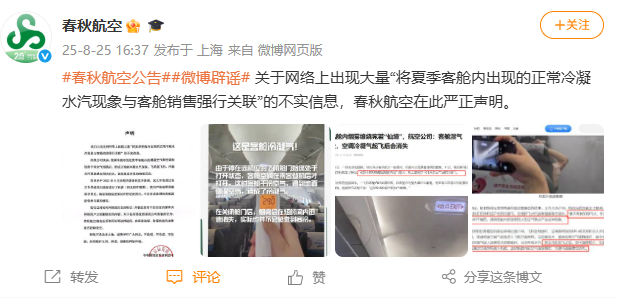
Core Viewpoint - Spring Airlines issued a statement addressing false information linking normal condensation phenomena in summer cabins to cabin sales, clarifying that the condensation is a common physical reaction and not indicative of temperature manipulation for profit [1] Group 1: Company Operations - Spring Airlines operates as a low-cost carrier, charging for items like blankets and drinks, which has led to passenger complaints about cabin temperatures being too cold [5][8] - The airline has a fleet of 134 Airbus A320 series aircraft with an average age of 7.76 years, covering over 230 routes and transporting 29 million passengers annually [9] - In 2024, Spring Airlines reported a revenue increase of 11.5% to 20 billion yuan and a net profit increase of 0.69% to 2.273 billion yuan [9] Group 2: Financial Performance - Compared to major airlines, Spring Airlines remains profitable while others face losses, with major airlines reporting a combined net loss of 61.59 million yuan in 2024 [10] - Spring Airlines' unit cost decreased by 3.3% to 0.316 yuan in 2024, while its unit non-fuel cost fell by 1.7% to 0.205 yuan [10] - The airline's passenger yield decline was only 6.5%, with a 6.4% increase compared to 2019, indicating better performance relative to competitors [12] Group 3: Cost Control Strategies - Spring Airlines employs a single aircraft model strategy, using only Airbus A320 series planes, which reduces procurement and maintenance costs [15] - The airline has eliminated first and business class, maximizing seating capacity and reducing unit costs by 10-15% compared to dual-class configurations [15][16] - In 2024, Spring Airlines' sales and management expenses were significantly lower than those of major airlines, with sales expenses at 249 million yuan and management expenses at 272 million yuan [16] Group 4: Revenue Generation - The airline has separated ancillary services from ticket prices, generating over 600 million yuan annually from services like baggage and meal sales [17] - In 2024, ancillary revenue reached 1.03 billion yuan, a 14.44% increase from 2023, contributing 5.15% to total revenue [17]
故意调低温卖毛毯?春秋航空“严正声明”!去年盈利22.7亿元,是“国内最赚钱航司”
Mei Ri Jing Ji Xin Wen· 2025-08-26 00:55
Core Viewpoint - Spring Airlines has issued a statement refuting false information linking normal condensation phenomena in summer cabins to cabin sales, emphasizing that the condensation is a common physical reaction and not indicative of temperature manipulation for profit [1][5]. Company Overview - Spring Airlines, established on July 18, 2005, is one of China's first private airlines, operating 134 Airbus A320 aircraft with an average age of 7.76 years, covering over 230 routes and transporting 29 million passengers annually [7][8]. - The airline is recognized as the most profitable in China, with a 2024 revenue of 20 billion yuan, up 11.5% year-on-year, and a net profit of 2.273 billion yuan, reflecting a 0.69% increase [8][9]. Financial Performance - In contrast to major state-owned airlines, which reported losses despite revenue growth, Spring Airlines maintained profitability with a unit cost of 0.316 yuan, down 3.3% year-on-year, and a non-fuel unit cost of 0.205 yuan, down 1.7% [8][9]. - The airline's revenue per passenger kilometer decreased by only 6.5% year-on-year, compared to double-digit declines for larger competitors, indicating better resilience in a competitive market [9][10]. Operational Metrics - In July 2024, Spring Airlines reported a 10.41% year-on-year increase in passenger capacity, with a passenger turnover of 534,860.29 million kilometers, reflecting an 8.6% increase [10][12]. - The airline's load factor was 91.86%, a slight decrease of 1.53 percentage points year-on-year, with domestic flights achieving a load factor of 92.96% [10][11]. Cost Control Strategies - Spring Airlines employs a low-cost model, operating a single aircraft type (Airbus A320) to streamline maintenance and training costs, which helps in reducing overall operational expenses [13][14]. - The airline has increased seating capacity on its aircraft while maintaining comfort, with 186-seat configurations and the introduction of 240-seat A321neo models, enhancing revenue potential [14][15]. Ancillary Revenue - The airline has successfully diversified its revenue streams, generating over 1 billion yuan from ancillary services in 2024, a 14.44% increase from the previous year, contributing to 5.15% of total revenue [15][16].
故意调低温卖毛毯?春秋航空“严正声明”!去年盈利22.7亿元 是“国内最赚钱航司”
Mei Ri Jing Ji Xin Wen· 2025-08-26 00:52
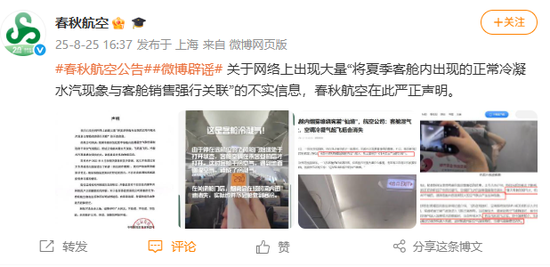
Core Viewpoint - Spring Airlines issued a statement addressing false information linking normal condensation in summer cabins to cabin sales, clarifying that the condensation is a common physical phenomenon and not indicative of temperature manipulation for profit [2] Group 1: Company Operations - Spring Airlines operates as a low-cost carrier, charging for items like blankets and water, which has led to passenger complaints about cabin temperatures being too cold [4] - The airline has a fleet of 134 Airbus A320 series aircraft with an average age of 7.76 years, covering over 230 routes and transporting approximately 29 million passengers annually [7] - In 2024, Spring Airlines reported a revenue increase of 11.5% to 20 billion yuan and a net profit increase of 0.69% to 2.273 billion yuan [7][8] Group 2: Financial Performance - Compared to major airlines like Air China and China Eastern Airlines, which reported losses, Spring Airlines remains profitable with a unit cost of 0.316 yuan, down 3.3% year-on-year [8][9] - The average ticket price in the economy class has decreased by over 10% year-on-year, but Spring Airlines' revenue per passenger kilometer only declined by 6.5%, showing resilience in a competitive market [9] - In Q1 2025, Spring Airlines maintained its position as the most profitable airline in China with a net profit of 677 million yuan [9] Group 3: Cost Control Strategies - Spring Airlines employs a single aircraft model strategy, using only Airbus A320 series planes, which helps reduce costs related to maintenance and training [13] - The airline has increased seating capacity in its aircraft, allowing for more passengers without increasing operational costs significantly [14] - In 2024, Spring Airlines' auxiliary revenue reached 1.03 billion yuan, contributing 5.15% to total revenue, indicating a focus on diversifying income streams [15]
故意调低温卖毛毯?春秋航空“严正声明”!去年盈利22.7亿元,是“国内最赚钱航司”:行李托运、餐饮等辅业创收超10亿元
Mei Ri Jing Ji Xin Wen· 2025-08-26 00:42
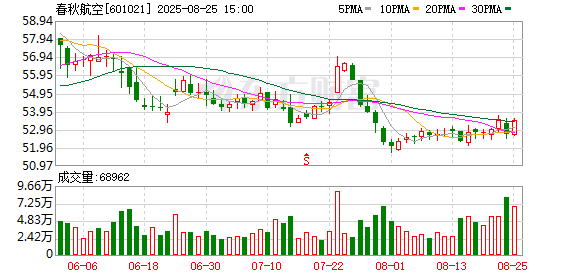
Core Viewpoint - Spring Airlines issued a statement addressing false information linking normal condensation in summer cabins to cabin sales, clarifying that the condensation is a common physical reaction and not indicative of temperature manipulation for profit [1][4]. Group 1: Company Operations - Spring Airlines operates as a low-cost carrier, charging for items like blankets and drinks, which has led to passenger complaints about cabin temperatures being too cold [4][7]. - The airline has a fleet of 134 Airbus A320 series aircraft with an average age of 7.76 years, covering over 230 routes and transporting approximately 29 million passengers annually [8]. - In 2024, Spring Airlines reported a revenue increase of 11.5% to 20 billion yuan and a net profit increase of 0.69% to 2.273 billion yuan [8]. Group 2: Financial Performance - Compared to major airlines like Air China and China Eastern Airlines, which reported losses, Spring Airlines remains profitable, with a unit cost of 0.316 yuan, down 3.3% year-on-year [9][10]. - The airline's passenger kilometer revenue decline was only 6.5%, showing resilience compared to the double-digit declines of larger carriers [11]. - In Q1 2025, Spring Airlines maintained its position as the most profitable domestic airline with a net profit of 677 million yuan [11]. Group 3: Cost Control Strategies - Spring Airlines employs a single aircraft model strategy, using only Airbus A320s, which helps reduce costs related to procurement, maintenance, and training [14][15]. - The airline has increased seating capacity on its aircraft, with some A320s accommodating up to 186 seats, which helps lower unit costs [15]. - In 2024, Spring Airlines' auxiliary revenue reached 1.03 billion yuan, contributing 5.15% to total revenue, indicating a focus on diversifying income streams [16].
航空机场板块8月25日涨1.54%,中信海直领涨,主力资金净流入611.07万元
Zheng Xing Xing Ye Ri Bao· 2025-08-25 08:47
Market Performance - The aviation and airport sector increased by 1.54% on August 25, with CITIC Hainan leading the gains [1] - The Shanghai Composite Index closed at 3883.56, up 1.51%, while the Shenzhen Component Index closed at 12441.07, up 2.26% [1] Stock Performance - CITIC Hainan (000099) closed at 24.38, up 2.22% with a trading volume of 422,500 shares and a transaction value of 1.022 billion [1] - China Eastern Airlines (600115) closed at 4.17, up 2.21% with a trading volume of 836,500 shares and a transaction value of 345 million [1] - Southern Airlines (600029) closed at 6.00, up 2.04% with a trading volume of 849,300 shares and a transaction value of 505 million [1] - HNA Holding (600221) closed at 65.1, up 1.92% with a trading volume of 5,206,400 shares and a transaction value of 823 million [1] - China National Aviation (601111) closed at 7.54, up 1.89% with a trading volume of 1,215,900 shares and a transaction value of 266 million [1] Fund Flow Analysis - The aviation and airport sector saw a net inflow of 6.1107 million from institutional investors, while retail investors contributed a net inflow of 16.3 million [2] - The sector experienced a net outflow of 169 million from speculative funds [2] Individual Stock Fund Flow - CITIC Hainan had a net outflow of 51.4 million from institutional investors, with a net inflow of 14.3 million from retail investors [3] - Xiamen Airport (600897) had a net outflow of 1.1377 million from institutional investors, with a net inflow of 517,100 from retail investors [3] - Shanghai Airport (600009) had a net inflow of 5.1069 million from institutional investors, while retail investors contributed a net inflow of 343,720 [3]





7月顺丰业务量增速领跑,油运景气度拐点向上 | 投研报告
Zhong Guo Neng Yuan Wang· 2025-08-25 02:47
Group 1: Express Delivery Industry - In July, SF Express achieved a business volume growth rate of 34%, leading among all express companies [1][2] - During the week of August 11-17, the total collection volume of postal express was approximately 3.523 billion pieces, with a week-on-week decrease of 0.06% and a year-on-year increase of 11.81% [1][2] - The total delivery volume during the same week was about 3.511 billion pieces, with a week-on-week decrease of 0.09% and a year-on-year increase of 15.11% [1][2] - By July 2025, the year-on-year business volume growth rates for SF Express, Yunda, YTO, and Shentong are projected to be 33.7%, 7.6%, 20.8%, and 11.9% respectively, with market shares of 8.4%, 13.2%, 15.8%, and 13.3% [1][2] - The "anti-involution" trend has led to price increases in several grain-producing areas, and with the peak season approaching, it is expected that the price per express delivery will rise [1][2] Group 2: Logistics Sector - The chemical product price index (CCPI) in China is currently at 4024 points, showing a year-on-year decrease of 10.3% [3] - The domestic sea freight price for liquid chemicals is 158 yuan/ton, reflecting a year-on-year decrease of 8.4% [3] - The operational rates for paraxylene (PX), methanol, and ethylene glycol are 84.6%, 80.7%, and 65.1% respectively, with varying year-on-year changes [3] - The establishment of the "Haimorning Artificial Intelligence Research Institute" and "Haimorning Robotics Research Institute" aims to focus on advanced technologies in logistics [3] - The airline sector is experiencing an increase in average daily flights, with a year-on-year growth of 4.18% [3] Group 3: Shipping Industry - The crude oil transportation index has increased, while the domestic shipping index continues to rise [4] - The China Export Container Freight Index (CCFI) is at 1174.87 points, with a year-on-year decrease of 40.5% [4] - The domestic container freight index (PDCI) is at 1091 points, showing a year-on-year increase of 15.9% [4] - The BDI index for dry bulk shipping is at 1950 points, with a year-on-year increase of 11.7% [4] - The oil transportation sector is expected to see a demand boost due to OPEC+ production increases and geopolitical factors [4] Group 4: Road, Rail, and Port Operations - The total cargo throughput at ports decreased by 2.8% week-on-week, but increased by 3.8% year-on-year [5] - The total container throughput was 6.75 million TEUs, with a week-on-week decrease of 0.6% and a year-on-year increase of 6.6% [5] - The total number of trucks passing through highways was 54.93 million, reflecting a week-on-week increase of 3.06% and a year-on-year increase of 4.65% [5] - The dividend yield of major highway operators is currently higher than the yield of China's ten-year government bonds, indicating attractive investment opportunities [5]

东航江苏公司证照器械“大管家”刘光辉:于毫厘间见初心
Zhong Guo Min Hang Wang· 2025-08-25 02:26
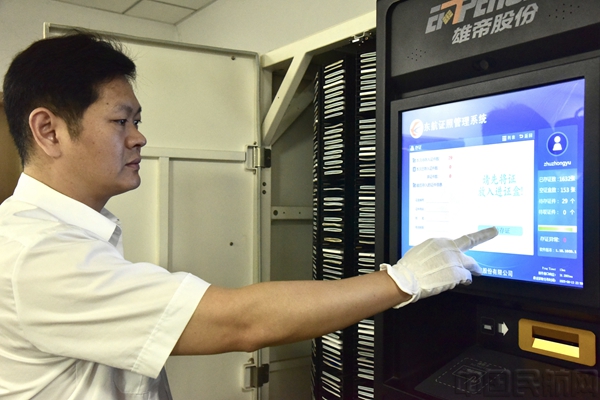
方寸之地,捍卫起落安妥 暑运高峰,证照器械室外常排起长队。由于执勤器械管理尤为严格,空中安全员在航班落地后须立即交 回安全器械包,双方当场清点数量、检查性能、测试电量等。确认无误后,器械包才被放回指定位置待 命。 《中国民航报》、中国民航网 记者胡夕姮 通讯员李晓静 报道:暑运期间,东航江苏公司航班量激增 40%,证照器械室管理员刘光辉迎来了一年中最繁忙的时段。子夜时分的机组控制中心(CCC)大厅依 然灯火通明,他紧盯屏幕处理航班信息,精准调取护照柜中的证件,清点着待发放给空中安全员的器械 包,逐一复核所有流程。紧张有序的值守常常持续至凌晨,只为保障每一个航班安全起飞。"再过一个 小时,早航班机组就要过来签到了。"尽管疲惫,他和同事们始终提前做好万全准备。 精准无误托举空中防线 "没有证照器械室,航班就飞不了。"刘光辉语气沉稳。智能护照柜中存放着机组人员执行航班不可或缺 的"通行证"——护照、台湾通行证、港澳通行证。每一本证件都关联着航班运行的合法性与国际飞行的 准入许可。 管理绝非简单的存取。他和同事们每日需在深夜为次日航班精确匹配证件,严格执行人证核对与签字交 接,航班结束后第一时间收回证照,未归还将触发 ...
中国交通:反内卷行业,两个行业的故事 —— 航空公司和物流会解决根本问题吗
2025-08-25 01:40
Summary of Key Points from the Conference Call Industry Overview - **Industry Focus**: The conference call primarily discusses the **Chinese airline and logistics industries** in the context of the **2025 anti-involution campaign** aimed at addressing aggressive competition and stabilizing market conditions [2][4][18]. Core Insights and Arguments - **Anti-involution Campaign**: The campaign is a strategic initiative by the Chinese government to stabilize pricing and enhance service quality across various sectors, particularly logistics and airlines, during a downward economic cycle [2][4][8]. - **Logistics Sector**: The logistics industry is experiencing regulatory efforts to curb over-competition, with price adjustments and guidance from authorities like the State Post Bureau and NDRC. This is expected to improve industry stability and profitability [2][3][18]. - **Airline Sector Challenges**: Airlines face unique challenges, including weak demand and a shift to rail travel, rather than just aggressive competition. The dominance of Online Travel Agencies (OTAs) complicates pricing regulations, as they control 70-80% of flight ticket sales [2][3][10][18]. - **Stock Recommendations**: The analysis maintains a cautious stance on Chinese airlines due to ongoing unprofitability, while expressing a positive outlook on logistics companies like ZTO, SF Holdings, and JD Logistics, which are expected to benefit from regulatory measures [3][4][18]. Additional Important Content - **Passenger Volume Trends**: Despite an increase in passenger volumes during the summer, airlines continue to face pricing pressures, with domestic air passenger volume rising by 2.7% year-over-year in July, while international passenger volume increased by approximately 16% [9][11]. - **Pricing Power Issues**: The average airfare for domestic economy class dropped by 7.5% year-over-year, remaining 5% below pre-COVID levels, indicating persistent demand challenges [11][10]. - **High-Speed Rail Competition**: The growth of high-speed rail (HSR) is diverting passengers from air travel, particularly for short-haul flights, exacerbating the challenges faced by airlines [10][12][14]. - **Regulatory Focus**: The logistics sector has seen a narrowing decline in Average Selling Prices (ASP) due to intensified regulatory supervision, which may serve as a model for potential measures in the airline sector, although challenges remain [18][21]. Conclusion - The conference call highlights the contrasting dynamics between the logistics and airline sectors in China, emphasizing the need for regulatory interventions to stabilize pricing and improve profitability, particularly in the logistics industry, while the airline sector continues to grapple with deeper-rooted demand issues and competitive pressures.
