博时基金

Search documents
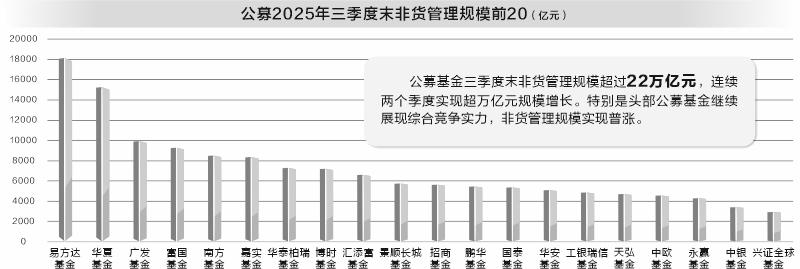
指数基金与“固收+”产品齐发力
Zhong Guo Zheng Quan Bao· 2025-10-28 21:10
Core Insights - The domestic equity market showed strong performance in Q3, with public fund management scale surpassing 35 trillion yuan by the end of the quarter [1] - Stock index funds contributed significantly to the growth, with an increase of 1.01 trillion yuan, while bond funds also saw substantial growth due to market adjustments [1][3] - Several "explosive" products emerged, with multiple funds achieving new scale increments exceeding 200 billion yuan [1][4] Fund Management Scale - By the end of Q3, the top ten public fund management institutions included E Fund, Huaxia Fund, and GF Fund, with E Fund adding over 250 billion yuan in management scale [2] - Other notable institutions like Huaxia Fund and GF Fund also saw significant increases, with additions of over 150 billion yuan and 100 billion yuan respectively [2] Stock and Bond Fund Performance - Stock index funds saw a total scale increase of over 1 trillion yuan, with mixed funds and money market funds also contributing to the overall growth [1] - The secondary bond funds experienced a scale increase of over 490 billion yuan, indicating a favorable environment for "fixed income+" products [3] Notable Fund Products - The Yongying Stable Enhanced Bond Fund became the largest "fixed income+" product in Q3, with a scale increase of over 270 billion yuan and a return rate of 7.37% [3] - The Invesco Great Wall Jingyi Fengli Bond Fund achieved a remarkable return rate of nearly 15%, with its scale increasing to 257.95 billion yuan, marking a 126-fold increase [4] - Other "fixed income+" products also saw significant scale increases, with several funds adding over 150 billion yuan in Q3 [4]
公募股票仓位集体攀升
Zhong Guo Zheng Quan Bao· 2025-10-28 21:10
Group 1 - Public funds have collectively increased their stock positions in Q3, with an average stock position of 83.28%, up 2.13 percentage points from Q2 [1] - The average stock position for equity open-end funds reached 90.14%, an increase of 2.26 percentage points from the previous quarter [1] - The concentration of holdings in public funds has risen, with stock open-end funds and mixed open-end funds seeing increases in concentration by 0.94 percentage points and 2.1 percentage points, respectively [1] Group 2 - Most fund companies have raised their stock positions, with only 37 companies showing a slight decrease; 27 companies have an average stock position exceeding 90% [2] - Notable fund managers have significantly increased their positions, with some funds reaching over 90% stock allocation, such as the funds managed by Guo Jie and He Chongkai [2] - Several mixed funds are nearing full investment, with significant increases in equity assets, including the Zhongxin Jian Investment fund, which saw a stock position increase of over 10 percentage points [3] Group 3 - Some funds have notably reduced their stock positions, indicating market risk; for instance, the fund managed by Wu Wei decreased its stock position from 90% to 60% [3][4] - The performance of style indices has shown significant differences, suggesting that fund managers need to evaluate not only growth potential but also pricing rationality and industry dynamics [4]
三季度股债跷跷板效应显著公募规模排位赛格局悄然生变
Zheng Quan Shi Bao· 2025-10-28 18:33
Core Insights - The public fund industry in China has seen significant growth in total management scale, reaching 36.45 trillion yuan by the end of Q3, an increase of approximately 2.41 trillion yuan from Q2, driven by a rebound in the equity market and rising ETF scales [2][3] - The competition among fund companies has intensified, with top firms like E Fund and Huaxia Fund showing substantial growth in non-monetary management scale, indicating a shift in market dynamics [3][4] Fund Performance - Equity funds have outperformed bond funds, with a notable shift of funds from pure bond funds to equity and "fixed income plus" products, highlighting a "see-saw" effect between stocks and bonds [6][7] - The top-performing products in Q3 were mainly ETFs, with significant growth in scales for products like Huatai-PB CSI 300 ETF and E Fund CSI 300 ETF, reflecting strong investor interest [6][9] Company Rankings - The ranking of public fund companies has changed, with E Fund leading in non-monetary management scale growth, followed by Huaxia Fund and Fuguo Fund, which also saw substantial increases [3][4] - Smaller fund companies have faced challenges, with over 70 firms experiencing a decline in non-monetary management scale, primarily due to heavy redemptions in bond funds [7][8] Investment Trends - The technology-themed active equity funds have gained popularity, with a significant increase in their scale, reaching approximately 4.3 trillion yuan, marking the largest growth in recent quarters [9][10] - The performance of active equity funds has been impacted by poor results and fund manager departures, leading to a decline in scale for some funds [10]

公募分红逼近1700亿 债基独占七成份额 ETF也是分红大户
Sou Hu Cai Jing· 2025-10-28 18:09
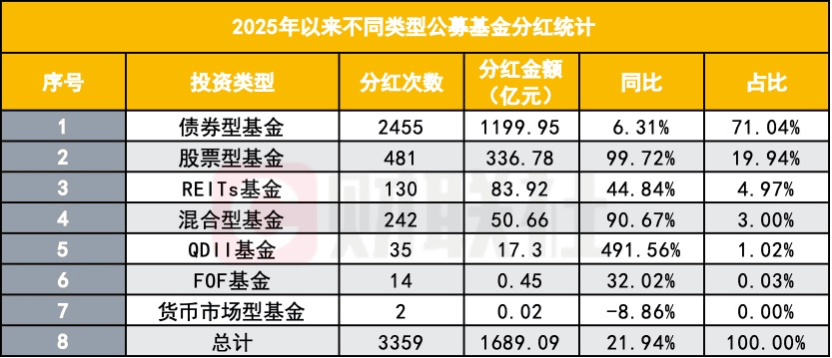
Core Insights - The public fund sector is experiencing a significant increase in dividend distributions, with a total of 3,359 distributions amounting to 168.91 billion yuan, representing a year-on-year growth of 21.94% [1][2][5] Group 1: Dividend Distribution Overview - Bond funds remain the primary contributors to the dividend market, with 2,455 distributions totaling 119.99 billion yuan, accounting for 71.04% of total dividends and showing a year-on-year increase of 6.31% [2][6] - Equity funds, including stock and mixed funds, have seen dramatic increases in dividend amounts, with stock funds distributing 33.68 billion yuan (up 99.72%) and mixed funds 5.07 billion yuan (up 90.67%) [2][4] - QDII funds have shown the most remarkable growth, with a total dividend of 1.73 billion yuan, reflecting a staggering year-on-year increase of 491.56% [2][4] Group 2: Fund Company Strategies - A total of 138 public fund companies have implemented dividend distributions this year, with 113 companies exceeding 100 million yuan and 45 companies surpassing 1 billion yuan in total dividends [4][5] - Leading companies like E Fund and Huatai-PB have adopted different strategies, with E Fund distributing 12.25 billion yuan across 140 instances, while Huatai-PB achieved 10.77 billion yuan with fewer funds but higher individual payouts [5][6] - The trend indicates a shift towards more frequent and substantial dividends as a means to enhance investor confidence and loyalty, with companies increasingly using dividends as a branding and customer retention strategy [7]
首批浮动费率基金“成绩单”来了
券商中国· 2025-10-28 13:09
Core Viewpoint - The first batch of new floating-rate funds launched in late May has shown mixed performance due to varying investment strategies, with some funds excelling in the AI sector while others lagged in traditional sectors like liquor and banking [1][3][7]. Performance Analysis - As of October 27, the average increase for the first batch of 26 funds is approximately 14.3%, but performance varies significantly among them [3]. - Notable performers include Huashang Zhiyuan Return with a 53.58% increase and Jiashi Growth Win with a 47.57% increase, while several funds have underperformed [3][5]. - Only 9 out of the 26 funds have outperformed their benchmarks, indicating the challenge of achieving excess returns in a rising market [2][9]. Investment Strategy - The leading fund, Huashang Zhiyuan Return, heavily invested in the booming AI sector, with top holdings including Zhongji Xuchuang and Dongshan Precision [6][7]. - Fund managers are adopting a strategy of closely tracking benchmarks while allocating a portion of their portfolio for enhanced returns [10]. Regulatory Context - The China Securities Regulatory Commission (CSRC) has emphasized the importance of outperforming benchmarks as a key consideration for fund managers' compensation [8][9]. - The performance benchmarks for these funds primarily include indices like the CSI 300 and the CSI 800 [8]. Market Trends - The success of the first batch of floating-rate funds is expected to positively influence the fundraising and operation of subsequent batches [11][12]. - The second batch of funds has begun to diversify into industry-specific themes, indicating a shift from broad market selection to targeted strategies [11][12].

天府证券ETF日报-20251028
天府证券· 2025-10-28 10:46
Report Summary 1. Market Overview - On October 28, 2025, the Shanghai Composite Index fell 0.22% to 3988.22 points, the Shenzhen Component Index fell 0.44% to 13430.10 points, and the ChiNext Index fell 0.15% to 3229.58 points. The total trading volume of A-shares in the two markets was 2165.5 billion yuan. The top-performing sectors were Comprehensive (2.06%), National Defense and Military Industry (1.07%), and Transportation (0.24%), while the worst-performing sectors were Non-ferrous Metals (-2.72%), Beauty Care (-1.51%), and Steel (-1.35%) [2][6]. 2. Stock ETFs - The top-traded stock ETFs on this day were Huaxia CSI A500 ETF (down 0.59%, premium rate -0.56%), Cathay CSI A500 ETF (down 0.50%, premium rate -0.59%), and E Fund ChiNext ETF (down 0.12%, premium rate -0.19%) [3][7]. 3. Bond ETFs - The top-traded bond ETFs were Haifutong CSI Short-term Financing ETF (up 0.01%, premium rate -0.00%), Boshi CSI Convertible and Exchangeable Bond ETF (down 0.32%, premium rate -0.51%), and Cathay CSI AAA Science and Technology Innovation Corporate Bond ETF (up 0.09%, premium rate 0.04%) [4][9]. 4. Gold ETFs - Gold AU9999 fell 3.67% and Shanghai Gold fell 3.59%. The top-traded gold ETFs were Huaan Gold ETF (down 3.56%, premium rate -3.45%), E Fund Gold ETF (down 3.56%, premium rate -3.48%), and Boshi Gold ETF (down 3.56%, premium rate -3.48%) [12]. 5. Commodity Futures ETFs - Dacheng Non-ferrous Metals Futures ETF fell 1.47% with a premium rate of -1.06%, Huaxia Feed Soybean Meal Futures ETF fell 0.05% with a premium rate of 4.46%, and Jianxin Yisheng Zhengzhou Commodity Exchange Energy and Chemical Futures ETF fell 0.32% with a premium rate of 0.01% [13]. 6. Cross-border ETFs - The previous trading day, the Dow Jones Industrial Average rose 0.71%, the Nasdaq rose 1.86%, the S&P 500 rose 1.23%, and the German DAX rose 0.28%. On this day, the Hang Seng Index fell 0.33% and the Hang Seng China Enterprises Index fell 0.97%. The top-traded cross-border ETFs were E Fund CSI Hong Kong Securities Investment Theme ETF (down 2.13%, premium rate -1.61%), Huatai-PineBridge CSI Korea Exchange Sino-Korean Semiconductor ETF (up 0.23%, premium rate 2.33%), and Huatai-PineBridge Hang Seng Technology ETF (down 1.22%, premium rate -0.92%) [15]. 7. Money Market ETFs - The top-traded money market ETFs were YinHua RiLi ETF, HuaBao TianYi ETF, and Money Market ETF JianXin TianYi [17].
中证A50指数ETF今日合计成交额7.35亿元,环比增加36.49%
Zheng Quan Shi Bao Wang· 2025-10-28 08:49
Core Viewpoint - The trading volume of the CSI A50 Index ETFs increased significantly today, with a total transaction amount of 735 million yuan, marking a 36.49% increase compared to the previous trading day [1] Trading Volume Summary - The trading volume of the following ETFs showed notable increases: - **Fuguo CSI A50 ETF (159591)**: Trading volume reached 123 million yuan, up by 103 million yuan, a 518.02% increase [1] - **CSI A50 ETF Fund (561230)**: Trading volume was 78.44 million yuan, an increase of 61.50 million yuan, representing a 363.00% rise [1] - **E Fund CSI A50 ETF (563080)**: Trading volume amounted to 42.53 million yuan, up by 22.56 million yuan, a 112.91% increase [1] Market Performance Summary - The average decline for ETFs tracking the CSI A50 Index was 0.73% at market close, with the following ETFs experiencing the largest drops: - **E Fund CSI A50 Enhanced Strategy ETF (512030)**: Decreased by 0.97% [1] - **CSI A50 (563350)**: Fell by 0.87% [1]
周期行业基金:从投资能力分析到基金经理画像:金融产品每周见20251028-20251028
Shenwan Hongyuan Securities· 2025-10-28 06:38
Report Title - Cycle Sector Funds: From Investment Ability Analysis to Fund Manager Portraits - Weekly Insights on Financial Products 20251028 [1] Report Industry Investment Rating - Not provided in the report Core Viewpoints - Based on fund holdings, cycle sector funds can be classified into 5 types: "Cycle + Satellite", "Sector Rotation", "Sub - sector", "Cycle Rotation", and "Cycle Equilibrium". Most fund managers adopt "Cycle + Satellite" and "Sub - sector (mainly resources and energy)" strategies, with the fewest using the "Cycle Equilibrium" strategy [3]. - Three overall investment ability analyses of cycle sector funds: They can create relatively stable excess returns in the long - term compared to the sector index; are relatively good at stock - picking in utilities, basic chemicals, petroleum and petrochemicals, and non - ferrous metals, have outstanding stock - picking ability in building materials, transportation, coal, and steel in some periods, and are relatively weak in building decoration; and cycle sector fund managers have more prominent cycle stock - picking ability than all - sector fund managers [3]. - Seven dimensions to compare cycle sector funds with different style characteristics: High turnover does not necessarily mean high returns; there are many high - dividend and high - ROE style products, mainly mid - and large - cap stocks; most cycle sector funds hold idiosyncratic stocks; resource funds are more right - sided overall, while energy funds are more left - sided; by analyzing the skewness and kurtosis coefficients of stock - picking returns, fund managers with high confidence in stock - picking ability can be found; by finding similar funds and analyzing their performance in good and bad times, the environmental adaptability of fund managers can be characterized; there are products with outstanding sector rotation ability [3]. - How to screen the observation list of cycle sector funds: Screen with the following quantitative indicators: excess performance momentum, performance in good and bad environments, stock - picking ability, left - and right - sided investment ability; for rotation - type products and "Cycle + Satellite" style products, additionally consider their sub - sector rotation effects; other indicators to consider include the fund manager's tenure being as long as possible and the fund size being neither too large nor too small [3]. Summary by Directory 1. Cycle Sector Fund Screening and Classification - **Classification Method**: Based on Shenwan primary industry characteristics, four sub - sectors of the cycle sector are identified. Funds are classified into 5 types according to their average allocation ratio and rotation ratio in the cycle sector in the past three years: "Cycle + Satellite" (average cycle allocation ratio between 60% - 70%), "Sector Rotation" (average cycle allocation ratio below 50%), "Sub - sector" (average sub - sector allocation ratio > 50%), "Cycle Rotation" (annual average change in industry allocation ratio > 50%), and "Cycle Equilibrium" (the rest) [10]. 2. Cycle Sector Fund Stock - holding Characteristics - **Overall Excess Returns**: Cycle sector funds can create relatively stable excess returns in the long - term compared to passive indices, with prominent excess returns from February to August 2024 and since May 2025 [22]. - **Industry - Level Excess Returns**: They are relatively good at stock - picking in utilities and basic chemicals, have outstanding performance in building materials in some periods, and are relatively weak in building decoration [23]. - **Stock - picking Ability Comparison**: Cycle sector fund managers have more prominent cycle stock - picking ability than all - sector fund managers [32]. - **Stock - holding Preferences**: Cycle sector funds prefer to allocate resources, with most of their heavily - held cycle stocks in the resources category in the past two years. In contrast, balanced funds initially paid more attention to energy stocks, and no single category of stocks is overly favored in the top - allocated stocks in 25H1. Few stocks are continuously heavily held by cycle sector or balanced funds, indicating a natural rotation tendency of cycle stocks [37]. - **Cluster Analysis**: There are four relatively unique types: focusing on gold (e.g., Qianhai Kaiyuan Gold and Silver Jewelry), focusing on energy (coal) (e.g., Wanjia Selection A), focusing on transportation (e.g., GF Multi - Strategy), and generally偏向 resources (e.g., Qianhai Kaiyuan Shanghai - Hong Kong - Shenzhen Core Assets) [41]. 3. Comparison of Cycle Sector Funds with Different Style Characteristics - **Turnover and Return**: High - turnover cycle sector funds do not generally achieve higher returns in the short - term. In the long - term, there are high - performing products in both high - turnover and low - turnover groups [48]. - **Stock - holding Style**: There are many high - dividend and high - ROE style products in cycle sector funds, and most of their holdings are mid - and large - cap stocks. Different types of cycle sector funds have different market - cap preferences, with chemical funds having smaller - cap holdings, other sub - sector funds having mid - cap holdings, and balanced, rotation, and "Cycle + Satellite" products having relatively larger - cap holdings [49][53]. - **Stock Popularity**: Most cycle sector funds hold idiosyncratic stocks. Most high - performing cycle sector funds mainly hold individual idiosyncratic stocks, but some also hold more market - preferred stocks [61]. - **Left - and Right - sided Investment**: The left - sided buying coefficient of cycle sector funds is at the median level of active equities. Resource funds are more right - sided, energy funds are more left - sided, and balanced, "Cycle + Satellite", and rotation style products are around the median level. There are high - performing funds on both the left and right sides [66]. - **Stock - picking Ability**: By analyzing the skewness, kurtosis, and mean/standard deviation of stock - picking returns, funds with appropriate right - skewed returns, moderate kurtosis, and high mean/standard deviation can be selected [69]. - **Performance in Good and Bad Times**: Different types of products show different market environment adaptability. For example, many products with strong performance in bad times are "Cycle + Satellite" products, while those with strong performance in good times are mostly sub - sector theme products [72]. - **Sub - sector Rotation**: There are products with outstanding rotation ability in cycle sector funds, including actively rotating, rotation - downplaying, and timely - rotating products [76]. 4. Cycle Sector Fund Observation List - Quantitative indicators for screening: Excess performance momentum, performance in good and bad environments, stock - picking ability, left - and right - sided investment ability, sub - sector rotation effects for rotation - type and "Cycle + Satellite" style products, and other considerations such as the fund manager's tenure and appropriate fund size [79]. - Observation list: Funds such as Nuode Lixin A, Invesco Great Wall Pillar Industries A, ICBC Dividend Preferred A, SDIC UBS Prosperity Drive A, Dacheng Trend Industry A, and Dacheng State - owned Enterprise Reform A are included [3][80]
近26亿,跑了!
Zhong Guo Ji Jin Bao· 2025-10-28 05:45
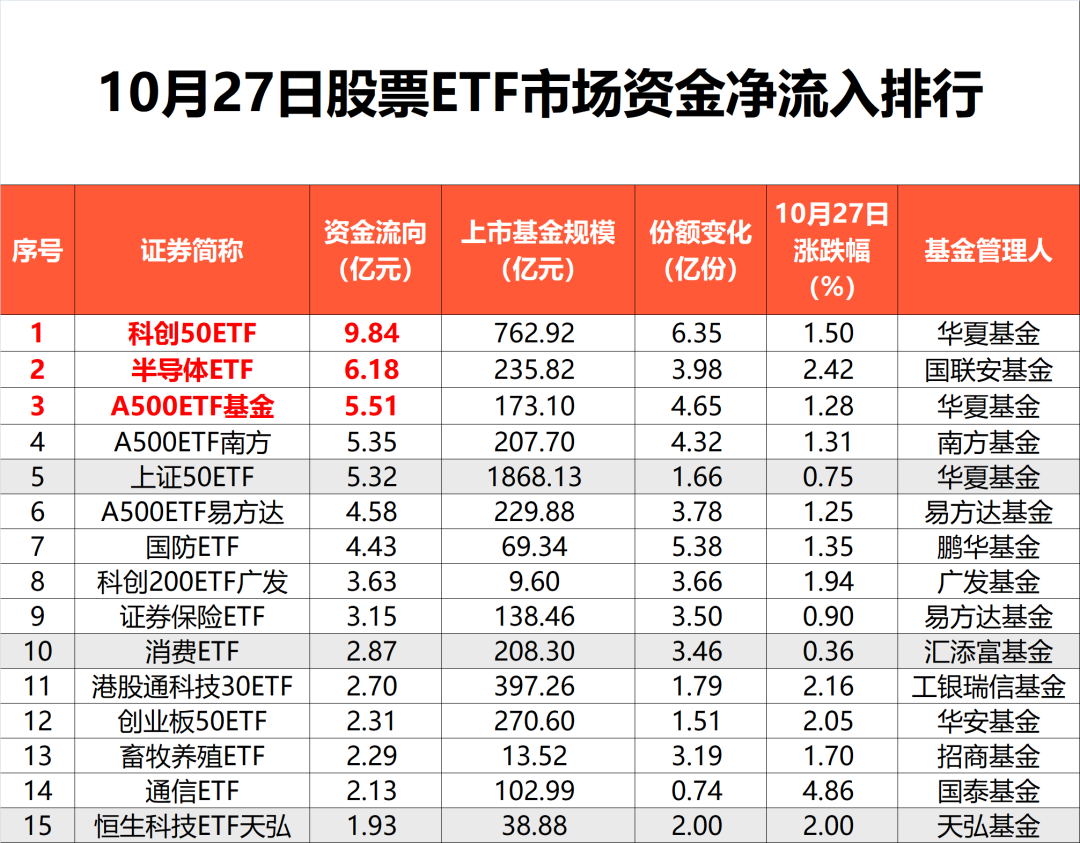
Group 1 - The A-share market experienced a significant rise, with the Shanghai Composite Index approaching the 4000-point mark, reaching a new high for the year [1] - Despite the market surge, there was a net outflow of nearly 2.6 billion yuan from stock ETFs, with notable outflows from bank and chip ETFs [1][5] - Bond ETFs and Hong Kong market ETFs saw net inflows, indicating a shift in investor sentiment towards safer assets [2] Group 2 - The total scale of stock ETFs in the market reached 4.67 trillion yuan, with a reduction of 1.18 billion units in total shares on the day of the market rise [2] - The AAA Sci-Tech Bond Index recorded the highest net inflow among indices, amounting to 1.87 billion yuan [2] - The top-performing ETFs in terms of net inflow included the Sci-Tech 50 ETF and the Semiconductor ETF, with inflows of 984 million yuan and 618 million yuan respectively [3][4] Group 3 - The banking ETF experienced the largest net outflow, exceeding 800 million yuan, followed by the Chengdu-Chongqing Economic Circle ETF and Hong Kong Securities ETF, both with outflows over 500 million yuan [6][8] - Despite some industry and broad-based ETFs experiencing net outflows, institutional investors remain optimistic about the future of the A-share market [9] - Factors such as the easing of US-China trade tensions and the successful conclusion of the 20th National Congress are expected to boost market sentiment and risk appetite [9]
近26亿,跑了!
中国基金报· 2025-10-28 05:42
Core Viewpoint - The A-share market experienced a significant rise, with the Shanghai Composite Index approaching the 4000-point mark, while stock ETFs saw a net outflow of nearly 2.6 billion yuan despite the overall market uptrend [2][5][18]. Fund Flow Summary - On October 27, the stock ETF market saw a total net outflow of approximately 2.6 billion yuan, with a reduction of 11.79 million shares [5][12]. - In contrast, bond ETFs and Hong Kong market ETFs recorded net inflows of 2.45 billion yuan and 460 million yuan, respectively [5][12]. - The AAA Sci-Tech Bond Index led the inflows among indices, attracting 1.865 billion yuan [6]. ETF Performance - The top-performing ETFs in terms of net inflow included: - Sci-Tech 50 ETF with a net inflow of 984 million yuan [9]. - Semiconductor ETF with a net inflow of 618 million yuan [9]. - A500 ETF with a net inflow of 551 million yuan [9]. - Conversely, the banking ETF experienced the largest net outflow, exceeding 800 million yuan [14][16]. Market Sentiment and Outlook - Despite the outflows from certain industry-themed and broad-based ETFs, institutions remain optimistic about the future of the A-share market [18]. - Factors contributing to this optimism include the easing of Sino-U.S. trade tensions and the successful conclusion of the 20th National Congress of the Communist Party, which are expected to enhance market risk appetite [18]. - The focus for future investments is anticipated to be on emerging technologies and high-end manufacturing, supported by cyclical finance [18].