
中国生物制药

Search documents
*ST苏吴股价低于1元;银诺医药暗盘涨超260%
2 1 Shi Ji Jing Ji Bao Dao· 2025-08-15 02:36
Policy Developments - Qian'nan Prefecture's medical monitoring reported over 1,600 medical traceability rescues in the first half of the year, with 3.47 million residents insured, including 1.19 million special hardship groups [1] - Medical expenses for special hardship groups reached 282 million yuan, with reimbursements totaling 244 million yuan [1] Regulatory Changes - Tianjin's Medical Insurance Bureau proposed a new warning system for designated medical institutions, introducing yellow and red cards for non-compliance, which could lead to payment suspensions and contract terminations [2][3] Drug and Device Approvals - Qihuan Biotech's QT-019B CAR-T cell therapy received FDA approval for clinical trials, marking a significant milestone as the first universal CAR-T product developed by a Chinese company for autoimmune diseases [4] - Cloudtop's Acquimod NDA has been accepted in Taiwan, with peak sales potential estimated at 5 billion yuan, targeting moderate to severe ulcerative colitis [5] Financial Disclosures - China National Pharmaceutical Group reported a 10.43% decline in net profit for the first half of 2025, with revenues of 36.797 billion yuan [6] - Dongcheng Pharmaceutical's net profit fell by 20.7% to 88.65 million yuan, with revenues of 1.38 billion yuan [8] - Yangpu Medical reported a net profit of approximately 15.27 million yuan, with revenues down 21.22% to about 231 million yuan [9] Capital Market Activities - Hongxing Xianghe completed an A-round financing to enhance its innovative biopharmaceutical R&D efforts [10] - Silver诺药业-B saw a dark market surge of over 260%, with net proceeds from its global offering expected to reach approximately 610 million yuan [11] - Huaxi Biotech's controlling shareholder secured a loan commitment of up to 250 million yuan for share buybacks [12] - Nanmo Biotech's major shareholder increased its stake from 17.10% to 18.50% through market transactions [13] - WuXi AppTec repurchased 282,340 shares for approximately 27.99 million yuan as part of its buyback plan [14] Industry Developments - Wuxi City signed a strategic cooperation agreement with China National Pharmaceutical Group, emphasizing the importance of the biopharmaceutical industry for national security and economic development [15][16] Market Alerts - *ST Suwu's stock price fell below 1 yuan, risking delisting if it remains below this threshold for 20 consecutive trading days [17] - Aimeike's subsidiary REGEN Biotech Inc. is involved in a significant arbitration case with a claim of 1.6 billion yuan, affecting its financial outlook [18] - Sanyou Medical's actual controller plans to reduce their stake by up to 2% through block trades [19]




平安证券(香港)港股晨报-20250815
Ping An Securities Hongkong· 2025-08-15 02:34
Market Overview - The Hong Kong stock market showed a decline, with the Hang Seng Index closing at 23,831 points, down 145 points or 0.61% [1][5] - The market turnover decreased to 82.799 billion, with net inflows of 484 million from the Stock Connect [1][5] - The US stock market remained stable despite previous inflation concerns, with the Dow Jones down 11 points, the S&P 500 up 1 point, and the Nasdaq down 2 points [2] Market Outlook - The report emphasizes that the Hong Kong market has advantages such as low valuations and increasing trading activity under the "profit-making effect," maintaining a relatively optimistic medium to long-term outlook [3] - Significant inflows of southbound funds were noted, with a total of 135.6 billion HKD in July, marking a recent high, and continued inflows in early August totaling 36.2 billion HKD [3] - Investment opportunities are highlighted in sectors such as artificial intelligence, robotics, semiconductors, and industrial software, as well as new consumption sectors supported by policy [3] Key Company Performances - Notable stock performances include Li Ning (2331HK) up 5.88% and Tingyi (0322HK) up 3.06% among the Hang Seng Index constituents [1][5] - In the technology sector, Huahong Semiconductor (1347HK) rose 3.04%, and Horizon Robotics (9660HK) increased by 2.44% [1][5] Economic Data - The US inflation rate for July remained steady at 2.7%, slightly below the forecast of 2.8% [2] - The report indicates a positive trend in investment sentiment, with the Stoxx 600 index in Europe rising for three consecutive days [11]
投资者报告 - 2025 年中国医疗健康-Investor Presentation-Asia Summer School 2025 China Healthcare
2025-08-15 02:26
Summary of Key Points from the Conference Call on China Healthcare Industry Overview - The conference focused on the **China Healthcare** sector, particularly the pharmaceutical and biotech industries, highlighting the attractive investment landscape in the Asia Pacific region [2][5][6]. Core Insights and Arguments - **Growth Projections**: The global pharmaceutical market is expected to grow at a **CAGR of 5.7%** from 2023 to 2028, while the Chinese pharmaceutical market is projected to grow at a **CAGR of 7.7%** during the same period [9][12]. - **Market Dynamics**: The Chinese pharmaceutical market is characterized by a significant reliance on imported products, particularly in the albumin segment, where **60-70%** of the market is composed of imports [34]. - **Out-licensing Trends**: There has been a notable increase in out-licensing activities, with over **$50 billion** in deals recorded in 2024, driven by narrowing innovation gaps and emerging complex modalities [41][42]. - **Regulatory Environment**: The plasma industry in China faces high entry barriers, with only **<30 plasma fractionators** currently operating, leading to a market consolidation trend [33][34]. Important Developments - **Upcoming Events**: Key sector events include the **CSCO 2025** and **WCLC 2025** conferences, which are expected to influence stock performance in the pharmaceutical and biotech sectors [6][8]. - **Pipeline Assets**: Several companies, including Hengrui and CSPC, have significant pipeline assets with upcoming drug approvals and trial progress expected in **2H25** [32][27]. Potential Risks and Challenges - **Supply Constraints**: The Chinese plasma market is underdeveloped compared to global standards, with a limited variety of plasma derivatives available [34]. - **Market Competition**: The top five plasma companies dominate approximately **60%** of the market, indicating a highly consolidated competitive landscape [33]. Additional Insights - **Investment Sentiment**: The overall sentiment towards the China healthcare sector remains positive, with analysts highlighting the potential for significant returns driven by innovation and market expansion [2][41]. - **Technological Advancements**: The introduction of recombinant human albumin (rHSA) is expected to disrupt the albumin market, potentially capturing **~10%** of the total market share [35]. This summary encapsulates the key points discussed during the conference call, providing a comprehensive overview of the current state and future outlook of the China healthcare sector.




国金证券:中国创新药处创新成果兑现初期 看好下一重磅单品可能诞生的细分赛道
Zhi Tong Cai Jing· 2025-08-14 03:41
Core Viewpoint - The report from Guojin Securities highlights the rise of innovative drugs in China, indicating that the industry is in the early stages of realizing innovation outcomes, with significant opportunities for independent development and large-scale licensing deals in the future [1][2]. Group 1: Background and Market Trends - The surge in innovative drug licensing deals (BD) and upfront payments has become a focal point in the market, with the potential for the next billion-dollar upfront payment being a key question [2]. - Guojin Securities previously published a comprehensive report in March 2024, analyzing over 200,000 clinical trials and 3,000 pharmaceutical companies, predicting the rise of innovative drugs in China and a boom in BD transactions [2]. - The global landscape for innovative drug licensing has entered a new era, with China accounting for 40% of total upfront payments, as multinational corporations face patent cliffs for their blockbuster drugs [2][3]. Group 2: Innovations in Oncology - The evolution from PD-1 to combinations such as PD-1/VEGF and PD-1/IL-2 is crucial for enhancing efficacy while reducing toxicity in cancer treatments [3]. - Companies like Kangfang Biotech and Innovent Biologics are leading the way with promising early data on new combinations targeting various cancer types [3]. - The exploration of immune large molecules has shifted from single antibodies to multi-target combinations, aiming to improve therapeutic outcomes [3][4]. Group 3: Future Predictions - The exploration of cytokine-based immunotherapy is just beginning, with numerous companies investigating combinations of PD-1 and IL-2, among other strategies [4]. - Chemokine receptors may emerge as the next focal point in cancer immunotherapy, with companies like Lixin Medicine targeting specific receptors in the tumor microenvironment [4]. - The report anticipates that combinations involving PD-1 and various cytokines will become significant avenues for development in the field of tumor immunotherapy [4].

都是创新药指数 A股和港股有何不同?
2 1 Shi Ji Jing Ji Bao Dao· 2025-08-13 14:56
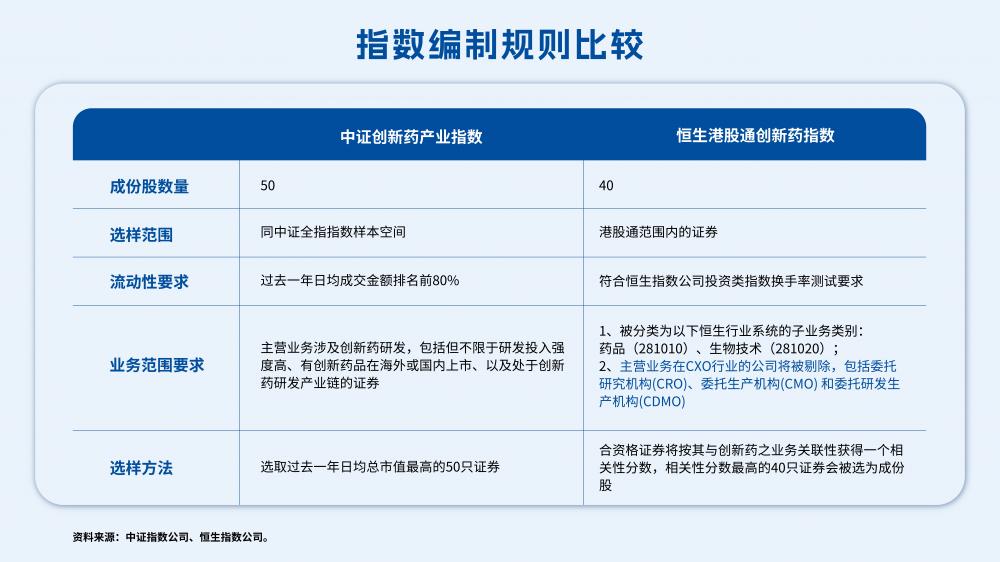
Core Viewpoint - The innovation drug sector has seen a continuous rise in popularity this year, with various indices related to innovation drugs in both Hong Kong and A-shares showing strong performance [1] Index Comparison - The Hang Seng Hong Kong Stock Connect Innovation Drug Index focuses on Hong Kong stocks related to innovation drug research, development, and production, while the CSI Innovation Drug Industry Index targets A-share companies involved in innovation drug R&D, selecting up to 50 representative stocks [2] - The Hang Seng index excludes contract research organizations (CROs) and selects stocks based on their relevance to innovation drug business, while the CSI index does not exclude CROs and selects the largest 50 stocks by market capitalization [2] Industry Distribution - The CSI Innovation Drug Industry Index has a higher weight in chemical preparations (46.6%) and medical R&D outsourcing (21.3%), while the Hang Seng index has a greater focus on chemical preparations (48.9%) and other biological products (41.1%) [5] - The Hang Seng index excludes medical outsourcing companies, leading to a different industry distribution compared to the CSI index, which includes this segment [5] Component Stock Concentration - The Hang Seng index has a higher concentration of component stocks, with the top ten stocks accounting for approximately 75% of the index, while the CSI index's top ten stocks account for less than 50% [9] - Major stocks in the CSI index include WuXi AppTec (13.09% weight) and Hengrui Medicine (10.19% weight), while the Hang Seng index features CSPC Pharmaceutical (10.75% weight) and China National Pharmaceutical (10.31% weight) [11] Summary - Both indices focus on the innovation drug industry but differ in their compilation rules, industry distribution, and component stocks, which investors should consider based on their investment goals and risk tolerance [12]

旺山旺水,急需补血
凤凰网财经· 2025-08-13 13:38
Core Viewpoint - The article discusses the challenges and opportunities faced by the innovative pharmaceutical company, Wangshan Wangshui, particularly in the context of its recent IPO filing and the competitive landscape of the pharmaceutical industry [2][3]. Group 1: Company Overview - Wangshan Wangshui Biopharmaceutical Co., Ltd. was founded in 2013 by a professor-student duo, focusing on the research and commercialization of innovative drugs [5][8]. - The company has gained attention for its effective drug VV116, which has been approved for COVID-19 treatment in China and Uzbekistan [9][11]. Group 2: Product Pipeline and Market Potential - The company is currently focusing on three main areas: antiviral, neuropsychiatric, and reproductive health, with a total of nine innovative assets in its pipeline [11]. - The market sizes for these areas are projected to grow significantly from 2024 to 2035, with compound annual growth rates of 6.4%, 1.6%, and 1.4% respectively [11]. Group 3: Financial Challenges - Despite the promising product pipeline, the company has struggled with cash flow, relying heavily on external financing and bank loans to sustain operations [4][22]. - The revenue from VV116 has significantly decreased due to reduced market demand, leading to substantial losses in recent years [18][22]. - As of April 2023, the company's total liabilities reached 641 million yuan, with over half being current liabilities [22]. Group 4: Future Plans - The company plans to use the funds raised from its IPO for research and development, capacity expansion, and to supplement working capital [24].

国金证券:从IL-2双抗 看TAA、细胞及趋化因子的PD-1升级新方向
Zhi Tong Cai Jing· 2025-08-13 09:14
Core Viewpoint - The report from Guojin Securities highlights the rise of innovative drugs in China, indicating that the industry is in the early stages of realizing innovation outcomes, with significant opportunities for independent development and large-scale licensing transactions in the future [1] Group 1: Industry Trends - The global oncology immunotherapy landscape is entering a new era characterized by the combination of PD-1 and TAA (tumor-associated antigens) with cytokines [2] - Multinational pharmaceutical companies are facing patent cliffs for their blockbuster drugs while new innovative drug assets are rapidly emerging globally, including in China, leading to a trend of licensing agreements to fill pipeline gaps [2] - The global innovative drug business development (BD) upfront payments have reached the billion-dollar level, with China accounting for 40% of the total upfront payments [2] Group 2: Drug Development Focus - The evolution from single antibodies to dual and multi-target molecules is ongoing, with a focus on enhancing efficacy and reducing toxicity [3] - The exploration of new molecular constructs has progressed from combinations of immune checkpoint inhibitors (ICIs) and TAAs to combinations with cytokines like IL-2, aiming for better therapeutic outcomes [3][4] - The next wave of innovation in the post-PD-1 era is just beginning, with numerous companies exploring combinations of PD-1 with IL-2 and other structural innovations [4] Group 3: Potential Investment Targets - The report suggests that promising new products may emerge from segments such as TCE (T-cell engagers), other dual/multi-antibodies, and innovative ADCs (antibody-drug conjugates), with a focus on leading clinical enterprises [5] - Recommended companies to watch include Innovent Biologics (01801), Kintor Pharmaceutical (09926), and Kelun-Biotech (06990) [5]

26岁,她买一家上市公司
投资界· 2025-08-13 09:08
Core Viewpoint - The article discusses a significant acquisition in the Hong Kong market, where Wanjing Capital plans to acquire the entire equity of a Chinese new retail supply chain company for approximately HKD 297 million, highlighting the growing trend of mergers and acquisitions in the region [3][5][10]. Group 1: Acquisition Details - Wanjing Capital intends to purchase 75% of the shares of Alpine Treasure Limited for a total cash price of HKD 222.8 million, with an offer price of HKD 0.6189 per share, representing an 82.32% discount from the closing price of HKD 3.5 per share, but a 75.95% premium over the company's latest net asset value per share [5][6]. - The acquisition includes a mandatory unconditional cash offer for the remaining 120 million shares at the same price, totaling HKD 74.27 million, bringing the total acquisition cost to nearly HKD 300 million [5][6]. Group 2: Company Background - The target company, established in September 2018, primarily operates in Singapore, focusing on construction services and property investment, including civil engineering, building construction, logistics, and transportation services [5][6]. - For the fiscal year 2024, the target company reported revenues of SGD 5.597 million, a slight decline of 0.15% year-on-year, and a net loss of SGD 784,200, which is a 24.39% reduction in losses compared to the previous year [5]. Group 3: Key Individuals - Wanjing Capital is a private investment firm founded in July 2023, with its sole director and beneficial owner being 26-year-old Wang Kaily, who graduated from Peking University and has further degrees from the University of Sydney and University College London [6]. - Wang Kaily is the daughter of Wang Zhenhua, the actual controller of New Town Holdings, and she indirectly controls shares in several listed companies through Huasheng Trust [6]. Group 4: Market Trends - The article notes a surge in merger and acquisition activities in the Hong Kong market, with several high-profile transactions occurring recently, including significant investments by notable investors like Cai Wensheng [8][9]. - The market response to these acquisitions has been enthusiastic, with some companies experiencing dramatic stock price increases post-announcement, indicating a revitalization of interest in Hong Kong equities [9][10].

创新药指数 “基因” 大比拼
Jin Rong Jie· 2025-08-13 07:59
Core Viewpoint - The innovation drug sector has seen a significant increase in interest this year, with various indices related to innovation drugs in both Hong Kong and A-shares showing strong performance [1]. Index Comparison - The CSI Innovation Drug Industry Index focuses on A-share companies involved in innovation drug research and development, selecting up to 50 representative stocks, while the Hang Seng Hong Kong Stock Connect Innovation Drug Index targets Hong Kong stocks that can be traded via the Stock Connect and are related to innovation drug research, development, and production [1][3]. - The Hang Seng index has excluded contract research organizations (CROs) from its selection criteria, while the CSI index includes them, leading to differences in sample selection and index composition [1][3]. Industry Distribution - The top three weighted industries in the CSI Innovation Drug Industry Index are chemical preparations (46.6%), medical research outsourcing (21.3%), and other biological products (15.2%). In contrast, the Hang Seng index emphasizes chemical preparations (48.9%) and other biological products (41.1%) [5][6]. Component Stock Concentration - The Hang Seng Hong Kong Stock Connect Innovation Drug Index has a higher concentration of component stocks, with the top ten stocks accounting for approximately 75% of the index, while the CSI Innovation Drug Industry Index has a more diversified composition with the top ten stocks making up less than 50% [8]. - Notable component stocks include WuXi AppTec in the CSI index, which has a weight of over 13%, while the Hang Seng index features companies like CSPC Pharmaceutical Group and China Biologic Products, each with weights exceeding 10% [10]. Market Products - There are currently market products such as the Hang Seng Innovation Drug ETF (159316) and the E Fund Innovation Drug ETF (516080) that track these two indices [11].
中金:“双目录”机制启动 进一步支持创新药产业链发展
智通财经网· 2025-08-13 07:25
Core Viewpoint - The National Healthcare Security Administration (NHSA) has announced the preliminary review results for the 2025 National Basic Medical Insurance, Maternity Insurance, and Work Injury Insurance drug catalog, with 534 drugs passing the initial review, indicating a significant step towards a dual catalog mechanism that promotes both basic insurance and innovative commercial insurance [1][2]. Group 1: Drug Catalog Overview - A total of 534 drugs were reviewed, with 310 drugs excluded from the catalog and 224 drugs included. The commercial insurance innovative drug catalog includes 121 drugs, with 12 drugs under non-exclusive agreements still in negotiation [2]. - The NHSA will continue to advance the basic catalog adjustments and the commercial insurance innovative drug catalog, including expert reviews in August-September, price negotiations in September-October, and results announcement in October-November [2]. Group 2: Dual Catalog Mechanism - The dual catalog mechanism establishes a clear division of responsibilities, where the basic medical insurance catalog covers essential clinical drugs, while the commercial insurance innovative catalog focuses on high-value drugs not covered by basic insurance but with significant clinical value [3]. - The framework encourages commercial insurance companies to invest in innovative drug development through various means, such as investment funds, to provide stable long-term funding for innovative drug research [3]. Group 3: Implications for Drug Development - The commercial insurance innovative drug catalog is a crucial step in developing a multi-tiered medication security system, addressing diverse medication needs of the population. It is believed that supplementing commercial insurance on top of basic insurance will facilitate the introduction of high-priced innovative drugs [4]. - Innovative drugs can accumulate real-world data and enhance clinical penetration through commercial insurance applications, thereby increasing their potential market value [4]. Group 4: Investment Recommendations - Companies to watch include BeiGene, Kelun-Biotech, CanSino Biologics, Innovent Biologics, and Zai Lab, along with other relevant companies such as CSPC Pharmaceutical Group, China National Pharmaceutical Group, and Hengrui Medicine [5].