
同仁堂

Search documents
口服抗衰低龄化趋势显著,口服抗衰迎来升级革命
Tou Bao Yan Jiu Yuan· 2026-01-30 13:48
Investment Rating - The report does not explicitly state an investment rating for the oral anti-aging industry Core Insights - The oral anti-aging market is experiencing a significant shift from being targeted primarily at older adults to encompassing all age groups, driven by the rise of the beauty economy and younger demographics seeking anti-aging solutions [10] - Consumer demand is increasingly focused on visible signs of aging, such as skin improvement and enhanced physical/immune health, rather than cellular or molecular changes [12][14] - The market is witnessing a trend towards innovative formulations that combine multiple active ingredients for synergistic effects, moving away from single-component products [24] Summary by Sections Definition and Classification - Oral anti-aging refers to the intake of specific nutrients and bioactive substances to regulate physiological mechanisms and delay cellular aging, categorized into comprehensive and targeted anti-aging [8][10] Consumer Insights - Consumers prioritize products that visibly improve skin issues and enhance physical/immune health, with collagen, vitamin C, and vitamin E being the most recognized ingredients [12][14] - The awareness of emerging anti-aging components like NMN and ergothioneine is still low, indicating a need for better consumer education [12] - Key factors influencing purchase decisions include efficacy, safety, ingredient transparency, and authoritative endorsements [15][17] Market Participants - The market features both international brands focusing on NMN and ergothioneine, and domestic brands like汤臣倍健 that primarily use collagen peptides [21][23] - International brands dominate the NMN market, with a significant share held by brands like W+ and Swisse [22] Development Trends - The oral anti-aging market is evolving towards complex formulations that address specific aging concerns, with a notable increase in innovative dosage forms like powders and gummies [24][25] - Regulatory support is enhancing the market's growth, with policies recognizing the anti-aging industry as a key area within the silver economy [26]
“大批中成药将退出市场”是真的吗?
Sou Hu Cai Jing· 2026-01-30 13:02
Core Viewpoint - The recent implementation of the "Regulations on the Registration Management of Traditional Chinese Medicine" by the National Medical Products Administration is expected to significantly impact the market for traditional Chinese medicine, with a potential exit of many products by 2031 due to stricter requirements for drug registration and safety information [1][2][5]. Group 1: Policy Implementation and Timeline - The new regulations took effect on July 1, 2023, providing a transition period of three years, with an actual deadline for compliance extending to 2031 due to the five-year drug re-registration cycle [1][5]. - Many companies, including leading firms like Yunnan Baiyao and Tongrentang, are already preparing to meet the new requirements by enhancing their product safety information [1][5]. Group 2: Rationale Behind the Policy - The policy aims to improve drug safety by mandating that traditional Chinese medicine products clearly state contraindications, adverse reactions, and precautions, addressing public concerns about medication safety [2][4]. Group 3: Market Impact and Industry Dynamics - The regulations are not expected to lead to a mass exit of traditional Chinese medicine products; instead, they may encourage companies to focus on their core strengths and improve product quality [4][5]. - The Chinese traditional medicine market is characterized by excessive competition, with over 4,500 production companies and approximately 2,400 traditional Chinese medicine enterprises, leading to a potential consolidation as weaker companies may exit the market [5][6]. - The policy could facilitate a shift from a fragmented market to a more robust and high-quality development phase, aligning better with consumer needs [6].


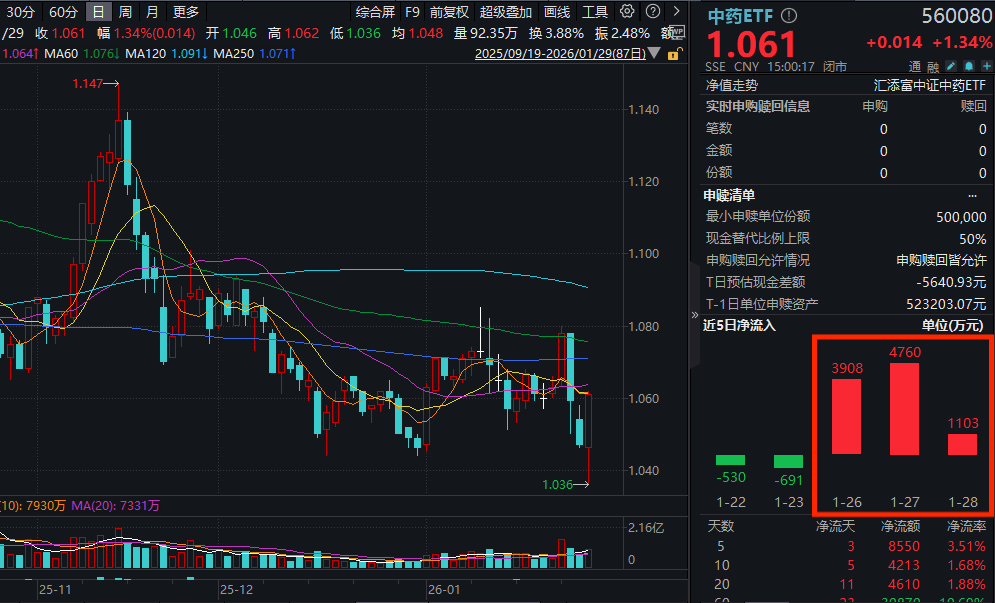
片仔癀大涨近7%,终结九连跌!中药ETF(560080)放量收涨超1%,近3日“吸金”近1亿元!机构:中药产业2026有望触底回升
Sou Hu Cai Jing· 2026-01-29 09:49
Core Viewpoint - The Chinese medicine sector is experiencing a rebound, with the Chinese Medicine ETF (560080) showing significant inflows and a notable increase in trading volume, indicating renewed investor interest [1][5]. Group 1: Market Performance - The Chinese Medicine ETF (560080) rose by 1.34% with a trading volume of nearly 100 million yuan, reflecting a 34% increase compared to the previous period [1]. - Over the past three days, the ETF has attracted approximately 100 million yuan in investments [1]. - Key constituent stocks of the ETF, such as Pizhou Pharmaceutical, have shown strong performance, with Pizhou rising nearly 7% after a nine-day decline [5]. Group 2: Valuation Insights - The latest price-to-earnings ratio (PE-TTM) for the index tracked by the Chinese Medicine ETF is 24.23, which is below 83.95% of the time since its inception in May 2015, indicating attractive valuation [3]. - The index's valuation percentile is at 16.05%, suggesting a favorable price-performance ratio for investors [3]. Group 3: Future Outlook - The Chinese medicine sector is expected to recover in 2026 after a weak performance in 2025, driven by inventory digestion and an increase in flu incidence, which may boost demand for OTC products [7]. - Companies with strong brand power and effective inventory management are likely to benefit from the anticipated recovery in the sector [8]. - The adjustment of the essential drug list is expected to progress in 2026, potentially enhancing the accessibility of traditional Chinese medicine [8]. Group 4: Investment Recommendations - Investors are advised to focus on high-quality assets with low valuations in the Chinese medicine sector, particularly those that can effectively manage inventory and have strong brand recognition [8][9]. - The performance of companies that successfully integrate both hospital and outpatient markets is highlighted as a key factor for future growth [8].

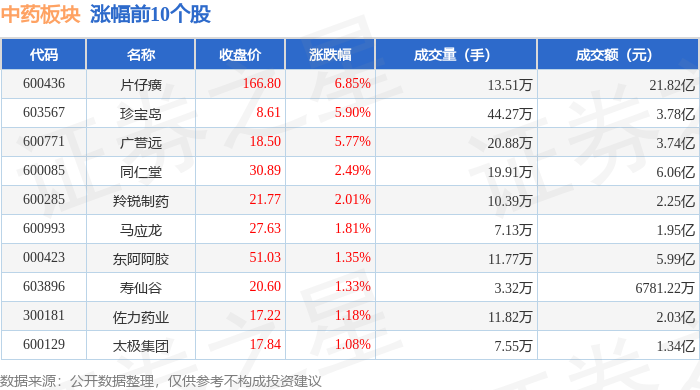
中药板块1月29日涨0.98%,片仔癀领涨,主力资金净流入1210.05万元
Zheng Xing Xing Ye Ri Bao· 2026-01-29 09:04
证券之星消息,1月29日中药板块较上一交易日上涨0.98%,片仔癀领涨。当日上证指数报收于4157.98, 上涨0.16%。深证成指报收于14300.08,下跌0.3%。中药板块个股涨跌见下表: 从资金流向上来看,当日中药板块主力资金净流入1210.05万元,游资资金净流出9243.6万元,散户资金 净流入8033.56万元。中药板块个股资金流向见下表: | 代码 | 名称 | 主力净流入(元) | 主力净占比 游资净流入 (元) | | 游资净占比 散户净流入 (元) | | 散户净占比 | | --- | --- | --- | --- | --- | --- | --- | --- | | 600436 | 片仔瘦 | 2.4216 | 11.07% | -9063.85万 | -4.15% | -1.51 Z | -6.92% | | 600085 | 同仁堂 | 5722.98万 | 9.44% | -1391.28万 | -2.30% | -4331.71万 | -7.15% | | 600771 | 广营远 | 4647.58万 | 12.43% | -2690.82万 | -7.20% | - ...


2025年中国中成药产量为181.4万吨 累计下降7.7%
Chan Ye Xin Xi Wang· 2026-01-29 03:50
知前沿,问智研。智研咨询是中国一流产业咨询机构,十数年持续深耕产业研究领域,提供深度产业研 究报告、商业计划书、可行性研究报告及定制服务等一站式产业咨询服务。专业的角度、品质化的服 务、敏锐的市场洞察力,专注于提供完善的产业解决方案,为您的投资决策赋能。 2020-2025年中国中成药产量统计图 数据来源:国家统计局,智研咨询整理 上市企业:云南白药(000538),同仁堂(600085),片仔癀(600436),白云山(600332),太极集团 (600129),东阿阿胶(000423),九芝堂(000989),贵州百灵(002424),葵花药业(002737),吉林敖 东(000623) 相关报告:智研咨询发布的《2026-2032年中国中成药行业发展形势分析及产业前景规划报告》 根据国家统计局数据显示:2025年12月中国中成药产量为19.4万吨,同比增长2.1%;2025年中国中成药 累计产量为181.4万吨,累计下降7.7%。 ...

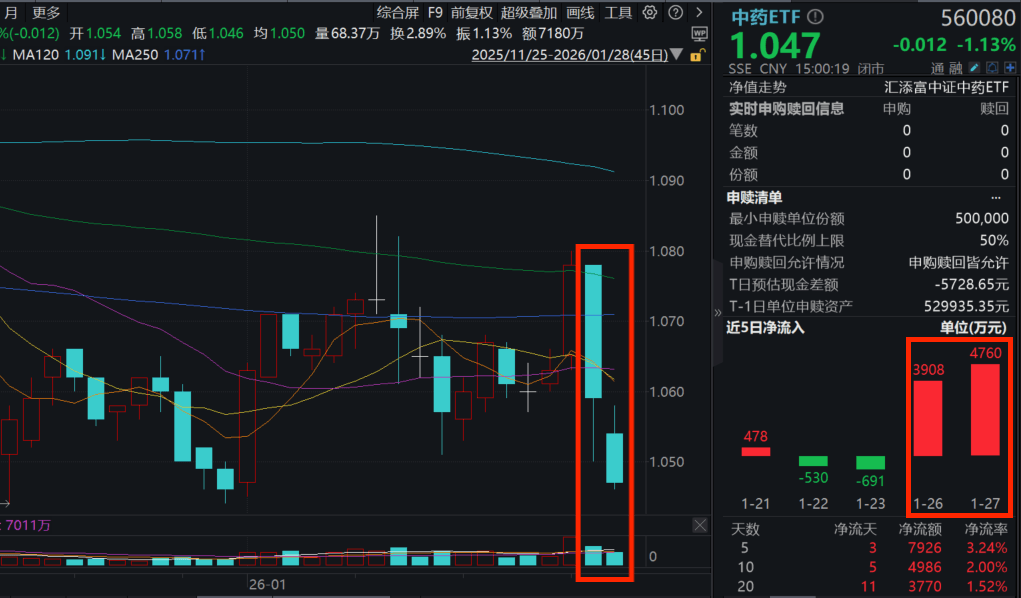
片仔癀连跌9日,再度刷新2020年6月以来新低!中药ETF(560080)跌超1%,近2日吸金超8600万元!关注中药2025业绩及基药目录调整进展
Xin Lang Cai Jing· 2026-01-28 08:58
Core Viewpoint - The traditional Chinese medicine (TCM) sector is experiencing a second consecutive day of decline, with the TCM ETF (560080) dropping by 1.13% and a total trading volume exceeding 71 million yuan, indicating a potential buying opportunity as it has attracted over 86 million yuan in the last two days [1][3]. Group 1: Market Performance - The TCM ETF (560080) has seen a decline in key constituent stocks, with Yunnan Baiyao and China Resources Sanjiu both falling over 1%, while Yiling Pharmaceutical dropped over 3%. Conversely, Jilin Aodong rose over 1% [3]. - The TCM ETF's tracked index has a current price-to-earnings (PE TTM) ratio of 24.22, which is below 83.72% of the time since its inception in May 2015, indicating a favorable valuation [6]. Group 2: Earnings Forecasts - As of January 25, 2026, 11 TCM listed companies have released their 2025 annual reports and earnings forecasts, with 6 companies showing positive year-on-year net profit growth. Notably, 3 companies have growth rates exceeding 100% [7]. - The primary drivers for the earnings growth include the establishment of a "hospital + external" collaborative development model, with a focus on enhancing external market channels, particularly e-commerce [7]. Group 3: Policy and Structural Changes - The basic drug catalog has completed preliminary expert selection, with significant adjustments expected in 2026. The current catalog, last updated in 2018, includes 685 varieties, of which 268 are traditional Chinese medicines [7]. - The upcoming adjustments to the basic drug catalog are anticipated to enhance the accessibility of grassroots medications and promote a "1+X" medication model, potentially leading to rapid market expansion [7]. Group 4: Investment Themes - Three main investment themes in the TCM sector are highlighted: 1. Price governance, focusing on price reductions and market share in the context of centralized procurement and insurance negotiations [8]. 2. Consumption recovery, driven by macroeconomic improvement and increased health awareness among the aging population, benefiting TCM sales [9]. 3. State-owned enterprise reform, which is expected to yield performance improvements and investment opportunities in the TCM sector [9].
哪怕是中国最大的民营中医院,赚的也全是“辛苦钱”
Sou Hu Cai Jing· 2026-01-28 01:47
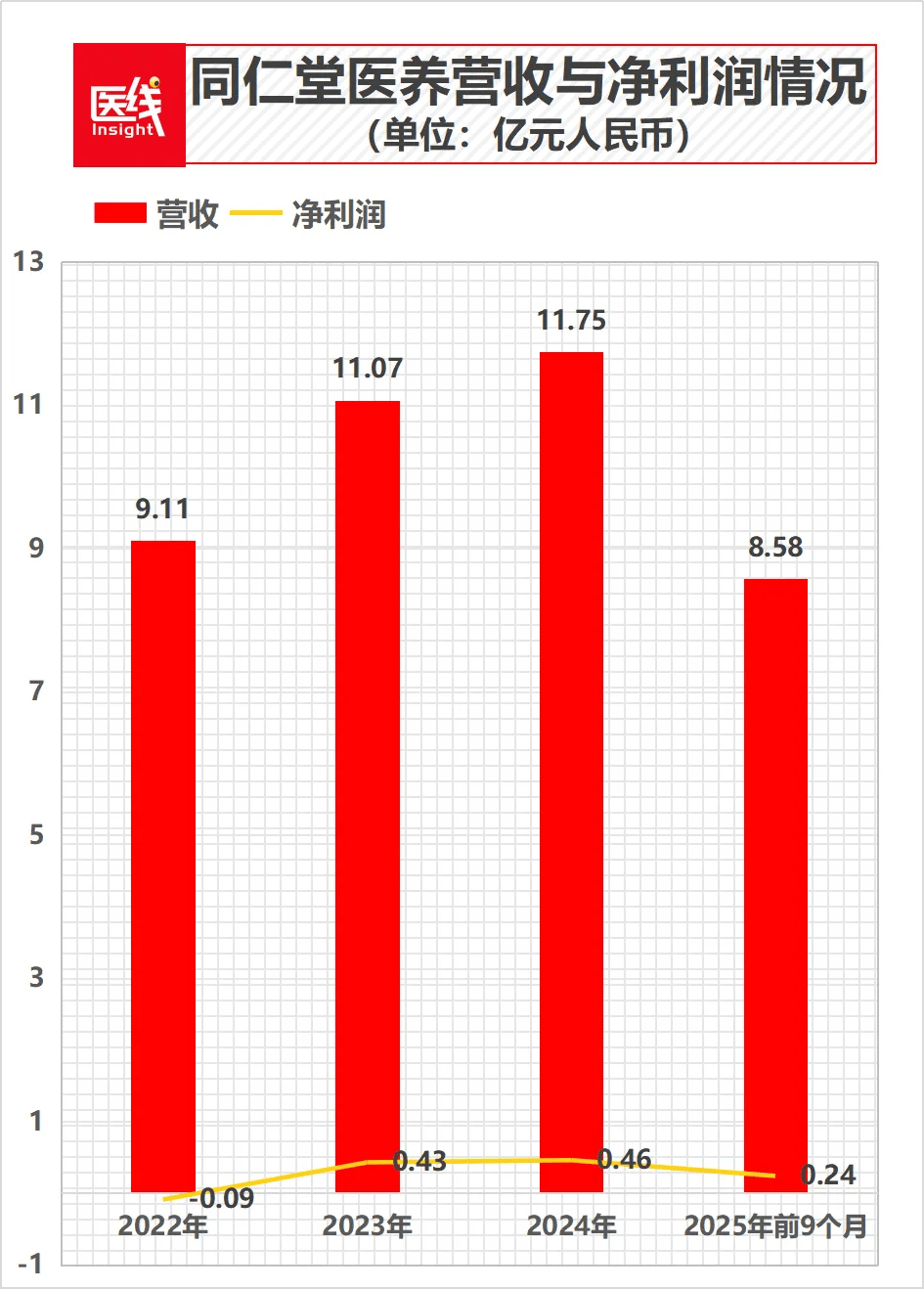
Core Viewpoint - The article highlights the challenges faced by Tongrentang Medical Investment Co., Ltd., despite being the largest private traditional Chinese medicine (TCM) hospital in China, including high labor costs, heavy reliance on brand reputation, and strict healthcare regulations, leading to low profitability [1][2][3]. Group 1: Financial Performance - In 2024, Tongrentang Medical received 3 million patient visits, the highest in the private TCM sector, but only achieved a net profit of 46.2 million yuan, which includes a one-time asset sale gain [1][4]. - Revenue figures show a gradual increase: 911 million yuan in 2022, 1.107 billion yuan in 2023, and 1.175 billion yuan in 2024, with net profits of -9.23 million yuan, 42.63 million yuan, and 46.2 million yuan respectively [4][5]. - The net profit margin for 2024 was only 3.9%, indicating a struggle to convert high patient volume into substantial profits [6][8]. Group 2: Operational Challenges - The company faces a "scale trap," where high patient volume does not translate into efficient monetization due to the labor-intensive nature of TCM services [10]. - Employee costs have surged, making it difficult for the company to maintain profitability as it expands its workforce to accommodate more patients [9][10]. - The reliance on a few top physicians is significant, with the top five doctors contributing 11.4% of total revenue in 2022, highlighting a vulnerability in the business model [20][22]. Group 3: Market Position and Growth Potential - Despite its challenges, the TCM market is projected to grow significantly, with the market size expected to increase from 659.9 billion yuan in 2019 to 1,001.6 billion yuan in 2024, reflecting a compound annual growth rate (CAGR) of 8.7% [35][42]. - The company’s growth strategy has included acquisitions, such as the purchase of Sanxi Hall, which has contributed significantly to revenue and profit margins [12][14]. - The TCM industry is anticipated to continue expanding, with a projected market size of 1,620.5 billion yuan by 2029, indicating a favorable long-term outlook for companies like Tongrentang Medical [42].
大批中成药将退出市场
2 1 Shi Ji Jing Ji Bao Dao· 2026-01-27 10:01
记者丨唐唯珂 编辑丨季媛媛 中成药淘汰赛序幕拉开!大批中成药将退出市场。 距离2026年7月1日仅剩半年时间,国家药监局《中药注册管理专门规定》第七十五条的落地进入最后窗口期。 这一被业内称为中成药"生死条款"的规定明确,自2023年7月1日施行满三年起,说明书【禁忌】【不良反应】【注意事项】任意一项仍标 注"尚不明确"的中成药,再注册申请将依法不予通过。这意味着,国内现存约5.7万个中成药有效批准文号中,超70%存在安全信息标注问题的 批文将面临淘汰,一场由监管驱动的中药产业深度出清正式进入攻坚阶段。 此次监管新政的核心,是彻底终结中成药说明书长期以来的"尚不明确"时代,倒逼药品持有人补齐上市后安全数据短板。 中国食品药品监管杂志此前研究显示,2018年版《国家基本药物目录》中268个中成药品种的465份说明书里,不良反应、禁忌、药物相互作用 的标注率仅为20.64%、30.1%和1.07%,大量品种依靠模糊表述完成上市后的市场流通。而随着再注册大考临近,这种"模糊免责"的模式已彻 底失去生存空间。 图/图虫 国家药监局的监管动作已提前落地,2025年全年发布多批中成药说明书修订公告,活力苏口服液、固肾生发 ...

大批中成药将退出市场
21世纪经济报道· 2026-01-27 09:37
记者丨 唐唯珂 编辑丨季媛媛 中成药淘汰赛序幕拉开!大批中成药将退出市场。 距离2026年7月1日仅剩半年时间,国家药监局《中药注册管理专门规定》第七十五条的 落地进入最后窗口期。 这一被业内称为中成药"生死条款"的规定明确,自2023年7月1日施行满三年起,说明书 【禁忌】【不良反应】【注意事项】任意一项仍标注"尚不明确"的中成药,再注册申请 将依法不予通过。这意味着,国内现存约5 . 7万个中成药有效批准文号中,超7 0%存在安 全信息标注问题的批文将面临淘汰,一场由监管驱动的中药产业深度出清正式进入攻坚 阶段。 此次监管新政的核心,是彻底终结中成药说明书长期以来的"尚不明确"时代,倒逼药品 持有人补齐上市后安全数据短板。 中国食品药品监管杂志此前研究显示,2018年版《国家基本药物目录》中2 6 8个中成药品 种的465份说明书里,不良反应、禁忌、药物相互作用的标注率仅为2 0 . 6 4%、3 0 . 1%和 1 . 0 7% , 大 量 品 种 依 靠 模 糊 表 述 完 成 上 市 后 的 市 场 流 通 。 而 随 着 再 注 册 大 考 临 近 , 这 种"模糊免责"的模式已彻底失去生存空间。 ...

中成药再注册大考进入半年倒计时
2 1 Shi Ji Jing Ji Bao Dao· 2026-01-27 09:01
21世纪经济报道记者唐唯珂 距离2026年7月1日仅剩半年时间,国家药监局《中药注册管理专门规定》第七十五条的落地进入最后窗 口期。 这一被业内称为中成药"生死条款"的规定明确,自2023年7月1日施行满三年起,说明书【禁忌】【不良 反应】【注意事项】任意一项仍标注"尚不明确"的中成药,再注册申请将依法不予通过。这意味着,国 内现存约5.7万个中成药有效批准文号中,超70%存在安全信息标注问题的批文将面临淘汰,一场由监 管驱动的中药产业深度出清正式进入攻坚阶段。 此次监管新政的核心,是彻底终结中成药说明书长期以来的"尚不明确"时代,倒逼药品持有人补齐上市 后安全数据短板。 中国食品药品监管杂志此前研究显示,2018年版《国家基本药物目录》中268个中成药品种的465份说明 书里,不良反应、禁忌、药物相互作用的标注率仅为20.64%、30.1%和1.07%,大量品种依靠模糊表述 完成上市后的市场流通。而随着再注册大考临近,这种"模糊免责"的模式已彻底失去生存空间。 国家药监局的监管动作已提前落地,2025年全年发布多批中成药说明书修订公告,活力苏口服液、固肾 生发丸、小活络制剂等多款常用品种均被要求补充三大核心 ...